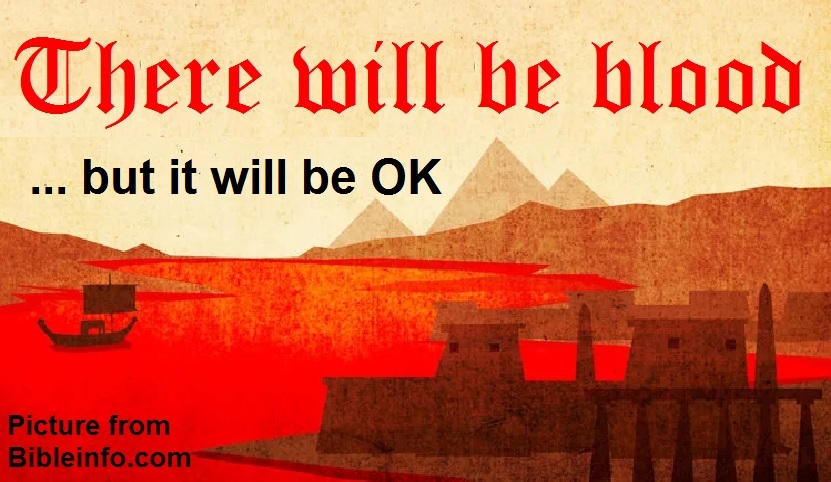
Colin Gale reflects on how the first of the ten plagues of Egypt hints at the truth that God alone can bring great good out of the darkest horror.
Let me start by wishing all fathers a Happy Fathers’ Day! I have been a father for twenty-four years, but today is the first Fathers’ Day on which I am also a father-in-law, as my son was married last summer. Since that wonderful day, along with other members of my family, I have spent the last ten months learning about my daughter-in-law’s deep connections with friends and family going back generations in Bristol.
Likewise, there has been a process, led by me though involving others, of my daughter-in-law being inducted into the history and traditions of our family. Notably, this has included an introduction to being a supporter of the Australian Rules football club that my family have followed since before I was born. We have given her a scarf in club colours to wear; we have painstakingly taught her the words of the club song; and we will continue to tell her the stories of the club’s triumphs and tragedies; its origins in an economically deprived but proudly working class suburb of Melbourne; the astonishing success it savoured especially in the 1920s and the 1950s; the wilderness years it endured between 1958 and 1990; its many closely-fought and heart-breaking grand final losses; the shining victories of the past and the present; and the ever-renewing hope for the future.
Before she was married, none of these things mattered to my daughter-in-law. She did not even know about them. If she had known, it would have been from the position of a neutral observer. But now that she has been grafted by law into our family, she has a stake in that history, as well as in the club’s present fortunes. The club’s victories are her victories, just as they are ours; the wilderness years, the set-backs and defeats are all hers, just as they are ours.
All this, of course, is only about football, and I know that it doesn’t really matter. But I hope we understand that, when we read the book of Exodus, we do so not as neutral observers, but as those with a deep interest in that history, and what it means for our present and our future. Everyone who has put their trust in Christ has been grafted into the story of the people of God. Their triumphs and tragedies, their close shaves and comebacks have all become ours, no matter how long ago they took place, and no matter that at that time we ourselves “were excluded from citizenship in Israel, strangers to the covenants of promise and without hope and without God in the world”. We have a stake in that history because “in Christ Jesus we who were once far away have been brought near through the blood of Christ” (cf. Ephesians 2:12-13).
When we look at Exodus chapter 7, we come to a very serious and sobering part of the history of Israel, and to match this I have chosen a solemn title for the sermon today, a phrase I take no pleasure in adopting but do so in order to do justice to the contents of Exodus chapter 7. The title is ‘There will be blood’. I have borrowed it from the title of a 2007 Hollywood film whose subject was the lawless, cut-throat world of nineteenth-century oil prospecting in the American West. The depressing meaning of the film’s title is that wherever there is oil to be found and dug up, and monetary fortunes to be made and lost, as sure as night follows day, and human nature being what it is, there will, eventually, be violence and blood.
Exodus chapter 7, and the chapters that follow describing the ten plagues of Egypt, make a point that on first sight looks equally stark, a point so stark that these chapters are not often preached on: that wherever there is open defiance of God, there will eventually be blood. Yet on closer examination, it turns out that these sombre chapters reveal a wonderful secret, which is that in the end, this will be the kind of blood that ultimately saves us.
How can we possibly arrive at that or any other positive endpoint, given that the story I am telling starts with the really horrifying assertion that ‘there will be blood’? I suggest we may do so in three stages:
- By asking the question, ‘Is it really so horrific?’
- By giving the answer, ‘Yes, it really is that horrific.’
- By glimpsing how God can alone bring great good out of the worst horror.
OK, so you’ve had the trigger warning now, in Exodus chapter 7 there will be blood, a plague of blood in fact.
The LORD said to Moses, “Tell Aaron, ‘Take your staff and stretch out your hand over the waters of Egypt – over the streams and canals, over the ponds and all the reservoirs’ – and they will turn to blood. Blood will be everywhere in Egypt, even in the wooden buckets and stone jars.” Moses and Aaron did just as the LORD had commanded … and all the water was changed into blood. The fish in the Nile died, and the river smelled so bad that the Egyptians could not drink its water. Blood was everywhere in Egypt.
I think we can all agree that this sounds pretty bad. Put to one side, if you can, the terror of those who, like ITV’s Doc Martin, couldn’t stand the sight of blood. More frightening than the sight of gore is this: if it were literally true that all the water in Egypt had turned to blood – not just in the Nile, but in all the streams and canals, ponds and reservoirs, even the water in buckets and jars – then every last one of the Egyptians would have faced death by dehydration within three days or so, and they would have known that to be the case. It says in verse 23 that ‘all the Egyptians dug along the Nile to get drinking water, because they could not drink the water of the river’, but if literally all the water in Egypt had turned to blood, they would have died of dehydration in three days or so.
So now comes the question: ‘Was it really so horrific? Was it really as bad as described?’ Biblical scholars of the twentieth and twenty-first centuries have suggested that a widespread invasion of toxic algae could have turned the Nile brown or red, killed a lot of its fish, made its waters dangerous to drink, and created an overwhelming impression that red or brownish hues, accompanied by a horrible stench, were everywhere and had gotten into everything. Such an invasion would have been a perfectly plausible, natural event. It would have made it difficult, but not actually impossible, to find safe drinking water. It certainly would have caused fear and dread.
None of this explains away the intervention of God in human history, by the way. Whichever way you look at it, the plague of blood as described in Exodus 7 is a miracle of timing, and is preceded and followed by other miraculous events. Not all the biblical scholars who propose a natural explanation for this plague are trying to demythologize the Bible. Some of them are simply seeking to “discern a pattern of increasing intensification within the whole series” of Egyptian plagues,1 starting with the least serious and progressing through to the most serious and actually life-threatening. The issue is that, within Exodus itself, the first plague seems to be viewed “more as a disgusting nuisance than as a fundamental threat to life. It lasted seven days, causing the Egyptians to dig for water, [and] Pharaoh himself did not take it seriously at all.”2 Verse 23 tells us that he did not take it to heart. Wherever there is open defiance of God, there will be blood, but in the first plague, at least no-one died – apart from the fish, that is. Even so, in answering the question ‘Was it really so horrific?’, we have to say that it was bad enough, and that it was an evil portent of the death that was to come.
We haven’t got a ten week sermon series planned for the ten plagues of Egypt – imagine what a trial it would be if we had! – but next week Claire will be speaking about the tenth plague, the plague on the firstborn. Without wanting to steal too much of her thunder, I will just say that the tenth plague is the terrifying culmination of the threat that is part and parcel of the first plague. Of the tenth plague, it is not possible to say that at least no-one died. This plague justifies the dreadful warning to those who defy God that ‘there will be blood’. It is the blood of the first-born sons of Egypt. By then, it really had becomethat horrific.
In the midst of the horror of the ten plagues, in the light of the lesson that ‘wherever there is defiance of God, there will be blood’, how can we believe it possible for God to bring great good out of the darkest horror? The writer of Exodus did believe that great good could come out of great horror. Otherwise it would not have been written in verse 5 that, when the Egyptians see God’s mighty acts of judgment, they “will know that [he is] the LORD”, or in verse 17 that “by this [Pharaoh] will know that [he is] the LORD”. Back at the start of Exodus chapter 5 Pharaoh says ‘Who is the LORD, that I should obey him and let Israel go? I do not know the LORD and will not let Israel go’ (Exodus 5:2). Coming to know the LORD in the midst of deepest horror doesn’t make the horror go away, but nevertheless it is a great good to come to know the LORD, however it comes about.
Of course, we don’t see this happening in an uncomplicated way in Exodus chapter 7. What we read instead is that, before the plague of blood, God would “harden Pharaoh’s heart” in verse 3, and that “Pharaoh’s heart became hard, and he would not listen” to Moses and Aaron, “just as the LORD had said”, either before the plague in verse 13, or after it in verse 22. Here, in other words, we are up against the mystery of human responses to God making himself known, and the mystery of God’s prior knowledge of the inclinations of the human heart.
The conundrum at the heart of the story of the hardening of Pharaoh’s heart, and the consequent horrific plagues, is the same conundrum at the heart of the story of the passion of Jesus Christ, who was “handed over” to his executioners to be put to death “by God’s set purpose and foreknowledge”, according to the apostle Peter’s sermon at Pentecost (Acts 2:23). They meant it for evil, but God intended it for good to accomplish the saving of many lives: in the rescue of Israel from Egypt in the one case, and in the resurrection of Jesus from the dead in the other. ‘The LORD hardened Pharoah’s heart’ tells us that the Exodus is the story of God working, not Pharaoh.3 ‘Jesus Christ handed over by God’s set purpose’ tells us that the crucifixion is the story of God working, not the Jews or the Romans. And in both cases, the great good that was achieved through the greatest of horrors, was achieved by means of blood.
Even if the plague of blood could be regarded as a nasty inconvenience, the plague on the first-born could not have been written off in this way. The only way Israelite families themselves avoided the tragic consequences of this plague was by coating their doorposts with the blood of a sacrificial lamb, so that the angel of death would pass on by their houses.
I am saying that the message of Exodus chapter 7, in the context of the Bible as a whole, is that God can bring good out of the greatest horror. The truth of this is tested in human experience, precisely when facing the greatest horror. In the midst of such horror, the alternative explanation that God is a bloodthirsty tyrant intent on wreaking plague, misfortune and maximum harm on the unsuspecting and undeserving must be faced. How is it possible to sustain trust in an all-loving and all-powerful God in the light of human pain and suffering? Here too we are up against a mystery, and on the basis of the big picture of the Old and New Testaments we are not able to solve the mystery, but we are able to say two things:
First, God has acted to absorb the horror of human pain, suffering and death within his own person, in the shedding of his own blood. In giving his first-born Son to die upon a cross, God was giving of his own self, in the mystery of the Trinity, to shield us from the worst effects of our own wrongdoing, as well as from all external evils.
Second, God has brought the greatest good out of the worst horror in the resurrection of Christ: life out of death, victory out of defeat, honour out of humiliation, heaven out of hell.
In the death and resurrection of Christ, God acts not with redemptive violence from above us, but with redemptive suffering from alongside us. So the thought which is here in Exodus chapter 7 that ‘wherever there is defiance of God, there will be blood’ need not trigger us, or terrify us. Rather, it reassures us that God is for us to the ‘N’th degree, even to the point of shedding his own blood. The blood of lambs on doorposts rescued the Israelites from plague and slavery, and the blood of Jesus Christ, the Lamb of God, saves us from death and hell. The split blood of murdered Abel called out for retribution on his murderer brother Cain, but the shed blood of Jesus speaks the better word of mercy for sinners who do not know what they are doing (cf Genesis 4:10; Luke 23:34; Hebrews 12:24).
The first plague of Egypt is one of many places in Scripture in which we are reminded that ‘there will be blood’ and Scripture as a whole tells us that this is not a threat of destruction, but a promise of deliverance. We may have faith in the blood of Christ to bring the greatest good out of the worst horror: life out of death, victory out of defeat, honour out of humiliation, heaven out of hell.
The Old Testament tells us that the Israelites memorialised the story of their deliverance from Egypt by an annual Passover feast, and the fathers among them were told that in days to come, when their children asked them about the meaning of the memorial, they were to say ‘[We] do this because of what the LORD did for [us] when [we] came out of Egypt’ (Exodus 13:8, cf. 13:14-15). The New Testament tells us that at the time of the transfiguration, Jesus spoke with Moses and Elijah about his exodus – our English version of the Bible uses the word ‘departure’ but in the original language it is literally the word ‘exodus’ – “which he was about to bring to fulfilment at Jerusalem” (Luke 9:31).
These are the stories that I want to pass on to others, as a father, as a lay preacher, but above all as a Christian, in the same way as they were passed on to me by my parents and other men and women of faith. The story of the first Egyptian plague is undoubtedly a story of blood and horror. So too is the story of the crucifixion of Christ. But these are also stories that tell us who God is: “God is whoever raised Jesus from the dead, having [previously rescued] Israel from Egypt”.4 They are stories of God ultimately bringing the greatest good out of the worst horror. They are stories of liberation and hope for the future. Through the blood of Christ, they are the stories of who we are, and who by the grace of God we may become.
1 B. Childs, The Book of Exodus, page 154.
2 Ibid.
3 G. Forde, The Captivation of the Will, pages 51-52.
4 Robert Jenson, Systematic Theology, vol. 1, chapter 4.
 St. George's Church Ramsgate