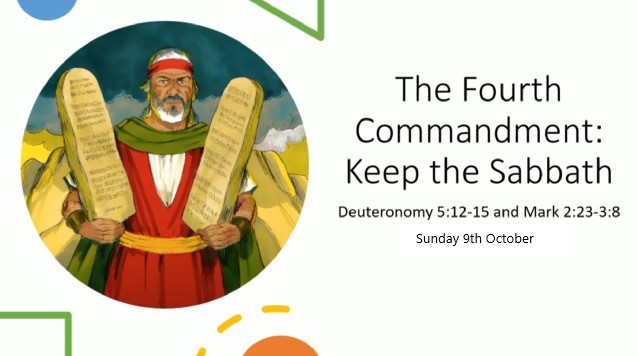
“Six days you shall labour and do all your work, but the seventh is the sabbath to the LORD your God.” (Deuteronomy 5:13-14a)
Many people today worry about work-life balance. How can you avoid work taking up so much of your time and energy that little is left for other important aspects of life? We recognise that work should not be allowed to dominate our lives, yet increasingly we live in a society where many people are being pushed into working longer hours than ever.
Synagogue Showdown –
Mark 3:1-6 Jesus had been making waves. His teaching had increasingly been challenging the accepted religious teaching of his fellow Jews and his popularity was growing.
The key religious teachers of the day, the Pharisees did not like it and were increasingly looking for a way to discredit Jesus.
And so one Sabbath, there they all were gathered in the Synagogue at Capernaum. Jesus was speaking and they were watching. Looking for reasons to condemn him.
The biggest issue was obedience to the Sabbath. The insistence that no work be done on one day a week. It was a unique Jewish tradition, that helped to mark them out from the other nations along with circumcision. It was also the fourth of the ten commandments, the foundational laws for the people.
But what counted as work? The Jewish teachers had worked at and agreed a complicated list of rules and regulations to clarify what could and could not be done on the Sabbath. Every conceivable eventuality had been thought of. For example, one rule taught:
“If a building fell down on the Sabbath, enough rubble could be removed to discover if any victims were dead or alive. If alive, they could be rescued, but if dead, the corpses must be left until sunset.”
And the guidance was clear. You can’t pick wheat on the Sabbath, but Jesus’s disciples had and Jesus had refused to stop them. It was also clear that you can’t work to cure ill people on the Sabbath, unless the condition was life threatening. Yet, Jesus was known to have healed people on the Sabbath. The rules and regulations were put in place by generations of Jewish teachers to ensure the Sabbath was kept, but Jesus did not seem to care about this Jewish tradition.
So, with the Pharisees watching, Jesus acts almost deliberately provocatively. There is a man there with a shrivelled hand. Not a life threatening condition. Jesus tells him to stand up in front of everyone. He does so. Then Jesus asks a couple of questions, which cut to the heart of the issue:
“Which is lawful on the Sabbath, to do good or to do evil, to save life or to kill?”
No-one responds. No-one wants to engage with Jesus. Mark says that Jesus looks around with anger and grief at their stubbornness. They refuse to accept that their whole way of interpreting the Sabbath is wrong, that they have turned what is meant to bring people joy and freedom has been made by them into a straightjacket of rules and regulations. A way to judge people, rather than a gift of life.
In defiance, Jesus commands the man with the shrivelled hand to stretch it out. It is completely restored, yet another miracle demonstrating the blessing that Jesus brings, but for the watching Pharisees the final straw. They go out and begin to plan (presumably on the Sabbath) how to kill Jesus. It seems for them the Sabbath is more about killing than saving a life.
This story is one of many in the gospels, where Jesus falls out with the religious teachers of the day over following the Sabbath. If the Pharisees way of following the Sabbath was wrong, then how are we as Christians to understand the fourth commandment today? Does Jesus’s unwillingness to follow the Pharisee’s regulations, mean that the whole idea of the Sabbath is irrelevant and can be ignored? Or do we still need to take it seriously and follow the commandment carefully? Is Sabbath observance one of the ways we express holy resistance in today’s world?
Sabbath Foundations
To help answer that question it is important to understand the reasons given for Sabbath observance. Interestingly, the Ten Commandments are listed in two places in the Old Testament. Once in Exodus 20 and once in Deuteronomy 5. Mostly, the wording is exactly the same, but whilst both command not working on the Sabbath, it is in the fourth commandment, that the wording is most different. The difference is mainly around the reasons given.
Holy Identity – Exodus 20:8-11; Genesis 2:1-3
In the Exodus 20 version, the reason for following the Sabbath is because it is the pattern that God set down in Creation.
Right at the start of the Bible, the Creation is described through God’s work over six days. But then radically, it says that on the seventh day, God stopped working and rested. He called that day, ‘Holy’ in other words set apart or special.
The seven day pattern of work and rest is rooted in the very person of God, the Creator of heaven and earth. Since we are made in his image, we too are called to rest one day in seven. It’s part of who we are.
God does not exist just to create, work and achieve, he also exists to rest and enjoy what he has done. In the same way, as human beings our identity, our value, our reason for being is not tied up in what we do, but in the fact we are made in the image of God.
Perhaps our children’s TV programmes are quite unhelpful in this regard. When you have programmes like Postman Pat, Fireman Sam and Bob the Builder, you are subtly implying that people are defined by the work they do.
The Sabbath helps us to recognise that we are more than what we do or achieve. By putting aside a day a week to stop working and focus on God, we regain a deeper understanding of our true identity as made in the image of God.
Holy Freedom – Deu. 5:12-15
But, the Sabbath is about more than that. Deuteronomy gives us a different reason for the Sabbath. The last part of the commandment says:
“Remember that you were slaves in Egypt and that the LORD your God brought you out of there with a mighty hand and an outstretched arm. Therefore the LORD your God has commanded you to observe the Sabbath day.” (Deuteronomy 5:15)
The Sabbath is designed to set us free from overwork. When they were slaves in Egypt, before any of the plagues come on Egypt, Moses goes to Pharaoh and asks him to let the people have a three day holiday from their work to go and worship the LORD.
But Pharaoh responded, by asking why they wanted to take the people away from their labour? He then responded by making the Israelites work even harder, forcing them to make bricks without providing them with straw.
If God had rescued them from such an exploitative and hard task master, then, they were not allowed to let work dominate their lives. They were to express the freedom, God had given them, by setting aside one day a week, when they did not work.
The command was given to prevent an enslaving addiction to work, but also to give them a regular time to celebrate the freedom God had given them and praising him. The Sabbath is all about freedom.
When we fail to observe the Sabbath, we become enslaved to work and we forget about the God who sets us free.
Lord of the Sabbath
So, the description of the commands in the Ten Commandments, help to give us a positive understanding for the Sabbath command. It is rooted in both the nature of God and the story of his salvation of Israel, a story of freedom. So, how does this help us untangle the debate between Jesus and the Pharisees and how we should follow the commandment as Christians today.
A Question of authority
In the gospels, the debate is fundamentally about who has authority to interpret the Old Testament commandments. Jesus says elsewhere that he has not come to destroy the law and nowhere does he say that the command to obey the Sabbath is no longer relevant. But he does interpret the law in a fundamentally different way to the teachers of his day.
In the first part of our reading from Mark’s gospel, Jesus is challenged about his disciples plucking ears of corn on the Sabbath. Jesus sees no problem with this. Certainly, it is not the kind of work a farmer would do on a non-Sabbath day. However, it did break the regulations given by the Pharisees.
Jesus’s response is not to argue the details of what counts as work, but that one who has God given authority is able to interpret the Law in an appropriate way, even when it goes against the accepted norms of the day. He does this by telling a story of David, God’s appointed king, when he and his men eat the bread that was meant to be reserved for the Priests. The point Jesus is making is that he as the Son of David, has the authority to interpret the Sabbath laws in the right way. He makes this point explicit at the end, by calling himself, ‘Lord of the Sabbath.’ In other words, as God’s appointed person, his understanding of the Sabbath Law has more authority than theirs. Rather than judging him by their legalism, they should be welcoming him as God’s anointed king and be eager to learn from him.
A Question of identity and freedom
So, how does Jesus’s understanding of the fourth commandment differ from that of the Pharisees. I think it is best summed up by what he says in 2:27:
“”The sabbath was made for humankind, and not humankind for the sabbath;”
The Pharisees had turned the Sabbath into a kind of test as to how well you could follow the Law of God. As such it had become a burden, a stick with which to beat others that you looked down on or disagreed with.
Jesus wants us to see that it is a gift from God, for our good. Therefore it is appropriate to enjoy free snacks and for people to be healed on a Sabbath, because these are signs of the blessing of God.
So, we should seek to keep the Sabbath, because God commands it for our good. It sets us free from being constantly at work and helps us to see that our identity is not rooted in what we do or achieve, but who we are as children of God.
Sabbath Application
So, what does this mean for us as Christians today? What might following the fourth commandment in Jesus’s way look like? How can we make sure we embrace the freedom and the identity that following the Sabbath brings.
Personal Application
In our personal life, this does call for Holy Resistance. For many of us, there are constant pressures to work harder or longer: fear of not having enough money, fear of letting people down, fear of upsetting people by saying, ‘No.’ when they ask us to do something, fear of failure through not working hard enough. With so many things to fear it is hard to carve out a day each week to be free from whatever our work is and give space to be with God.
What we need is faith. We need to trust that God will provide our needs, that he loves us unconditionally, that he wants us to say ‘no’ to too much work, that he doesn’t care about our success or failure, but our faithfulness. When we choose to trust in God, we can say ‘no’ to working every day of the week.
And we need to do that. We need to show that holy resistance. If you are a student, you need to organise your week to have a complete day off each week from your studies, trusting that God has given you enough time in the rest of the week to complete your studies.
If you have a boss, who is trying to increase your work to every day of the week, you need to be willing to say, ‘No.’, trusting that even if they fire you, God will provide another day off.
Where possible, we should seek to have Sunday as our day off work, so that we can share it with other Christians, but I know that for many people, that is not always possible, for those with contracts that insist you work some Sundays, nurses, doctors and vicars! But we need to make sure we guard another day each week as a day of complete rest. I try hard to guard Wednesdays as a day where I avoid doing anything that is at all to do with work.
This can be hard, but when we do this, we find freedom from the pressures of overwork and a better sense of an identity not rooted in our jobs.
Political Application
But as well as our personal action, we should be concerned about the wider society. The Deuteronomy version of the command in particular stresses that they should not make servants or animals work on the Sabbath, that they need rest to.
Where we have any political influence we should be working to encourage employment that does allow regular rest for at least a day each week and does not drive people to have lives dominated by work. Increasingly, our society has been so obsessed with economic growth, consumerism and making money, that Sundays as a special day of rest for people has been lost. It’s not good for our society and forces too many into exploitative work patterns when it is not necessary.
We also need to be aware of the economic pressures that push people into overwork and encourage our politicians to work to limit that.
More than any other of the Ten Commandments, the fourth commandment has a political dimension. Because the Sabbath was made for humankind, we should seek to see it applied for the benefit of humankind.
Sabbath Hope
Jesus challenged the teaching of the Jews of his day about the Sabbath.
The first Christians did not abandon the Sabbath as a result, but they did change the day of the week from a Saturday to a Sunday. Why? Because that was the day Jesus rose from the dead. The day, in which he rested from his mission and became the first to receive the future resurrection body.
The Sabbath is not just to remind us of God’s salvation in the past or to help us embrace the freedom and identity we have in the present, but it is also a pointer to a better future, to the eternal rest, that one day God will provide for us who put our hope in the resurrected Christ.
 St. George's Church Ramsgate