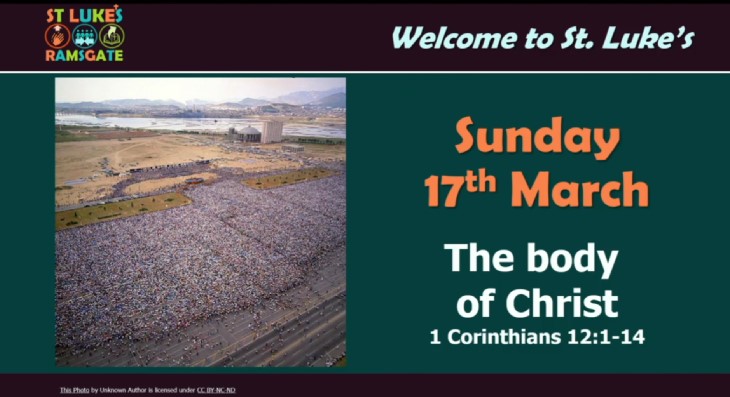
“The body is a unit, though it is made up of many parts; and though all its parts are many, they form one body. So it is with Christ.” (1 Corinthians 12:12)
As we reflect on this passage, we need to ask ourselves how we are enabling every church member to play their part in growing the church, the body of Christ?
Questions, questions! – 12:1
As you probably know, through Lent we have been experimenting with our study groups looking at the Bible passage we preach on in advance and submitting questions about the passage to me as the preacher. I’ve then tried to answer the questions as part of the sermon each week. This is now the fourth week doing this and there is one week to go.
In a way the letter we have been studying has been appropriate for this process, not only because this part of 1 Corinthians is talking about church life at a time when we are having a year of discernment, but because some of 1 Corinthians is probably Paul answering some questions from the Corinthians.
What about Spiritual gifts?
We see that at the start of our passage, where Paul introduces the topic of ‘Spiritual gifts’ probably in a response to a question about them. The response probably continues all the way through to the end of chapter 14 and includes the chapter on love that we looked at last week.
We are not sure what the question, Paul was answering was, but in these chapters, although he talks about a variety of gifts that different people have, in chapter 12 he emphasises the equal value of all believers and in chapter 14 he emphasises the importance of using the gifts to build the church up. The chapter on love helps to underpin both these points, for love both values the other and wants to build them up.
These ideas remind us of Paul’s point in chapter 8:
“Knowledge puffs up, but love builds up.”
It seems that some in the church were being made to seem ‘spiritual’ because of their ‘spiritual gifts’ and so given greater value than others in the church. Perhaps people were saying things like:
- “Maximus is so spiritual, he speaks in tongues all the time”
- “Julius is so spiritual, he prayed for his slave who had a fever and she was healed!”
- “Agrippina is so spiritual, she spoke words in church that really spoke to me last week.”
The problem here is that some in the church were becoming puffed up by their spiritual prowess, whilst others were feeling unimportant or unspiritual in comparison – that they did not matter to the life of the church. The church was becoming divided between the so called spiritual and unspiritual.
Equality of all believers
Paul’s response is to emphasise that all Christians are spiritual. He does that in four ways in our reading.
- Same Spiritual Confession – vs. 2-3
First, Paul emphasises that conversion itself, is a sign that someone has the Holy Spirit powerfully at work in them.
No-one he says, can say, “Jesus is Lord!” unless the Holy Spirit makes that possible. That by itself shows that you are spiritual in the most important and fundamental way.
It is only by the Spirit at work in someone that people can change their heart attitude from rejecting Christ to submitting to Christ. To be a Christian at all is a powerful act of the Spirit. So all Christians are equally spiritual and so valuable members of the church.
- Same Spiritual Source: vs. 4-11
Secondly in verse 4 to 11, the constant stress is on the source of the Spiritual gifts: the Spirit, Christ and God. Whatever your gift, Paul is saying, no matter how impressive or unimpressive it seems, no matter how natural or supernatural it appears, it’s source is the same: the Spirit.
Some people may seem more ‘spiritual’ than others. But their abilities, the things they do are a gift of the spirit to them. Not a reward or payment, not because they are any more special or valuable than anyone else, but simply because the Holy Spirit chose to give them that gift.
Again, Paul’s emphasis on the source of the gifts underlines the equal value of all Christian followers.
- Same Spiritual Goal: vs. 5,7, chapter 14
Thirdly, all gifts are meant to have the same spiritual goal – and it is not to make one person look more impressive than another.
Rather they are to be used to serve others, as verse 5 says and for the common good as verse 7 says. Chapter 14, emphasises as well that the point of the gifts is to build up the church.
The building up of the church as a community of Christians is not the work of just apostles and prophets, or vicars and preachers, it is the responsibility of the whole church using their various gifts.
We are all gifted, in order that we can all be gifts to the wider community.
- Same Spiritual Body: – vs. 12-26
The fourth, argument Paul makes is that as Christians we are all part of the same spiritual body. This argument starts in verse 12 and goes on for most of the rest of the chapter.
Paul compares the community of Christians, the church with a human body. Just as a human body has many different parts, hands, feet, eyes, ears, nose, liver and heart, each distinct and with their own role, so the same is true of the church with its members having distinct parts and roles to play.
Your role may be important, but you still need others in the body to play their roles. They matter just as much. As Paul jokingly says,
“The eye cannot say to the hand, I don’t need you!”
The seemingly more spiritual cannot look down on the seemingly unspiritual and say I do not need you. Everyone is an important and valued part of the body of Christ.
So Paul’s response to the Corinthians question about Spiritual gifts, emphasises the equal spiritual value of every Christian, but he also talks about the variety of gifts. It is this variety that tends to raise questions for us. Indeed, the questions submitted this week, were mainly about the variety of gifts.
Variety of gifts
So, let’s look at the four questions about the Spiritual gifts.
- Is this an exhaustive list of all spiritual gifts?
The simple answer is ‘No’.
Even chapter 12 contains another list at the end.
The list in verse 7-10 has 9 gifts, but at the end of the chapter in verses 28-30, there is another list of 8 items, four of which are repeated from this list: prophecy, miracles, healing and tongues and four are new: apostleship, teachers, helps and administrators.
One of the groups were concerned that the list in verses 7-11 is a bit limited, because of its focus on gifts to do with speech and the miraculous – what about the need for people to carry out the necessary practical and administrative tasks of church life. Well the ‘helpers’ and ‘administrators’ of the later list show that the gap is plugged! Not all gifts look ‘supernatural’ or ‘spiritual’, seemingly practical gifts are just a much of the Spirit as the others.
There are also other different lists that Paul gives in Romans 12, Ephesians 4 and in 1 Peter 4, there is a very simple lists two broad gifts: those who speak for God and those who serve.
Since they are all different, the lists seem to be illustrative only, giving examples of the variety of gifts that Christians might have. We don’t need to try and fit with one of the gifts on any list or feel upset that gifts we might feel we have aren’t on any of these lists!
Nonetheless, it is helpful to consider what gift you might have, so that you can more effectively play your part in building up the church. This leads us to our second question:
- How do we discern who has what gift?
This is a harder question to answer, because it is not one that is addressed directly in this passage or any other.
The lack of detailed answer to the question may suggest that in some ways the discernment process is obvious. We just need to get on with the Christian life and it will become clear.
If we are all people of the Spirit and seek to serve one another as part of the community of believers, then as you try different roles out, pray for people, share thoughts and ideas in groups and Bible studies and help out in practical ways, you will begin to discern the roles and gifts that God has given you in particular.
Having said that, I think this is also something that needs to be done with the help of the Christian community. In Acts when the apostles needed some more leaders, they asked the church community to suggest names.
We need to get better at spotting where others seem to be particularly gifted and encouraging them to make more of that gift.
So, you may notice that in a Bible study, someone is particularly good at understanding scripture and explaining it to others. That may be a sign that they have the gift of teaching. Perhaps if you spot that in someone you should tell them and maybe also tell the church leadership.
You may spot that someone has a growing passion for prayer, and notice some amazing answers to their prayers. Again, it would be good to tell them and encourage them to pray more for others.
You may spot that someone is particularly good at organising an event and you might want to encourage or suggest them to help with one of the church committees.
Let’s be more pro-active and deliberate at spotting gifts in others and encouraging them to make greater use of them.
But, if just giving things a go and being helped by the wider community to discern gifts is important, this leads on to the next question:
- How can we give room for the gifts to be expressed to build up the body?
I think the best answer is to see the importance of both big church and small church.
In big church, we can be encouraged by being part of something big, with the more established preachers, music leaders and so on.
Small church, however, can be much more about one another. Everyone can pray for everyone else. We can all share what we think God is saying to us through the Bible or by the Spirit, we can organise small scale events, and help each other out in practical ways.
In both contexts as one of the groups suggested we need to value everyone equally and encourage people especially when they are trying things out for the first time.
As part of our Year of Discernment, maybe we need to think radically how we can do small church better and encourage more to be involved in small church.
- How do all matter equally (vs. 25), while some gifts are greater (vs. 31)?
Our last question takes us back to the thrust of Paul’s message. Paul seems to be emphasising that all Christians are equally spiritually valuable in the church.
But at the end of chapter 12 his list suggests that some gifts are greater than others. How can we hold these together?
Paul does want to say that all are equally spiritually valuable, but that there is also a good ambition to want to become more effective as a Christian. Not to become more puffed up, but to be better at building the church up.
Throughout these chapters, Paul lists a number of gifts, but the two that appear consistently are tongues and prophecy. Interestingly, tongues do not appear in any of the lists outside 1 Corinthians. Probably this shows that this was an issue in the church in Corinth and if you read through chapter 14, the suggestion is that some seemed to want to use the gift of tongues in church services. This may be because they felt it made them look more ‘spiritual’, because it came across as more ‘supernatural.’
But back in 12:2, Paul reminds them, that although they used to follow the example of dumb idols, where perhaps ecstatic spiritual experiences were highly valued, we now follow the God who speaks clearly to us. So, in chapter 14, Paul emphasises that the church is built up primarily through the sharing of intelligible words. Tongues may encourage the individual spiritually, but they are no good at building the rest of the church up, whereas prophecy – speaking the words of God – will build up the church powerfully. So, prophecy is near the top of Paul’s list of spiritual gifts and tongues is at the bottom, because what matters is not looking spiritual, but building up the body of Christ with the word of God.
So, let’s value all Christians as equally spiritually valuable, but also pray for, discern and encourage gifts in ourselves and others that will enable the effective building of Christ’s community here in Ramsgate.
 St. George's Church Ramsgate