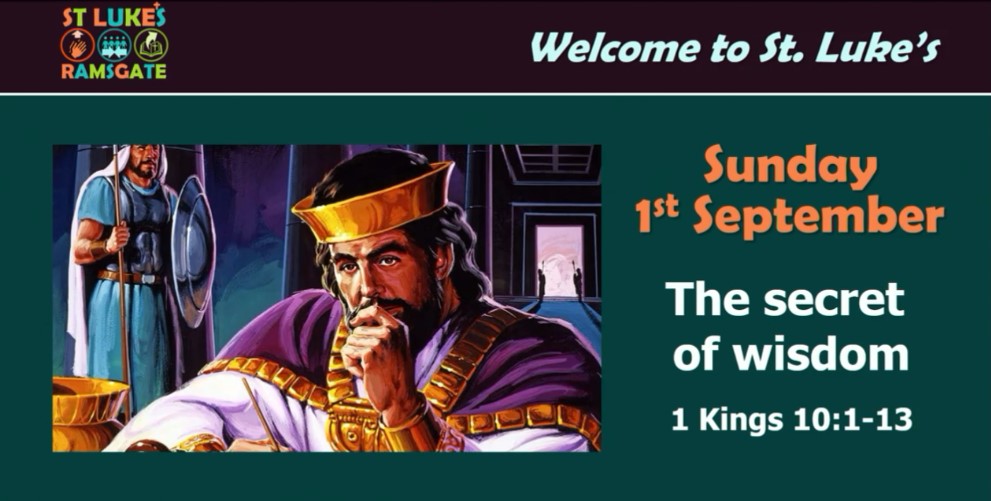
This week’s theme is the secret of wisdom as we focus on Solomon, Israel’s wisest king.
The Queen of Sheba’s Visit
Solomon is celebrated in the Old Testament as the wisest of men. The first few chapters of 1 Kings are very complimentary. We’ve thought about his prayer for wisdom rather than wealth (chapter 2), and last week we had planned initially to look at one particular instance where he resolved a dispute between two women who both claimed to be the mother of a baby (chapter 3). And here in chapter 10, with the visit of the Queen of Sheba, we see a woman completely overwhelmed by Solomon’s wisdom and success. What follows in chapter 4 is a summary that goes like this: God gave Solomon wisdom and very great insight, and a breadth of understanding as measureless as the sand on the seashore. He spoke 3,000 proverbs and his songs numbered a 1,005. From all nations people came to listen to him, sent by all the kings of the world, who had heard of his wisdom (1 Kings 4:30-34).
So this week we are jumping from 1 Kings 2 to 1 Kings 10, and this is where we will be finishing this short series. What we’ve missed out is the memorable story of the baby, the building of the temple plus a grand palace, and then in chapter 11 the reference to Solomon’s 700 wives. In those days, many such marriages were arranged as a way of ensuring peace with surrounding countries. But over time these arrangements turned Solomon’s heart away from the Lord.
After his death it also becomes clear that he was something of a tyrant, imposing forced labour on his own people to build the Temple, and later the Canaanites who had been allowed to stay in the land, but also a heavy burden on Hebrew families from the northern tribes, and so after his death there is an acrimonious split between those 10 northern tribes (known as Israel) and the two southern ones, Judah and Benjamin (thereafter known as Judah). So, it begs the question: Just how wise was Solomon? Clearly he was a shrewd politician. Quite possibly, like some of our prolific modern writers, he used researchers to come up with proverbs and poems for which he then took the credit!
The two books of Kings were written a long time after his death. In fact, the timeline from the death of King David to the exile in Babylon covers a period of 400 years. Now if I was going back 400 years and writing a book about the English Civil War between King Charles 1 and the English Parliament, I would need to do a lot of research. I used to think it was a straight battle between cavaliers (royalists) and roundheads (parliamentarians, led by Oliver Cromwell), but apparently Cromwell was dealing with issues in his own ranks. Some of his people, known as ‘Levellers’, wanted even more democracy than he did. Oliver Cromwell’s statue stands proudly outside Parliament to this day, but he ambushed and shot four of the leading Levellers in order to crush the movement and secure his own agenda. In fact, it was not until almost 250 years later, in1891, that minutes of a debate that took place in Putney were discovered inside a book in one of the Oxford University libraries, revealing the strength of sentiment among those Levellers. In them you find the words of one of the generals of Cromwell’s New Model Army, Thomas Rainsborough: I think that the poorest man in England has a life to live, as the greatest man. I think that the poorest man is not bound to a government that he has not had a voice to put himself under. What I’m trying to say is that much in our past is either unrecorded, suppressed or lost. Getting to the truth is not easy, and the past throws up a complex and often contested story. Historians have a difficult job.
So here’s a writer who is sifting through the various sources, recognising that there were those who thought Solomon was wonderful, and yet others who clearly didn’t. And rather than take sides, he cleverly allows both voices to be heard and in the process he allows you to draw your own conclusions. But he’s not neutral, and there’s a phrase in chapter 10 which you could be excused for not noticing, which we must revisit.
The Queen of Sheba’s visit is a celebrated moment in Solomon’s reign. It’s clearly one of many state visits by the kings and queens of the region, but it’s singled out for special attention. There are those who have turned it into a romance (e.g. the 1959 Hollywood film ‘Solomon and Sheba’). So there’s a story that the queen returns to Sheba (somewhere around Ethiopia). She is pregnant with Solomon’s son, and that son returns to visit his illustrious father 20 years later, only to find that Israel is not what his mother described. It has become decadent, and no longer worthy to be called the people of the supreme God. So he steals the Ark of the Covenant from the temple and takes it back. To this day Ethiopia claims to have the Ark, but they say it’s hidden away. It’s not the only theory about the Ark (2 Chronicles 35 contradicts the Ethiopian claim, and you might prefer the Steven Spielberg version!), but it’s certainly interesting that the Ark of the Covenant is only mentioned once after Solomon’s reign.
And so to the visit. The queen comes with a list of carefully crafted questions, and Solomon answers them all. She is impressed by what she hears and sees, which probably doesn’t include the conscripted labour force from the northern tribes, and what the text of this chapter doesn’t give you either is any examples of the king’s wisdom. What it says is … when she saw all the wisdom of Solomon and the palace he had built, the food on his table, the seating of his officials, the attending servants in their robes, his cupbearers, and the burnt offerings he made at the temple of the Lord, she was overwhelmed (10:4-5). It seems that she was given a tailor-made tour of the best bits.
The text keeps referring to Solomon’s wisdom, but all the examples it gives are about his wealth, and you get the sense that Solomon is one of the world’s great businessmen. Now you can find numerous books and websites with titles like ‘10 secrets of a successful business’. We doff our caps to successful people all the time. They usually rise early, work late and skimp on holidays. Unlike us mortals, they see an opportunity and exploit it to the full. We remind ourselves in church that God’s wisdom is different to human wisdom, but in practice we’re often only interested in those people who are successful and wealthy.
So here’s the phrase for you to notice. This is the Queen of Sheba’s parting shot: Praise be to the Lord your God, who has delighted in you and placed you on the throne of Israel. Because of the Lord’s eternal love for Israel, he has made you king, to maintain justice and righteousness (9). How ironical! The king’s primary task was to look after his people. That phrase ‘justice and righteousness’ is a classic phrase the prophets used to reprimand the nation’s leaders: You turn justice into bitterness and cast righteousness to the ground … let justice roll on like a river, righteousness like a never-failing stream (Amos 6:7 & 24).
I wonder what happened when the queen said that. Maybe Solomon shifted awkwardly. She was probably saying more than she knew. If you’d reminded her of her words later, she would probably have forgotten, but the writer has retained them in his final edit. He lets the words linger in the midst of this celebration of opulence. God’s kings were to be champions of righteousness and justice, generous to foreigners and good shepherds of their own people, but this king had fallen at the first hurdle.
It’s probably no surprise that the nation divided after Solomon’s death, for he had accumulated sumptuous amounts of wealth for the few whilst exploiting the many. And Solomon’s glory did not impress Jesus as it impressed the Queen of Sheba: Consider the lilies of the field. They do not labour or spin. Yet I tell you, not even Solomon in all his splendour was dressed like one of these (Luke 12:27).
So what do you want from life? You may not be a powerful leader like Solomon, but you may share his aspirations. Perhaps we need a new breed of hero, people who are driven more by service than wealth. Such people already exist, but they are the unsung heroes.
William Carey is one such hero from Baptist history. Information filtering through about life in India had concerned him, so in the 1790s he went there, where he was confronted with babies being sacrificed in the Ganges River, in Bengal alone 600 widows being burned on their husbands’ funeral pyres every year, and the caste system which still exists to this day. He worked hard. It was 7 years before he saw his first convert, and through his 41 years there he only saw 700. But he learnt umpteen languages, translating the whole Bible into 6 and the NT into 23. He built a printing press, and when it burned down, he raised money in Britain to build another. He harassed successive governments until the killing of children, the burning of widows, and the burial alive of lepers were made criminal offences. He understood the meaning of righteousness and justice.
Almost 1000 years after Solomon, a group of men in search of wisdom came to Jerusalem. They met the king who had recently renovated the temple, but quickly realised that he was not the source of the wisdom they sought. So they travelled further until they came to an ordinary house in Bethlehem. There they found a toddler, and they bowed in worship and presented their gifts.
About 30 years ago former Archbishop of Canterbury, Donald Coggan, produced a lent series for the Scripture Union. He entitled it “A king with a difference”. The substance was this. Kings have palaces, but this king had nowhere to lay his head. Kings have territory, but his kingdom was not of this world. Kings have armies, but when one of his follower attacked the high priest’s servant, this king said that those who live by the sword will die by the sword, and he told us to love our enemies. Kings have servants, but this king came not to be served, but to serve, and to give his life as a ransom for many.
The fear of the Lord is the beginning of wisdom, and King Jesus offers the wisdom our planet needs. So may you find what this queen never found. The way of Jesus seems a very far cry from the chapter we’ve read, but it’s the power of God for everyone who believes. In the words of the NT apostle: What seems to be God’s foolishness is wiser than human wisdom, and what seems to be God’s weakness is stronger than human strength (1 Corinthians 1:25). May we all invest in this superior wisdom!
 St. George's Church Ramsgate