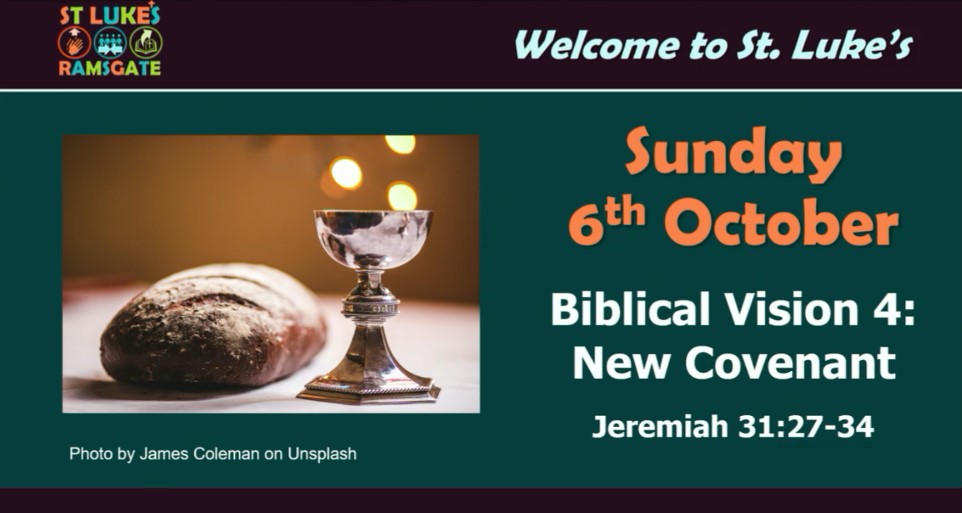
“This is the covenant that I will make with the people of Israel after that time,” declares the LORD. “I will put my law in their minds and write it on their hearts. I will be their God and they will be my people.” (Jeremiah 31:33)
This week we return to our theme of Biblical Visions and look at Jeremiah’s prophecy of a coming ‘new covenant’, which will bring forgiveness and transformed hearts and minds.
As recorded at St. Luke’s
Biblical Vision 4: New Covenant
A hell of a life…
None of us want life to go badly. Most of us hope for a peaceful life, a happy marriage, a successful career, a healthy retirement, happy families and so on.
But, sometimes, life can be hell. We find ourselves embroiled in conflicts, marriages falling apart, being made redundant, struggling with ill health and seeing our families estranged.
We might ask, where is God in all that? Is this really part of his plan for my life? Surely he would want me to have an easy life?
We’re going through a series on Biblical Vision, looking at key moments in the Bible, when God reveals his big plans to key people. Today we come to a really important passage in Jeremiah, where God lays out his plans.
Now, although the vision we are looking at is positive, it is worth remembering that Jeremiah’s message was often much more about the struggles that God was going to bring. In fact, for Jeremiah, life was hell. He lived through the complete destruction of his kingdom and city and found himself hated for a message that proved to be true. Yet, God used him powerfully and his message is one that as we will see is fundamental to understanding the story of the whole Bible and even the Christian message! His was a hell of a life, but he was certainly part of God’s plan!
Jeremiah in Biblical History
To my shame in nearly a quarter of a century of regular preaching I have never preached on Jeremiah 31 before. In fact, in looking through my notes, I’ve only ever preached on Jeremiah once before! This is quite shocking, when you consider how big a Biblical book Jeremiah is, and how important this passage in Jeremiah 31 is.
To understand Jeremiah and this passage, we’ll need a quick recap of what we have looked at in our series on Biblical Vision so far as we have gone through the Biblical history looking at God’s vision statements.
The Gradual fulfilment of God’s Vision:
We started with Abraham and God’s promise that he would bless him and his family and through him bless all nations. This would happen by making his family into a great nation, a fulfilment that moved forward by stages:
First, he would have many descendants, then they would settle in the promised land, then they would be ruled by a victorious king and his dynasty. Once all this was fulfilled after 100s of years, Israel was a great nation under David’s son Solomon. In fact rulers of nations would come to be blessed by his wisdom!
But alongside this plan for Israel to be a great nation and intricately connected to it was God’s plan for them to be his people. This was to be expressed in a special covenant relationship.
This was made clear to them on the way from being slaves in Egypt to the promised land, when God told them through Moses:
“”Now if you obey me fully and keep my covenant, then out of all nations you will be my treasured possession. Although the whole earth is mine, you will be for me a kingdom of priests and a holy nation.” (Exodus 19:6-7)
What did it mean to obey God fully? Well, the Ten Commandments set out the basic ideas of obedience.
What was a covenant? A covenant is kind of relationship plus promise. So, a marriage is a covenant relationship, that comes about when a man and a woman in a special ceremony promise to remain committed to each other for the rest of their lives. And at Mount Sinai, Israel ratified their covenant relationship with God, by agreeing to be loyal to him and to obey his commandments. This was all sealed by a special ceremony, which involved animal sacrifices and the sprinkling of the blood of the sacrifice on both the people and the altar to God.
So, by the time of Solomon, who built a temple for God, the covenant relationship and promise to become a great nation was all in place.
The Disintegration of the vision
But from this high point, things went downhill. Why? Because the kings failed to be loyal and obedient to God and the people followed suit. God had kept his side of the covenant, but the people were consistently disobedient and disloyal.
Even Solomon, led astray by his many foreign wives, allowed the worship of foreign gods. So, God, declared that most of the kingdom would be taken from his family. And in his son’s time the kingdom split in two. A Southern kingdom around Jerusalem, still ruled by David’s descendants and a Northern kingdom ruled by other kings.
The kings of both nations were often wicked, oppressive and idolatrous. God was patient, but in the end, he punished them for their wickedness by sending first the Assyrian empire to exile the people of the northern kingdom, then the Babylonian empire to exile the people of the southern kingdom.
This second exile happened was forecast by Jeremiah and happened during his lifetime. Indeed, much of Jeremiah’s book is taken up with warnings to Israel to stop sinning and to turn back to God before it was too late. But his warnings fell on deaf ears and Jerusalem and the temple built by Solomon was destroyed.
Many of them probably thought it was all over. The covenant, the promises, the vision of God for a people through whom he could bless the nations all destroyed.
But although, Jeremiah’s preaching had mainly forecast this destruction, it also contained a message of hope, that the covenant, the vision of God was not over. In fact, in the midst of this tragedy, God proclaims through Jeremiah a significant vision of a brighter future.
A Different Future (31:28)
Most of Jeremiah’s book is about destruction. Verse 28 echoes the key theme of the book, but notice, that although destruction is the focus, it is not the end of the story:
“And it will be just as I watched over them,
to uproot,
to breakdown,
to overthrow,
to destroy,
and to bring evil,
then I will watch over them
to build,
and to plant!”
declares the LORD. (verse 28)
If you take on a house with a garden full of weeds, you need to start by uprooting all the weeds, before you can plant a beautiful garden. If you take on a derelict site on which to build a new house, first of all you need to demolish the house before you can build something better. If you are a doctor looking after a patient with cancer, first you need to cut out the cancer, and punish the body with chemotherapy and radiotherapy before you can bring about a healed and renewed healthy body.
Jeremiah lived through a time of uprooting and destruction. It wasn’t pleasant, but the nation that was meant to be great, and a blessing had proved to be corrupt and a curse. Uprooting and destruction were needed, before something better could be planted and rebuilt.
A Different Covenant (31:32-34)
But how will things be better?
The old covenant had just not worked. Israel kept breaking it. Jeremiah makes this point in verse 32:
“…the covenant that I made with their ancestors when I took them by the hand to bring them out of the land of Egypt — a covenant that they broke, though I was their husband,” says the LORD.” (Jeremiah 31:32)
Over generations Israel had consistently failed to live up to their side of the covenant relationship, if they kept running after other gods, and created a society of oppression rather than justice.
Things seemed impossible. How could the covenant work, when Israel would not change? How could a leopard change its spots?
Actually, that phrase about leopard and spots, comes originally from Jeremiah!
“Can the Ethiopian change his skin or the leopard its spots? Neither can you do good who are accustomed to doing evil.” (Jeremiah 13:23)
Of course, Israel was not unique in this regard. Evil seems ingrained in all humanity. Despite the many great technological, philosophical and societal advances in recent history. Evil and wickedness at every level continues to destroy lives. What hope is there?
Well God has a solution. It is a new covenant. Look at verse 33:
“This is the covenant that I will make with the house of Israel after that time,” declares the LORD. “I will put my law in their minds and write it on their hearts. I will be their God, and they will be my people.”
The great vision for Israel was that God would be their God and they would be his people. That could only work, though, if they are changed on the inside. A law on their minds and writing on the heart talks about a radical inner transformation. A true winning of hearts and minds. One that would also involve God’s forgiveness for sin as verse 34 makes clear:
“For I will forgive their wickedness and will remember their sins no more.”
Jesus and the New Covenant
So, how could this happen? The first covenant at Sinai was ratified by animal sacrifices and blood. But it had failed. A more powerful sacrifice and blood was needed.
At the last supper, with his disciples, Jesus prepared them for his imminent death by giving them bread and saying, “This is my body.” Then he gave them a cup of wine and in the words of Luke 22:20, he said:
“This cup is the new covenant in my blood, which is poured out for you.” (Luke 22:20)
The only place the phrase, ‘new covenant’ is used in the Old Testament is this passage in Jeremiah. Jesus was declaring that his imminent death on the cross, would be the sacrifice that would make possible the new covenant, not just a call to try and live by God’s rules, but the promise of a deep forgiveness of sin and an inner transformation of heart to enable us to truly become God’s people.
As Christ himself was torn down and uprooted by the sins of the world on the cross, God raised him up to become for us the means of entering into a new covenant with God, where we can be enabled to lives of loyalty and obedience to God.
What about our vision?
So, what has all this to say about our vision as church today?
Firstly, we need to accept that God’s plans can include destruction and judgement. Sometimes things need to be uprooted for something better to be planted. Sometimes things need to be destroyed for something better to be rebuilt. If we want to be part of something better, like Abraham we may need to leave some things behind, like the Israelites in Egypt, we may need to leave one home to travel through the wilderness to a better home, like Jeremiah, we may need to witness destruction in our time in a hope of God building a better future.
Even the Christian call to each individual is a call to repentance, that will often mean letting go of things we value in order to let go of someone whose value surpasses all. Are you willing to do that in order to grasp Christ?
Secondly, our vision needs to be about inner transformation of people. We want to see God at work transforming people from the inside out. Becoming a Christian is not primarily about taking up new habits, like prayer, Bible reading and coming to church (important as those things are). It is not primarily about joining a community of like-minded people (crucial as that is to faith). It is primarily about coming to know God as your God, Jesus as your saviour and the Holy Spirit working in you to bring about fundamental inner transformation. Creating in you a heart eager to live for God.
If our aim in growing the church is just to attract a crowd, then we will not really have achieved anything. We need to be about the new covenant, calling people to accept God’s work in their lives for a radical inner transformation. Anything short of that is failure. Not that we shouldn’t welcome people to join us as a church family and encourage them to pray, read the Bible and come to church, these are all the means to the end of inner transformation – but we must not mistake them for the end!
Thirdly, Jeremiah lived through a terrible time to be a prophet and a member of Israel. His experiences would have not been too dissimilar to the kinds of experiences of those living in some of today’s war zones. Sometimes for us today it can feel like life is falling apart, that we are living through a time of uprooting and destruction. But, although that may be God’s plan for now, it is not his ultimate goal. As Jeremiah could see, the ultimate goal is always to plant and to build.
 St. George's Church Ramsgate