“God reveals deep and hidden things; he knows what lies in darkness,
and light dwells with him.” (Daniel 2:22)
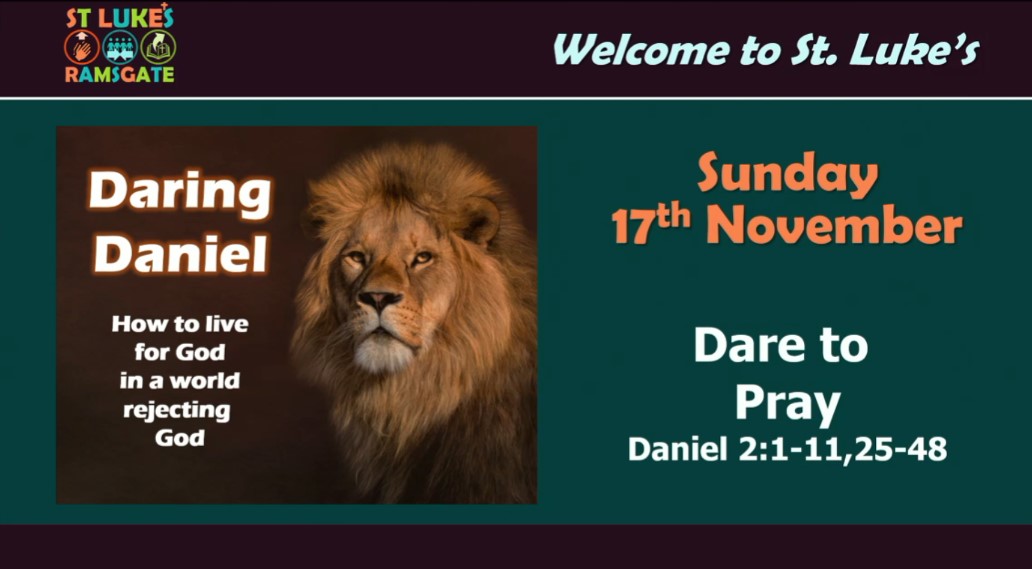
This Sunday, we return to our series on Daniel. Faced with an impossible seeming challenge from the boss, Daniel turns to prayer. As a result, Daniel brings some powerful and challenging truths to the king.
As recorded at St. Luke’s
Dare to Pray (Daniel 2)
Safeguarding Sunday
Today is Safeguarding Sunday, which is poignant considering the Archbishop has had to resign, because of a failure to deal adequately with a Safeguarding issue.
But, why do institutions or organisations fail to tackle abusers. Part of the problem is that it takes courage to call out, challenge or uncover such wicked behaviour when it comes to light. Victims need to dare to share the abuse they have suffered, leaders in an organisation need to be willing to accept that sometimes well respected people within an organisation might be an abuser, and they have to be willing to share that truth beyond the organisation, risking reputational damage for themselves and the organisation itself.
In short stopping abuse, needs people to act in ways that can be deeply uncomfortable. Yet, not to act can allow abusers to go unpunished and more people to suffer abuse. Which tragically is what happened with John Smyth.
Our reading today from Daniel, is not about tackling abuse, but it does involve people being willing to challenge conventional thinking and to speak the truth, even though to do so is risky.
It’s a long story, but involves two key characters, Nebuchadnezzar who was king of the Babylonian empire, the biggest empire ever seen in the Near East up until that point and Daniel, a Jewish exile recruited to be trained up in the Babylonian empires civil service.
Let’s start by considering Nebuchadnezzar, someone who dares to push beyond conventional thinking, albeit in a very bullying and aggressive way!
Nebuchadnezzar: Dares to Push beyond Conventional Thinking
Under Nebuchadnezzar’s father, the Babylonians had destroyed the Assyrian Empire and before he was king Nebuchadnezzar, himself had led an army, which had wiped out the Egyptian Army under Necho II in the Battle of Carchemish. With the empire now established, Nebuchadnezzar’s dad had died and he had taken over ruling this large and powerful empire.
Nebuchadnezzar, was already then used to turning the world upside down, as well as enforcing his rule through violent means. We see both those aspects in this story.
He has had a disturbing dream and he wants to know its meaning. The normal way of doing things was to tell the dream to his advisers, then they would give an interpretation. But how could Nebuchadnezzar be sure, their interpretation was the real meaning of the dream and not just an attempt to interpret it along with conventional thinking? Nebuchadnezzar comes up with a bold request. He wants them to tell him what the dream was, before telling him the meaning. Only then could he be confident that they had real insight beyond human thinking.
The magicians and advisers respond by saying, this is impossible! How can they know his dream? No other king has ever made such a request. Basically, they say this is an impossible and ridiculous suggestion. So, Nebuchadnezzar becomes angry and threatens violence. “Tell me or you all die!” is the gist of what he is saying.
Now, admittedly, this is not the kind of boss you would want to work for. And Nebuchadnezzar’s threats of violence are not to be commended – he is clearly not concerned about safeguarding his staff! His style of rule is closer to Stalin than the Archbishop of Canterbury!
Yet, there is something to be commended about his bold request. He wants to get beyond the platitudes of conventional thinking, he wants to push to the deeper meaning behind his dream. He is questioning the attitudes of his day. He wants to really know the truth.
- Do we dare to push beyond conventional thinking?
Perhaps you too are someone fed up with the conventional wisdom of today. Perhaps like Nebuchadnezzar, God has brought you to long for a deeper meaning or understanding of life. Perhaps you are beginning to question the kind of ideas you have always believed in.
Increasingly, people in our society are questioning some of the commonly held assumptions. Louise Perry, for example has written a book called, The Case Against the Sexual Revolution, questioning many of the now conventional beliefs about sexual liberation, because she has come to see that on the whole sexual liberation has been bad for most women, but most benefits predatory men.
Others are beginning to question the idea that science can fully explain life and shows us that God is not needed. They are seeing that science cannot answer all our questions, it does not help us find agreement on some of the big cultural questions of the day. It cannot connect us with the deeper meanings of life and the world. Perhaps we need guidance from God after all.
Still others are questioning whether the technological revolutions around smart phones are leading us and particularly our children to become increasingly anxious and depressed, that rather than connecting people they are leaving people increasingly isolated and alone and distracting us from exploring deeper meanings in life.
Will you be a Nebuchadnezzar and dare to push beyond conventional thinking and ways to seek a deeper truth?
Daniel: Dares to Seek God’s Help
The magicians and advisers see no way to be able to meet Nebuchadnezzar’s demand to tell him his dream, so the command goes out that all of them be killed. This is where Daniel comes in. Although they are at the lowest rung of the civil service, he and his friends also face death. But Daniel response in a different way to the magicians and other advisers. He dares to pray, to seek God’s help.
This contrast between Daniel and his friends and the magicians and advisers, is fundamental to the story and rooted in a contrasting belief in God.
In verse 11, the Magicians and advisers say: ‘No one can reveal it to the king except the gods. The gods do not live among humans’ (vs. 11)
They believe in the spiritual, but not in a spiritual that reveals things to human beings, not in gods who listen and speak.
Daniel on the other hand, believes in the God revealed by Moses and the prophets. He believes in a God who does listen and speak. So rather than responding with despair, he dares to seek God’s help, he dares to pray.
“He urged them to plead for mercy from the God of heaven, concerning this mystery.” (vs. 18)
And the amazing thing is God answered his prayer, and that night revealed Nebuchadnezzar’s dream and its meaning to him. Daniel prayed, God revealed and the other magicians and advisers were saved.
- Do we dare to seek God’s help?
This is a challenge for us as Christians today. Like the magicians and advisers, it is easy to despair, to see the impossible, to give up and resign ourselves to collapse. We can forget that our God is the God who speaks and listens. He is not a distant unknowable God, but one we can engage with, cry out to. He is, ‘our Father.’
Over this year of discernment, we have been asking God to speak to us. To show us the plans for the future. Like Daniel, who asked his friends to pray, we’ve done this together and we think that God has now revealed the outlines of a way forward. A vision not of despair, but I hope of growth.
But, we need to keep on praying. Indeed, prayer must be front and centre of our attempts to implement the vision if we really are to grow the church. We need to dare to seek God’s help.
But of course, daring to seek God’s help, may involve us becoming part of the solution. The truth is it is easier or more comfortable to sit back and despair, than pray for God to intervene and risk becoming part of God’s solution. That is what happened to Daniel, he was the one that having now been given Nebuchadnezzar’s dream had to tell the king what it was and its interpretation. He needed to dare to speak truth to power.
Interlude: The Dream and its interpretation
So, what was the dream and what was its interpretation?
In the dream was a statue, with four layers. The head was gold, the chest and arms silver, the belly and thighs bronze and the legs and feet of iron and clay. In the dream a rock comes and strikes the feet of iron and clay and the statue is destroyed and all its parts lost without trace, whilst the rock becomes a huge mountain and fills the earth.
The interpretation is that each stands for a great kingdom, beginning with the kingdom of gold, which is Nebuchadnezzar’s kingdom. But none of the Kingdom’s last, each one is replaced by the other, until finally a different kind of kingdom, represented by the rock and mountain, which is God’s kingdom. This kingdom will endure forever.
For Nebuchadnezzar, the dream and interpretation is both encouraging, but also deeply challenging. His kingdom is golden, but it won’t last, it is not ultimate. God has something better in mind.
Daniel: Dares to Speak Truth to Power
Now how would you feel about telling Nebuchadnezzar that his kingdom, great though it is, is not going to last? This is the guy, who was quite quick to order his whole civil service to be killed. Wouldn’t you want to tell him what you think he wants to hear?
Again here is a contrast between the magicians and other advisers and Daniel. Back in verse 4, they say to Nebuchadnezzar, “O King live forever!” They tell him what they think he wants to hear, that his kingdom is going to be the one that lasts. That his conquests mark the end of history. They want to give him the attractive conventional wisdom of the day.
But Daniel is willing to tell him the deeper truth that comes from God: ‘After you, another kingdom will arise…’ (vs. 38) Your kingdom is not the ultimate kingdom. Actually, there will be three other great kingdoms after you, but none of them will be the ultimate kingdom. Only God’s kingdom is eternal.
Fortunately, for Daniel, Nebuchadnezzar is delighted to be told this deeper truth and to know that because Daniel told him the dream as well as its meaning he could trust it was true and Daniel’s God is the true God:
“Surely, your God is the God of gods and the Lord of kings and a revealer of mysteries…” (vs. 46)
Had Nebuchadnezzar been converted? He had certainly taken a big step in the right direction, but as we will see next week, he still had some way to go!!
- Do we dare to speak God’s truth?
As for us, will we like Daniel dare to speak God’s truth. Are we prepared to tell people the deep things God reveals, when it may well not be what they want to hear?
Daniel told Nebuchadnezzar, that his cherished empire, magnificent as it was, his life’s work would ultimately be like rubbish blown away by the wind. That only God’s kingdom is eternal.
Are we willing to challenge people, that the things they work for and value most in life, great and good as those things may be, will one day all come to nothing? That they need to seek first God’s kingdom and his righteousness?
To trust in what Christ has done for them and not in what they have achieved for themselves?
Will we dare to speak or share God’s truth?
Nebuchadnezzar dared to push beyond conventional thinking to God’s truth, Daniel dared to pray that he might be used by God as a solution to the crisis and he dared to speak challenging truths to power. Will we dare to step out of the conventional and seek first God’s kingdom and his righteousness?
 St. George's Church Ramsgate