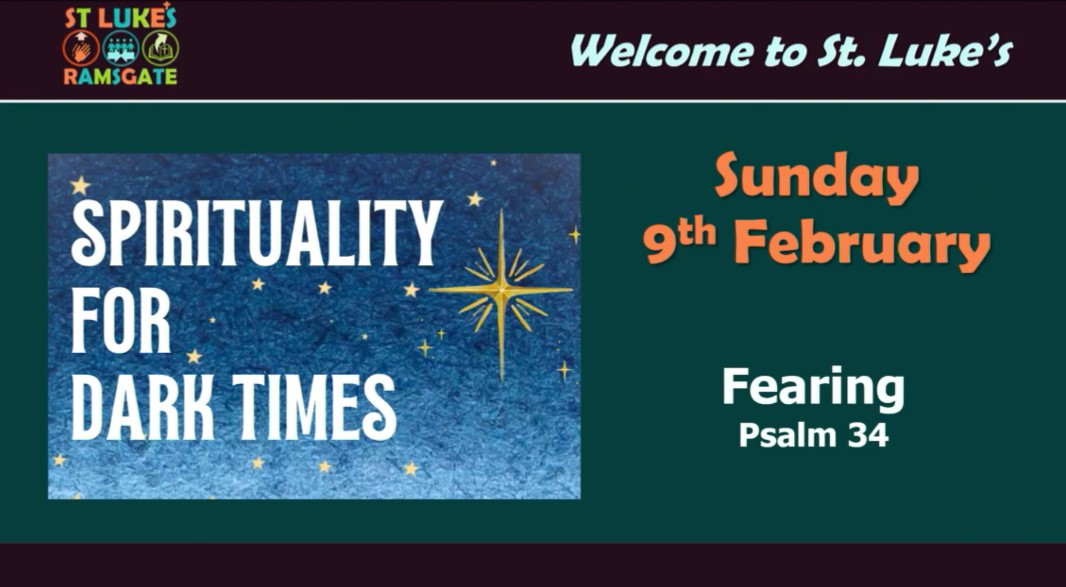
“Fear the LORD, you his saints, for those who fear him lack nothing.” (Psalm 34:9)
We often think of spirituality as bringing us a sense of peace and comfort from connecting with God’s love and that is true. But it should also bring us into a healthy fear of God. Fear of God is freeing not limiting, it brings peace, because we are confident that justice will win out and it develops a wisdom in us, that will enable us to prosper in life.
Psalm 34 – Spirituality for Dark Times: Fearing
Speedy Steve
Steve Coogan, the well-known comic actor has been in a bit of trouble. He was caught speeding at 97mph on the M6. But, why? What fears motivated him?
Maybe, he enjoyed the thrill of the fear of breaking the law or of risking his life by driving so fast. Or did the fear of being late to some appointment cause him to drive at high speed?
He claims that since being caught he has been driving below the speed limit. It seems fear of a driving ban, fear of the power of the law over him has made him drive more safely. And this is part of the point of the law, isn’t it? That a healthy fear of the consequences of breaking the law help us to be good.
Fear of the right things can lead us to live a good life.
Spirituality for Dark TImes
But, sometimes, fear is awful. Sometimes we can face fearful situations that we need to be rescued from.
We are going through a series called, ‘Spirituality for Dark Times’, and dark times can certainly be fearful times. Spirituality is not an activity, that is separate from the rest of our lives, a hobby we do on Sundays, an alternative activity to playing golf, cycling or reading the Sunday paper.
It is in connecting with God, that we find both a lifeline from the struggles of life and the power to live a good life. And today, I want to show that a Christian spirituality, can both help us in times of great fear and lead us to have a healthy fear that brings about a good life.
To help us do that, let’s look at Psalm 34.
Desperate Dave
Psalm 34 was written as a response to God’s rescue from a desperately fearful situation. We can see that in the title of the Psalm:
“Of David. When he pretended to be insane before Abimelech, who drove him away, and he left.” (Psalm 34 – Title)
The situation referred to is probably the story related at the end of 1 Samuel 21. There the king in question is called, Achish, King of Gath, a king of the Philistines, the enemies of Israel, whom David had spent most of his life, fighting. Why does the Psalm refer to him as, ‘Abimelech’? We’re not quite sure, but it may have been a title for the Philistine kings, as it literally means, ‘My Father’ is king. But that is not important.
What is important is to understand David’s situation. He had become a very successful army commander under, Saul, king of Israel and even married, Saul’s daughter. But he was a victim of his own success. When people started singing in the streets:
“`Saul has slain his thousands, and David his tens of thousands’?”
Saul became jealous and worried, that David was going to take over his kingship. So, Saul began to plot to have David killed and David had to flee for his life? But where would he go? Perhaps thinking that the old adage, “My enemies, enemy is my friend”, David fled to Achish, King of Gath, the enemy of Saul, hoping he would offer protection.
But, then the people in Achish’s court, started quoting the ditti:
“Saul has slain his thousands, and David his tens of thousands.”
And David realised, that the Philistines might see him as a threat best eliminated. Wherever he looked it seemed that there were people out to kill him. And so not surprisingly it says in 1 Samuel, that he was very afraid!
He had become Desperate Dave, there was nowhere safe for him. Imagine, you were in his situation, imagine the terror you would feel. How frightened you would be.
The story in 1 Samuel, says that David discovered a clever way out of the predicament. He pretended to be mad. As a result, the king didn’t want him around and didn’t see him as a threat. So David was able to escape and hide out in the Judean countryside until eventually Saul died in battle with the Philistines and David was made king.
But, what has all this to do with Spirituality? 1 Samuel doesn’t mention God at all in this story. That’s where Psalm 34 comes in. It is David’s poetic response to what happened and it is all about spirituality.
Spirituality seeks Salvation from fear- vs. 1-8
In the Psalm David doesn’t boast about his clever scheme, but God’s rescue. The Psalm begins with a call to praise God in verses 1 to 3, then David explains how he was saved from his terrifying situation.
Verse 4 tells us:
“I sought the LORD, and he answered me; he delivered me from all my fears.”
and verse 6 says:
“This poor man called, and the LORD heard him, he saved him out of all his travels.”
What did David do, when faced with a situation of great fear. He sought the LORD and called out to him. Christian spirituality, is a lifeline from the terrifying situations we may come to face in life.
Indeed, when we find ourselves afraid or anxious, our instinct needs to be to bring our problems to God, he can and will rescue us from our greatest fears. As Paul says,
“Do not be anxious about anything, but in everything, by prayer and petition, with thanksgiving, present your requests to God.” (Philippians 4:6)
David in the Psalm is saying, look God rescued me from this terrible situation and he can and will rescue you to. As verse 8, says:
“Taste and see that the LORD is good, blessed is the one who takes refuge in him.” (Psalm 34:8)
Whatever difficulty you are facing in life at the moment. Bring it to God. Take refuge in him. In fearful situations, God is our lifeline. Call out to him.
Spirituality develops a holy fear – vs. 9-20
The Hinge of the Psalm verses – 7-9
Spirituality is for every situation in life. It can rescue us from terrifying fear, but it also can help us develop a good holy fear.
David says,
“Fear the LORD, you his saints, for those who fear him lack nothing.” (Psalm 34:9)
What kind of fear are we talking about here? It is not the kind of fear that leaves us terrified and paralysed. After all, we know God loves us.
Next week we will come to Psalm 23 and see that God is a God of comfort and care, our good shepherd.
But the fear of the LORD is something commanded regularly in both the Old and New Testaments. What does it mean? How does it link to Spirituality.
Fear that surrenders to God – vs. 9-10
Firstly, the Psalm tells us that to fear God, is to surrender to him, to become deeply dependent on him, to accept that without him, there is no hope, no salvation. To fear God, is to fear not having his help, to fear a life without him.
Verse 10 expresses this. It compares young lions with those who seek the LORD. Young lions, would have been seen as the strongest and most powerful of the beasts in David’s time. A lion can look after itself. Surely, it doesn’t need help, it is self-sufficient, it can rely on its own strength.
Verse 10, says, no. Young lions can grow weak and hungry. No-one is self-sufficient. No-one can depend on their own strength. The only way we can truly survive in life, is to give up on depending on our own strength and surrender ourselves to God, in utter dependence on him, so that the most terrifying thing in life is to lose his help.
As Peter says to Jesus in John 6, when others were deserting Jesus:
“Lord, to whom shall we go? You have the words of eternal life.” (John 6:68)
Such a fear will drive us to want to stay connected with God, to seek him in prayer and to learn from him, through study of his word and to be part of his people by being part of a church. It is surrendering our whole lives to God in complete dependence that drives our spirituality.
Fear that seeks the good life – vs. 11-14
Secondly, to fear God is to fear the consequences of displeasing him. It is to understand that he is the ultimate judge of our lives; that he is the one we will have to give an account to, in life beyond death.
Jesus warns us:
“I tell you, my friends, do not be afraid of those who kill the body and after that can do no more. But I will show you whom you should fear: Fear him who, after the killing of the body, has power to throw you into hell. Yes, I tell you, fear him.” (Luke 12:4-5)
Indeed, when we make decisions in life, we often have to weigh up who to fear more. Steve Coogan had to decide whether he was more afraid of being late, so that he would speed in his car, or of the law, so that he would obey the law and drive safely.
When our spirituality connects us with God in such a way that we truly appreciate how he is the ultimate judge over good and evil, then even though we can be confident, that he forgives those who turn to him, we will take seriously the need to live to please God.
And this is a good thing. As it says in Proverbs:
“The fear of the LORD is the beginning of wisdom,
and knowledge of the Holy One is understanding.”(Prov. 9:10)
So, David in verses 11 to 14, wants to encourage a fear of the LORD that leads to a good life, a life of truth telling, a life that seeks peace.
Our spirituality connects us with God and so leads us into a holy fear, which in turn is the route to leading a good life.
Fear that sustains in trouble – vs. 15-22
But finally, this is a fear that sustains us in trouble. To fear God, is also to have a confidence in the face of whatever else might scare us. After all, if we come to understand that God is the most fearful thing we will ever know, and yet he loves us and wants the best for us, then what else do we ultimately need to be afraid of?
This I think is the sense of the last section of the Psalm. Why be afraid of troubles, if the LORD is bigger than those troubles and can ultimately deliver us from them?
David had come to understand this afresh when God rescued him from Achish, king of Gath. God does not keep us from fearful situations, but he will ultimately bring us safely through them.
David expresses this in a profound way in verse 20:
“he protects all his bones, not one of them will be broken.” (Psalm 34:20)
John, in his gospel, says that this verse was fulfilled in Jesus on the cross. Unlike the two people who were crucified with him, and contrary to normal practice at crucifixions, Jesus’ bones were not broken. Jesus on the cross was a fulfilment of this Psalm, His God was protecting Him, and was rescuing him, as indeed he did in the resurrection from death.
Ultimately, the death and resurrection of Jesus, is what can set us free from all other fears. As it says in Hebrews:
“Since the children have flesh and blood, Jesus too shared in their humanity so that by his death he might destroy him who holds the power of death–that is, the devil– and free those who all their lives were held in slavery by their fear of death.” (Heb. 2:14-15)
When we fear the God, who demonstrated his power over death and life, then like Jesus, who was not afraid to go through the horrors of death on the cross, we can be free from all fear, because we trust that God is the one who has the ultimate power and the ultimate say, and as the Psalm says:
“The LORD redeems his servants;
no-one will be condemned who takes refuge in him.”
 St. George's Church Ramsgate