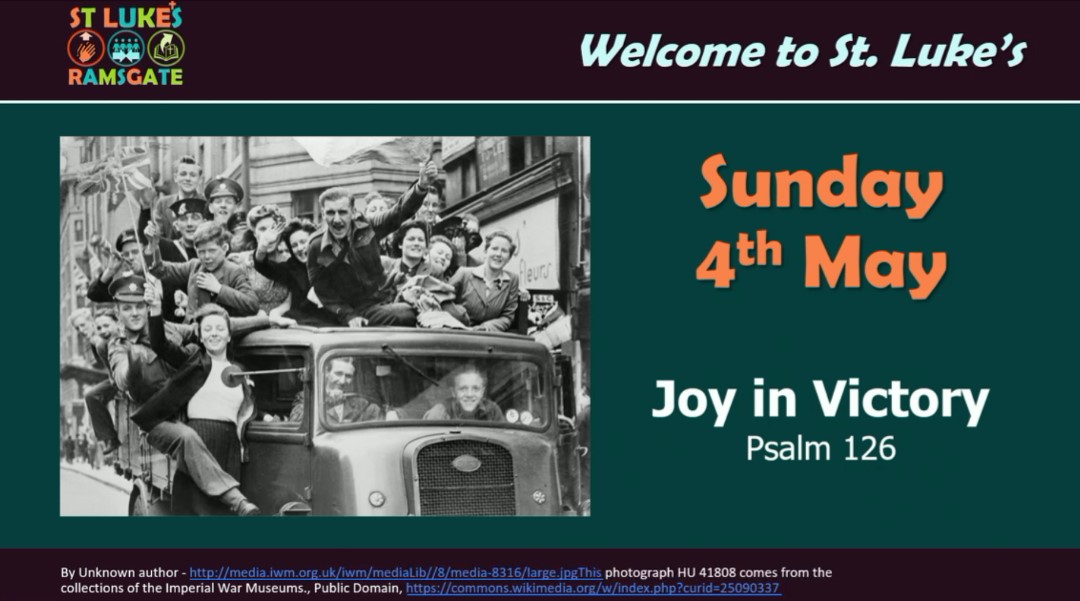
Jesus says: “I tell you the truth, you will weep and mourn while the world rejoices. You will grieve, but your grief will turn to joy.” (John 16:20)
Thinking of World War II it is often the case that the greater the suffering or challenge the greater the joy when the suffering or challenge is overcome. In the quote above, Jesus was preparing the disciples for his imminent death. For many at the time, the death of Jesus was a reason to rejoice. A trouble maker had been eliminated, the status quo maintained.
But, the greater joy would be reserved for Jesus’ disciples. Although, they would go through the trauma of losing Jesus, they would discover the amazing joy of seeing him again as the one who had defeated sin and removed the fear of death, not just violent death as at the end of World War II, but the fear of death full stop. That is the incredible joy that people are still discovering today, as they come to follow Jesus.
Joy in Victory (Psalm 126)
Have you got something that is worth celebrating?
We live in a culture that looks for all kind of excuses for a party and a bit of fun. But is there any substance to a lot of our celebrating? Are we actually celebrating something that matters, or is much of it just a flimsy excuse to get together and eat, drink and be merry?
Take Easter for example. People enjoy the chocolate eggs, hot cross buns, easter egg hunts and a long bank holiday weekend. But are they celebrating anything worthwhile or meaningful? Or is it just an excuse to have fun at that time of year?
VE Day – Something Really Worth Celebrating
Thursday is the eightieth anniversary of VE day, the end of the second world war in Europe. The original VE day in 1945 was truly a day worth celebrating. It’s hard to imagine what it would have been there.
For over five years, the whole country had been caught up in an almighty struggle that had cost millions of lives around the world and brought huge restrictions, upheaval and terror to the lives of most people in Britain. Food had been rationed, there was a constant threat from bombing and later on the V2 rockets, millions were risking their lives fighting on the front line, many had lost loved ones, sons, husbands and fathers to the fighting. Even those not called up to fight had to work extra hard to ensure the manufacturing war effort could continue with so much of the workforce off fighting. We may romanticise the war, but it had been tough.
But, in the end all the hard work, restrictions, deprivations and fighting had been worth it. The evil of Naziism had been defeated, the peace and security of our country secured and the war had come to an end. This was something really worth celebrating and it was a celebration shared by almost everyone. Here was a moment of true joy. And it showed.
The joy of the day broke down normal social conventions, as people poured out onto the streets and embraced those they had never met before. Even the two daughters of the king, Princess Elizabeth and Princess Margaret slipped out of Buckingham Palace and joined the crowds incognito. Queen Elizabeth, when she remembered the day said,
“I remember lines of unknown people linking arms and walking down Whitehall, all of us just swept along on a tide of happiness and relief.”
There were bonfires, street parties, drinking, music from gramophones, accordions and barrel organs and dancing in the streets.
Albert Jarrett who was in the RAF having joined up from his home in Jamaica recalls:
“It was a marvellous day unlike anything I have experienced since. It was a great day and we celebrated and went along to the dancing halls to have fun – wonderful to be with so many relieved people!”
Jack Bracewell who was in the army and stationed in Germany when the news came through said:
“We heard a rumour going around camp that the war had ended, and everyone was asking is it true. When it was confirmed we were all euphoric and couldn’t really take it in at first. There was a lot of drinking and singing that night.”
This was the joy of victory. A celebration of the transformation
from war to peace,
from fear to security,
from struggle to relief.
It was something they had been waiting for, even expecting, but when it came it must have felt almost unreal.
Celebration comes with Transformation
True celebration occurs when there has been a real transformation from one situation to something that is far better. VE day celebrated the transformation from war to peace.
The Psalm we read begins by celebrating the transformation from exile to returning home. One of the great stories of the Bible is that the people of Israel had been terribly defeated by the Babylonian empire. Their main city, Jerusalem had been destroyed, and their temple had been burnt down. Many of them had been taken away from their homes and made to live near Babylon in exile. But God promised that he would bring them back. It seemed impossible. It looked to be all over for the Israelites as a nation and a people. But, 70 years after the exile the impossible happened. Babylon was defeated by the Persians and incredibly, the Persians encouraged the Jews to return to Jerusalem and rebuild their temple.
It was a moment of transformation that the first few verses of the Psalm refer to in words that I think also sum up the feelings of the moment, the same kind of feelings that people would have had on that first VE day.
“When the LORD brought back the captives to Zion,
we were like men who dreamed.
Our mouths were filled with laughter,
our tongues with songs of joy.” (Psalm 126:1-2)
You cannot help but celebrate true life changing transformation.
But the Psalm also acknowledges who it was that had given them this moment of transformation.
Then it was said among the nations,
“The LORD has done great things for them.”
The LORD has done great things for us,
and we are filled with joy.”
Many also wanted to acknowledge that God had answered their prayers at the end of the war too. St. Paul’s in London had to have ten consecutive services giving thanks for peace, each one attended by thousands of people. No doubt many other churches up and down the country similarly held services of thanksgiving.
A celebration rooted in thanksgiving to a God that has enabled such amazing -and for the Jews seemingly impossible – transformation of their fortunes gives us ongoing hope.
This Psalm is looking back to the celebrations when they returned from exile. But it recognises that there are now fresh challenges, that also need a transformation of fortunes. So, it becomes a prayer, a cry to God to the God who has shown that he can transform the most hopeless situation, that he can do it again:
“Restore our fortunes, O LORD, like streams in the Negev.”
It is a prayer, that has a confidence that God can transform our lives for the better. ‘The streams in the Negev’ comment refers to the amazing transformation that happens in the wilderness of the Negev on the rare occasions when it rains, and the streams are filled once more. Suddenly, the wasteland becomes alive as dormant seeds, enlivened by the rain spring into life and flowers appear everywhere. It is a joyful image of unimaginable transformation.
Is your life in need of transformation? Do your fortunes need reversing? Then why not pray to the God who has shown again and again that he can transform our fortunes. Why not see if he might not give you a real reason to celebrate?
Celebration comes after Struggle
Not that following God is easy. Jesus said to his followers, “Take up your cross and follow me.”
Becoming a Christian can be hard, because it may mean letting go of attitudes or behaviours that we value or enjoy, when God tells us we need to stop, because they are destructive for us and or others.
Becoming a Christian can be hard, because others may ridicule us for it and in some parts of the world to be a Christian may even mean full on persecution, imprisonment or even death.
Becoming a Christian can be hard, because it is a call to play an active part as one of God’s people, to care for other Christians as though they were your family, to work to grow the church and share the good news of Jesus with a wider world.
To become a Christian is to take part in a struggle. But it is a struggle that leads to victory. And the victories most worth celebrating are the ones that have involved the greatest struggle.
That’s the sense of the last two verses of the Psalm:
“Those who sow in tears will reap with songs of joy.
He who goes out weeping, carrying seed to sow,
will return with songs of joy, carrying sheaves with him.”
(Psalm 126:5-6)
Just as sowing seed is hard work, with no immediate reward, its ultimate benefit will be a transformative harvest that will bring great joy.
That was true of the Second World War. It was a struggle for the whole nation of epic proportions. But it led to a victory, the elimination of Nazi power, that was truly worth celebrating. True celebration often comes after great struggle.
Becoming a Christian may mean embarking on a life of struggle, but it is a struggle that will lead to an eternal victory really worth celebrating. The victories most worth celebrating always involve a struggle.
But for Christians the greatest struggle, the one that has secured our victory, is not the one we make, but the one God has made on our behalf.
Jesus echoing the theme of sowing and reaping, said about his upcoming death on the cross:
“I tell you the truth, unless a grain of wheat falls to the ground and dies, it remains only a single seed. But if it dies, it produces many seeds.” (John 12:24)
His death was an immense struggle. It was a struggle to obey God in the face of a horrifying death, but he obeyed. It was a struggle to bear the sins of the whole world by the sacrifice of his own life, but he did it, condemning the evil of sin, the devil and rebellion against God and paying our punishment, so that we can be forgiven and reconciled with God. It was a struggle to face the fear of death and even death itself and to come out ultimately victorious, as he did when he rose again on the third day, the victory to beat all victories.
VE day celebrated the defeat of one form of evil and the end of war. Jesus’ death and resurrection, goes way beyond that. He defeated all evil, guaranteeing its ultimate abolition and he defeated death itself. That is the transformative victory through struggle that gives us a real reason to celebrate at Easter.
Just as we reap the benefits of those who fought in World War II to destroy the threat of Nazi Germany, and can celebrate their achievements, so when we give our lives over to Jesus and become part of his kingdom, we reap the benefits he won for us through his struggle: forgiveness of sin, freedom from evil and the gift of eternal life. That is what we celebrate at Easter.
At the end of World War II not everyone was celebrating. Those who had fought for the Nazis were utterly defeated. They had chosen the wrong side in the war.
If we want to be part of the ultimate eternal celebration, we need to choose the side of victory. We need to give our lives to Jesus. When we do that we will find something really worth celebrating.
 St. George's Church Ramsgate