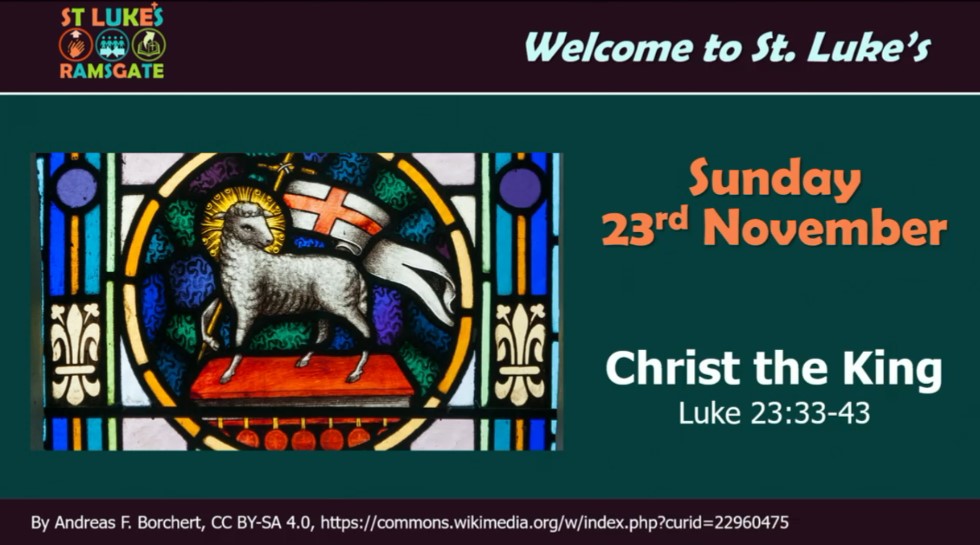
“For the Lamb at the centre of the throne will be their shepherd; he will lead them to springs of living water.
And God will wipe away every tear from their eyes.” (Revelation 7:17)
He is also our shepherd. ‘Shepherd’ was a common image in the ancient world for kings. They led the people as a shepherd leads his flocks. In this verse, however, in imagery echoing Psalm 23, we are told that Jesus as our shepherd king will lead us to springs of living water. His rule brings us life, a life where God will wipe every tear from our eyes.
Why not recommit to making Jesus the king of your life, accepting his sacrifice for your sins and allowing him to lead you to eternal life?
Luke 23:33-43, Christ the King
What makes reality TV so appealing?
What makes Reality TV so appealing to watch? There are probably many reasons, but I think one of them, is that we enjoy the ignorance on display. Whilst we as viewers are shown all the facts, the contestants on these shows are often portrayed as deeply ignorant.
This used to happen in the early stages of X-Factor. Contestants would claim to be amazing singers, but when we watched them perform, they were terrible. They were ignorant of their abilities.
Similarly, shows like the Apprentice, are often edited to highlight someone claiming to be for example a great salesperson and then to show that they fail to make any sales at all.
The most successful recent TV show has been Traitors, where ignorance is almost the whole point of the show. Most of the contestants, ‘the Faithful’, have one task, to find the Traitors, the ones who have the power to ‘murder’ someone each night. But the faithful are ignorant of the identities of the Traitors. Despite this they often become convinced they know who one of the traitors is only to be shocked to discover that they were wrong.
People sometimes say that ignorance is bliss, but the reality is that ignorance is dangerous – not because people may laugh at you, although that is a danger, but because you may not realise you have a serious problem and you may not see your greatest opportunity.
Christ the King?
Our passage today is from Luke’s gospel. It is the set gospel reading for the Sunday before Advent, which is called, ‘Christ the King.’
When you think of kingship, normally we imagine, palaces, thrones, adoring cheering crowds and the various symbols of power and majesty. The scene in this passage is completely opposite to that. Jesus is being crucified alongside two criminals and is mocked by the crowds. The cross was designed not just as an instrument of torture or execution, but as a public display of humiliation. Jesus on the cross was as far away from the idea of kingship as you can imagine.
Yet, above his head a placard was placed, which read, simply: “Jesus King of the Jews.” As we read on, we know this statement to be true, but almost everyone else is ignorant of the fact.
Jesus’ Astounding First Words: “Forgive them…”
Jesus’ first words on the cross in Luke’s gospel are astounding:
“Father, forgive them, for they do not know what they are doing.” (Luke 23:34)
Forgiving people is never easy. When we are hurt, upset or abused we naturally want justice to be served, we lash out at our abusers, we want them to hurt as much as we do. Jesus was receiving the most brutal treatment imaginable, but rather than lashing out, he prays for their forgiveness.
But Jesus is doing what he has taught others to do. He said to his disciples:
“But I tell you who hear me: Love your enemies, do good to those who hate you, bless those who curse you, pray for those who ill-treat you.” (Luke 6:27-28)
Forgiving others is not an easy thing to do, yet occasionally we hear of Christians saying that they forgive people who have done them incredible harm. The most recent example of this was Erika Kirk, who announced at the thanksgiving service for her assassinated husband, Charlie Kirk, that she forgave his killer.
How can we forgive people as Christians? The answer is to look again at the cross, not just to the example Jesus shows here by forgiving those who had put him on the cross, but the fact that Jesus was willing to go to the cross so that we could be forgiven. If Jesus paid such a price for our forgiveness, then how can we not pay the lesser price of forgiving others?
Jesus gives another reason why the people who put him on the cross should be forgiven – their ignorance. ‘They did not know what they were doing.’ It was an ignorance expressed through the mockery of Jesus.
Ignorant Mocking:
Luke describes three groups that mock Jesus: the Jewish Leaders, the Roman soldiers and the criminal on the cross beside him.
Ignorant by motive:
The mockery came from a place of ignorance. None of them truly understood who Jesus really was or why he had come. But ignorance is no real defence. Often, we are happy to stay ignorant of the facts, when it helps us achieve our goals. This seems to be true at the cross.
The Jewish Leaders had been publicly criticised by Jesus for their corrupt practices. One way to deal with critics is to mock them. Sadly, we see that tactic used increasingly commonly in our political debate today. Their attitude is that it is better to be ignorant than to allow truth to stop their mockery.
The Roman soldiers mocked Jesus on three separate occasions. For them to mock the King of the Jews was a way to bully the Jews as a whole. It was an expression of racist bullying, that allowed them to feel superior as the conquering Romans. They did not want truth to get in the way of racist bullying – better to remain ignorant.
The criminal was probably just following the crowd. It’s much easier to accept the ignorance of the prevailing view around you rather than risk questioning it and standing out. Ignorance was the easy route to take.
Ignorant of Christ’s role
They had different motivations, but the nature of their ignorance was remarkably similar. They all assumed that God’s special chosen king, couldn’t suffer the humiliation of death on a cross.
All three groups basically say the same thing:
“If you are… the Messiah / the King of the Jews… Save Yourself!”
For them the successful crucifixion of Jesus is evidence that his claims to be the Messiah are unfounded. But this was to judge Jesus in human terms. It assumes that strength is the foundation of power. That death is the end of human ambition.
When Jesus first told his disciples that he was going to die, Simon Peter would not accept it. But Jesus’ response to Peter was strong: “Get behind me Satan! You do not have in mind the things of God, but of men.” (Mark 8:33) That same ignorance was now being expressed by Jesus’ enemies.
Ignorant of Salvation:
They were also ignorant of the power of God to save his anointed King. Psalm 22 is referenced in all the Gospel accounts of the cross. It is a Psalm of David, the archetypal King of Israel, who himself was persecuted by enemies, but saved by God before he eventually became king.
The Psalm particularly emphasises the mockery of those around him, a mockery that is strikingly similar to the mocking of Jesus at the cross.
“All who see me mock me; they hurl insults, shaking their heads: “He trusts in the LORD; let the LORD rescue him. Let him deliver him, since he delights in him.”” (Psalm 22:7-8)
The Psalm even includes details that although written by David 1000 years earlier, match what happened at the cross. In particular, it mentions Jesus clothes being divided up and lots being cast. The Psalm says:
“They divide my garments among them and cast lots for my clothing.” (Psalm 22:18)
So, the Psalm expresses the reality of God’s future king suffering in terrible ways, but it finished with confidence in God’s salvation.
“For he has not despised or disdained the suffering of the afflicted one; he has not hidden his face from him but has listened to his cry for help.” (Psalm 22:24)
It was this hope of salvation that all the mockers at the cross seemed ignorant of. But there was an exception.
Majestic Faith:
Somehow, the other criminal being crucified, sees through the ignorance of all around him in a way that brings him last minute salvation. Rather than ignorance he has a majestic faith. He recognizes what everyone else has missed.
He is Guilty
Firstly, he sees that he is in fact guilty. That should have been obvious, he was being crucified as a criminal after all. His guilt was writ large for everyone to see. Yet, he accepts not just that his punishment is justified, but also that he needs to give an account to God beyond death.
‘Don’t your fear God?’ he says to the other criminal.
We all naturally like to think of ourselves as being basically good people. Or at least not as bad as most. But comparing ourselves to others is to be ignorant of the judgement of God.
Accepting our guilt before God is the first step to overcoming ignorance.
Jesus is King
Secondly, though, this criminal sees the truth about Jesus. Not only does he see that Jesus is innocent and undeserving of crucifixion, but that he is going to come into a kingdom. He sees that Jesus is the Messiah, the Christ, the King.
The next step to being free of ignorance is to recognise the spiritual truth of who Jesus is. Only then are we ready to look to him for salvation.
God saves those who call on him!
Thirdly, this man understands as the Psalmist did, that God saves those who call on him. He understands that Jesus will be saved, he understands also that the only hope of his own salvation is to call out to Jesus.
That is the final step of being free from ignorance to see that Jesus is the way to salvation and crying out to him for help.
Jesus’ Amazing Last Word: “Paradise”
Which brings us to the end of our passage. Jesus’ last word in the passage is addressed to the criminal:
“Truly, I tell you, today you will be with me in Paradise.”
The word ‘Paradise’ comes from the Persian word for garden. In the ancient world, the gods were seen to live in beautiful gardens. The Greek version of the Old Testament uses the word, ‘Paradise’ for the ‘Garden of Eden.’ It was where God walked with Adam and Eve. For the Jews of Jesus time, ‘Paradise’ had come to be seen as the place where people went to be with God when they died, while they waited for the final resurrection.
For Jesus, to tell this man who had been condemned by the world to the most serious punishment imaginable, because of his crimes, that God would nonetheless welcome him to paradise was truly amazing grace.
This man after all, was on the point of death, he had done nothing in life to deserve a place in heaven, and he had no chance to mend his ways and repay God for his wrongdoing. No matter how bad you have been, no matter how late you have left it, you can still cry out to Jesus for mercy. But first you need to deal with your ignorance.
Deal with ignorance
Jesus said he was being crucified because of the ignorance of those who put him on the cross.
Peter in one of his first sermons said to the crowds in Jerusalem:
“Now, brothers and sisters, I know that you acted in ignorance, as did your leaders.” (Acts 3:17)
Later, Paul when challenging the Athenians about their worship of idols said,
“In the past God overlooked such ignorance, but now he commands all people everywhere to repent.” (Acts 17:30)
Ignorance is not bliss and it is no defence. The people who crucified Jesus were ignorant because it suited their agendas. They were ignorant of what God’s Messiah would come to do and they were ignorant of God’s power to save.
But the criminal on the cross who cried to Jesus for help, had a majestic faith. He recognised his guilt before God, the kingship of Jesus, and the possibility of salvation for those who call out to him. For him, faith had dispelled all ignorance.
So, have you dealt with your ignorance? If not, why not look afresh at the gospels of Jesus to see if Jesus is indeed, Christ the King.
And if you believe he is, then let us as a church work to help others deal with their ignorance so they can join us in Paradise.
 St. George's Church Ramsgate