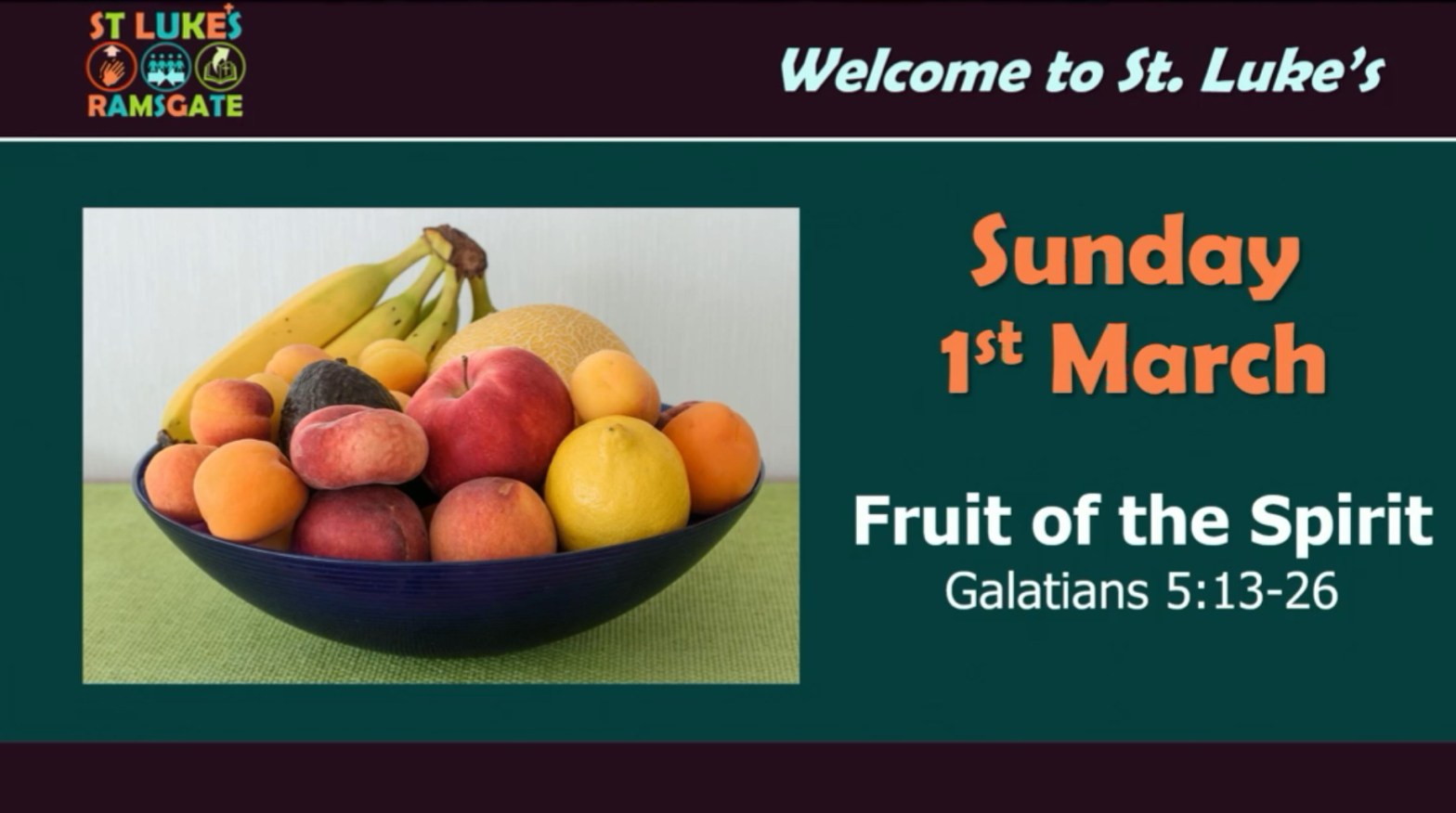
“Since we live by the Spirit, let us keep in step with the Spirit.” (Galatians 5:25)
Last week, we looked at the two humanities on offer. The one rooted in Adam’s disobedience to God in the Garden of Eden and the other rooted in Christ’s obedience to God in the Garden of Gethsemane as he expressed his willingness to die on the cross as a sacrifice for our sins. We now have the option of continuing to live simply in the old way as a descendant of Adam and his disobedience, or by faith in Christ as those reconciled to God and assured of his forgiveness.
Join us this Sunday as we introduce our new series on the Fruit of the Spirit.
Two Humanities in our Lives
Last week we were looking at Romans 5, and how two key moments in history defined two possible ways of being human:
Adam’s disobedience in the Garden of Eden
and
Jesus’ obedience expressed in the Garden of Gethsemane, that led to his willing sacrifice on the cross.
We all inherit Adam’s disobedient humanity, through our natural birth, but we can become part of Jesus’ true humanity through being born again by faith in him.
In Galatians 5, Paul uses two different terms to talk about how these two humanities are expressed in our lives as Christians today.
‘The Flesh’ stands for what we are by natural birth. It is the disobedient attitude that we inherit from Adam, our natural tendency to say, ‘No!’ to God’s will and live for our own self-interest.
‘The Spirit’ stands for what we are by new birth, because when we put our faith in Jesus, we received the Holy Spirit in our lives. This is expressed powerfully in the Confirmation service, when the Bishop prays for each of the candidates that they will receive the Holy Spirit.
Paul is clear that these two humanities are ultimately incompatible:
“For the sinful nature desires what is contrary to the Spirit, and the Spirit what is contrary to the sinful nature. They are in conflict with each other, so that you do not do what you want.” (Galatians 5:17)
As Christians we have this constant struggle, between the flesh or the humanity we inherit from Adam and the Spirit that we receive when we put our faith in the new humanity of Christ. It is an inner war, which we all experience, but the encouragement is to lean into the Spirit and reject the flesh.
This all may sound a bit abstract, but Paul makes it concrete with two lists, ‘the works of the flesh’ and ‘the fruit of the Spirit’.
The Works of the Flesh
Not a complete list
Let’s start with the works of the flesh. The first thing to say, that this is not a complete list of all possible vices, that arise out of the flesh. In a similar list, a Jewish philosopher called, Philo, who wrote a little before the New Testament had 140 examples. This is just an example list, a taster.
Neither is Paul saying that everyone who lives according to the flesh does all of these ‘works’. Most of us can probably see that we have been caught up in a few of these works or attitudes in the past, not everyone will have been guilty of all.
Remarkably Contemporary
Secondly, this list is remarkably contemporary, with perhaps the exception of ‘idolatry’ which is usually not expressed in the same way as it was in the first century Graeco-Roman culture. Otherwise, these are all actions and attitudes that are common today. Indeed, when I’ve talked about this passage when doing baptism preparation, it is a passage that people find quite easy to relate to!
There are 15 different actions and attitudes listed, and although it is not easy to put them into groups, the following four groups is a reasonable way to categorise them.
- Sexual (3)
The first three are all to do with sexual sins.
It is notable, that a lot of our modern culture appeals to our sexual appetites, with sexualised images used to sell us things or distract us on social media and pornography awash on the internet.
- Replacing God (2)
The second two are to do with replacing the true God with counterfeits. In Paul’s day this meant worshipping idols, that was going to temples with statues of made-up divinities to worship. In our day, God is replaced most frequently with an advertising industry that sells us a vision of life being satisfied by material possessions and exciting experiences rather than a deep relationship with God.
The Greek word for witchchraft or sorcery is pharmakeia, which is where we get our word, ‘Pharmacy’ from. The sorcery of Paul’s day was often accompanied with drug taking to try and simulate a spiritual experience. Once again, today, many people replace God with drugs.
- Self over Community (8)
Perhaps, sex and drugs is what you would expect from a Christian list of vices. But the majority of the list is taken up with attitudes and actions that are about concern for self and damaging to the rest of the community.
Again, these feel incredibly contemporary. Social media tends to appeal to some of these attitudes, perhaps particularly hatred and factions, where people are fed only the thoughts and ideas of people like them and the more outrageous and hateful posts tend to gain the most interest. The result is people increasingly aligning with one group against another, which they hate. So, community is increasingly divided and angry.
It can be seen from the context, that Paul is concerned to discourage behaviours that tend to destroy the sense of community in the church:
“If you keep on biting and devouring each other, watch out or you will be destroyed by each other.” (Galatians 5:15)
“Let us not become conceited, provoking and envying each other.” (Galatians 5:26)
Our vision to ‘dare to share’ is a challenge to work towards cohesion within and across our church communities. Not to fall into the ways of the flesh, that will created hatred and factions within and between church communities, but to work towards mutual understanding and concern for each other.
- Drunkenness (2)
The final two in the list are to do with excessive drinking or wild partying. It is making oneself out of control through drink. A great contrast to the self-control that is one of the characteristics of the fruit of the Spirit.
Works of the Law
The phrase, ‘works of the flesh’, echoes a phrase Paul has used earlier in the letter of Galatians: “works of the Law”. This is deliberate.
Paul links self-centred immoral behaviour, with a religion that focuses on human achievement and self-identification through following legal or religious regulations. Such behaviour leads not to true righteousness, but a kind of self-righteousness that can express itself in hatred, discord, factions and selfish ambition.
In contrast, Paul says, that as Christians we are not about following the Law in that way.
In particular, he says:
“But if you are led by the Spirit, you are not under law.” (Galatians 5:18)
There is a fleshly way of following the law, that leads to self-righteousness, and there is being led by the Spirit, which produces the kind of character, which naturally lives according to the Law. Paul calls this character, ‘the fruit of the Spirit.’
The Fruit of the Spirit
So, why does Paul use the term “fruit” rather than saying the works of the Spirit?
Holistic Character Formation
Primarily, because this is about a holistic character formation, rather than specific actions or attitudes. Notice the word, ‘fruit’ here is singular. These are characteristics that describe one fruit not lots of different types of fruit.
So, for example, we might describe a banana as yellow, bendy, with a tough skin and soft innards. A banana needs all of those qualities to make it a banana. If it is yellow and bendy, with a tough skin, but without soft innards, it is not a banana.
In the same way this list of nine qualities or virtues, are all necessary for the character being described to be truly the fruit of the Spirit.
Most non-Christians will have some of these qualities, but when the Spirit gets to work in us, we will develop all of these qualities in increasing measure.
Gradual, Inevitable Growth
But it does not happen overnight. We may become Christians overnight and therefore enter immediately into a new relationship with God, knowing we are completely forgiven and filled with his Spirit. We become part of the new humanity Christ brought in.
But just as it is often hard to tell when looking at a tree what kind of tree it is, it becomes obvious as time goes by, because the fruit will gradually and inevitably grow and so you can tell whether it is an apple tree or a plum tree or an oak or a sycamore.
Love Centred, Other Focussed
Finally, it is worth noticing that ‘love’ comes first in the list. It has priority, and compared with other lists of virtues in the world of Paul’s day, ‘love’ is distinctively seen in Christian lists.
Why is it so important? Because love, the concern for others as much as for ourselves is the true fulfilment of the Law. When we follow the Law for religious achievement or identity, as some were encouraging Paul’s original readers to do or we use Christianity as a badge for our own ideologies or political outlooks, then we are not showing love, we are ultimately being selfish and denying the heart of the law. When, however, we live by the Spirit, and the quality of love grows in our lives, we truly fulfil the Law:
“The entire law is summed up in a single command: “Love your neighbour as yourself.”” (Galatians 5:14)
I am not going to look at the rest of the list in detail now. This is actually an introduction to a sermon series. Over nine sermons, spread out over the next few months, we are going to look at each of these qualities that describe the Fruit of the Spirit, so that we can truly grow this fruit more and more in our lives and community.
How to Live
But, how can we grow the fruit in our lives. Verses 24 and 25 help us. Remember Paul, has said that within us as Christians is a battle between the flesh and the Spirit, between our old humanity inherited from Adam, and our new humanity that we have through faith in Christ.
So, how do we interact with this battle?
See the Flesh as Crucified
Firstly, we need to see our flesh as crucified:
“Those who belong to Christ Jesus have crucified the sinful nature with its passions and desires.” (Galatians 5:24)
Notice, that ‘crucified’ is in the past tense, it has already happened. When we accept that Jesus died for our sins on the cross, we are putting our own fleshly life which we inherit from Adam on the cross.
Crucifixion in the ancient world was not just designed to inflict a torturous death, it was designed to humiliate the victim, to destroy their dignity in the sight of all those watching. In Jesus’ crucifixion, we see Jesus dying for the sins that arise out of our fleshly desires. In this way we see the true horror of what our flesh results in. The cross of Jesus humiliates and shames the sinful nature. We are meant to think, if that is what the flesh does, to our saviour, then how can I follow the desires of my flesh any more.
So, the first step towards the fruit of the Spirit, is to see the true horror of the flesh within us. So, that we may naturally reject it more and more, when it seeks to influence the way we live.
Walk in step with the Spirit
The second thing we are to do is to keep in step with the Spirit:
“Since we live by the Spirit, let us keep in step with the Spirit.” (Galatians 5:25)
On Strictly come dancing, celebrities who are most amateur dancers are paired with professional dancers. To start with they can’t dance well at all, but as they practice with the professionals, they learn to follow the steps of the professional, and gradually they look increasingly impressive as dancers in their own right.
The Holy Spirit is God and shares the qualities of God. The more we seek to live in the way the Spirit lives, the more we will grow in the fruit of the Spirit, imitating the virtuous qualities of God and Jesus themselves.
There will be some steps that come more naturally to some than others. One person may already be naturally gentle, but not very self-disciplined, by walking in step with the Spirit, their self-discipline will continue, another may be joyous, but not patient, by walking in step with the Spirit they will become more patient.
So, as we set out on this journey of exploring the Fruit of the Spirit together, let’s pray for God’s help to see our flesh as crucified in Christ and our lives increasingly walking in step with the Holy Spirit.
This is not Cultural Christianity, this is transformational Christianity.
 St. George's Church Ramsgate