“I wait for the Lord, my soul waits, and in his word I put my hope.” (Psalm 130:5)
How do we keep going through dark times? Wait on God.
As recorded at St. Luke’s
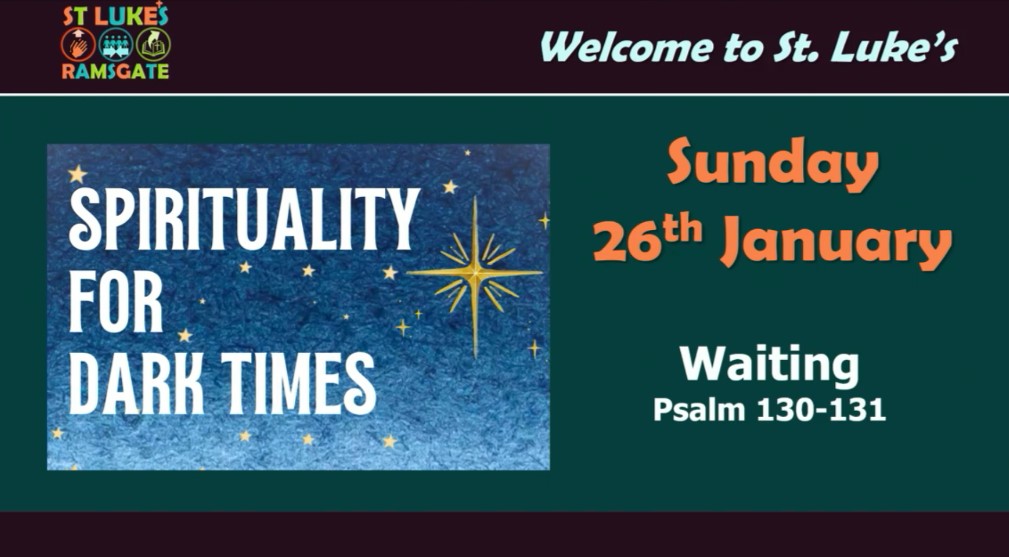
Psalms 130 and 131
St Luke’s, Ramsgate 26 January 2025
In the Book of Psalms there are fifteen so-called ‘songs of ascent’, and it is believed that these would have been sung by pilgrims walking to Jerusalem for one or other of the feasts of the Tabernacles, Passover, Pentecost. In our Bibles they are numbered 120 through to 134, and this morning we have heard Psalms 130 and 131 being read. As psalms go, all of them are relatively short, so the words would have been fairly easy for people walking along to remember. No-one knows what tunes they were set to, but if we were to imagine marching tunes, or tunes that have a definite beat, and a brisk walking pace, we probably wouldn’t be far off. Maybe something along the lines of the tune of the Proclaimers’ ‘I would walk 500 miles, and I would walk 500 more, just to be the man who walked a thousand miles to fall down at your door’.
Twenty-five years ago, there was another song by the Proclaimers that was less widely known, but was even more like a song of ascent. The beginning of it went like this: ‘I’m on my way from misery to happiness today, aha, aha, aha, aha’. As well as being a bit of an ear-worm – once you’ve heard it, it goes round and around and gets into your brain – this lyric is so characteristic of a song of ascent that we can actually use these words as a framework to explore the four things that Psalm 130 offers by way of a spirituality for dark times (which overlap with a couple of things that are offered by Psalm 131).
Let’s start with the first three verses of Psalm 130, and with that phrase ‘from misery’. Right at the outset, this psalm strikes a note of heartfelt anguish that will resonate with anyone who has ever battled anxiety or depression. ‘Out of the depths, I cry to you, O Lord.’ It is not that the psalmist feels sad, or unhappy. Instead, it is as if they are falling helplessly down a bottomless pit, unable to feel anything at all, unable to rescue themselves. ‘O Lord, hear my voice’, the Psalmist cries in verse 2, not certain as to whether anyone sees or hears or cares about their plight: ‘let your ears be attentive to my cry for mercy’. In short, these words all emerge from a deep and abiding misery.
Many other psalms strike a similar note, which is why we are in the middle of a series of sermons on Psalms that offer a spirituality for dark times. Some years ago, there was even a book of sermons by Martin Lloyd-Jones on Psalm 73 titled Spiritual Depression, which I am sure must still be in print and easily available to buy, and is well worth a read. The Psalms do not offer religious platitudes in the face of the range of human experience. They are far too realistic, and authentic, for that.
‘Out of the depths I cry to you, O Lord.’ Psalm 130 starts with misery, and it is a misery of a very particular kind, a misery that we hardly dare to admit to ourselves, let along to those around us, for fear we discover that there is no remedy to be found. It is the misery of wrongdoing, it is the misery of guilt, it is the misery of sin. “If you, O Lord, kept a record of sins, O Lord, who could stand?”
I should add that our sin is not the only possible source of misery. In life, we are assaulted by the world and the devil, through no fault of our own, as well as by our own flesh. But the psalmist speaks of the misery of sin specifically, and today that is what we are considering.
We live in a therapeutic age, in which guilt is believed to be always unhealthy and psychologically damaging, and indeed there is such a thing as false guilt, whereby we feel guilty for things that are not our fault. However, there are also such things as sin and wrongdoing, of which we are all guilty in some way and to some degree regardless of our feelings in the matter. In another age, this prompted the authors of the Book of Common Prayer to write that “we have left undone those things which we ought to have done, and we have done those things which we ought not to have done, and there is no health in us. But thou, O Lord, have mercy upon us miserable offenders”.
Modern prayer books have quietly dropped talk of us being miserable offenders, with no health in us. Having lost the misery, we are in danger of losing the realism and the authenticity of calling a spade a spade. We are in danger of thinking that we’re not so bad really, that the wrong we have done doesn’t amount to much when everything is said and done, and that it is far outweighed by all our good deeds – that in our case anyway, “the ‘nice’ column is longer than the ‘naughty’ column”, and that as a result we are basically ‘good people’.1 In short, we are in danger of deluding ourselves about our position before God, by thinking that we are “justified in his sight by the works of the law” (Romans 3:20).
Misery, and utter dependence on God for mercy, is the Psalmist’s clear-sighted starting point, and misery is a better starting point than self-deception for all those who know themselves to have offended against God’s holy law. “Through the law we become conscious of sin”, as Paul teaches in his letter to the Romans.
Misery may be the starting point, but it is not the end point in this song of ascent, which moves on from misery to happiness – on from a particularly motivated misery to a particularly motivated happiness. “Happy are those whose transgressions are forgiven, whose sins are covered”, we read in Psalm 32. And here in Psalm 130, we read in verse 4, “but with you, Lord, there is forgiveness, therefore you are to be feared”. The Lord does not, in fact, keep a record of sins. Instead, he keeps a record of names in his Book of Life, and life came to the world through Jesus Christ. The grace of God “is grounded not only in a heart of love but in its disclosure through the death [and resurrection] of Jesus as the basis of deliverance”.2 It turns out there is a remedy. “With you, Lord, there is forgiveness, therefore – our text says – you are to be feared.”
“The forgiveness of sins does not leave us with a [shallow and] cheerful, domestic idea of God. Rather, it calls forth from us a new respect for the humanly incomprehensible majesty and greatness of the God who can redeem humanity from so grave a predicament. … If we can only begin to understand what is meant here by the fear of the Lord”, according to the American preacher Fleming Rutledge, “we will understand the one thing we really need to know in life and death. The fear of the Lord is the beginning of wisdom, as the Psalms and Proverbs repeatedly say … The fear of the Lord arises out of the discovery that he is a God of infinite mercy and compassion …The fear of the Lord is a very different thing”, she says, from the fear of any other person. And true happiness is a different thing from mere jollity or cheerfulness.
Properly understood, the fear of the Lord is happiness, because it liberates us from living in fear of any other person. “I want you to know tonight that we as a people will get to the Promised Land”, Martin Luther King to his congregation in the midst of the civil rights struggle, actually on the night before he died. “So I’m happy tonight. I’m not worried about anything; I’m not fearing any man. Mine eyes have seen the glory of the coming of the Lord.” Or, as the apostle Paul puts it, “there is now no condemnation for those who are in Christ Jesus” (Romans 8:1). Happy are those whose transgressions are forgiven, whose sins are covered. “With the Lord [there is] unfailing love, and with him is full redemption” (Psalm 130:7).
At the time the Psalmist wrote, of course, the fullness of this redemption lay in the future. The Lord himself “will redeem Israel from all their sins”, it is written, not that he had done so already. The law came through Moses, the New Testament tells us, but grace and truth came through Jesus Christ. Not only so, but we whose hope is in Christ are still on our way from misery to happiness. There remains a future, unachieved aspect to the bliss we are promised. We are not yet entirely free from the misery of sin; we have not completely entered into un-attenuated joy. And this will always be the case, for so long as we remain in this life. We, together with all creation, long to be liberated one day from our bondage to decay, and eagerly await the glorious freedom of the children of God (Romans 8:21). We are still on our way from misery to happiness.
In this time of waiting, what we need is patience, accompanied by eager anticipation. “I wait for the Lord, my soul waits”, says Psalm 130, verses 5 and 6. “My soul waits for the Lord more than [night]watchmen wait for the morning, more than watchmen wait for the morning”. There is patient confidence in this waiting, that the Lord will surely come, just as morning follows night. That same confidence is to be found in Psalm 131, verse 2: “I have stilled and quieted my soul, like a weaned child with its mother”. Yet there is also urgent expectation: “My soul waits for the Lord more than watchmen wait for the morning”.
This waiting is not resigned or complacent, as if we weren’t sure, or didn’t care, whether the Lord would ever show up. Yet neither is it anxious, as if we thought all would be lost if he didn’t show up within our preferred timescale. This kind of waiting is an essential building block of a spirituality for dark times, and it is founded not on our exceptionally well developed skills in waiting, but on the certain knowledge, and the childlike trust, we can have in relation to a God who is not slow in keeping his promise. It is not always easy. In dark times, sometimes all we are able do is to hang on with our fingernails, wait upon God’s timing – whatever we may think of it – and to do so both patiently, and urgently. To call on him ‘out of the depths’, as the Psalmist does, is at one and the same time a cry of despair, and an expression of confidence. “The way out of the depths begins in the possibility of prayer and the awareness that only the One who hears that prayer can draw us out.”3
So our happiness at knowing that our sins are forgiven is a mode of trusting in God to take care of the past. Our eager waiting to be adopted as God’s children, and the redemption of our bodies (cf. Romans 8:23), is a mode of trusting in God to take care of the future. But in the light of this, in the space between the ‘now’ and the ‘not yet’, what remains for us to do today? The answer that Psalm 130 gives, is the same as that given by Psalm 131. Both psalms contain only one imperative phrase – in other words, there is only one thing the psalms actually tell us to do – and it is the same in both psalms. Psalm 130 verse 7 reads: ‘O Israel, put your hope in the Lord, for with the Lord is unfailing love’. Psalm 131 verse 3 reads: ‘O Israel, put your hope in the Lord, both now and forevermore’. The catchy refrain to these songs of ascent, the ear-worm lyric to both of them is ‘O Israel, put your hope in the Lord’. That is what we are invited to do today while we wait for the future to unfold – not just to hang around passively, looking to see what will happen, but to actively put our hope in him, to deliberately place all our eggs into one basket. This is, in fact, the only spirituality offered in the Bible for dark times, and the only spirituality that will do us any good in the final analysis – to put our hope in the Lord, today, every day, and forevermore.
Doing this involves giving up hope in our own mortal powers as independent agents, capable of forgiving ourselves, picking ourselves up and dusting ourselves down, trying harder to do better, succeeding where previously we’ve failed, pulling ourselves up by our bootstraps, pretending that we are self-made people. That would be a form of idolatry.
Doing this also involves relinquishing hope in the powers of other mortal agents, depending entirely and ultimately on friends, family members, or loved ones to pull us through when times get tough. That too would be a form of idolatry. Whoever or whatever we actually rely on to bring us out of the depths of despair, that is our God right there.
Yet there is only one God who has the power to rescue us from our miserable, mortal human condition, and bring us to true and lasting happiness. God is whoever brought the Israelites out of slavery, and out of the land of Egypt. God is whoever raised Jesus Christ from the dead, as the first-fruits of all who have died. And in Christ, and in the power of the Holy Spirit, God helps those who are unable to help themselves.
So today if we hear his voice, let’s not harden our hearts, as our forebears did. As long as it is called today, let us fix all our hope on him; and by the grace of God we will do the same tomorrow. We continue to be a work in progress. We have not yet arrived at perfection. We are still on our way from misery to happiness today. Let’s not mind about any of that. Let us never pretend that it isn’t so. Songs of ascent, which start in the depths of our need, are perfectly appropriate on our lips. Here is the core of our spirituality for dark times: to trust the God and Father of our Lord Jesus Christ to make up for all that we lack today, to forgive us our sins, to give us patient endurance, and to place and keep us on the right path, even when we cannot see the way ahead. And in him we will never be disappointed.
1 Cf. Fleming Rutledge, And God Spoke to Abraham, p. 191.
2 Leslie C. Allen, Psalms 101-150, p. 196.
3 Patrick Miller, Interpreting the Psalms, p. 140.
 St. George's Church Ramsgate
Hi there,
I’d like to try and get involved with the Tuesday shelter kitchen?
Please can you tell me who to contact?
Thanks
Joanna
Sent from my iPhone
LikeLiked by 1 person
Hi Joanna,
Drop in to the meal on a Tuesday night, there will be someone there who can help you, it opens at 5:30. During the week the Social Enterprise Kitchen is open each day from 10:30am to 4pm, I’m sure somebody will be able to help you too.
Many thanks for considering this!
LikeLike
Thanks
Sent from my iPhone
LikeLike