“Jesus said, ‘Truly I tell you, unless you change and become like little children, you will never enter the kingdom of heaven.'” (Matthew 18:3)
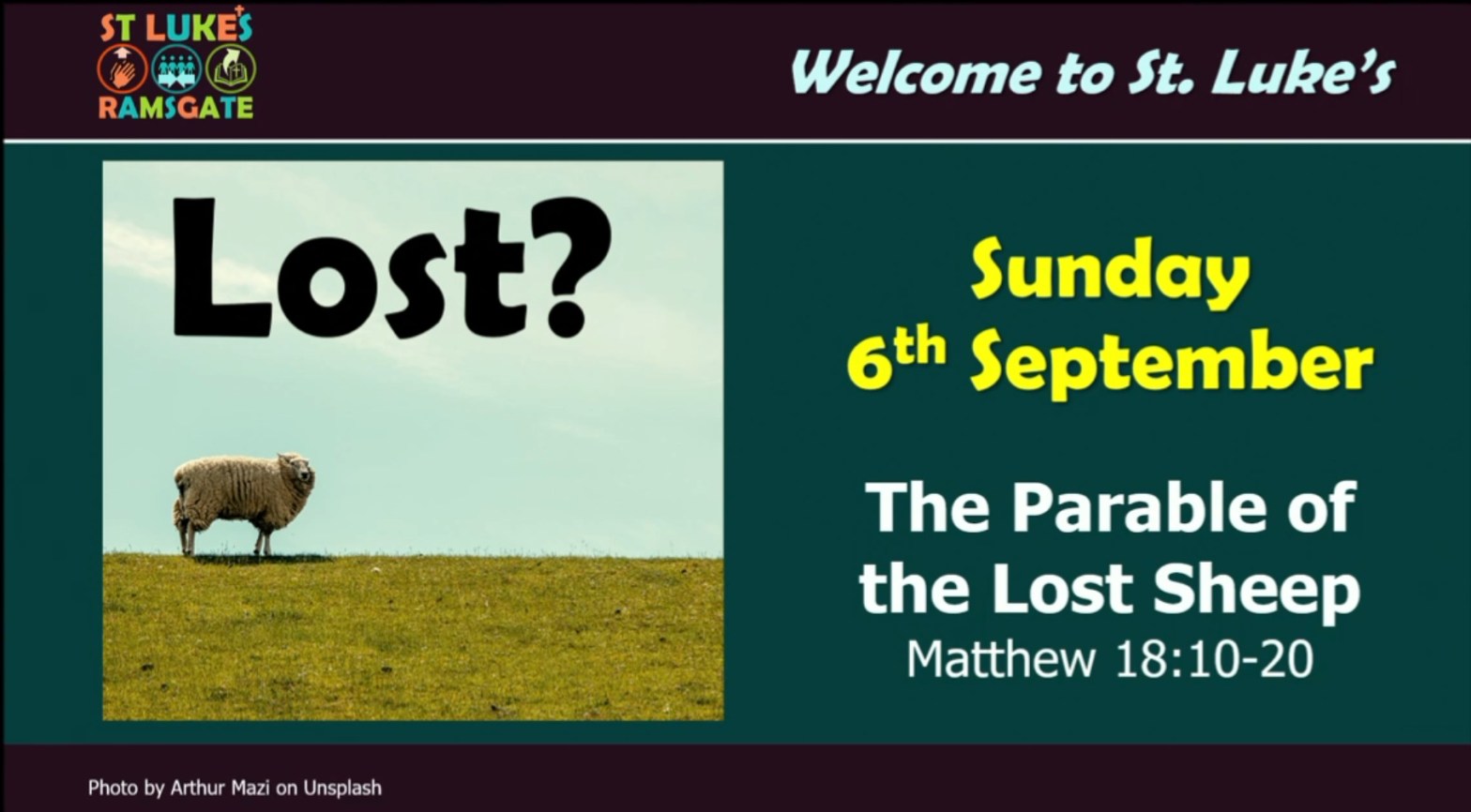
The theme for our service is ‘The Parable of the Lost Sheep’ as we begin a series looking at some of the stories Jesus told from Matthew’s gospel.
Due to technical issues video and audio of the sermon are not available but sermon text is below.
The Parable of the Lost Sheep (Matthew 18:10-14)
How do you react when you discover you have lost something?
How do you react when you discover you have lost something?
If you lose a sock, then you probably shrug your shoulders and probably don’t care much.
If you lose a shoe, then you would probably search much harder. When I was at university I went to a summer ball and there was a bouncy castle. I took off my new shoes to go on the bouncy castle, when I came off, I put some shoes back on, but it turned out they weren’t my shoes. I tried going round to see if someone else had my shoes, but to no avail they were lost. Disappointing and frustrating, but not disastrous!
If you lose your car, then you would probably be really upset. I once parked my car and popped into some shops. When I came back about 15 minutes later, the car had gone! It was devastating, had it been stolen or what? So, I asked around and discovered that it had been towed away! I had to catch a bus to the compound and pay a release fee to have my car back. A lot more hassle than I would go through for a sock.
If you lose a child, then you would be really upset. Some of you may remember moments when you have lost a child and the feelings of deep worry and upset that it can cause. Of course, if a child goes missing, nothing else matters, finding your offspring becomes the only thing you focus on no matter how much time or effort it takes.
How do you react when you discover you have lost something? It depends. It depends how much the thing you have lost matters to you.
You matter to God!
Part of the point of what Jesus is saying in today’s reading is how much you matter to God.
Little Ones – vs. 1-9
The key point is what Jesus says in verse 14:
“In the same way your Father in heaven is not willing that any of these little ones should be lost.” (Matthew 18:14)
Just as you would not be willing to lose a car or a child, God is not willing to lose any of the ‘little ones’. But what does he mean by ‘Little Ones’?
The Parable of the Lost Sheep is part of a continuous section of teaching Jesus gives to his disciples that runs through the whole of chapter 18 and it all begins with a little child. Jesus places a little child among them and says,
“I tell you the truth, unless you change and become like little children, you will never enter the kingdom of heaven. Therefore, whoever humbles himself like this child is the greatest in the kingdom of heaven.” (Matthew 18:3-4)
When he talks of becoming like ‘little children’, he means we need to learn afresh to stop relying on our own abilities, achievements, possessions or reputations. We need to come to God with nothing to offer him and accept that he loves us anyway. We need to become a ‘little one.’ This is the only way we can become part of the Kingdom of Heaven.
If we try and claim a place in God’s Kingdom, through our abilities, achievements, possessions or reputations, then we end up disqualifying ourself, because we have put ourself above God, turning in his generous gift into a service that we have paid for like a master paying a servant.
To be a Christian is to become a ‘little one.’ And so whoever we are, no matter how much ability we have, how much we have achieved, no matter how many possessions we have or whatever kind of reputation we have, we still matter to God as one of the little ones.
And much of the rest of what Jesus says, stresses how much we matter to God.
Millstones
Jesus goes on firstly, to talk about how angry God will be at those who cause his little ones to turn away from him in sin. It is a strong warning:
“But if anyone causes one of these little ones who believe in me to sin, it would be better for him to have a large millstone hung around his neck and to be drowned in the depths of the sea.” (Matthew 18:6)
The amount of anger we have about someone being hurt, shows how much the person being hurt matters to us. As a parent if someone hurts your child, you would be rightly furious with them and they should be scared of you. Your child matters to you and you will want to protect them.
Jesus’ point about millstones and being thrown into the sea is about how seriously God will be angry with those who hurt us who belong to him. If someone tries to cause you to fall away from him, then they are in line for hell. That is how much you matter to Him.
Angels – vs. 10
Secondly, Jesus talks about angels. In verse 10 he says:
“For I tell you that their angels in heaven always see the face of my Father in heaven.” (Matthew 18:10)
Now, this idea of each of us having an angel only appears a couple of times in the Bible and this is one of them. The other time is even vaguer! So, what is Jesus saying here?
In Daniel it speaks of angels representing nations and in Revelation it speaks of angels representing churches. But here, it suggests that each ‘little one’ has a representative angel.
More than that our angels see the face of God. That is an incredible privilege. The Bible consistently says that no man can look on the face of God and in the great vision of heaven in Isaiah, the Seraphim or angels cover their faces before God. The angel that represents you, however, sees the face of God. They have direct access to God, to speak to God on your behalf.
These days most of us are able to see on our phone who is phoning us. If it is an unknown number and you are busy, then you will probably ignore it. However, if it is someone you know, someone who is in your contacts, then you will probably answer it. They are someone who matters to you. In the same way, having an angel that sees the face of God, means we are in God’s close family contacts. We matter to him.
Shepherd – vs. 12-13
Thirdly, Jesus tells the story of the Shepherd searching for the sheep who has wandered off. This story is also told in Luke 15:3-7. In both versions of the story, there is:
- A certain man
- 100 sheep
- 1 is lost
- then it is found
- and there is rejoicing over the fact.
However, the context and the way the stories are told is very different. In Luke the application is to the lost sinner repenting and turning back to God, but here it is to the disciple who strays and is brought back to the fold.
In both, though the point is how much the lost sheep matters to the shepherd. The one that has wandered off becomes the all-embracing focus, whilst the other 99 are almost forgotten about. They are safe, but the shepherd does not want to permanently lose the one that has wandered off and is in danger of being eaten by wild animals or falling into a pit. So, he goes off seeking the one sheep until he is found.
The sovereign God isn’t happy to say ‘well, we’ve still got ninety-nine, let’s not worry about the odd silly one that drifts away from the flock – probably not worth much anyway.” No, for a shepherd every sheep matters, every one is valuable, he cannot afford to lose any of them.
So Jesus concludes:
“”In the same way your Father in heaven is not willing that any of these little ones should be lost.” (Matthew 18:14)
All these points work together to show how much we as ‘little ones’ matter to God. You need to know that. These days psychology will tell us that children who are brought up in loving homes have a much greater chance at a flourishing and good life, because they have a strong grounding knowing that they matter to their parents, that they are deeply loved. Without that grounding people struggle in all kinds of ways.
But as Christians, whether we were brought up in a loving home or not, we know we matter, not because of our parents attitude to us, but because the God who created the universe and rules over all loves us more deeply than we can imagine. You need to know that you matter, because you matter to God!
How much do you care for God’s other children?
But, if you know how much you matter to God, do you know how much other Christians, other little ones matter to God?
We like to know God loves us. But do we think enough about the fact that God loves our fellow disciples!
The function of this teaching from Jesus is not fundamentally to show us how much we matter to God, but what flows from that. It is to show how much other Christians and their place as God’s children should matter to us too. Because every little one is so important to the Father, the way we act towards any one of them is extremely important in God’s sight.
Welcoming not Despising – vs. 5-10
So, firstly, if we realise how much other Christians matter to God, how valuable that are then we will want to welcome them and not despise them.
This is what Jesus says explicitly:
“And whoever welcomes a little child like this in my name welcomes me.” (Matthew 18:5)
“Take care that you do not despise one of these little ones;” (Matthew 18:10)
Indeed, to despise other Christians, to treat them as though they do not matter or aren’t worth anything for whatever reason, may be the thing that causes them to stumble, the thing Jesus says in verse 6 to 9, that you want to avoid doing at all costs.
So, we need to be pro-active at welcoming all into our churches, because every person who comes is a ‘little one’ or potentially a ‘little one’ whom God values deeply. We need to find ways to show that they matter to us, that we want them to be a part of us, that we care for them. And this needs to be a whole community activity. If some are welcoming, whilst others ignore them or worse, then they will not feel welcomed. This has to be a deeply embedded part of our culture and we need to work hard to keep it as a deeply embedded part of who we are.
And we need to ask ourselves honestly, are there some Christians that we despise or look down on? Maybe because we feel they might be encroaching on what belongs to us, or not following the traditions of our church, or because they do not dress in a certain way or speak in a certain way. We need to be honest about our own prejudices and pray that God will help us to be truly welcoming to all and not despise them. Why? Because each one matters to God, and we should be afraid of causing what belongs to God to be lost.
On top of all that, as it makes clear in verse 15 onwards, we need to do what we can to help bring back those who like the wandering sheep have wandered off into sin. Why? Because they matter to God too.
I matter, You matter, they matter
The point of this teaching from Jesus is to say how valuable every Christian is to God. We are not God’s socks, we are his children we matter. The more we understand that for ourselves, the more we also need to understand that other Christians also matter and so we need to welcome and not despise them and seek to bring wanderers back to God.
Sermon am: Matthew 18:10-14 (2,160 words)
Aim: To have a real concern for that others are not lost to their faith.
Changing Church
2020 has seen probably the biggest changes to the way we engage with church in a lifetime. Of course we hope that many of these changes will not be permanent, whilst others we hope may well continue beyond the present crisis and no doubt the church will come out of all this different in some way.
But as we make changes to church life for whatever reason it is perhaps more important than ever that we are clear about the fundamentals of what our church life is all about.
In Matthew 18 Jesus is teaching his disciples how they are to relate to other disciples. How they are to live in Christian community.
As we saw last week, the teaching stems from a question about who is the greatest in the Kingdom of Heaven. Jesus challenges this desire to be greater than others as a big danger for the life of the church and its members.
Now he moves on to emphasise that every disciple matters to God and so every disciple should matter to every other disciple.
Two Pictures: One Point – Every Disciple Matters to God
Jesus makes the point using two powerful pictures, which help us to see how God sees the ‘little ones’, Jesus word to describe disciples, those who come humbly to God like little children.
Their Angels in Heaven
The first picture Jesus gives us is a glimpse into the throne room of heaven. There he says the angels that represent each individual disciple are in God’s presence and see God’s face.
When I was at university, I knew someone whose dad was a cabinet minister at the time. His dad, would have regularly sat in the cabinet room at 10 Downing Street with Margaret Thatcher. He was only one step away from personally influencing the most powerful person in the country.
What Jesus says here about every disciple is infinitely more impressive than that!! Why? Not only are the angels more closely connected with their individual disciple, but this is God’s throne room – God is infinitely more powerful and vastly more awesome than any Prime Minister, President, King or Queen.
And actually we can easily miss an important fact in this picture.
When Isaiah had his great vision of God in the temple. In the vision were amazing angels – seraphim flying around God Himself. They called out:
“Holy, holy, holy is the LORD God Almighty;
the whole earth is full of his glory!”
And the sound of their voices made the whole building shake!
But, there is another key fact about these Seraphim: they covered their faces with two of their wings. Great, mighty and awesome as these seraphim were, they did not dare to look on the face of God!!
But what does Jesus say about the angels of ‘the little ones’?
They always see the face of my Father in Heaven!!
In other words the angels of the little ones of every individual disciple and especially every insignificant seeming disciple of Christ have an access to God that is of the highest rank for angels!!
That is how much every disciple matters to God.
The Lost Sheep
The second picture that Jesus gives is the more familiar story of the Lost Sheep.
Comparison with other Lost Sheep Parable
Now, we need to be careful here. This Parable or story of Jesus appears twice in the Gospels. Once in Matthew and once in Luke. We must be careful not to assume they are both making the same point.
There are big similarities between the stories:
Both involve a certain man and 100 sheep. 1 sheep is lost and then found by his owner who rejoices when he finds him.
The basic story is the same, but there are some important differences between Luke’s version and Matthew’s version suggesting a slightly different point is being made by each.
In Luke Jesus is addressing the Pharisees, who are criticising him for hanging out with sinners.
In Matthew Jesus is addressing the disciples in a block of teaching about how to relate to other disciples.
In Luke, therefore, the context shows the sheep represents ‘the lost’, ‘the sinners,’ those outside the community of faith, being brought in by God. It is Jesus’s way of justifying his evangelism of sinners. As Jesus says elsewhere in Luke:
“For the Son of Man came to seek and to save what was lost.” (Luke 19:10)
In Matthew, however, the context shows the sheep represents a disciple who is in the process of wandering off from the Christian community and faith in God.
In Luke the Parable is about evangelism, in Matthew it is about Pastoral Care. Both are about people mattering to God, even though they might not seem to matter to others!
Every Disciple Matters
And in the story Jesus tells, the sheep that wanders off becomes the total focus and energy of his owner. He is the one that matters more than all other 99 sheep, that are still safely in the flock on the mountain.
Why? Because he is worried about this sheep being permanently lost. For the shepherd, each sheep matters as a financial asset, to lose one would be serious. One that wanders off becomes an easy prey to wolves and if that happens, then the sheep is lost forever.
So, the shepherd forgets about the other 99 and throws everything into finding the one and Jesus says, when he finds that one, he is happier about having that one, than about the other ninety-nine. The one is immensely valuable to the Shepherd.
Jesus makes the point of the story abundantly clear in verse 14: God does not want to lose any of the little ones. He does not want them to wander away from faith in him, from salvation. He does not want them to perish.
And Jesus tells the disciples this, because he wants them to have the same attitude. If every disciple matters to their Father in Heaven, no matter how insignificant, confused or misled, they should matter to them as well. If God does not want any of them to perish, we too should be about helping every disciple to remain in the faith.
Now next week we will see that sadly, people do get to a point where they have rejected the church so much that we have to treat them as permanently lost. And I can think of many people that have been lost to the Christian church over the years. Every time that happens it is a tragedy in God’s eyes and it should be in ours as well.
We need to work to make the church a place that values every disciple and is determined to do all it can to help those who are wandering off re-discover their place in the life of the church.
I don’t mean that we should become like a sect bullying or controlling people to make sure they don’t leave. That is not the way of Christ or the church.
Rather we need to become a church where every disciple of Christ is valued by every other disciple of Christ?
Three Ways to Respond:
Briefly I want to suggest three ways to respond. Three activities that should be the foundation of church life and remain so whatever changes covid-19 or anyone else forces on us.
Prayer
Firstly, if we are concerned and value our fellow disciples, we will want to pray for people!
We saw that every disciple’s angel sits in the heavenly courtroom.
Did you know your prayers also go into the heavenly courtroom?
In Revelation 8, part of the vision involves incense being burned on the golden altar in front of the throne of God. These represent the prayers of God’s people. The point is that every prayer comes before the face of God – he sees our requests, he reads our emails / letters! We matter to God and our prayers matter to God.
So, if we are concerned about our fellow disciples then we will want to pray for them! So, that our concern is added to God’s concern.
So who do you pray for?
As a vicar I aim to pray for every church member at least once a week – that’s a list of around 200 names! But, then I am called to be the vicar at St. Luke’s.
You probably cannot pray for 200 names each week, but could you pray for 20? Why not make a list of other Christians you know at church – perhaps especially the ones who have less friends at church and pray for them. You may not have seen them for 6 months or be able to see them at present, but you can still let God know that they matter to you by praying for them.
Care
Secondly, we need to care. To help keep people connected with the community of the church. After all part of the problem for the sheep in the story is that it had wandered off from the rest of the flock. One of the biggest dangers for disciples of Christ is that they wander off from any connection with other Christian brothers and sisters.
How do we stop that happening? First of all as it says in verse 10, we need to ensure that we are not despising or looking down on those members of our community that you might see as less important in some way.
Paul warns the church in Corinth about their services, where the wealthy were being well catered for, but the poor were being ignored:
“Don’t you have homes to eat and drink in? Or do you despise the church of God and humiliate those who have nothing? What shall I say to you? Shall I praise you for this? Certainly not!” (1 Corinthians 11:22)
If people feel looked down on or valued less than an ‘in-crowd’ then they may easily feel pushed away and wander off. Let’s work hard to make sure that does not happen.
More positively we also need to be pro-active in ensuring everyone feels a valued member of the community.
That is why at the start of lockdown we set up a phone network and we’ve kept up wishing people happy birthdays. That’s why we’ve also tried to make sure everyone has access to the service by using YouTube or sending out DVDs to those who cannot access YouTube and having regular emails or sending out letters those who do not access email!
But, as we move forward into a new phase of the present situation and as we look to the future we need to ask ourselves, how do we ensure that we show care to every disciple in our community and make sure we keep them well connected, so that they do not wander off?
Share – God’s Truth
Finally, if we value every disciple as mattering to God, then we will want to share God’s truth with them.

