This year in YI we are going to get inspiration for our bible studies from a book by Rebecca McLaughlin called: 10 questions every teen should ask (and answer) about Chrisitanity. Questions include – ‘How can I live my best life now?’, ‘Can’t we just be good without God?’, ‘Hasn’t science disproved Christianity’, ‘Why can’t we just agree that love is love?’ and 6 more.
These sessions this term are on the 15th and 22nd January and the 5th February at St. Luke’s church hall from 5-6:30, followed by games and activities from 6:30-7:30 that might appeal to other friends. Sunday 29th we will be going to Queens Road Baptist church for The Event – a joint churches in Thanet youth gathering that happens monthly.
To the church of God in Corinth, to those sanctified in Christ Jesus and called to be holy, together with all those everywhere who call on the name of our Lord Jesus Christ– their Lord and ours:
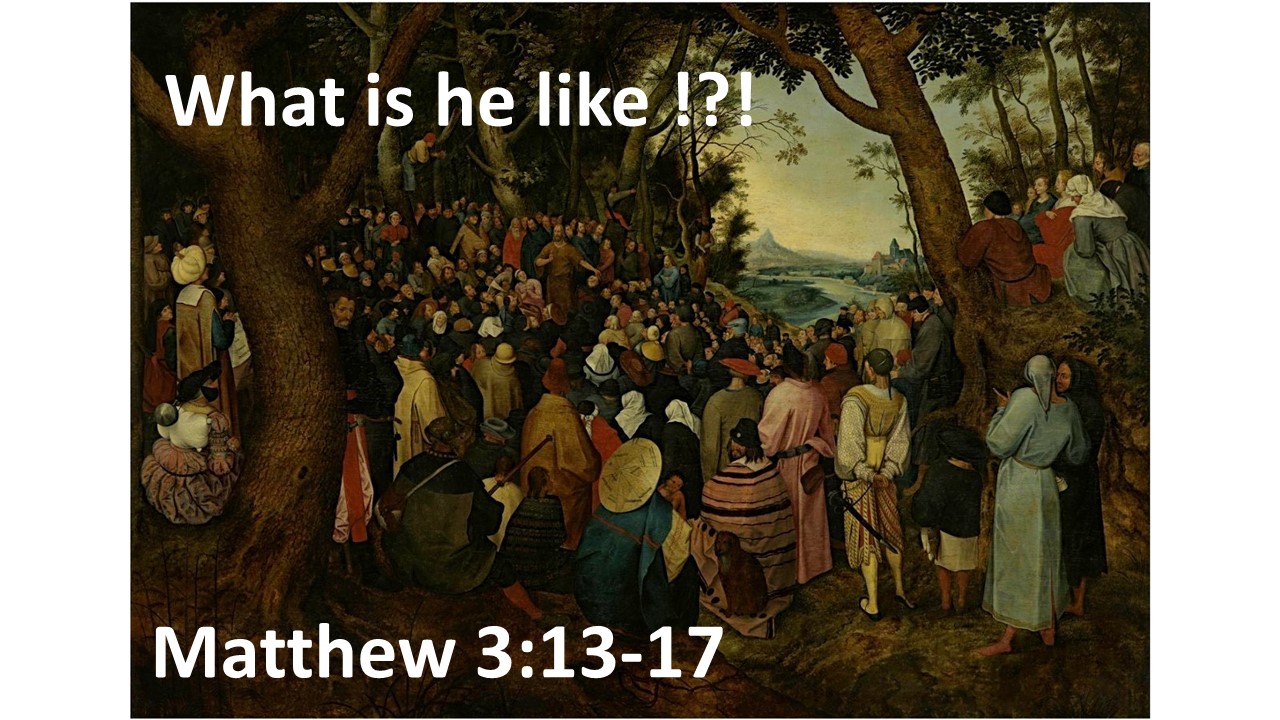
What is Jesus like? How does he stand out from the crowd? Jesus’s baptism comes at the start of his ministry, but it also shows us who Jesus really is.
A version of this sermon preached at St. Luke’s on the same day
A sermon preached at St George’s Church, Ramsgate, on Sunday 8 January 2023 by Colin Gale
On the Sunday that follows the twelve days of Christmas, there is a tradition of having one of the Gospel accounts of the baptism of Jesus read, alongside other readings that are associated with the beginning of his ministry. Then in the period between Christmas and Easter, the Bible readings in church are often designed to give a quick recap of the major events in the life of Jesus as told in one or other of the Gospels, starting at his baptism and leading through to his death, resurrection and ascension.
But there is a significance to the baptism of Jesus over and above the fact that it’s the start of a story we have likely heard many times before. The Gospel reading we have heard gives us two answers to the question, ‘What is Jesus like?’, both of which turn out to be of vital importance to us today. The first way of answering the question is this: in being baptised, Jesus shows us that he is one with us. To try to explain this, I am going to tell you a story written by Søren Kierkegaard.
“Suppose there was a king who loved a humble maiden from a peasant family … Let everyone rejoice … for love is overjoyed when it unites equals, but it is triumphant when it makes equal that which was unequal. Let the king’s love reign! But then there arose a sadness in the king’s soul. … He spoke to no-one about his sadness. Had he done so, everyone would doubtless have said, ‘Your Majesty, you are doing the girl a generous favour for which she could never thank you enough’, and that would have caused the king even more sorrow. Would the maiden ever be happy? Would she be able to forget what the king wished to forget, namely, that he was the king and she a former lowly maiden? … If the memory of her former state awoke within her, and … stole her thoughts away from the king … or if this memory at times crossed her soul like death crossing over a grave – where then would be the glory of their love be? She would have been happier had she remained in obscurity, loved by one of her own kind. And even if the maiden were content … the king would never be satisfied, simply because he loved her … He would much rather lose her than be her benefactor. … If equality cannot be established, love becomes unhappy and incomplete.”[1]
This story is a parable concerning the relationship between Jesus Christ and his disciple, and Kierkegaard considers options for how that relationship could be put on a healthy footing. “One way could be by the elevation of the disciple”, he writes. “God could lift the disciple up to his own exultant state and this could well divert the disciple with an everlasting joy. But God, the unselfish king, would find no satisfaction in this. He knows that the disciple, like the maiden, would be gravely deceived … bewitched by a simple change of costume”.
Kierkegaard then considers the option of unity being “brought about by God directly appearing to the disciple and receiving his or her unhindered worship. That would surely make the disciple forget about himself or herself, much in the way the king could have appeared in all his glory to the humble maiden, making her forget herself in worshipping adoration. … This might have satisfied the maiden but not the king, who desires not his own exultation but hers. Nor would she understand him, and this would make the king’s sorrow even worse.”
“Who can grasp the contradiction of this sorrow”?, asks Kierkegaard: “The unity of love will have to be brought about in some other way. If not by way of elevation, of ascent, then by a descent of the lowliest kind. God must become the equal of the lowliest. But the lowliest is one who serves others. God must therefore appear in the form of a servant. But this servant’s form is not merely something he puts on, like … a cloak … No, it is his true form. For that is the unfathomable nature of boundless love, that it desires to be equal with the beloved; not in jest, but in truth.”[2]
In appearing in the flesh as a helpless baby, and in submitting to the baptism of John, Jesus Christ truly became one with us. That is the meaning behind the short conversation between John the Baptist and Jesus as recorded by Matthew, the gospel writer. John tried to deter him, saying ‘I need to be baptised by you, and do you come to me?’ (verse 14). The logic of his objection is something like this: You are the Messiah. Don’t try to put yourself in the place of those who are being baptized for the forgiveness of sins. You should remain a king in all your glory. To take on the role, not only of a servant, but actually of a repentant sinner, is appropriate for me, John the Baptist, and everyone I have baptised up till now, but for you, wouldn’t it be a humiliating form of play-acting?
The answer Jesus gave to this was: Let it be so now: it is proper for us to do this to fulfil all righteousness. This must have been a mysterious saying for John to hear, and in fact we are here at the edge of the great mystery of righteousness, but at the heart of this saying of Jesus was his determination to stoop so low, precisely in order to raise sinners heavenward. The New Testament tells us that ‘Jesus Christ, the Righteous One’, is the propitiation for our sins’ (I John 2:2), and this is true only because he ‘was willing to humble himself and put himself in our place, so that our sins became his, and his righteousness became ours. ‘God made him who had no sin to be sin’, the apostle Paul writes, ‘so that in him we might become the righteousness of God’ (2 Corinthians 5:21). Jesus died and rose again for our sake, but he also lived the perfect life for us, that we have been unable to live for ourselves. Because he is one with us, he is able to bring righteousness to the nations, and ultimately to us.
That identification is genuine, it is not play-acting, and nowhere is it clearer than in the baptism of Jesus. For as long as Jesus retained all the privileges of his Messiah-ship and divinity, he had no need of John’s baptism of repentance. But in accepting baptism, he humbly descended to be one with all of us who need, and know we need, the forgiveness of sins. Without his baptism, and the radical identification with sinners it entailed, the death and resurrection of Jesus could be of no benefit to us. So it is his baptism that provides the vitally important assurance we need that not only is he like us, he is actually one with us.
So that is the first way in which our Gospel reading answers the question ‘What is he like?’, and here is the second part of the answer: immediately after being baptised, Jesus shows us that he is one with God the Father and God the Holy Spirit. You may remember hearing the words of the Lord to the prophet Isaiah in our Old Testament lesson this morning: ‘This is my servant, whom I uphold, my chosen one in whom I delight: I will put my Spirit on him, and he will bring righteousness to the nations’. (I said ‘…righteousness to the nations’, in the Old Testament reading we heard ‘ …justice…’, but in the thought-world of the Old and New Testaments, those two concepts are fused together.) The fulfilment of Isaiah’s prophecy is in our Gospel reading. ‘As soon as Jesus was baptised, he went up out of the water. At that moment heaven was opened, and he saw the Spirit of God descending like a dove and lighting on him. And a voice from heaven said, “This is my Son, whom I love; with him I am well pleased”.’
Here we are at the edge of another great mystery, the mystery of the Holy Trinity, and what we see here is the closest possible identification of Jesus Christ with God the Father and God the Holy Spirit, the closest possible identification that is consistent with ongoing differentiation. If the Holy Spirit had not descended upon Jesus at his baptism, Jesus would not have been in a position to say, as he did say in John chapter 15, that “when the Spirit of truth comes, whom I will send you from the Father, he will testify on my behalf”. And if the Father had not said “This is my Son, whom I love; with him I am well pleased” at Jesus’ baptism, Jesus would not have been in a position to say, as he does say in John chapters 10 and 14, ‘I and the Father are one. Whoever has seen me has seen the Father’. At the baptism of Jesus and at Pentecost, the Father, Son and Holy Spirit act in concert and in concord. They act as one, because they are one. It’s not just that Jesus is like the Father and the Spirit – rather, he is at one with them.
This is of vital importance to us, because it means that through Christ “we have access to the Father by one Spirit”, as Paul writes in Ephesians chapter 2. Any authentic experience we may have of God is simultaneously through Christ, with the Father, and by the Spirit.
Practically, what this means is that it is not “possible to be in the Spirit without being in the Son” or to “have a valid relationship to God that is not mediated by Jesus, or to try to reach the Father by some other spiritual path than the one true and living way he has given us in Jesus”.[3] Because the three persons of the Trinity are one substance, and one in will and purpose, Christians may show tolerance, hospitality, humility and respect towards adherents of other world religions, certainly, but we cannot regard those religions as “independent manifestations of the Spirit that can be set alongside God’s self-manifestation in Christ”[4] on an equal footing. That would be to divide the unity of the persons of the Godhead.
Likewise it is not possible to be in the Son without also being in the Spirit, because “it is through the Spirit that we come to believe the gospel and to receive all that the Father has done for us in the Son … None of this is a possibility for, or an achievement of, our own inherent spirituality … it is a gracious work of God within us”.[5]
Because the three persons of the Trinity are one substance, and one in will and purpose, practically what this means for us is that the Son and the Spirit do not operate in silos to oversee different stages of the Christian life. It is not the case that we “receive salvation from sin from Christ crucified and then, having fulfilled certain further conditions … go on to a further stage in which we are baptised in the Holy Spirit into the fullness of God’s life and power”.[6] That too would be to divide the unity of the persons of the Godhead. On the contrary, the beginning, the middle and the end of the Christian life is the enjoyment of “access to the Father through Christ by one Spirit”.
Because the three persons of the Trinity are one substance, and one in will and purpose, practically what this means for us is that the Holy Spirit will not be encountered via “introspective inner journeys into ourselves” – once again, that would be to divide the unity of the persons. Instead, he will be found by an “outward journey beyond ourselves into Christ”[7] – the incarnate, crucified and risen Lord of history, from whom the Spirit of God comes to us – or rather, we will be found by him and led on this journey.
The baptism of Jesus deserves to be remembered on one appointed Sunday near the start of the year, because it shows us what Jesus is like, and why it matters. First, by his baptism he has shown himself to be one with us, and he has shown us that the true form of God is that of a servant. Because he has stooped so tenderly, he can lift our humanity to the heights of his throne in union with him. Second, having been baptised, Jesus is shown to be one with the Father and the Holy Spirit. Because of that unity, we may be brought into the life of God the Father, not via one route out of many possible routes, nor by a mystical inner journey, nor by a two-step second-blessing process, but always, only and ever through Christ by the Holy Spirit. And this truly is the triumph of God’s love.
[1] Søren Kierkegaard, Provocations (Plough Publishing House, 2002), pp. 91-92.
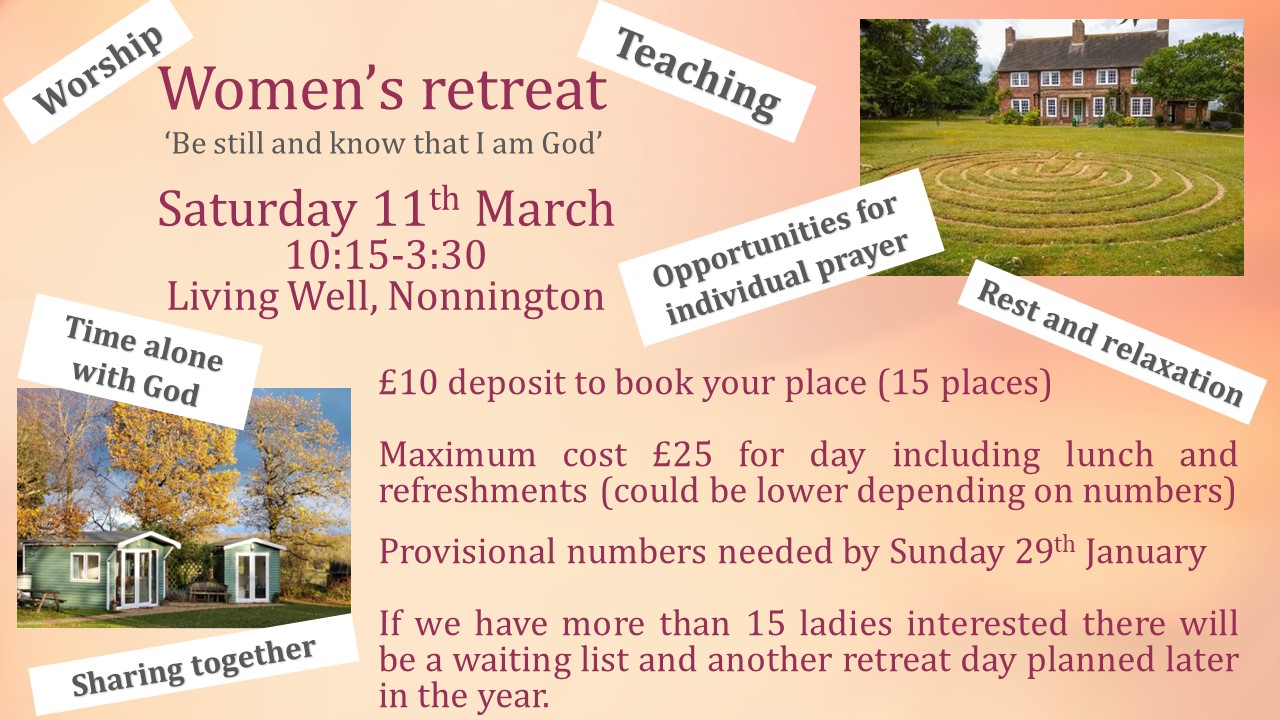
We are planning a women’s retreat on Saturday 11th March at the Living Well centre in Nonnington. A time to be still and know that God is God. There will be worship, teaching, sharing together, lunch, opportunities for individual prayer, time for rest and relaxation, to be still.
Arrivals from 10:15 with the programme running from 10:30-3:30.
There are limited places – to reserve a place please bring a £10 deposit to Claire from next week. The price in total will be no more than £25 and may be reduced depending on numbers. We need provisional numbers by the end of January and then full payment by mid-February.
If we have more than 15 ladies interested, there will be a wait list and we will look to run it again later in the year.
The idea is that we can share lifts, so when you book please let Claire know if you are willing to drive.
I really love celebrating New year’s eve, staying up and seeing in a new year with friends or family that you greatly care about. The reason I think I love it so much is that it’s a way of underlining the previous year and starting afresh on a new page.
A new year brings hope – something better, something different.
That’s why many people make New Years resolutions, to either stop a bad habit or pick up new and better once – a fresh start.
Towards the end of the Old Testament history of God’s people they needed a fresh start. They had come a long way from the days of Moses where they enjoyed the blessing of being Gods chosen people (Numbers 6:22-end), where they were given his name and known as his.
They started okay but later in their history The leaders of God’s people rarely followed God or led the people to know God for themselves. God gave opportunity after opportunity for his people to have fresh starts. time and time again He called for them to come back to him. To have a fresh start with God. That is God’s nature.
As we enter 2023 are you in need of a fresh start? How are you feeling at the beginning of this new year? Physically, mentally, emotionally. And How do you feel spiritually? Do you feel really close to God, fully living a Jesus like life, ready to shine your halo?
We are works in progress and sometimes on a daily basis feel in need of a fresh start with God. Maybe we lose our patience, maybe flat out lie, maybe we deny that we live God and know him.
The good news for all of us is that God is willing and able to give us a fresh start. A good thing for a new year
Jesus- God’s son
There’s a song I learnt when I went to Christian summer camp when I was younger it’s based on John 3:16 and shows that Jesus God’s son was the plan for helping the world have a fresh start with God and enjoy relationship with him being in his company.
As we’ve looked at over Advent and Christmas, Jesus was the promised baby, the wonderful counsellor, mighty God everlasting father, prince of peace. As Gods son he was to be our everlasting father too!
What do you think that means everlasting father?
One commentator wrote: everlasting Father refers to Jesus’ father-like character. He will provide and protect his children with wisdom and compassion. This child, son of God, would come to earth to redeem and adopt sinners into the family of God, offering love and protection as our everlasting.
Jesus as Everlasting father came to redeem and adopt – in other words to offer us a fresh start – to know again we are a child of God – he’s adopted us.
Galatians reading
That is what our reading from Galatians tells us – that through Jesus we are redeemed, receive adoption to sonship, have God’s spirit in our hearts, and receive an inheritance from our Abba Father. We see God in all three persons at work here in the Galatians passage and He as three persons is at work in our life too.
We declare that in words of affirmation of faith. Common worship has this following affirmation of faith that I think agrees with the Galatians passage and is as follows
Affirmation of faith
We believe in God the Father,
from whom every family
in heaven and on earth is named.
We believe in God the Son,
who lives in our hearts through faith,
and fills us with his love.
We believe in God the Holy Spirit,
who strengthens us
with power from on high.
We believe in one God;
Father, Son and Holy Spirit.
And it is this God who adopts us, offers a fresh start and lets us be called a child of God.
A fresh start through Adoption
What does it mean to be adopted? What is happening when adoption takes place? In the UK Adoption is the legal process by which a child or a group of siblings who cannot be brought up within their birth family become full, permanent and legal members of their new family. In the bible reading the word sonship means the exact same thing
We may know friends who were adopted, or have been adopted ourselves. Even if we don’t know someone personally in books and movies there are quite a number of characters who were adopted. I love a good story. I love escaping into a book or a movie. To see a storyline develop, to see good overcome evil and for the hero or heroine of the story to have a happy ending.
In Roald Dahl’s book Mathilda found her family in Miss Honey, her teacher who understood her and loved her as her own
In Kung fu Panda Po was adopted by Mr Ping a Goose who raised him as his own
Paddington came all the way from Peru had no family in England but in a sense he became adopted by the Brown family – he found a place where he belonged.
Oliver is adopted by Mr Brownlow, a well off gentleman who showed love and forgiveness after Oliver got caught after his friend tried to steal from Mr Brownlow. Oliver was shown love and care like he had never known
Finally superman known as Kal-el from planet Krypton is sent to earth and found by Martha and Jonathan and given a new name, the name Clark Kent.
These examples from literature help to set the scene to dig a bit deeper into the privilege and joy that exists because we can also be called a child of God. The song Father God I wonder expresses the joy of fully knowing who we are in Christ. fully knowing that we are his children just leads to praise.
Children of God
What does being the children of God mean?
In the letter to the Galatians Paul has been writing to this church to get them to realise that through faith in Jesus they no longer have to be a slave to the law , to the old ways, but that Jesus died and rose again so that everyone would be free from the chains of sin. When we do stuff that isn’t as God intends we can get wrapped up in it. Jesus died so we could be free from that. That as we repent we start afresh with God
Being free though isn’t by what we do, or how good we try and be, it’s only possible because Jesus redeemed us.
Jesus was able to do this because he was the perfect human, raised a Jew, circumcised, knew his scriptures. Fully obeyed God. In the Old Testament God made a deal with his people, made a covenant, if they obeyed his ways he would bless them, and circumcision was a sign of that. In Luke’s gospel we read that Jesus too was circumcised – this is what qualifies him as being a man under the law, meaning he was obedient to the Jewish law in order to give freedom for all.
Do you feel free from the chains of sin? Do we still strive to be good or do we strive to know our father and in doing so become more like him.
The second thing as a child of God is that we are given Gods spirit. The New Testament letters are full of passages about how the spirit enables us to live as a member of Gods family – Galatians talks about the fruit we produce as Gods spirit lives in us (ch 4) In 2 Peter 1:4 the NLT says ‘And because of his glory and excellence, he has given us great and precious promises. These are the promises that enable you to share his divine nature and escape the world’s corruption caused by human desires.’
Are we aware of Gods spirit in us, guiding us, motivating us, helping us to change and grow into more of the family likeness, more like Jesus. Because we have Gods spirit in us we can truly call out to him as our daddy – not a distant inaccessible father but a daddy who sticks close who protects, who gives us and longs for us to have good things and cries with us through the challenges and difficulties of life.
Because that’s the third thing that comes with being a child of God receiving the blessing and inheritance of our eternal father
In Matthew we read about how as God cares for the animals so he will care even more for us his children- and he loves the animals so that’s huge!
In johns gospel we see that Jesus desire is for us to have life in all its fullness
And that being a child of God isn’t just for now it’s for eternity.
This year what will it mean for us that we are a child of God.
Maybe you need to hear you are loved and precious and to let go of what might chain you and stop you from being free because of what God has done for you.
Maybe we need to stop striving and be still and know God as our loving father.
Maybe you need to know you are never alone, that God through his Holy Spirit can live in you guiding directing when we ask Jesus to be part of our lives.
Maybe you need to know God longs to bless you and to know the certainty of eternal life
Conclusion
In this year ahead maybe we need to once again or for the first time have a fresh start with our God who made us and loves us, who sent his son to give us freedom, to redeem us, to give us sonship, legally adopted, given the name Child of God. Maybe we need to more fully accept we are his children and be expectant of all he has in store for us in this year ahead. Amen.
Script of sermon preached at St George’s by Rev Claire Coleman on 1st January 2023.
Three words and expressions came top of the Oxford Word of the year 2022 competition: ‘Goblin Mode,’ ‘Metaverse’ and #IStandWith. What have they to do with Christmas? Read this talk given at the Sailor’s Church Carol Service on Friday 23rd December.
Oxford Word of the Year – Our contradictory culture
Recently I came across an article about The Oxford Word of the Year. It was a competition run where people could vote on a new word or expression that they felt reflected the mood of our times in 2022. I have to say, the three top words and expressions, were not ones that I was that familiar with, but as I read about them, they did seem to sum up how people are behaving in 2022. At the same time they seemed to be contradictory.
The winner was: Goblin Mode.
Apparently it refers to a type of behaviour which is unapologetically self-indulgent, lazy or greedy, typically in a way that rejects social norms or expectations. You may not have heard of the phrase, but perhaps you have seen people living it out. In the wake of Covid and the enforced lockdowns, many people have looked at their lives and decided to cut out anything that was difficult. They have retired early or given up on volunteer roles, deciding instead to focus on indulging themselves rather than working hard.
In third place, though was #IStandWith.
This is a phrase that was particularly used of peoples’ reaction to the Russian invasion of Ukraine. In response to the horror of that war, people wanted to show solidarity and support for people suffering in Ukraine. For some #IstandwithUkraine has involved a willingness to make real sacrifices: Our government being willing to accept rising fuel costs as the price of support for Ukraine and people welcoming Ukrainian refugees into their homes.
These two terms sum up 2022 well, but they also seem contradictory. You cannot embrace Goblin Mode and Stand with those who are suffering. Yet, some people do try and have it both ways. After all it is possible to say, #IStandWith in an abstract way, by putting up a Ukrainian flag or posting on Facebook or Twitter, without being willing to make sacrifices or do anything to really help.
This latter idea of abstract support brings us to the term that came second: Metaverse
The idea of the metaverse is really just an extension of the idea of the world wide web. Already people meet with others virtually using some kind of video call. My daughter recently had some university interviews without leaving the house and I often play chess on my phone with people from all over the world. The metaverse takes this idea and tries to make it a bit more real. It creates an artificial world on the internet, where you interact with others, with a made up image called an Avatar, whilst sitting at home on your computer. You can meet with others, without actually going anywhere or dressing up for the occasion
Perhaps the Metaverse is a way of combining #IStandWith with Goblin Mode. After all it means you can join with others in a virtual meeting, while remaining in bed in your pyjamas and eating ice cream!
God’s Commitment to Us: The Word made Flesh
So what has all this to do with the Christian message of Christmas? Put simply, Christmas is the message that the Son of God rejected Goblin Mode and came to stand with us not in a metaverse kind of way but in a deeply real way. It says at the start of John’s gospel:
“And the Word became flesh and lived among us, and we have seen his glory,
the glory as of a father’s only son, full of grace and truth.” (John 1:14)
“The Word” of course refers to Jesus, as God’s eternal Son, who has always been there. It was he who came down from heaven and ‘became flesh.’ Jesus’s conception was not the beginning of a new person, which is the case with every other human being, it was the eternal person of the Son of God becoming something new: a human being. This is the great truth at the heart of the Christian celebration of Christmas.
But in what sense did Jesus ‘become human’? Was it as though Jesus was taking on an avatar, sitting in heaven, but appearing as a man on earth – communicating to us from a distance, but in ‘bodily form’ like in the metaverse?
Such an idea is similar to an ancient idea called, ‘Docetism’. It was an idea that was rejected by the early church as completely wrong.
The problem is that if Jesus only became human as a kind of avatar, then he was only standing with us in an illusory and ultimately meaningless way. His life and death were as meaningless as someone playing a computer game and dying in the computer game, perhaps upsetting, but not really suffering or sacrificial.
But Jesus ‘became flesh’ or as the carol puts it:
God of God, Light of Light, Lo! He abhors not the Virgin’s womb.
It sounds messy and bloody and it was, because this was Jesus entering into the messy and bloody reality of human existence. This was certainly not Goblin Mode.
To really bring home this point, we need to understand what John means when he says, “we have seen his glory.” To find out we need to read on in the gospel. It becomes clear that for Jesus the moment he was glorified, was when he died on the cross, a bloody and horrific moment, that as the one who became flesh, Jesus entered into in utter reality. Yet, this was also the moment of grace. It is in his very real death, that Jesus took the punishment for the sins of humanity. He didn’t just stand with humanity, he stood in the place of humanity, in order to bring us forgiveness with God and to offer us a way through death to eternal life.
It was the very real, bloody and effective sacrifice of the cross that reveals to us Jesus’s true glory. All of which was only possible because the Son of God became flesh.
Our Response to God?
When we fully understand this message of Christmas, we can find something really worth celebrating not just in December, but throughout all our lives. Here is God come to truly stand with us in the darkness and messiness of our lives.
But, it is also a challenge to us. If Jesus rejected Goblin Mode to come and live among us, if he truly stands with us, then we need to ask ourselves, will we be willing to not just say, #IstandwithJesus, but fully embrace following Jesus, even though it may mean letting go of Goblin Mode, and rejecting laziness and self-indulgence in order to serve God by helping others and pointing people to him?
This is a transcript of the talk given at the St. George’s Carol Service on 21st December 2023.
Christmas Unwrapped Survey
Something I’ve been involved with for many years in the lead up to Christmas is something called, Christmas Unwrapped. It is an interactive presentation of the true Christmas story for children in the last year of Primary School. Various churches invite schools from across Thanet to attend.
As part of the event there is a survey of the 10 and 11 year olds with various questions to do with Christmas. When asked for their ‘Favourite Christmas Song’,
the most popular was: ‘All I want for Christmas is you’
followed by ‘The Last Christmas’ and ‘Jingle Bells’
When asked for their Favourite Part of Christmas
Spending time with family and Presents took the top two spots
When asked What will you give for Christmas,
Although, some said presents and money, “love” took the top spot!
Now I’m not sure what to make of that. At first glance a child saying, ‘I want to give love this Christmas’, provokes that sense of Ahhhh… isn’t that sweet!
Yet, a more cynical response might ask, shouldn’t you give love all year round, are you saying you only love people at Christmas? Surely, we give presents to express at Christmas as an expression of our all year round love?
And is giving love at Christmas really an excuse for saying, I’m not willing to spend any money on buying you any presents!!
When it comes to the Christian message of Christmas of course it is all about ‘God’s gift of love.’
That’s not to say that God only loved us when he sent Jesus. Rather, the birth of Jesus, was a historical event that expressed God’s eternal love for the world.
As it says later in John’s gospel,
“For God so loved the world that he gave his only Son,”(John 3:16)
But more importantly, God’s gift of love was certainly costly.
Love is costly
True love is never cost free. Love means treating another as valuable and important in your life, which means you will be willing to make sacrifices for them and that is costly!
In particular, to love someone, means to make yourself vulnerable to them. It means risking being rejected.
In John’s gospel we are told that the birth of Jesus, was the eternal Word, or Son of God being made flesh. In that moment, God became utterly vulnerable.
He was born not in a spotless maternity ward, but in a stable. Not into a family with a secure home, but one which was temporarily homeless. Not into a world, where he was welcomed, but one where the most powerful man of the time in his area, King Herod sought to destroy him.
Yet, the Christmas story is just a foreshadowing of what was to come. John tells us:
“He was in the world, and the world came into being through him; yet the world did not know him. He came to what was his own, and his own people did not accept him.” (John 1:10-11)
Someone came to our house for tea the other day wearing a provocative t-shirt with a picture of the typical Christmas stable scene on it. Underneath the scene were the words: spoiler alert – “he dies!”
For the eternal Word, the lack of acceptance ultimately meant a cruel and humiliating death on the cross. This is where God’s eternal love was exhibited even more powerfully. As he says later in John, “No one has greater love than this, to lay down one’s life for one’s friends.” (John 15:13).
So, God’s gift to us was costly – so, what made this gift worth such a great cost. What did Jesus’s death achieve for us.
Part of the answer comes in John 1:
“But to all who received him, who believed in his name, he gave power to become children of God, who were born, not of blood or of the will of the flesh or of the will of man, but of God.” (John 1:12-13)
Love needs accepting
So that is the gift, but will we accept it?
The publicity produced this Christmas is called, The Great Invitation. There is a sense in which Christmas is an invitation. Not just to come and enjoy the festive feel with traditional services, but to receive God’s ultimate gift. Yet, as with any invitation it needs to be accepted and as with any gift it needs to be unwrapped.
So is this the kind of present or invitation you are looking for?
In the Christmas Unwrapped survey one of the other questions the children were asked were: What do you hope to receive? The answers to this included things like: a phone, PC/Computer game station and money. If all we are looking for in life are material possessions, then we will probably miss God’s invitation and fail to open this most expensive and precious present.
However, when the children were asked about Hopes and Dreams for 2023, the two top spots were for a deceased family member to be with them and for another family member to get better. In this case the concerns were to somehow overcome sickness and death and find restored relationships.
These desires come closer to what God is offering us. God’s gift is an invitation not just to come to a church service at Christmas, but to follow him with all of your life in the way that does ultimately overcome sickness and death, because as children of God, we gain eternal life!
So, will we see God’s gift as merely a decorative gift to be left unwrapped and put away with all the other decorations until next Christmas or will we actually unwrap it and choose to follow Christ in the way of Life all year round?
Welcome in Christmas Day in the beautiful setting of St. George’s church decorated for the Christmas Tree festival. The service starts a 11:30pm, with carols, Holy Communion, readings and a reflection.
Join us this evening (Wednesday 21st) at 7pm for our Christmas Services. Traditional hymns and readings, the creation of a crib scene and all in the setting of a beautiful church decorated for the Christmas Tree festival. Mince Pies and mulled wine afterwards.




 St. George's Church Ramsgate