Paradise Regained (Luke 4:1-13)

“We have a high priest who has been tempted in every way, just as we are – yet he did not sin” Hebrews 4:15

What has forty days in a wilderness fasting and being tempted by the devil to do with paradise? Everything. In the wilderness experience, Jesus wrestled with what it really meant to be God’s son. In so doing, he prepared himself to resist the temptations of a public ministry. Let’s all use this Lent, to learn afresh what it means to be a disciple of Christ and to prepare ourselves to resist the temptations we may face.

As recorded at St. Luke’s

Paradise Regained (Luke 4:1-13)

St. Luke’s Ramsgate 9 March 2025

You may have heard that in the seventeenth century John Milton wrote the poem Paradise Lost, which re-tells the story of the temptation and fall of Adam and Eve in the Garden of Eden over ten thousand lines. (Don’t worry, I’m not going to read it to you!) It’s less well known that Milton wrote a sequel, a two thousand line poem titled Paradise Regained. (I won’t be reading that one either.) But Paradise Regained is a re-telling of the Gospel story of Jesus being tempted in the desert. So the Garden of Eden was the setting in which humanity succumbed to temptation and paradise was lost, and the desert was the setting for the story we have heard read from Luke chapter 4 this morning, in which Jesus resisted and overcame temptation, and paradise was regained.

It’s helpful for us at the outset to have the big picture of what is at stake in the Gospel reading, so that we don’t go away thinking that what we have here, are some top tips from Jesus about how to resist temptation, maybe as some kind of Lenten discipline. The fact is that we need a lot more than a few top tips! Having ourselves repeatedly failed to resist temptation, we are lost. A little bit of Lenten discipline is not going to remedy that. Frankly, we need rescuing from the consequences of our own actions.

It is fair to say that there is some wisdom to be gained from Luke chapter 4 as to how we may do better in the future. But, over and above that, there is much comfort to be gained from this chapter in the knowledge that someone in the past – not just anyone, but a capital-S Someone – has done better than we could ever hope to do, and that we may look to him, rather than have to rely on our own feeble efforts, to recoup everything that we have lost, to deal with our past, and to secure our future. I said I wouldn’t read all twelve thousand lines of John Milton’s poems, but here is a very short excerpt:

“A while ago”, writes John Milton, “I sang of the happy garden lost by one man’s disobedience. Now I sing of paradise regained to all mankind through one man’s obedience, being tested with every temptation, and the tempter beaten – with all his cunning, beaten and thrown back – and Eden created again in the empty wilderness.”1

So this morning let us consider the character of each of the three temptations outlined in Luke chapter 4, and how they were resisted and overcome by Jesus, and then let us consider the common character of every temptation, and how they were resisted and overcome by him, and from this let us obtain both wisdom and comfort.

But just before we get on to the first temptation, let me say this: we may think that we are all experts when it comes to temptation: because we are constantly subject to it, thanks to the devil; because we are vulnerable to it, thanks to the flesh; and because it’s all around us, thanks to the world. Because of the flesh, the world, and the devil, we may think that we are all experts when it comes to temptation. However, I’m not sure that’s precisely right. Our strength to resist temptation is very limited. “Either it has to be taken away, or [our resistance must be] supported by the Lord’s word, or else [our strength] collapses, we cannot hold up”.2 When we succumb to the pressure to do the wrong thing, this is proof that we are no kind of experts when it comes to the pain of temptation. We have just take the easy route out by succumbing to it, and that makes us, in fact, experts in sin and wrongdoing. But not Jesus – he is the true expert in temptation, because “he could hold the weight” indefinitely. “That doesn’t mean he couldn’t feel the pain of it, and the longer he held it, the worse the pain got, so that Jesus experienced every temptation to the end”3 in a way that none of us have ever done, yet without sin – in fact, precisely because he did so without sin. We by contrast have never been tempted to the nth degree; in fact, the Bible tells us that God will not let us be tempted beyond what we can bear, and that he will always provide a way out (1 Cor 10:13).

The first temptation recorded in Luke chapter 4 is the temptation to fulfil desire, purely and simply because of the existence of that desire. Jesus was fasting, and we are told in verse 2 of chapter 4 that he was hungry. And so the temptation was simply to do what was within his power to do, to close the gap between what he had, and what he wanted. “If you are the Son of God, tell this stone to become bread.” Indeed, in Luke chapter 9, Jesus would use his divine power to feed five thousand people in the wilderness, so here in chapter 4, verse 3, the temptation was effectively to do the same thing to serve himself in the wilderness. The rock-bottom reason he resisted this temptation was because he came not to be served, but to serve (Mark 10:45). And that’s what he was doing in the desert. He was serving not himself but us. Here is our mighty comfort. Jesus resisted temptation to regain the paradise that had been lost through humanity’s failure to resist temptation.

And here is wisdom: Jesus did not resist this temptation by means of any sort of miraculous power – by which his hunger vanished, for example – but solely by means of the word of the Lord in Deuteronomy chapter 8, ‘It is written, Man does not live by bread alone’. You may know how that verse from Deuteronomy continues: ‘Man does not live by bread alone, but by every word that proceeds from the mouth of God’, and here the word of the Lord alone proves to be enough to resist the devil and block this temptation. The word of the Lord was enough. Understanding this must put us to shame when we look back, given how many times we ourselves have fallen into sin in the past, but it also gives us hope for resisting temptation looking forward. The word of the Lord alone is enough to resist the devil and block temptation. That is wisdom.

The second temptation was to pride, power and influence, in verses 6 and 7. “I will give you all the authority and splendour [of the kingdoms of the world], for it has been given to me, and I can give it to anyone I want to. So if you worship me, it will all be yours.”

Now what Jesus could have said in response to this, and what we might have expected him to say, is ‘What are you talking about? All the kingdoms of the world are mine already. You can’t give me what I already possess.’ Instead Jesus said, in verse 8, “It is written, Worship your God and serve him only”.

Again, here is wisdom: the naked word of the Lord from Deuteronomy, chapter 6 this time, is more than enough to overcome this temptation. And here again is comfort. In relying solely on the word of the Lord to resist, rather than on an assertion of divine power and privilege, which was his by right, Jesus continues not to be served, but to serve you and me. The devil’s offer was a Faustian pact, the path of least resistance, an easy way, it would seem, of inheriting the kingdom of the Father – seemingly easy, but in practice ineffective. That was not the path chosen by Jesus. He laid all pride, power, and influence aside, and became the least of all. For our sake, he humbled himself and became obedient to death, even death on a cross. The cross was his throne; his crown was one of thorns; his royal accession was proclaimed in the notice pinned above his head: the king of the Jews. That was his path, and that was the only path, to being exalted to the highest place, and being given the name that is above every other name: Jesus Christ, the Son of God, Saviour of sinners.

The third temptation was to twist the word of God to his own advantage, to make it say something it doesn’t. “If you are the Son of God, throw yourself down [from the highest point of the temple], for it is written [in Psalm 91], ‘He will command his angels concerning you to guard you carefully” and so on. The implication is that angels would guard him no matter what reckless thing he did, but Psalm 91 doesn’t actually say that. Instead it says, “He will command his angels concerning you to guard you in all your ways”. When that phrase ‘in all your ways’ is left out, the promise is twisted. The promise is of protection in carrying out a vocation. It is not protection against stupidity and recklessness. Testing the limits of a blanket protection would be to put God to the test, so against this deliberately incomplete Scriptural citation Jesus places yet another word of the Lord from Deuteronomy, chapter 6: “Do not put the Lord your God to the test”. Once again, let those in need of wisdom take note: the word of God is enough to silence the tempter. And once again, let those in need of comfort take note: Jesus refused to put himself in harm’s way recklessly, but he was willing to do so in following the vocation he received from the Father. In following that vocation all the way to death on a cross, he entrusted himself wholly to his Father, and that trust was not disappointed, because he was delivered to death for our sins, and then was raised to new life for our justification (cf. Romans 4:25).

Now let us consider what is common to each of these temptations, and what is common to every temptation. Two out of the three temptations recorded in Luke chapter 4 start with the words, “If you are the Son of God”, then do such and such to prove it. (In Matthew’s account of the temptations, this is how all three of the temptations are introduced.) Yet in the previous chapter of the Gospel, the baptism of Jesus is recorded, after which the divine assurance was given: “You are my Son, whom I love; with you I am well pleased” (Luke 3:22). Sowing seeds of doubt in the word of the Lord and the divine Sonship of Christ is therefore common to all three temptations. Likewise, in whatever particular ways we are tempted, through them we are commonly invited to doubt the truth of God’s word, the reliability of his love, and our status as his children.

And let us not imagine that Jesus was only ever tempted in these three ways and no others: to the instant fulfilment of desire; to pride, power, and influence; and to twisting God’s word to his own advantage. We read in Luke chapter 4 verse 13 that the devil “finished all this tempting”, or according to another English translation “finished every test”, and then left only temporarily, later to return at an “opportune time”. We know from elsewhere in the New Testament that Jesus was “tempted in every way, just as we are, yet without sin”, and that consequently he is able “to sympathise with our weaknesses” (Hebrews 4:15). So, “as much temptation as hunger could give you, Jesus felt it. As much temptation as thirst could give you, Jesus felt it. As much temptation as anger could give you, Jesus felt it. As much temptation as lust can bring, Jesus felt it. As much temptation as greed could bring, Jesus felt it.”4 All of this, and more, is true.

We know he was tempted in many ways throughout his ministry. Just think of how he responded to Peter’s suggestion that he should not walk the way of the cross: “Get behind me, Satan! You are a stumbling block to me; you do not have in mind the things of God, but the things of men” (Matthew 16:23).

But the last and most trying temptation must surely have been the one Jesus experienced on the cross, when “those who passed by hurled insults at him, shaking their heads and saying, ‘You who are going to destroy the temple and build it in three days, save yourself; come down from the cross, if you are the Son of God’” (Matthew 27:39-40) – there is the tempter again, sowing seeds of doubt, and appealing to self-interest: ‘if you are the Son of God, save yourself’. In the 1980s film The Last Temptation of Christ, which was controversial at the time of its release, Jesus the film character succumbs to this temptation to come down from the cross and live out a normal domestic life with a wife and family into old age. Having shirked the way of suffering and death, the movie Jesus discovers at last that he has left himself nothing, and has left his followers and his doubters nothing whatsoever, to believe in ever again. There would be no forgiveness of sins, there would be no resurrection of the body, there would be no life everlasting. That would have been a grim scenario. That would have been a betrayal of Christ’s calling. In contrast, the Gospels show us what actually happened – the costly fulfilment of his calling, in the teeth of insults, in humility, and in willing surrender. How else would the Scriptures have been fulfilled which say that his glorification, and our redemption, must happen in this way?

Drawing this connection between the first recorded temptations of Christ’s ministry, and the last temptation – with those insidious questions ‘If you are the Son of God…’ acting as bookends – drawing this connection makes one thing crystal clear. Jesus did not undergo temptation simply to provide an example of resisting temptation for us to follow, and to teach us how to do it. No doubt, there is some value in knowing the power of the written word of God and the security of our status as children of God in overcoming temptation. There is wisdom in that. But in Luke chapter 4, “Jesus is not only showing us how to resist the devil, he’s [resisting the devil] for us, he’s in our place”.5 At the beginning and end of his ministry, he stands firm in the exact place where you, and me, and the rest of humanity, have faltered and fallen. He wasn’t in the desert on a personal journey of self-discovery – he went out there for our sake, and where our discipline failed, his stood firm. In doing so, he has regained paradise for you and for me. So let us remember this throughout Lent. Had Jesus deserved to die the death of a sinner, his death would have been unexceptional and ultimately meaningless. It would have saved no-one. But in fact, he withstood every temptation that was thrown at him. God made him who had no sin, to be sin for us, then raised him to life, and glorified him. And in this there is glorious comfort. Paradise, once lost, has been restored. “And we sing of paradise regained to all mankind through one man’s obedience, being tested with every temptation, and the tempter beaten – with all his cunning, beaten and thrown back – and Eden created again in the empty wilderness.”6

1 John Milton, Paradise Regained in Plain and Simple English (BookCaps Study Guide, 2012), page 3, altered.

2 Bryan Wolfmueller, What of Christ’s temptation?, http://www.youtube.com/watch?v=ADhO4zefldE, 09:10.

3 Ibid., 09:30.

4 Ibid., p. 09:40.

5 Ibid., 32:10.

6 See note 1.

This Week’s Notices 9th March 2025

(Hebrews 4:15)

This week is the start of Lent, a period of forty days (not including Sundays) where Christians traditionally fast from something and reflect more deeply on their walk with God. This is modelled on Jesus’ wilderness experience, when he spent forty days fasting and being tempted by the devil.

What was the point of this? The gospels tell us that it happened after Jesus had been baptised, but before he started his public ministry. It is tempting in our instant culture, to think that being “zapped” by God is all that is necessary to become a brilliant minister for God. Jesus was certainly “zapped” at his baptism when he was empowered by the Holy Spirit and encouraged by the Father who declared, “This is my Son, with him I am well pleased.” What more did Jesus need to get going?

He needed to wrestle with the astounding temptations that his calling would bring. This was the point of the wilderness experience. In two of the temptations, the devil begins with, “If you are the Son of God…” At his baptism, Jesus had the Father’s reassurance that he was God’s Son, but what did that mean for how he should live? Was he to use his power to meet his personal needs and turn stones into bread? No, his mission was to live by God’s word. Was he to use his position to test God’s protective power? No, he was not to put God to the test. Was he to build a kingdom the easy way, by worshipping Satan? No, he was to worship God alone. The kingdom would come about the hard way, through the cross and resurrection.

In the wilderness experience, Jesus wrestled with what it really meant to be God’s son. In so doing, he prepared himself to resist the temptations of a public ministry. Let’s all use this Lent, to learn afresh what it means to be a disciple of Christ and to prepare ourselves to resist the temptations we may face.

Paul Worledge

Electoral Roll

The electoral roll is the list of members of St. George’s parish who have the right to vote at our annual meeting. Every six years, the roll has to be renewed from scratch and 2025 is one of those years. So, if you consider yourself a member of St. George’s then please complete an electoral roll application, whether you were on the electoral roll before or not. To qualify to be on the electoral roll, you must be baptised, over 16 and either live in the parish of St. George’s or have attended St. George’s for six months or more.

It’s quick and easy to fill in an online form: apply to be on the electoral roll. If you are not sure which parish you live in then you can check via this website.

Youth and Children’s Pastor

St. Luke’s is now advertising for a Youth and Children’s Pastor. You can check out the details on the website. The deadline for applications is on 31st March. Please pray that we can find a really good candidate for this important role. Find out more…

Thanet Prayer Diary

You can download and print the Thanet Prayer Diary for March and April.

Robin Plant – Bible teaching on Genesis

The Earth is the Lord’s: The Message of Genesis. So often the book of Genesis is the battleground for debates about science and evolution. But if we listen to it on its own terms, what is it trying to tell us? About being human? About the world we live in? About different faiths? About mission? Genesis, we discover, tells the story of a world disfigured by human folly, but also of a creator who didn’t give up on it – and still doesn’t.Tuesdays, 7:30-9:00pm, Newington Free Church from 11th March to 1st April. See flier for more information.


Free Piano Concert – 12pm, Thu. 20th March, St. Luke’s

Featuring music from local composer, Bob Ward, Petra Hadjuchova will be performing a piano concert just after Cafe4All.

Revelation Strings Concert – 3pm, Sat. 22nd March, St. Luke’s

This orchestra is made up of experienced and young musicians and is in association with St. Lawrence College. It should be a lovely concert. £10 entry, but children are free.

Titanic Journey – 2-4pm, Sat. 5th April, St. George’s

Local historian, Bob Pryor presents, ‘My life with Titanic’. Tickets are £5 in advance and available onlineof £7 on the door.

St. George’s Day Parade

In preparation for the St. George’s Day parade on 27th April, GB Carnival are looking for donations of clean tin cans and plastic tubs. You can drop off your donations at the Carnival Club in St. George’s Hall 5-7pm every Wed. or at Community Soup in the church from 12 -2pm every Wed. and Sat.

Links to Share:

Dust to Dust: A reflection on the fear of death

At our Ash Wednesday service, many of us received a sign of the cross in ashes on our head. Part of the point is to remember our mortality… “ashes to ashes…”. But how are we shaped by our fear of death? Read 5 min. article.

Real Life Stories: Jack and Amy

Watch this 5-minute video of the latest ‘Real Life story’ from Christianity Explored, where Amy and Jack talk about their journey to faith. Watch video…

Finally, let’s set Lent as a time to prepare for the future work God has called us to.

Yours in Christ

Paul Worledge

(Vicar, St. Luke’s Ramsgate)


Weekly Calendar

Sunday 9th March – First Sunday in Lent

Eucharist (St George’s, 9:30am) – Reading: Luke 4:1-13

Sunday School (St George’s, 10:30am)

Monday 10th   

Prayer Meeting (St. Luke’s Church) – 9:30-10:00am

Craft Group (St. George’s Hall, Soup Kitchen) – 2:00-3:30pm

Study Group (South Eastern Road) – 7:15-9:30pm

Tuesday 11th  

Prayer Meeting (St. George’s Church) – 9:30-10:00am

Coffee Morning (St. George’s Hall) – 11:00am-12:00pm

Study Group (Lyndhurst Road) – 2:30-4:00pm

Community Meal (St. George’s Hall) – 5:30-7:00pm

Wednesday 12th

Study Group (Langdale Avenue) – 10:00-12:00 noon

Community Soup (St. George’s Church) – 12:00-2:00pm

Study Group (South Eastern Road) – 7:30-9:30pm

Thursday 13th

Prayer Meeting (St. Luke’s Church) – 9:30-10:00am

Saturday 15th

Prayer Meeting (St. George’s Church) – 9:30-10:00am

Community Soup (St. George’s Church) – 12:00-2:00pm

Sunday 16th – Second Sunday in Lent

Eucharist (St George’s, 9:30am) – Reading: Luke 13:31-35

Online Forms

Under the ‘Contact’ tab on the website, there are now three forms that you can use to help us in managing the church:

  • Events Application Form. Use this if you are organising a church event that needs a church room booked, advertising or ticketing.
  • Submit a Notice. Use this if you want to ask us to include a prayer request or other notice in the church notice sheet or email.
  • Maintenance Reporting Form.Use this to report any non-urgent issues with our buildings or grounds.

St. Luke’s Website

  • What’s On – a page which lets you know what is happening this week and gives information about upcoming events.
  • Notices – You can read the latest notices on this page.
  • Sermons – Read a transcript of a recent sermon or watch the YouTube version recorded at St. Luke’s. You can also listen to the sermon through the podcast website castbox.

Safeguarding Training

If you volunteer in anyway at church the national authorities are strongly encouraging you to take at least the Basic Module in safeguarding training once every three years.

If you have not completed the training in the last three years, then the module can be completed online and takes about ninety minutes. You can access the training by following this link. You will need to first register, to access the training. Once the training is completed, you will be sent a certificate. Please forward that certificate to James (office@stlukesramsgate.org), so that we can keep records of who has done the training.sent a certificate. Please forward that certificate to James (office@stlukesramsgate.org), so that we can keep records of who has done the training.

Electoral Roll Renewal

The electoral roll is the list of members of St. George’s parish who have the right to vote at our annual meeting. Every six years, the roll has to be renewed from scratch and 2025 is one of those years. So, if you consider yourself a member of St. George’s then please complete an electoral roll application, whether you were on the electoral roll before or not.

To qualify to be on the electoral roll, you must be baptised, over 16 and either live in the parish of St. George’s or have attended St. George’s for six months or more. You can find out which parish you live in using the ‘a church near you website.’

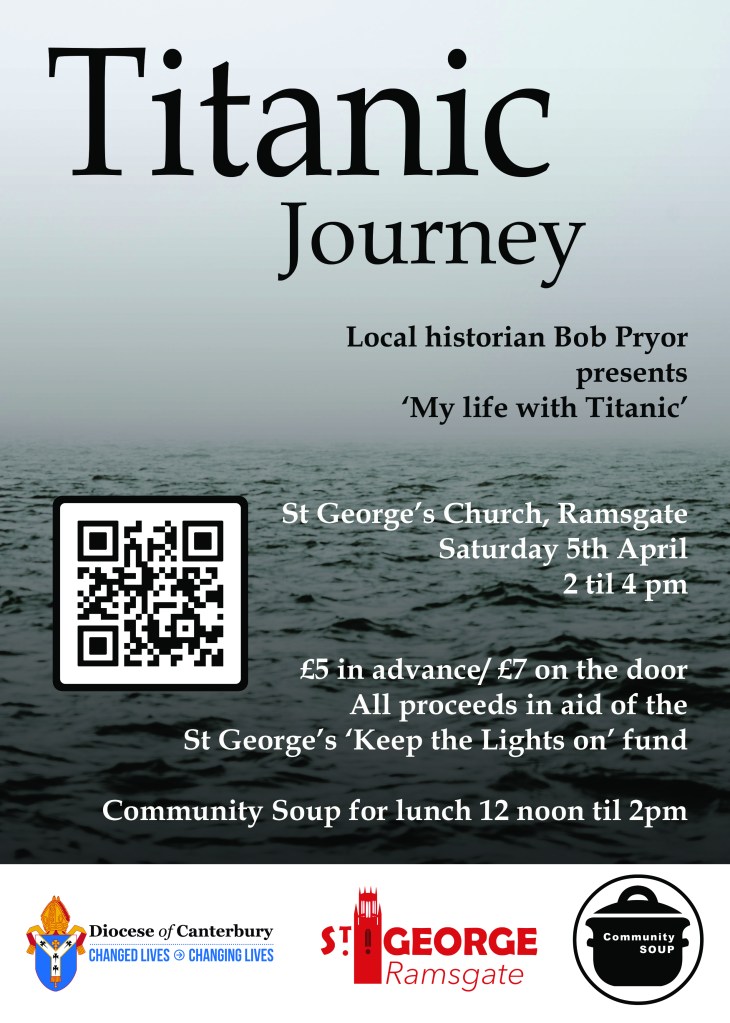
A Titanic Journey

A Titanic Journey with Bob Pryor at St George’s Church
Saturday 5th April– 2pm til 4pm
St George’s Church, Church Hill, Ramsgate, CT11 8RA
Talk/ Film /Q&A

Refreshments will be served.
Before the event starts our usual Community Soup lunch will be available at the church from 12 noon til 2pm.
Hot drinks and cake will be served during the interval before the Q&A.

Tickets are £5 in advance and £7 on the door. Book tickets here.

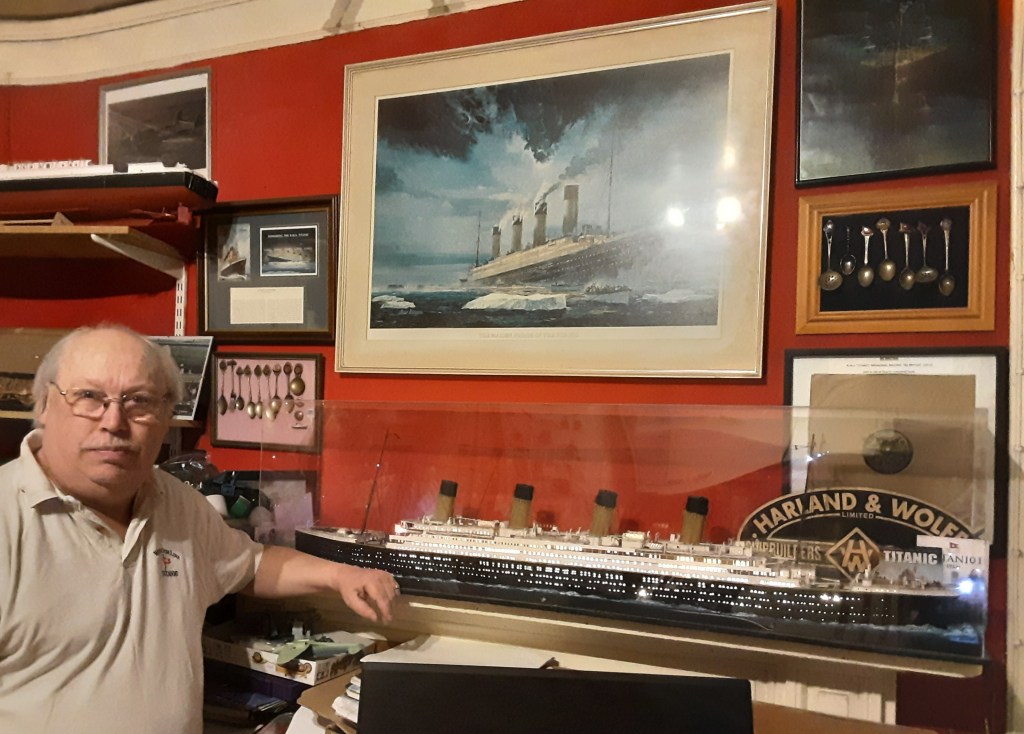
Local Ramsgate Historian Bob Pryor presents ‘My life with Titanic’

Bob invites us to join him on his journey that ‘started with some old yellow newspapers, travelled via Titanic survivors, onto founding one of the world’s largest Titanic societies. Film, television. And a Blue Peter badge’.
Bob says ‘Come with me on my journey. But I warn you Titanic a powerful mistress’ 

Proceeds from the event will go towards the ongoing work of St. George’s.

Confessing (Psalm 32)

‘I said to myself, “I will confess my rebellion to the Lord.” And you forgave me! All my guilt is gone.’ Psalm 32:5

There are earthly consequences to our sin, broken relationships, justice, maybe if a law was broken. When you remember back to times you have confessed something you may have only got back guilt and shame from that person or done the same for someone confessing something to you. We are not perfect, things hurt us and we respond. However let’s look together and what Confession is, how we can confess to God and how we can better support others who confess to us and want to accept God’s forgiveness.

As recorded at St. Luke’s

This Week’s Notices 2nd March 2025

(Psalm 32:5)

Guilt can take many forms—whether it’s a guilty verdict, a pang of guilt, or even a guilty pleasure. It can become more than just a feeling or judgment; it often manifests physically in our bodies through symptoms like headaches, difficulty sleeping, flushed cheeks, muscle tension, and physically secluding oneself. So, what is the remedy for this pervasive emotion?

Attempting to convince ourselves that we shouldn’t feel guilty through justification or rationalising can leave us (and possibly others) emotionally wounded and hinder our spiritual growth. In this context, Psalm 32 offers profound insights on the consequences of hidden guilt and the joy that comes from confession and God’s assurance of forgiveness.

This Psalm emphasizes the importance of confessing our mistakes to God and seeking His forgiveness for our disobedience. Yet, while our relationship with God is deeply personal, it is not meant to be solitary. The Book of James highlights the significance of community in the process of confession, reminding us in James 5:16 to “confess your sins to one another and pray for one another so that you may be healed.” As part of the body of Christ, our individual choices affect our fellow believers, and the support of those around us when we confess can significantly aid in our healing as well as others.

As you navigate this week, take time to incorporate Psalm 32 into your prayers. Reflect on how it influences your own faith, knowing that you can confess and rejoice in God’s love. Additionally, consider how you can be a source of support for others who may wish to share their struggles with you.

Beth Keenan


Country Dancing Event, Friday 28th, 7pm

Everyone is welcome to this country dancing event in St. Luke’s Hall. There will be hot food and lots of fun. The event is organised by the Men’s Group for everyone. Tickets are £5-a-head. See or contact Bruce Stokes for more information of tickets (07708 682464, bruce.stokes@btinternet.com).

Prayer Breakfast – Saturday 1st

The next Churches Together in Ramsgate prayer breakfast will be on Saturday 1st March, 9am at the Salvation Army. It will include a presentation about Active Christianity in Thanet Schools.

Ash Wednesday – 5th March 2024

There will be an Ash Wednesday service at 11am on 5th March at St. George’s. After the service, why not make the most of Community Soup, which runs from 12noon to 2pm every Wednesday.

Big Quiz Night – Update

Last November we took part in Tear Fund’s Big Quiz Night. Together, the 570 churches that took part raised £195,000. Thanks to all those who helped to put on the great event.

Robin Plant – Bible teaching on Genesis

The Earth is the Lord’s: The Message of Genesis. So often the book of Genesis is the battleground for debates about science and evolution. But if we listen to it on its own terms, what is it trying to tell us? About being human? About the world we live in? About different faiths? About mission? Genesis, we discover, tells the story of a world disfigured by human folly, but also of a creator who didn’t give up on it – and still doesn’t.Tuesdays, 7:30-9:00pm, Newington Free Church from 11th March to 1st April. See flier for more information.

Gather 25

Community Church Ramsgate are hosting a video link with this global church gathering. Everyone is welcome. Saturday 1st March from 6:30pm at the Corner, Ramsgate.

Fundraiser for the Community Meal

As part of International Women’s Day, Raushan Ara is hosting a “World on your Plate” fundraising event in aid of the St. George’s Community Meal. Participants have a chance to dress culturally and bring a dish of their own country to share. There will be guest speakers and live dance and music. Saturday 8th March, 1pm, Ramsgate Tandoori, Harbour Street.

St. George’s Day Parade

In preparation for the St. George’s Day parade on 27th April, GB Carnival are looking for donations of clean tin cans and plastic tubs. You can drop off your donations at the Carnival Club in St. George’s Hall 5-7pm every Wed. or at Community Soup in the church from 12 -2pm every Wed. and Sat.

Links to Share:

With Lent starting on Wednesday 5th, here are a couple of sets of devotional material being offered by mission agencies.

Tear Fund: Seeds of Hope or Journeys of Lament

Our Seeds of Hope weekly reflection guide offers a scripture, an inspiring video, a heartfelt prayer and thoughtful questions to help you deepen your faith and grow spiritually throughout Lent. 

Through our Lament series we offer brief reflections, inspirational quotes, images and songs, our reflection guide encourages you to be brutally honest and open with God about the pain and suffering that either you or others are experiencing. The guide includes 40 reflections for you to journey, we’ll also share some of the things we lament over.  

Sign up to receive this material…


CMS: How not to give up

Receive our brand-new Lent email reflections featuring seven compelling reasons not to give up, followed by regular hope-filled updates from Church Mission Society.

Together we’ll ponder some of St Paul’s words in Ephesians along with stories from people at the edges talking about how Jesus has brought them new life and hope. We hope you’ll join us!

Sign up to receive this material…

Finally, let’s learn take time to reflect, confess and rejoice.

Yours in Christ

Paul Worledge

(Priest in Charge, St. George’s Ramsgate)

 Weekly Calendar

Sunday 2nd – Sunday next before Lent

Eucharist (St George’s, 9:30am) – Reading: Luke 9:28-36

Monday 3rd  

No Prayer meeting on Monday this week

Craft Group (St. George’s Hall, Soup Kitchen) – 2:00-3:30pm

Study Group (South Eastern Road) – 7:15-9:30pm

Tuesday 4th  

Prayer Meeting (St. George’s Church) – 9:30-10:00am

Coffee Morning (St. George’s Hall) – 11:00am-12:00pm

Study Group (Lyndhurst Road) – 2:30-4:00pm

Community Meal (St. George’s Hall) – 5:30-7:00pm

Wednesday 5th

Study Group (Langdale Avenue) – 10:00-12:00 noon

Ash Wednesday Service (St. George’s Church) – 11:00am-12:00pm

Community Soup (St. George’s Church) – 12:00-2:00pm

Study Group (South Eastern Road) – 7:30-9:30pm

Thursday 6th

Prayer Meeting (St. Luke’s Church) – 9:30-10:00am

Saturday 8th

Prayer Meeting (St. George’s Church) – 9:30-10:00am

Community Soup (St. George’s Church) – 12:00-2:00pm

Sunday 9th – First Sunday in Lent

Eucharist (St George’s, 9:30am) – Reading: Luke 4:1-13

Online Forms

Under the ‘Contact’ tab on the website, there are now three forms that you can use to help us in managing the church:

  • Events Application Form. Use this if you are organising a church event that needs a church room booked, advertising or ticketing.
  • Submit a Notice. Use this if you want to ask us to include a prayer request or other notice in the church notice sheet or email.
  • Maintenance Reporting Form.Use this to report any non-urgent issues with our buildings or grounds.

St. George’s Website

  • What’s On – a page which lets you know what is happening this week and gives information about upcoming events.
  • Notices – You can read the latest notices on this page.
  • Sermons – Read a transcript of a recent sermon or watch the YouTube version recorded at St. Luke’s. There are now videos for all the sermons over the summer.

Safeguarding Training

If you volunteer in anyway at church the national authorities are strongly encouraging you to take at least the Basic Module in safeguarding training once every three years.

If you have not completed the training in the last three years, then the module can be completed online and takes about ninety minutes. You can access the training by following this link. You will need to first register, to access the training. Once the training is completed, you will be sent a certificate. Please forward that certificate to James (office@stlukesramsgate.org), so that we can keep records of who has done the training.

Crying (Psalm 6)

“Turn LORD and deliver me, save me because of your unfailing love.” (Psalm 6:4)

We continue our series on Spirituality for Dark Times with Psalm 6, ‘Crying’.

As recorded at St. Luke’s

Spirituality for Dark Times: Crying, Psalm 6

Eeyore or Tigger?

Are you an Eeyore or a Tigger?

You are probably familiar with the characters from Winnie the Pooh. Eeyore is the ultimate negative person. Always seeing the problems of life, a bit of a depressive. Tigger is the opposite, everything is positive, everything is positive.

So, how much are you like Eeyore and how much are you like Tigger? And how does that match your spirituality?

The most Tigger book in the Bible? – Philippians

From a spirituality point of view, Philippians is probably the most Tigger like book.

It is Thankful: Paul begins the letter with:

“In all my prayers for all of you, I always pray with joy…” (Philippians 1:4)

It looks on the bright side: Speaking about his imprisonment Paul says.

“Because of my chains, most of the brothers in the Lord have been encouraged to speak the word of God more courageously and fearlessly.” (Philippians 1:14)

Mustn’t Grumble: It wants against grumbling

“Do everything without complaining or arguing,” (Philippians 2:14)

Rejoicing Always: Tells us always to rejoice

“Rejoice in the Lord always. I will say it again: Rejoice!” (Philippians 4:4)

Being Content: And encourages contentment no matter what the circumstances:

“I know what it is to be in need, and I know what it is to have plenty. I have learned the secret of being content in any and every situation, whether well fed or hungry, whether living in plenty or in want.” (Philippians 4:12)

All of these statements would be applauded by a Tigger, but an Eeyore would struggle with all these statements.

The Most Eeyore Poem? – Psalm 6

When we come to Psalm 6, however, surely this is much more of an Eeyore spirituality?

  • Trembling before God: There is a kind of negativity that is afraid of God’s wrath and death:

“LORD do not rebuke me in your anger,

or discipline me in your wrath.” (vs. 1)

“Among the dead no one proclaims your name.

Who praises you from the grave?” (vs. 5)

  • Grumbling before God:

And it goes big on the problems that the writer is facing, which seem to be either a life threatening illness, gloated over by enemies or oppression by enemies, leading to stress and physical suffering, is it an actual illness. But it goes on about the problems with great passion:

“…I am faint…

… my bones are in agony…

my soul is in deep anguish…

How long, LORD, how long…?” (vs. 2-3)

“I am worn out from my groaning

All day long I flood my bed with weeping

and drench my couch with tears.

My eyes grow weak with sorrow;

they fail because of all my foes.”

  • Lacking Tigger Spirituality:

Needless to say it seems at first glance to be completely lacking the Tigger Spirituality of Philippians:

  • Where is the thanksgiving and the joy?
  • Why the focus on all that is wrong, with no mentions of the positives?
  • Isn’t this just grumbling about his situation?
  • Where is the joy or rejoicing?
  • Where is the attempt to be content in every situation?

What does true Christian Spirituality look like?

Where does this leave us with Christian spirituality? Are we meant to be Tiggers always focussing on the positives and praising and rejoicing in God? Or are we meant to be more like the Eeyore’s bringing the real struggles and pain before God? Both have their problems.

A Tigger spirituality can be emotionally uplifting, encouraging and motivating, but if it denies or glosses over the real pain we may be suffering, then it becomes untruthful. The result? The tension between our outer gloss of joy and our inner pain will tear us apart. Tigger spirituality will not help us through dark times.

On the other hand, Eeyore spirituality although it faces the reality of suffering and pain, grumbling alone will not lift us from despair, it will only lead us into self-pity and depression. Eeyore spirituality will not help us through dark times either.

What we need is a deeper understanding of what Paul means by “Rejoice in the Lord always” in Philippians. After all, Paul was not unwilling to share the emotional pain and suffering that he often experienced through life. Even in Philippians he is real about the pain and suffering faced by Christians:

“For it has been granted to you on behalf of Christ not only to believe on him, but also to suffer for him, since you are going through the same struggle you saw I had, and now hear that I still have.” (Philippians 1:29-30)

You also get the sense from Paul, that rejoicing in the LORD is not always straightforward:

“But even if I am being poured out like a drink offering… which is figurative for sacrificial suffering –  on the sacrifice and service coming from your faith, I am glad and rejoice with all of you.” (Philippians 2:17)

And actually Psalm 6, despite its passionate description of suffering, does in a less obvious way, “Rejoice in the Lord.” It demonstrates a spirituality that brings the deep reality of one’s pain and suffering before God, whilst nonetheless rejoicing in God as our gracious saviour.

Psalm 6 – Rejoicing in the LORD, while suffering

We have already looked at how the Psalm passionately expresses the pains that the writer is going through:

“My soul is in deep anguish. How long, LORD, how long?” (vs. 3)

But, the Psalm does this as a cry out to God. A cry, that whilst being honest about the suffering, is still deep down rejoicing in the LORD.

Rejoicing in the LORD, our Saviour  – vs. 1-4

In just four verses there are five cries to the LORD, which show a belief in God’s goodness and action:

  1. Dares to ask for forgiveness (vs. 1)
  2. Dares to ask for mercy or grace (vs. 2a)
  3. Dares to ask for healing (vs. 2b)
  4. Dare to ask for God to hurry up (vs. 3)
  5. Dares to ask for God’s return (vs. 4)

These are cries of hope from the midst of pain, to the God, whose love is unfailing. This is what it means to rejoice in the LORD when times are tough.

True Christian spiritually neither ignores our problems and struggles nor simply despairs about them. Both ignoring our problems and despairing about them deny that God has the power and concern to deal with them – that’s not rejoicing in God. It’s a failure of faith. True Christian spirituality rejoices in the God, for whom nothing is impossible and who cares deeply for us. As it says in 1 Peter:

“Cast all your anxiety on him because he cares for you.” (1 Peter 5:7)

Rejoicing in the LORD, our purpose – vs. 5

Even verse 5, which in a way says to God, “Don’t let me die! I’m no use to you dead!”

Why would he be no use to God dead? Because he wouldn’t be able to fulfil the key purpose of praising or rejoicing in God.

The Westminster Catechism, which was written as a statement of faith for Christians to learn in the Seventeenth Century begins:

“What is the chief end of man?

Man’s chief end is to glorify God, and to enjoy him for ever.”

In other words, in reflecting on the ultimate purpose of life, these Seventeenth century Christians decided our ultimate purpose was to  ‘Rejoice in the LORD always!’? After all what is ‘rejoicing in the LORD’ but glorifying him and enjoying him?

Rejoicing in the LORD, our confidence – vs. 8-10

Finally, the Psalm finishes on a note of utter confidence, which again is another way of expressing a joy in the LORD.

The confidence is that the LORD has heard his cry for mercy or grace and that he will therefore act.

Twice he says, “The LORD has heard…” The Psalmist, may still be ill, he may still be suffering – after all the salvation, expressed as shame of his enemies, is in the future still.

This is like someone who has been run over, lying in agony in the street, who having called for an ambulance, knows that help is on its way. The pain and suffering are still there, but you know that you are going to get the treatment you need and so even in the suffering it is possible to rejoice.

In the same way, true Christian spirituality brings the reality of our situation to God, but trusts that God will, in time deal with it. In so doing, we rejoice in God’s salvation even before it has fully taken effect. We rejoice in all things.

Always look on the Bright Side of life?

This approach of Psalm 6 to the struggles of life is very different to an approach which seeks to focus only on the positives and ignores the struggles. It is good and helpful to see the positives that might come out of bad situations to acknowledge the silver linings, but we shouldn’t at the same time ignore the reality of our struggles. Even Paul when he looks on the upside of being in jail in Philippians acknowledges that it is nonetheless a sacrifice on his part.

The Monty Python film, Life of Brian, is a rather ridiculous comedy about someone who is mistaken for the Messiah at the time of Jesus. It is a very funny film and takes the mickey out of many aspects of politics, life and of course religion.

In the final scene, Brian and others are hanging on the cross, and the film ends with them all singing, Always look on the bright side of life.  Perhaps this is meant to take the mickey out of those, who, whether for religious or cultural reasons seek to ignore the real pain and suffering of life and the reality of death, ignoring the negatives and looking for the positives. They always look on the bright side of life, whilst denying the negative side. Singing such a song while on a cross is ridiculous – perhaps that’s the point the film is making. That is the danger of Tigger spirituality.

True Christian Spirituality, however, is better expressed by the reality of Jesus on the cross. As he hung there facing not just the brutal reality of crucifixion, but taking on the sins of the whole world, he cried out, “My God, my God, why have you forsaken me?” This is the first line of Psalm 22, which also expresses powerfully the reality of suffering, but nonetheless looks forward to God’s ultimate rescue and the praise that would result.

As Christians we know that God did not leave Jesus’ in the grave, but raised him from the dead. His resurrection carries a promise for our future resurrection. We may cry out to God now with the pain of our suffering,

“My soul is in deep anguish, how long, LORD, how long?”

But we do so already confident and rejoicing in the hope of resurrection. Peter puts it perfectly:

“Praise be to the God and Father of our Lord Jesus Christ! In his great mercy he has given us new birth into a living hope through the resurrection of Jesus Christ from the dead,… In this you greatly rejoice, though now for a little while you may have had to suffer grief in all kinds of trials.” ( 1 Peter 1:3,6)

Christian Spirituality: Don’t be an Eeyore or a Tigger

The truth is that no-one is a total Eeyore or a total Tigger, but most of us have tendencies to be more one than another.

For those who are more naturally Tiggers, don’t let your Christian spirituality, be a constant focus on the positive and denial of the negative. Learn from the Psalmist. Be real with God. Express to him, the reality of your suffering and pain. Cry out to him for help. Don’t quickly move on to praise without taking time to acknowledge your struggles. If you don’t, your spirituality may become fake and  surface level, with God not let in to deal with the real issues. Let your spirituality be shaped by the cross.

For those who are more naturally Eeyore’s, don’t let your problems and struggles become your focus. Make the God, who is the forgiving, gracious, healer, who will come and help you, the focus of your thoughts. Bring your problems into his presence, rather than wallowing in self-pity. Be confident that he has heard your prayer, that he will come and help you. Let your spirituality be shaped by the resurrection.

This Week’s Notices 23rd February 2025

(Psalm 6:4)

Often in the psalms, the poet complains to God about their situation. Arguably, you could call this ‘grumbling,’ that is ‘complaining about someone or something in an annoyed way’ (Cambridge Dictionary). Yet, the Bible is clear elsewhere, that ‘grumbling’ is a sin. For example, Paul says, “Do everything without grumbling or arguing…” (Philippians 2:14).

Should we never complain about anything, never admit that we are suffering, never feel that there is something wrong with our life, always look on the bright side of life? The psalmist would certainly answer, ‘No!’ to all those questions. Indeed, Jesus, quoting a psalm on the cross, cries out, “My God, my God, why have you forsaken me?” (cf. Psalm 22:1). Isn’t that ‘grumbling’?

I think the difference is to do with who the complaint is addressed to. The kind of grumbling that Paul wants us to avoid, is addressed to other people or ourselves. It is the kind of complaint that is not concerned with sorting out what is wrong but is trying to invoke pity for you in others or a wallowing self-pity. Ultimately, it is very self-centred and manipulative, often used to denigrate those who we feel may have harmed us and to draw others to be on ‘our side.’

The psalms are different. They are addressed to God and the complaint is turned into prayer, a plea to the one for whom nothing is impossible. This kind of grumbling expresses our dependence on God and a faith that only he can help us. Even when it questions God and his actions, as Jesus does on the cross, the unwritten text is that we still believe he is our best hope.

So, turn your grumbling into prayer. Stop moaning to others and turn to God. This is the kind of spirituality we need to develop for dark times.

Paul Worledge

Prayer Breakfast

The next Churches Together in Ramsgate prayer breakfast will be on Saturday 1st March, 9am at the Salvation Army. It will include a presentation about Active Christianity in Thanet Schools.

Country Dancing Event, This Friday 28th February, 7pm

Everyone is welcome to this country dancing event in St. Luke’s Hall. There will be hot food and lots of fun. The event is organised by the Men’s Group for everyone. Tickets are £5-a-head. See or contact Bruce Stokes for more information of tickets (07708 682464, bruce.stokes@btinternet.com).

Ash Wednesday – 5th March 2024

There will be an Ash Wednesday service at 11am on 5th March at St. George’s. After the service, why not make the most of Community Soup, which runs from 12noon to 2pm every Wednesday.

Love Story Fundraiser

Thank you to all who supported the ‘Love Story Fundraiser’ at St. George’s last Saturday. It was a fantastic event with lovely music from the Coastal Choir. We raised nearly £900 for each of the two charities supported: St. George’s Community Meal and Speak Up.

Robin Plant – Bible teaching on Genesis

The Earth is the Lord’s: The Message of Genesis. So often the book of Genesis is the battleground for debates about science and evolution. But if we listen to it on its own terms, what is it trying to tell us? About being human? About the world we live in? About different faiths? About mission? Genesis, we discover, tells the story of a world disfigured by human folly, but also of a creator who didn’t give up on it – and still doesn’t.Tuesdays, 7:30-9:00pm, Newington Free Church from 11th March to 1st April. See flier for more information.

Gather 25

Community Church Ramsgate are hosting a video link with this global church gathering. Everyone is welcome. Saturday 1st March from 6:30pm at the Corner, Ramsgate.

Fundraiser for the Community Meal

As part of International Women’s Day, Raushan Ara is hosting a “World on your Plate” fundraising event in aid of the St. George’s Community Meal. Participants have a chance to dress culturally and bring a dish of their own country to share. There will be guest speakers and live dance and music. Saturday 8th March, 1pm, Ramsgate Tandoori, Harbour Street.

St. George’s Day Parade

In preparation for the St. George’s Day parade on 27th April, GB Carnival are looking for donations of clean tin cans and plastic tubs. You can drop off your donations at the Carnival Club in St. George’s Hall 5-7pm every Wed. or at Community Soup in the church from 12 -2pm every Wed. and Sat.

Links to Share:

Web of Poverty

This chart from the Church Urban Fund gives helpful analysis of all the different aspects that might contribute to a sense of poverty. See the chart. What aspects of the chart are we as a church good at helping people with? What aspects might we improve at?


What can Christians say about Donald Trump?

This article written by an American Christian theologian sets out a framework (or grammar) for assessing how we should view Donald Trump from a Christians perspective. Read more… (10 mins)

Finally, let’s learn to pray and not complain.

Yours in Christ

Paul Worledge

(Priest in Charge, St. George’s Ramsgate)

Weekly Calendar

Sunday 23rd – Second Sunday before Lent

Eucharist (St George’s, 9:30am) – Reading: Psalm 6

Monday 24th

Prayer Meeting (St. Luke’s Church) – 9:30-10:00am

Craft Group (St. George’s Hall, Soup Kitchen) – 2:00-3:30pm

Study Group (South Eastern Road) – 7:15-9:30pm

Tuesday 25th

Prayer Meeting (St. George’s Church) – 9:30-10:00am

Coffee Morning (St. George’s Hall) – 11:00am-12:00pm

Study Group (Lyndhurst Road) – 2:30-4:00pm

Community Meal (St. George’s Hall) – 5:30-7:00pm

Wednesday 26th

Study Group (Langdale Avenue) – 10:00-12:00 noon

Community Soup (St. George’s Church) – 12:00-2:00pm

Study Group (South Eastern Road) – 7:30-9:30pm

Thursday 27th

Prayer Meeting (St. Luke’s Church) – 9:30-10:00am

Friday 28th

Barn Dance & Hot Food (St. Luke’s Hall) – 7:00-9:30pm

Saturday 1st March   

CTiR prayer breakfast (Salvation Army) – 9:00-10:00am

Community Soup (St. George’s Church) – 12:00-2:00pm

Sunday 2nd – Sunday next before Lent

Eucharist (St George’s, 9:30am) – Reading: Psalm 32

Online Forms

Under the ‘Contact’ tab on the website, there are now three forms that you can use to help us in managing the church:

  • Events Application Form. Use this if you are organising a church event that needs a church room booked, advertising or ticketing.
  • Submit a Notice. Use this if you want to ask us to include a prayer request or other notice in the church notice sheet or email.
  • Maintenance Reporting Form.Use this to report any non-urgent issues with our buildings or grounds.

St. George’s Website

  • What’s On – a page which lets you know what is happening this week and gives information about upcoming events.
  • Notices – You can read the latest notices on this page.
  • Sermons – Read a transcript of a recent sermon or watch the YouTube version recorded at St. Luke’s. There are now videos for all the sermons over the summer.

Safeguarding Training

If you volunteer in anyway at church the national authorities are strongly encouraging you to take at least the Basic Module in safeguarding training once every three years.

If you have not completed the training in the last three years, then the module can be completed online and takes about ninety minutes. You can access the training by following this link. You will need to first register, to access the training. Once the training is completed, you will be sent a certificate. Please forward that certificate to James (office@stlukesramsgate.org), so that we can keep records of who has done the training.

This Week’s Notices 16th February 2025

Psalm 23:1

Psalm 23 is perhaps the most familiar of all the Psalms. It is often used at funerals, was the only scripture reading at the Channel Dash memorial service in Ramsgate harbour on Wednesday 12th and sung as the theme tune for the TV sitcom, The Vicar of Dibley.

It is popular for good reason. The promise of God’s comfort, support, presence and leading even as we walk through ‘the valley of the shadow of death’ goes to the heart of a Christian spirituality for dark times. Furthermore, its last lines offer great hope, with a promise of a wonderful welcome into God’s house for evermore.

The Channel Dash was a courageous attack by a tiny squadron of six biplanes on a flotilla of two well protected German battleships in the Dover straits in 1942. Sadly, many of the crew lost their lives. At the memorial service, I pointed out that the battle was a confrontation not unlike that of David and Goliath. Like the squadron of tiny planes, David, a young man with no armour, courageously went out against the enormous and well armoured Goliath. It was this David who wrote Psalm 23.

It is comforting to know that God is our shepherd, that he is there with us in the darkest of times. But, if we like David accept God as our shepherd, then we are also accepting his guidance and leadership. God can only be our shepherd if we follow him. That could mean having to face our own Goliaths. It does mean being led into green pastures, rather than thinking the grass is greener on the other side and accepting that his guidance leads us along the right paths, rather than being like sheep who go astray (cf. Isaiah 53:6).

Ultimately, it relies on us trusting that Jesus is ‘the good shepherd who lays down his life for the sheep’ and choosing to follow his voice. (cf. John 10:11,16)

Paul Worledge


It’s a Love Story, Concert Saturday 15th February, 7:30pm

Love Story will be another gala fundraiser night at St George’s church, featuring Coastal Choir and guests with the St George’s Community Meal and Speak Up sharing the proceeds. Tickets available online (£8, last chance to buy online: Friday 14th February) or £10 on door.

Country Dancing Even, Friday 28th February, 7pm

Everyone is welcome to this country dancing event in St. Luke’s Hall. There will be hot food and lots of fun. The event is organised by the Men’s Group for everyone. Tickets are £5-a-head. See or contact Bruce Stokes for more information of tickets (07708 682464, bruce.stokes@btinternet.com).

Fundraiser for the Community Meal

As part of International Women’s Day, Raushan Ara is hosting a “World on your Plate” fundraising event in aid of the St. George’s Community Meal. Participants have a chance to dress culturally and bring a dish of their own country to share. There will be guest speakers and live dance and music. Saturday 8th March, 1pm, Ramsgate Tandoori, Harbour Street.

Robin Plant – Bible teaching on Genesis

The Earth is the Lord’s: The Message of Genesis. So often the book of Genesis is the battleground for debates about science and evolution. But if we listen to it on its own terms, what is it trying to tell us? About being human? About the world we live in? About different faiths? About mission? Genesis, we discover, tells the story of a world disfigured by human folly, but also of a creator who didn’t give up on it – and still doesn’t.Tuesdays, 7:30-9:00pm, Newington Free Church from 11th March to 1st April. See flier for more information.

Gather 25

Community Church Ramsgate are hosting a video link with this global church gathering. Everyone is welcome. Saturday 1st March from 6:30pm at the Corner, Ramsgate.

Links to Share:

The 21: Wrestling with the Truth

In 2015, 21 men were kidnapped, tortured, and eventually killed by ISIS. Twenty of those men were Coptic (Egyptian) and one, Matthew, was Ghanian. They were all Christians. And that is why they were killed.  Read more and watched a trailer for a new animated film about their martyrdom.

How do we evangelise the way Jesus did?

As we relate to people around us, the conversation can suddenly turn ‘spiritual’. People say things like, ‘The religions are all very similar,’ ‘All my family is Roman Catholic,’ or ‘I’m learning about Mindfulness.’ You are standing on spiritual grounds with this person, and you want to take the opportunity and keep the conversation going without spooking them. But how? Register to join this online event on 18th February, 6-7pm.

Finally, let’s learn to follow the good shepherd.

Yours in Christ

Paul Worledge

(Priest in Charge, St. George’s Ramsgate)

 Weekly Calendar

Sunday 16th – Third Sunday before Lent

Eucharist (St George’s, 9:30am) – Reading: Psalm 23

Monday 17th

Prayer Meeting (St. Luke’s Church) – 9:30-10:00am

Craft Group (St. George’s Hall, Soup Kitchen) – 2:00-3:30pm

Study Group (South Eastern Road) – 7:15-9:30pm

Tuesday 18th

Prayer Meeting (St. George’s Church) – 9:30-10:00am

Coffee Morning (St. George’s Hall) – 11:00am-12:00pm

Study Group (Lyndhurst Road) – 2:30-4:00pm

Community Meal (St. George’s Hall) – 5:30-7:00pm

Wednesday 19th

Study Group (Langdale Avenue) – 10:00-12:00 noon

Community Soup (St. George’s Church) – 12:00-2:00pm

Depression & Anxiety Self-Help Group (Online) – 6:00-7:30pm

Study Group (South Eastern Road) – 7:30-9:30pm

Thursday 20th

Prayer Meeting (St. Luke’s Church) – 9:30-10:00am

Saturday 22nd  

Prayer Meeting (St. George’s Church) – 9:30-10:00am

Community Soup (St. George’s Church) – 12:00-2:00pm

Sunday 23rd – Second Sunday before Lent

Eucharist (St George’s, 9:30am) – Reading: Psalm 6

Online Forms

Under the ‘Contact’ tab on the website, there are now three forms that you can use to help us in managing the church:

  • Events Application Form. Use this if you are organising a church event that needs a church room booked, advertising or ticketing.
  • Submit a Notice. Use this if you want to ask us to include a prayer request or other notice in the church notice sheet or email.
  • Maintenance Reporting Form.Use this to report any non-urgent issues with our buildings or grounds.

St. George’s Website

  • What’s On – a page which lets you know what is happening this week and gives information about upcoming events.
  • Notices – You can read the latest notices on this page.
  • Sermons – Read a transcript of a recent sermon or watch the YouTube version recorded at St. Luke’s. There are now videos for all the sermons over the summer.

Safeguarding Training

If you volunteer in anyway at church the national authorities are strongly encouraging you to take at least the Basic Module in safeguarding training once every three years.

If you have not completed the training in the last three years, then the module can be completed online and takes about ninety minutes. You can access the training by following this link. You will need to first register, to access the training. Once the training is completed, you will be sent a certificate. Please forward that certificate to James (office@stlukesramsgate.org), so that we can keep records of who has done the training.

Fearing (Psalm 34)

“Fear the LORD, you his saints, for those who fear him lack nothing.” (Psalm 34:9)

We often think of spirituality as bringing us a sense of peace and comfort from connecting with God’s love and that is true. But it should also bring us into a healthy fear of God. Fear of God is freeing not limiting, it brings peace, because we are confident that justice will win out and it develops a wisdom in us, that will enable us to prosper in life.

As recorded at St. Luke’s

Psalm 34 – Spirituality for Dark Times: Fearing

Speedy Steve

Steve Coogan, the well-known comic actor has been in a bit of trouble. He was caught speeding at 97mph on the M6. But, why? What fears motivated him?

Maybe, he enjoyed the thrill of the fear of breaking the law or of risking his life by driving so fast. Or did the fear of being late to some appointment cause him to drive at high speed?

He claims that since being caught he has been driving below the speed limit. It seems fear of a driving ban, fear of the power of the law over him has made him drive more safely. And this is part of the point of the law, isn’t it? That a healthy fear of the consequences of breaking the law help us to be good.

Fear of the right things can lead us to live a good life.

Spirituality for Dark TImes

But, sometimes, fear is awful. Sometimes we can face fearful situations that we need to be rescued from.

We are going through a series called, ‘Spirituality for Dark Times’, and dark times can certainly be fearful times. Spirituality is not an activity, that is separate from the rest of our lives, a hobby we do on Sundays, an alternative activity to playing golf, cycling or reading the Sunday paper.

It is in connecting with God, that we find both a lifeline from the struggles of life and the power to live a good life. And today, I want to show that a Christian spirituality, can both help us in times of great fear and lead us to have a healthy fear that brings about a good life.

To help us do that, let’s look at Psalm 34.

Desperate Dave

Psalm 34 was written as a response to God’s rescue from a desperately fearful situation. We can see that in the title of the Psalm:

“Of David. When he pretended to be insane before Abimelech, who drove him away, and he left.” (Psalm 34 – Title)

The situation referred to is probably the story related at the end of 1 Samuel 21. There the king in question is called, Achish, King of Gath, a king of the Philistines, the enemies of Israel, whom David had spent most of his life, fighting. Why does the Psalm refer to him as, ‘Abimelech’? We’re not quite sure, but it may have been a title for the Philistine kings, as it literally means, ‘My Father’ is king. But that is not important.

What is important is to understand David’s situation. He had become a very successful army commander under, Saul, king of Israel and even married, Saul’s daughter. But he was a victim of his own success. When people started singing in the streets:

“`Saul has slain his thousands, and David his tens of thousands’?”

Saul became jealous and worried, that David was going to take over his kingship. So, Saul began to plot to have David killed and David had to flee for his life? But where would he go? Perhaps thinking that the old adage, “My enemies, enemy is my friend”, David fled to Achish, King of Gath, the enemy of Saul, hoping he would offer protection.

But, then the people in Achish’s court, started quoting the ditti:

“Saul has slain his thousands, and David his tens of thousands.”

And David realised, that the Philistines might see him as a threat best eliminated. Wherever he looked it seemed that there were people out to kill him. And so not surprisingly it says in 1 Samuel, that he was very afraid!

He had become Desperate Dave, there was nowhere safe for him. Imagine, you were in his situation, imagine the terror you would feel. How frightened you would be.

The story in 1 Samuel, says that David discovered a clever way out of the predicament. He pretended to be mad. As a result, the king didn’t want him around and didn’t see him as a threat. So David was able to escape and hide out in the Judean countryside until eventually Saul died in battle with the Philistines and David was made king.

But, what has all this to do with Spirituality? 1 Samuel doesn’t mention God at all in this story. That’s where Psalm 34 comes in. It is David’s poetic response to what happened and it is all about spirituality.

Spirituality seeks Salvation from fear- vs. 1-8

In the Psalm David doesn’t boast about his clever scheme, but God’s rescue. The Psalm begins with a call to praise God in verses 1 to 3, then David explains how he was saved from his terrifying situation.

Verse 4 tells us:

“I sought the LORD, and he answered me; he delivered me from all my fears.”

and verse 6 says:

“This poor man called, and the LORD heard him, he saved him out of all his travels.”

What did David do, when faced with a situation of great fear. He sought the LORD and called out to him. Christian spirituality, is a lifeline from the terrifying situations we may come to face in life.

Indeed, when we find ourselves afraid or anxious, our instinct needs to be to bring our problems to God, he can and will rescue us from our greatest fears. As Paul says,

“Do not be anxious about anything, but in everything, by prayer and petition, with thanksgiving, present your requests to God.” (Philippians 4:6)

David in the Psalm is saying, look God rescued me from this terrible situation and he can and will rescue you to. As verse 8, says:

“Taste and see that the LORD is good, blessed is the one who takes refuge in him.” (Psalm 34:8)

Whatever difficulty you are facing in life at the moment. Bring it to God. Take refuge in him. In fearful situations, God is our lifeline. Call out to him.

Spirituality develops a holy fear – vs. 9-20

The Hinge of the Psalm verses – 7-9

Spirituality is for every situation in life. It can rescue us from terrifying fear, but it also can help us develop a good holy fear.

David says,

“Fear the LORD, you his saints, for those who fear him lack nothing.” (Psalm 34:9)

What kind of fear are we talking about here? It is not the kind of fear that leaves us terrified and paralysed. After all, we know God loves us.

Next week we will come to Psalm 23 and see that God is a God of comfort and care, our good shepherd.

But the fear of the LORD is something commanded regularly in both the Old and New Testaments. What does it mean? How does it link to Spirituality.

Fear that surrenders to God – vs. 9-10

Firstly, the Psalm tells us that to fear God, is to surrender to him, to become deeply dependent on him, to accept that without him, there is no hope, no salvation. To fear God, is to fear not having his help, to fear a life without him.

Verse 10 expresses this. It compares young lions with those who seek the LORD. Young lions, would have been seen as the strongest and most powerful of the beasts in David’s time. A lion can look after itself. Surely, it doesn’t need help, it is self-sufficient, it can rely on its own strength.

Verse 10, says, no. Young lions can grow weak and hungry. No-one is self-sufficient. No-one can depend on their own strength. The only way we can truly survive in life, is to give up on depending on our own strength and surrender ourselves to God, in utter dependence on him, so that the most terrifying thing in life is to lose his help.

As Peter says to Jesus in John 6, when others were deserting Jesus:

“Lord, to whom shall we go? You have the words of eternal life.” (John 6:68)

Such a fear will drive us to want to stay connected with God, to seek him in prayer and to learn from him, through study of his word and to be part of his people by being part of a church. It is surrendering our whole lives to God in complete dependence that drives our spirituality.

Fear that seeks the good life – vs. 11-14

Secondly, to fear God is to fear the consequences of displeasing him. It is to understand that he is the ultimate judge of our lives; that he is the one we will have to give an account to, in life beyond death.

Jesus warns us:

“I tell you, my friends, do not be afraid of those who kill the body and after that can do no more. But I will show you whom you should fear: Fear him who, after the killing of the body, has power to throw you into hell. Yes, I tell you, fear him.” (Luke 12:4-5)

Indeed, when we make decisions in life, we often have to weigh up who to fear more. Steve Coogan had to decide whether he was more afraid of being late, so that he would speed in his car, or of the law, so that he would obey the law and drive safely.

When our spirituality connects us with God in such a way that we truly appreciate how he is the ultimate judge over good and evil, then even though we can be confident, that he forgives those who turn to him, we will take seriously the need to live to please God.

And this is a good thing. As it says in Proverbs:

“The fear of the LORD is the beginning of wisdom,

and knowledge of the Holy One is understanding.”(Prov. 9:10)

So, David in verses 11 to 14, wants to encourage a fear of the LORD that leads to a good life, a life of truth telling, a life that seeks peace.

Our spirituality connects us with God and so leads us into a holy fear, which in turn is the route to leading a good life.

Fear that sustains in trouble  – vs. 15-22

But finally, this is a fear that sustains us in trouble. To fear God, is also to have a confidence in the face of whatever else might scare us. After all, if we come to understand that God is the most fearful thing we will ever know, and yet he loves us and wants the best for us, then what else do we ultimately need to be afraid of?

This I think is the sense of the last section of the Psalm. Why be afraid of troubles, if the LORD is bigger than those troubles and can ultimately deliver us from them?

David had come to understand this afresh when God rescued him from Achish, king of Gath. God does not keep us from fearful situations, but he will ultimately bring us safely through them.

 David expresses this in a profound way in verse 20:

“he protects all his bones, not one of them will be broken.” (Psalm 34:20) 

John, in his gospel, says that this verse was fulfilled in Jesus on the cross. Unlike the two people who were crucified with him, and contrary to normal practice at crucifixions, Jesus’ bones were not broken. Jesus on the cross was a fulfilment of this Psalm, His God was protecting Him, and was rescuing him, as indeed he did in the resurrection from death.

Ultimately, the death and resurrection of Jesus, is what can set us free from all other fears. As it says in Hebrews:

“Since the children have flesh and blood, Jesus too shared in their humanity so that by his death he might destroy him who holds the power of death–that is, the devil–  and free those who all their lives were held in slavery by their fear of death.” (Heb. 2:14-15)

When we fear the God, who demonstrated his power over death and life, then like Jesus, who was not afraid to go through the horrors of death on the cross, we can be free from all fear, because we trust that God is the one who has the ultimate power and the ultimate say, and as the Psalm says:

“The LORD redeems his servants;

no-one will be condemned who takes refuge in him.”