This Week’s Notices – 20th October 2024

(Revelation 22:5)

We finish our series of Biblical Visions, with the last chapter of the Bible. It is the conclusion of Revelation, a book full of visions of the future.

Not that the visions of Revelation are quite as straightforward as some of the other vision statements we have been looking at. Rather, they describe visual pictures that are complex metaphors drawing on Old Testament imagery to describe the future.

The last couple of chapters are concerned with the ultimate future. What the world will be like in the time after Jesus’ returns and we are raised from the dead. They describe a future where the things that are wrong with our present world are ‘no more,’ whilst the things that are right with our present world are glorious and God is with his people in an intimate way.

We see all three of these elements in the verse above. Throughout the Bible, ‘night’ or ‘darkness’ is symbolic of the evil in our world, but in the new heaven and new earth, there is no night. Instead, all is light. Then as fully enlightened beings, we will be able to rule perfectly over God’s creation. Power no longer leads to corruption but is used for God’s good purposes. All of this is linked to God’s imminent presence with his people. His presence is their light.

This future vision gives us hope now. The evil in our world is temporary, but what is good has a future and our relationship with God will truly flourish. This is God’s vision for the future, but as well as giving us something to look forward to, it should inform our plans and what we invest in and work for now.

Paul Worledge

Vacuum Cleaner – Needed!

We need a replacement vacuum cleaner for the St. George’s church hall. Does anyone have a spare device, not needed, which they could donate? Preferably a cylinder style one. Please contact Mark Ogden on 07896 111159.

National Week of Prayer from 12th October

The National Week of Prayer runs from 12th to 20th October. YWAM are organising some local ‘Sphere of Influence’ prayer events:

Fri 18th                  Education, (7:30-8:30pm)

Elim Oasis Church, St Peter’s CT10 2TE

Sat 19th                 Family & Family of Nations, (4:30pm)

Multi-generational worship & a HUGE world map to pray on

                The Corner, Whitehall Rd, CT12 6DF

Sun 20th                Revival and Renewal

                                                 St Philip’s Church, Palm Bay CT9 3JJ

Find out more on  this video about the events.

The Light Party, St. Luke’s, 4:30-6:00pm, 31st October

Our alternative to Halloween. A party event for all ages. This annual event is great fun and a good way to provide a positive alternative to the darkness that is the focus of Halloween celebrations. Do come and encourage both church and non-church friends to come.

If you would like to volunteer to help make this event possible, then please speak to Charlie or Tonya.

What have we discerned?

As we come to the end of the Year of Discernment we want to share, Vision 2030, the plan we think God has for our churches over the coming five years. We will be making a presentation on Monday 11th November at 7:30pm at St. Luke’s church, members from both churches are encouraged to come and hear the plans. There will be opportunities for feedback in the meeting and in the weeks afterwards.

Men’s Group – Meeting this Week

The Men’s Group are going for a Pool and Buffet night at Frames in Margate, this Thursday 24th October, 7:30pm. Cost is £10 payable by 22nd October. Contact Bruce Stokes (07708682464 or bruce.stokes@btinternet.com), if you want to find out more or would like to go.

St. Mark’s Pre-Christmas Fayre

St. Mark’s Pre-Christmas Fayre will be taking place on Saturday 2nd November from 10:00am-12:30pm.

Coming Up: The Big Quiz

7:30-9:30pm, St. Luke’s Hall, 16th November. In aid of Tearfund.

Links to Share:

This week some articles on prayer.

Guide to Prayer Walking

This brief article gives a simple guide to prayer walking, a helpful activity as we think about how to reach and serve our local area. Read more…

Five prayer ideas for the home

This simple resource gives five creative prayer ideas for use by families in the home. See the resource

Finally, let’s give thanks for the hope of a new heaven and a new earth.

Yours in Christ

Paul Worledge

(Priest in Charge, St. George’s Ramsgate)

Weekly Calendar

Sunday 20th – The Twenty-first Sunday after Trinity

Eucharist (St George’s, 9:30am) – Reading: Revelation 22:1-5

Monday 21st           

Prayer Meeting (St. Luke’s Church) – 9:30-10:00am

Craft Group (St. George’s Hall, Soup Kitchen) – 2:00-3:30pm

Study Group (South Eastern Road) – 7:15-9:30pm

Tuesday 22nd         

Prayer Meeting (St. George’s Church) – 9:30-10:00am

Coffee Morning (St. George’s Hall) – 11:00am-12:00pm

Study Group (Lyndhurst Road) – 2:30-4:00pm

Community Meal (St. George’s Hall) – 5:30-7:00pm

Wednesday 23rd        

Study Group (Langdale Avenue) – 10:00-12:00 noon

Community Soup (St. George’s Church) – 12:00-2:00pm

Study Group (South Eastern Road) – 7:30-9:30pm

Thursday 24th    

Prayer Meeting (St. Luke’s Church) – 9:30-10:00am

Youth Hang Out (St. Luke’s Church) – 3:00-6:00pm

Saturday 26th       

Prayer Meeting (St. George’s Church) – 9:30-10:00am

Community Soup (St. George’s Church) – 12:00-2:00pm

Sunday 27th – Bible Sunday

Eucharist (St George’s, 9:30am) – Reading: Isaiah 55:1-13

Online Forms

Under the ‘Contact’ tab on the website, there are now three forms that you can use to help us in managing the church:

  • Events Application Form. Use this if you are organising a church event that needs a church room booked, advertising or ticketing.
  • Submit a Notice. Use this if you want to ask us to include a prayer request or other notice in the church notice sheet or email.
  • Maintenance Reporting Form.Use this to report any non-urgent issues with our buildings or grounds.

St. George’s Website

  • What’s On – a page which lets you know what is happening this week and gives information about upcoming events.
  • Notices – You can read the latest notices on this page.
  • Sermons – Read a transcript of a recent sermon or watch the YouTube version recorded at St. Luke’s. There are now videos for all the sermons over the summer.

Safeguarding Training

If you volunteer in anyway at church the national authorities are strongly encouraging you to take at least the Basic Module in safeguarding training once every three years.

If you have not completed the training in the last three years, then the module can be completed online and takes about ninety minutes. You can access the training by following this link. You will need to first register, to access the training. Once the training is completed, you will be sent a certificate. Please forward that certificate to James (office@stlukesramsgate.org), so that we can keep records of who has done the training.
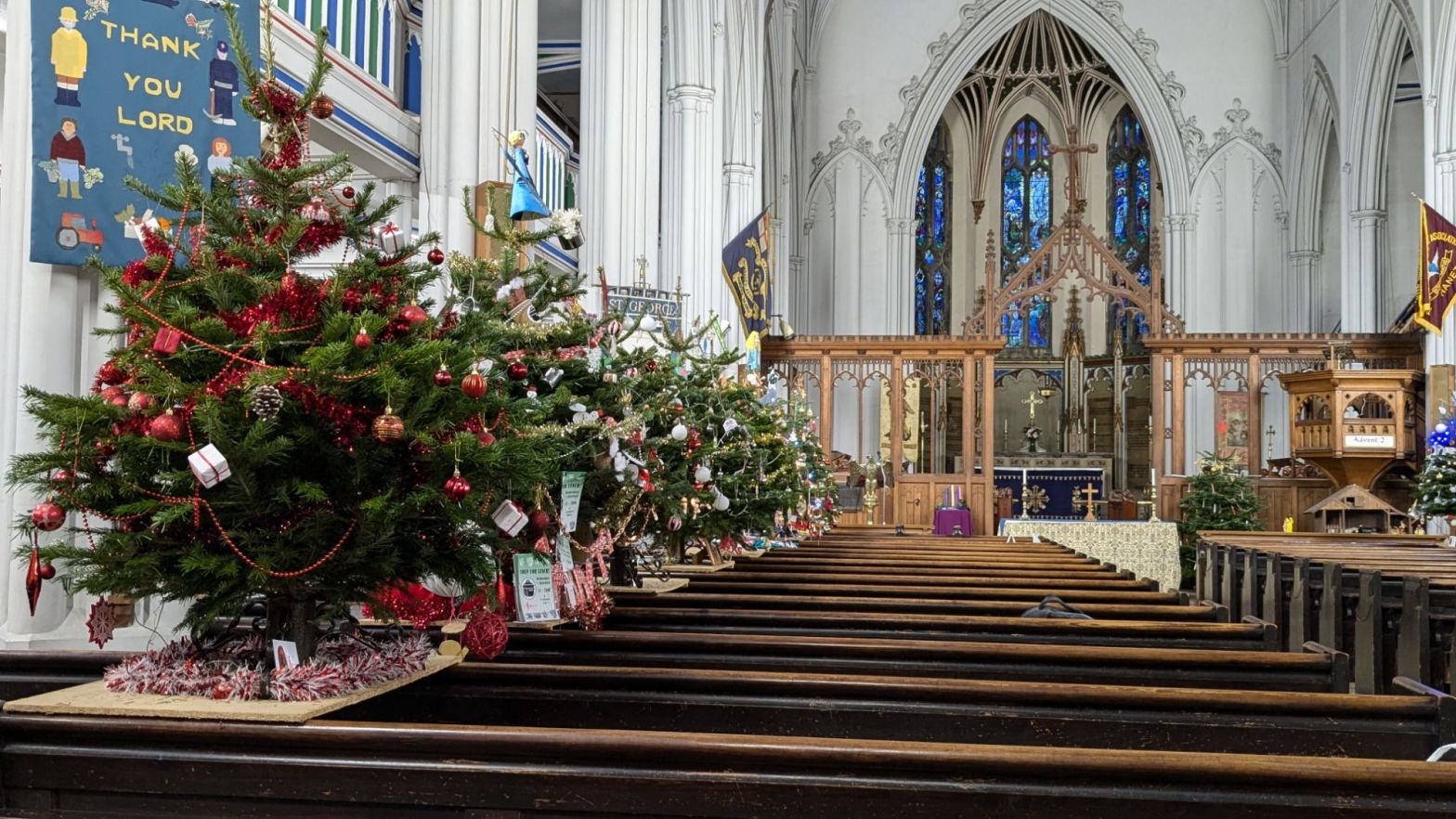

Light Party at St. Luke’s, 31st October

St. Luke’s Church, 31st October, 4:30-6:o0pm.

A great alternative to Halloween, for all ages.  Food, fun and treats (no tricks). Fancy dress, please (but not scary). Children must be with an adult at the party.

Contact Charlie Harley: crharley13@gmail.com .

Biblical Vision 5: Discipleship (Matthew 28:16-20)

“Therefore, go and make disciples of all nations, baptising them in the name of the Father, the Son and the Holy Spirit…” (Matthew 28:19)

The key phrase in this vision is: ‘make disciples.’ The rest elaborates what that means. Disciples are to come from all nations and be given a new identity through baptism as those who belong to the God who is now known as Father, Son and Holy Spirit. They are to be taught to obey all that Jesus had taught and they are to know that Jesus will always be with them. Whatever our vision is, it must have making disciples at its heart.

As recorded at St. Luke’s

Biblical Vision 5: Disciples (Matthew 28:16-20)

The Top 3 Influencers Today

Who or what influences you? Do you know? Do you care? Does it matter? And if it does matter, why do you allow that person, people or organisation to influence you?

We live in a world of social media and social influencers.

The main platforms that influencers operate on are Instagram, Tik Tok, X (formerly known as Twitter) and YouTube. These platforms enable anyone to write or share video content potentially with vast networks of people around the world.

For example, we will upload this sermon to YouTube and anyone in the world will be able to watch it. But the truth is very few will watch it online. The St. Luke’s YouTube channel has around 219 subscribers and the sermon with the most views has around 250 views.

Compared with the top social media influencers, these numbers are miniscule.

Top of the list is footballer, Cristiano Ronaldo, who has over 800,000,000 followers across all platforms, including over 600,000,000 on Instagram.

Next up is Selena Gomez, a singer song writer, who has over 580,000,000 followers across all the platforms, but mainly on Instagram.

In third place overall, but with the largest number of YouTube Subscribers, is MrBeast, who has 320 million subscribers on YouTube! In case you are wondering what makes MrBeast famous, well it’s not because he is a great sportsman like Cristiano Ronaldo or an amazing singer like Selena Gomez, it’s that he is very, very good at creating YouTube videos that hook you in!

And that is increasingly, how we are fed information and entertainment through the internet. We are led to watch and read that which catches our attention and draws us in. And as we watch all this information we are influenced.

Companies pay the influencers to push their products, so that we are influenced to buy them. But we are also influenced by the people we watch. We aspire to want to become like them, to have their talent, their fame, their wealth. We increasingly think these are the things that matter in life.

To have influence is to have power. MrBeast has even talked about the possibility of running for President of the USA.

Discipled or Influenced?

In the baptisms earlier on we urged both Alby and Pippa, to ‘fight valiantly as disciples of Christ.’  In our reading, Jesus’ great commission to his disciples and by extension to the church is to go and make disciples.

But is to be a disciple to be merely someone who is influenced by Jesus or does it mean more? Is being a disciple of Jesus a bit like being a YouTube follower of Ronaldo, Gomez or MrBeast? Is baptism just like clicking, ‘Subscribe’ on the internet? Or is there more to being a disciple?

First Century Internet?

A related question is about the scope of Jesus’ vision. Just as influencers today, seek to grow a massive worldwide subscriber base, Jesus’ tells his disciples to go and make disciples of all nations.

Except Jesus had to do it without the internet. Now information travels at the speed of light, then it was at the speed of a horse. To become a worldwide influencer today is challenging and only a handful manage it. Then it was impossible.

How could a man in his early thirties living in an occupied country on the edge of the Roman Empire, with no wealth, power or army and just a handful of uneducated followers hope to influence the whole world. Humanly, speaking this was perhaps the most ridiculous vision ever shared.

Yet, today, if being baptised is the equivalent of being a subscriber, then Jesus does not just have 100s of millions of followers, but billions. In fact, it is estimated that there are 2.5billion Christians in the world today, that is over three times the social media followers of Cristiano Ronaldo.

How was it possible for Jesus to create such a vast number of followers with no internet, no army, no money and no power?

The answer was that his disciples were to be the network and to build the network. If they the eleven disciples were to go and make disciples, then the disciples they made were also to be those who would make disciples and so on, until the network of disciples spread throughout the world and the message and influence of Jesus transformed the world.

For this to work, to be discipled had to mean more than to be influenced. You may choose to watch videos of Cristiano Ronaldo, you might even subscribe to his YouTube channel and encourage some of your friends to do the same, but you will probably not see your mission in life to be a part of growing Ronaldo’s internet following.

So, what is different about being a disciple of Jesus? How is it that Jesus’ followers could build a network to share his message that has lasted 2,000 years and created more followers than anyone else in history?

Disciples Recognise Jesus’ Authority

For any normal human being, Jesus’ vision was ridiculous. But Jesus, although, he was fully human like you and me was unique and special in so many ways.

These words of Jesus come at the end of Matthew’s gospel. If you want to see how special Jesus is, you need to read the whole gospel. When you do so, you will see that Jesus was the one that the Jews had been promised by God would come. He was the culmination of God’s plans, not some random bloke who cropped up and said a few interesting things. You will also see that his teaching was powerful, memorable, radical and unique. Not only that, but he performed miracles that showed both amazing compassion for the sick and power over sickness. You will find a man who had such a clarity of vision, that to the incomprehension of his closest friends he allowed himself to be arrested and crucified, stating that his death would be for the redemption of the world and the creation of a new relationship with God. Then most powerfully of all, he did not stay dead, but on the third day rose again and appeared to his followers.

Not surprisingly, at the start of our passage, the eleven disciples are face to face with this Jesus, trying to come to terms with this series of events and particularly His death and resurrection. They didn’t know what to do. Should they worship or doubt that this could all be true?

Then Jesus makes the boldest claim of all:

“All authority on heaven and earth has been given to me.”

Such a claim would be outrageous, if it was not for the fact that Jesus had just risen from the dead! In the mouth of the resurrected Jesus, however, it makes perfect sense.

And not only that it changes everything. If Jesus is the ultimate authority, then it makes sense not just to become a follower in a social media sense, but to dedicate your whole life to him, indeed, to risk your whole life for him.

And this is what his disciples did. Despite the threats and commands of human authorities, the imprisonments, beatings and ultimately executions, they carried on telling people about Jesus and inviting them to become his disciples too. No matter what they sought to obey Jesus’ command.

Disciples Obey Jesus’ Teaching

The word disciple means to be a learner. It is more than being vaguely influenced by someone, because you are interested in them or what they have to say. Rather it is a desire to find out, understand and live out what they teach. It means to orient your life by the direction that Jesus gives.

In today’s world we have so many potential ways to be told how to live and think and what to say. We watch youtube videos, read online article, books, newspapers or listen to podcasts. The internet algorithms can quickly lead us down a rabbit hole of radical ideas that seem to be backed up by one video or article after another.

But do we stop to think, why am I listening to, believing or even obeying this particular person that I am watching? What makes them special? Why should I aspire to be like them? What makes their advice better than anyone else’s?

Jesus’s teaching may be hard to obey – whoever said loving your enemy was easy? But, if Jesus truly was the one who was God’s promised king, the one who loves us so much he died for us, the one who has defeated death and the one who has been given all authority on heaven and earth, then doesn’t obeying him make more sense than obeying anyone else?

And unlike all the modern gurus and philosophers, his teaching has stood the test of time and been accepted by people from all cultures around the world. Surely, it makes more sense to obey him than anyone else? Surely, being his disciple is the best way to go.

Disciples Know Jesus’ Presence

So, disciples recognise Jesus’ authority and obey his teaching, they also know his presence.

In the last verse, Jesus makes a promise. He says,

“And surely I am with you always, to the very end of the age.”

Jesus is not just a historic character. A good teacher whose words are preserved in the Bible. For those who are his disciples, he is with us now, by His Holy Spirit.

Just like the first disciples, we can pray to him and seek his help in this life, both to live for him and cope with life’s challenges. Being a Christian is not just about obeying 2,000 year old teachings, it is about a relationship now with the living God, who is Father, Son and Holy Spirit.

Jesus’ vision was laughable

Jesus’s vision to reach all nations, with a bunch of uneducated powerless men, was laughable then and at times the idea of being a true disciple of Jesus can seem laughable now.

But, when we come to see who Jesus really is, how important his teaching is, and that we can have an ongoing relationship with him now, we can begin to understand why his vision was achieved and is still being achieved and I hope you might also want to become part of that vision.

Perhaps there are some here today, who now realise that in a world full of influencers trying to make you a follower, even though they have nothing worthwhile to offer you. Maybe now is the time to look again at Jesus as the only one worth being influenced by and more than that becoming a disciple of.

Community Soup – Update!

With funding from Canterbury Diocese and a Thanet District Council Shared Prosperity Fund grant, Community Soup is now operating regularly on Wednesday and Saturday lunchtimes, 12-2pm, from the main St George’s church building on a ‘pay what you can’ basis.
As the cost-of-living crisis has intensified there has been increased demand from people in Ramsgate for low-cost food. Community Soup offers a way for those who can afford to pay for lunch to support the church, whilst not excluding people who can only afford to pay a small amount.

Community Soup has received £10,000 from the UK Government through the UK Shared Prosperity Fund, as well as funds via Project 200, our 5-year regeneration project supported by Canterbury Diocese in advance of the 200th Anniversary of St George’s Church.
Delivery of the soup project has the added benefit of providing employment for local people. The longer-term goal for Community Soup is that it should eventually become self-sustaining in future so that it does not rely on grant funding but generates sufficient income from sales.

Regeneration Officer, Jemima Brown said ‘We are excited to be serving delicious soup cooked by Jenny Harris from St George’s Hall kitchen. The soup is now being taken over the church to be served in the church on Wednesdays and Saturdays, which is also a really nice way of getting the church building open more often’.

This project is funded by Thanet District Council as part of the UK Shared Prosperity Programme.

Midas Touch – Art Exhibition

Sat 12 & 19 October: 10am – 4pm
Sun 13 & 20 October: 12 – 4pm

Responding to the interior of St George’s church and across a palette of gold and ultramarine, artist Russell Chater presents new works under the title ‘Midas Touch’.

We Raised the Roof!

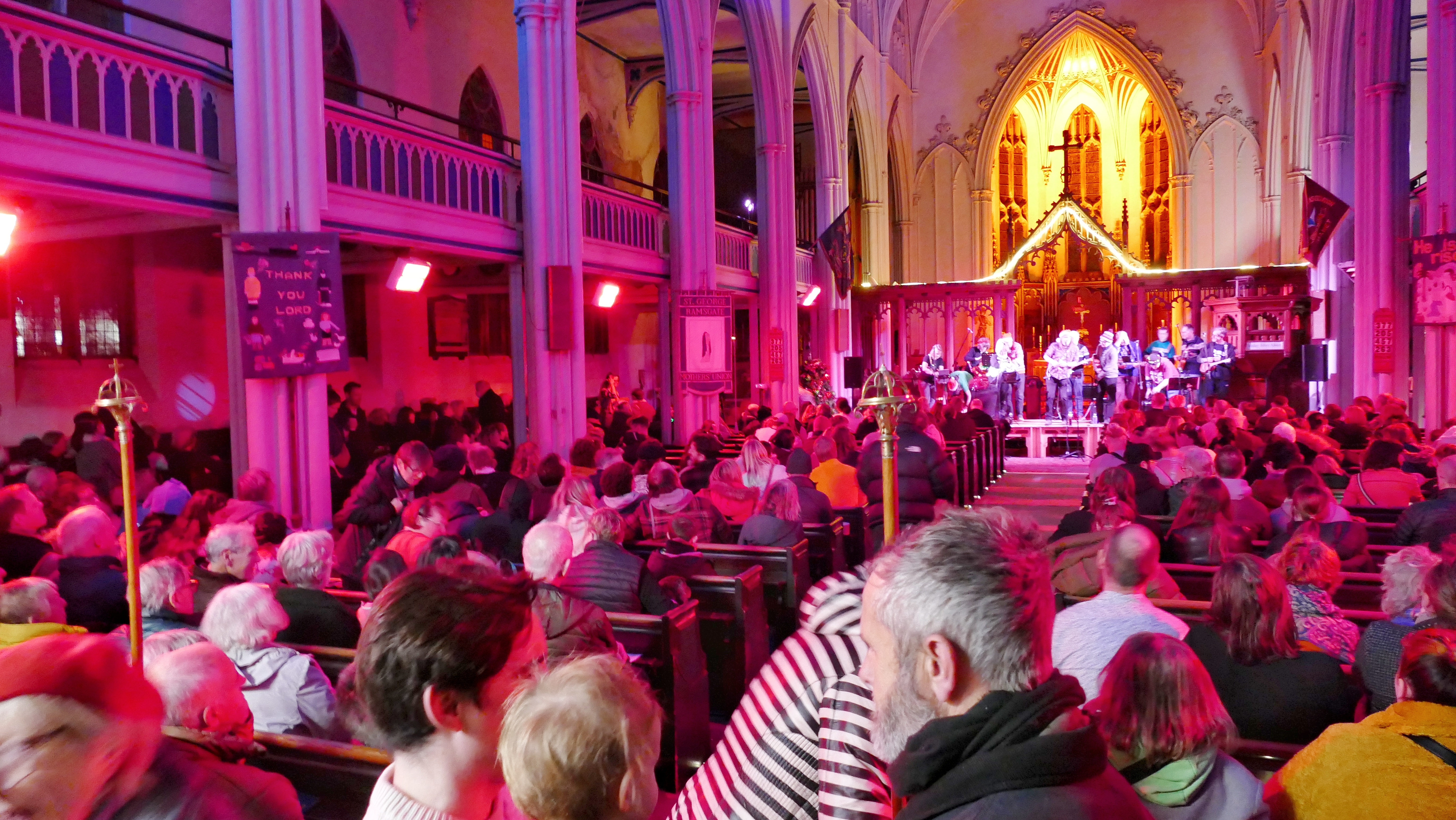
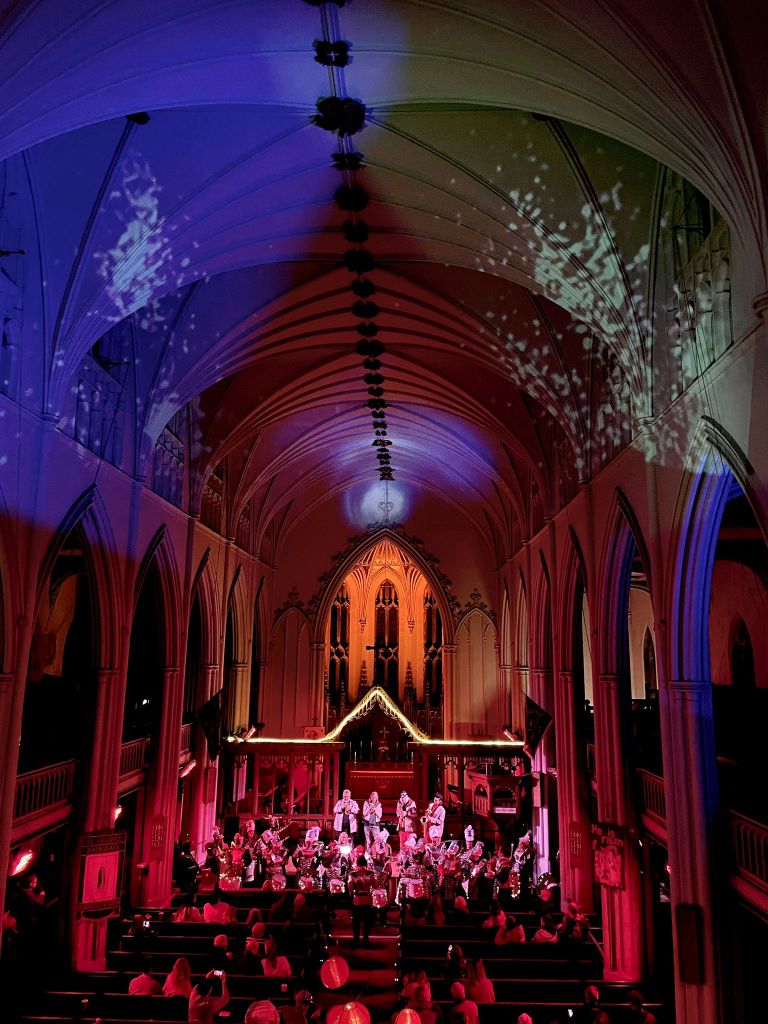
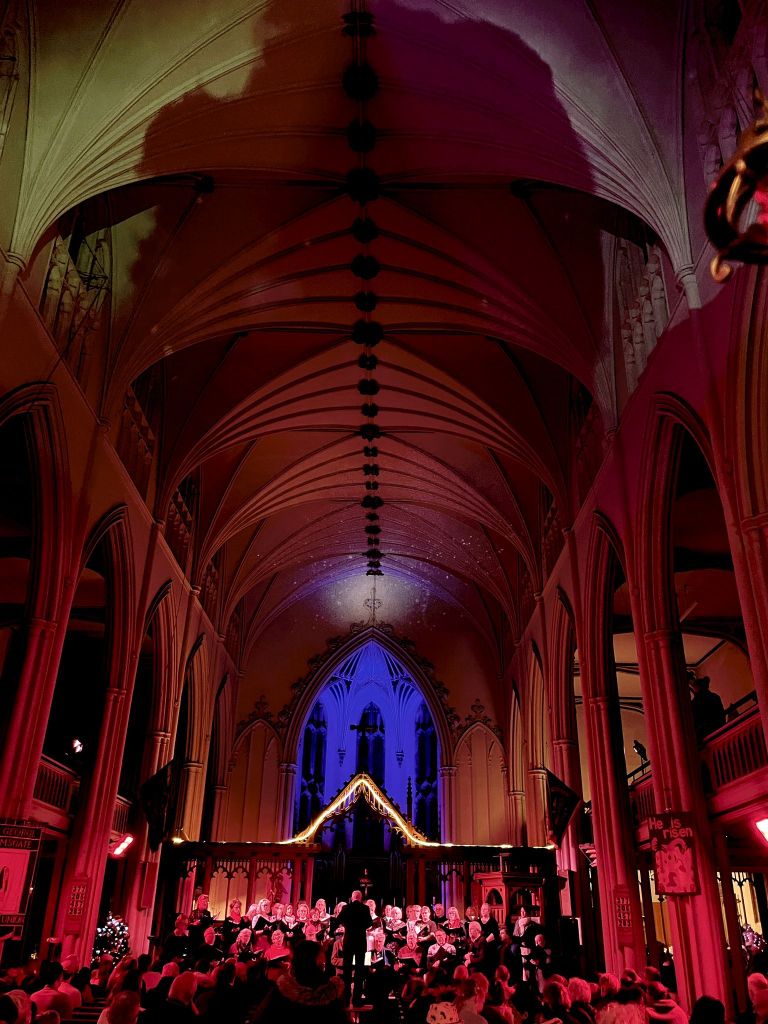
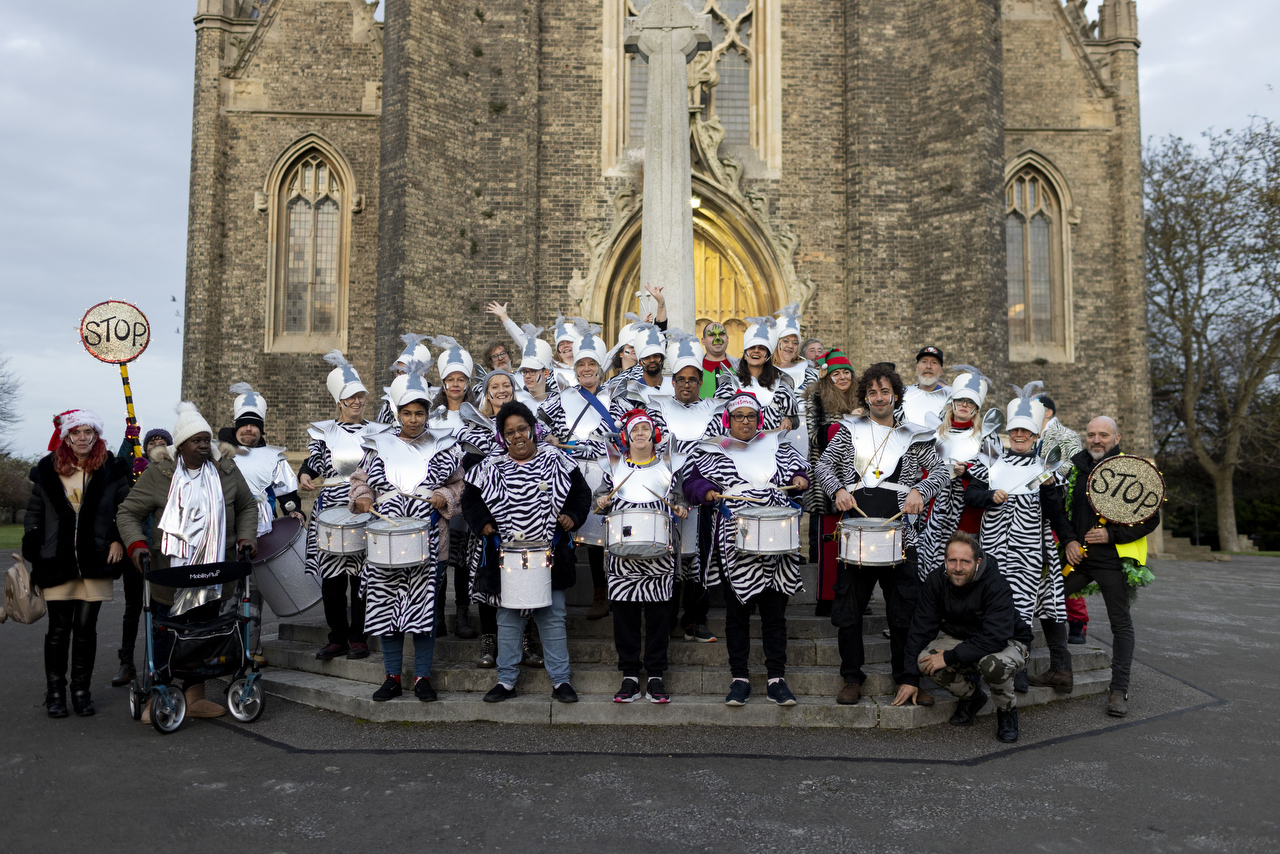
Last week with Pie Factory Music was fantastic! Not only did we raise over £1,000 – split equally between Pie Factory and The St George’s Restoration Fund, we also had a brilliant time doing it. Thanks to all the acts, staff and volunteers who worked so hard to put this event on and of course to everyone who bought tickets.

A key aim of Project 200 is to open up St George’s to everyone in our community. It’s really important for young, local musicians to have the opportunities to showcase their talents, so we were particularly excited to host artists from Pie Factory’s Emerging Artist programme.

Photographer Tom Keenan captured some lovely moments on the night.
More of his work is on his website.

This Week’s Notices – 13th October 2024

(Matthew 28:19)

We have been going through the Bible looking at moments when God revealed his plans to his people, so that they had a vision of the future that God was going to bring about. Each vision statement was relevant to particular people at particular times and although each had a lot to show us about what it means to be the people of God, they were not specifically meant for us.

They lived before Jesus, to whom the Old Testament ultimately points. He is the pre-eminent descendant of Abraham, through whom all nations are blessed. The rescue of Israel at the time of Moses from slavery in Egypt to a life in the promised land merely foreshadows, Jesus’ exodus through death, which brings us freedom from sin and the living hope of eternal life. Jesus was the Son of David, who would rule not just over Israel for a lifetime, but at God’s right hand eternally. It is the sacrificial blood of Jesus on the cross, that creates the New Covenant of inner transformation that Jeremiah looked forward to.

We now live after Jesus. So, the vision that Jesus gives to his followers, between his resurrection from the dead and his ascension into heaven, is a vision for God’s people until he returns. Matthew emphasises this vision, by making it Jesus’s last words in the gospel.

The key phrase in this vision statement is: ‘make disciples.’ The rest elaborates what that means. Disciples are to come from all nations and be given a new identity through baptism as those who belong to the God who is now known as Father, Son and Holy Spirit. They are to be taught to obey all that Jesus had taught and they are to know that Jesus will always be with them. Whatever our vision is to be, it must have making disciples at its heart.

Paul Worledge

Vacuum Cleaner – Needed!

We need a replacement vacuum cleaner for the St. George’s church hall. Does anyone have a spare device, not needed, which they could donate? Preferably a cylinder style one. Please contact Mark Ogden on 07896 111159.

National Week of Prayer from 12th October

The National Week of Prayer runs from 12th to 20th October. YWAM are organising some local ‘Sphere of Influence’ prayer events:

Mon 14th              Arts, Entertainment, Media, (7:30-8:30pm)

St Luke’s  Church, Ramsgate CT11 7JX

Tues 15th              National & Local Government and Justice, (7:30-8:30pm)

Kairos Cafe, Cecil Sq, Margate CT9 1BD

Wed 16th              Business & the Workplace, (7:30-8:30pm)

The Vale URC, Broadstairs CT10 1RB

Thu 17th                Health & Social Care, (7:30-8:30pm)

The Meeting Room, Yoakley House, Margate CT9 4AH

Fri 18th                  Education, (7:30-8:30pm)

Elim Oasis Church, St Peter’s CT10 2TE

Sat 19th                 Family & Family of Nations, (4:30pm)

Multi-generational worship & a HUGE world map to pray on

                The Corner, Whitehall Rd, CT12 6DF

Sun 20th                Revival and Renewal

                                                 St Philip’s Church, Palm Bay CT9 3JJ

Find out more on  this video about the events.

The Light Party, St. Luke’s, 4:30-6:00pm, 31st October

Our alternative to Halloween. A party event for all ages. This annual event is great fun and a good way to provide a positive alternative to the darkness that is the focus of Halloween celebrations. Do come and encourage both church and non-church friends to come.

If you would like to volunteer to help make this event possible, then please speak to Charlie or Tonya.

Questionnaire Response Analysis

Thank you to all those who filled in the online questionnaire during the summer. The full analysis is now available as a printed copy at the back of church and online. Please feel free to look at the printed copy, but don’t take it away! Read the online version…

What have we discerned?

As we come to the end of the Year of Discernment we want to share, Vision 2030, the plan we think God has for our churches over the coming five years. We will be making a presentation on Monday 11th November at 7:30pm at St. Luke’s church, members from both churches are encouraged to come and hear the plans. There will be opportunities for feedback in the meeting and in the weeks afterwards.

Links to Share:

This week some articles that deal with some of the struggles we face.

A Christian Response to Chronic Pain

The chances are that you know someone who lives with chronic pain, whether you are aware of it or not. Chronic pain is a specific type of suffering which is invisible, unpredictable and long-lasting. We discuss how this presents a particular set of challenges and hurdles to the sufferer, their loved ones and the wider church family, and we also share a personal example of living with chronic pain. Chronic pain demands a response; here we seek to bring biblical light to help people of faith who are seeking to respond well. Read more (an in depth article, but well worth the read if you suffer with chronic pain or want to know how to support those who do.)

Israel-Gaza war anniversary: why peacemakers need a touch of doubt

This article by Graham Tomlin aims at helping us understand the present Middle Eastern conflict from the point of view of Israeli’s and Palestinians and encourages us to think through what it means to ‘love our enemy.’ Read more…(7 min. read)

Assisted Suicide Bill

If you are concerned about the possible introduction of an assisted suicide law, then you may want to check out this message and way of contacting the MP about it. Find out more…

Finally, let’s pray that we can make more disciples.

Yours in Christ

Paul Worledge

(Priest in Charge, St. George’s Ramsgate)

Weekly Calendar

Sunday 13th – The Twentieth Sunday after Trinity

Eucharist (St George’s, 9:30am) – Reading: Matthew 28:16-20

Sunday School (St George’s, 10:30am)

Monday 14th          

Prayer Meeting (St. Luke’s Church) – 9:30-10:00am

Craft Group (St. George’s Hall, Soup Kitchen) – 2:00-3:30pm

Study Group (South Eastern Road) – 7:15-9:30pm

Tuesday 15th        

Prayer Meeting (St. George’s Church) – 9:30-10:00am

Coffee Morning (St. George’s Hall) – 11:00am-12:00pm

Study Group (Lyndhurst Road) – 2:30-4:00pm

Community Meal (St. George’s Hall) – 5:30-7:00pm

Wednesday 16th       

Study Group (Langdale Avenue) – 10:00-12:00 noon

Community Soup (St. George’s Church) – 12:00-2:00pm

Depression & Anxiety Self-Help Group (Perry Room) – 6:00-7:30pm

Study Group (South Eastern Road) – 7:30-9:30pm

Thursday 17th    

Prayer Meeting (St. Luke’s Church) – 9:30-10:00am

PCC Meeting (St. George’s Church) – 2:00-4:00pm

Youth Hang Out (St. Luke’s Church) – 3:00-6:00pm

Saturday 19th       

Prayer Meeting (St. George’s Church) – 9:30-10:00am

Sunday 20th – The Twenty-first Sunday after Trinity

Eucharist (St George’s, 9:30am) – Reading: Revelation 22:1-5

Online Forms

Under the ‘Contact’ tab on the website, there are now three forms that you can use to help us in managing the church:

  • Events Application Form. Use this if you are organising a church event that needs a church room booked, advertising or ticketing.
  • Submit a Notice. Use this if you want to ask us to include a prayer request or other notice in the church notice sheet or email.
  • Maintenance Reporting Form.Use this to report any non-urgent issues with our buildings or grounds.

St. George’s Website

  • What’s On – a page which lets you know what is happening this week and gives information about upcoming events.
  • Notices – You can read the latest notices on this page.
  • Sermons – Read a transcript of a recent sermon or watch the YouTube version recorded at St. Luke’s. There are now videos for all the sermons over the summer.

Safeguarding Training

If you volunteer in anyway at church the national authorities are strongly encouraging you to take at least the Basic Module in safeguarding training once every three years.

If you have not completed the training in the last three years, then the module can be completed online and takes about ninety minutes. You can access the training by following this link. You will need to first register, to access the training. Once the training is completed, you will be sent a certificate. Please forward that certificate to James (office@stlukesramsgate.org), so that we can keep records of who has done the training.aining.

Biblical Vision 4: New Covenant (Jeremiah 31:27-34)

“This is the covenant that I will make with the people of Israel after that time,” declares the LORD. “I will put my law in their minds and write it on their hearts. I will be their God and they will be my people.” (Jeremiah 31:33)

This week we return to our theme of Biblical Visions and look at Jeremiah’s prophecy of a coming ‘new covenant’, which will bring forgiveness and transformed hearts and minds.

As recorded at St. Luke’s

Biblical Vision 4: New Covenant

A hell of a life…

None of us want life to go badly. Most of us hope for a peaceful life, a happy marriage, a successful career, a healthy retirement, happy families and so on.

But, sometimes, life can be hell. We find ourselves embroiled in conflicts, marriages falling apart, being made redundant, struggling with ill health and seeing our families estranged.

We might ask, where is God in all that? Is this really part of his plan for my life? Surely he would want me to have an easy life?

We’re going through a series on Biblical Vision, looking at key moments in the Bible, when God reveals his big plans to key people. Today we come to a really important passage in Jeremiah, where God lays out his plans.

Now, although the vision we are looking at is positive, it is worth remembering that Jeremiah’s message was often much more about the struggles that God was going to bring. In fact, for Jeremiah, life was hell. He lived through the complete destruction of his kingdom and city and found himself hated for a message that proved to be true. Yet, God used him powerfully and his message is one that as we will see is fundamental to understanding the story of the whole Bible and even the Christian message! His was a hell of a life, but he was certainly part of God’s plan!

Jeremiah in Biblical History

To my shame in nearly a quarter of a century of regular preaching I have never preached on Jeremiah 31 before. In fact, in looking through my notes, I’ve only ever preached on Jeremiah once before! This is quite shocking, when you consider how big a Biblical book Jeremiah is, and how important this passage in Jeremiah 31 is.

To understand Jeremiah and this passage, we’ll need a quick recap of what we have looked at in our series on Biblical Vision so far as we have gone through the Biblical history looking at God’s vision statements.

The Gradual fulfilment of God’s Vision:

 We started with Abraham and God’s promise that he would bless him and his family and through him bless all nations. This would happen by making his family into a great nation, a fulfilment that moved forward by stages:

First, he would have many descendants, then they would settle in the promised land, then they would be ruled by a victorious king and his dynasty. Once all this was fulfilled after 100s of years, Israel was a great nation under David’s son Solomon. In fact rulers of nations would come to be blessed by his wisdom!

But alongside this plan for Israel to be a great nation and intricately connected to it was God’s plan for them to be his people. This was to be expressed in a special covenant relationship.

This was made clear to them on the way from being slaves in Egypt to the promised land, when God told them through Moses:

“”Now if you obey me fully and keep my covenant, then out of all nations you will be my treasured possession. Although the whole earth is mine, you will be for me a kingdom of priests and a holy nation.” (Exodus 19:6-7)

What did it mean to obey God fully? Well, the Ten Commandments set out the basic ideas of obedience.

What was a covenant? A covenant is kind of relationship plus promise. So, a marriage is a covenant relationship, that comes about when a man and a woman in a special ceremony promise to remain committed to each other for the rest of their lives. And at Mount Sinai, Israel ratified their covenant relationship with God, by agreeing to be loyal to him and to obey his commandments. This was all sealed by a special ceremony, which involved animal sacrifices and the sprinkling of the blood of the sacrifice on both the people and the altar to God.

So, by the time of Solomon, who built a temple for God, the covenant relationship and promise to become a great nation was all in place. 

The Disintegration of the vision

But from this high point, things went downhill. Why? Because the kings failed to be loyal and obedient to God and the people followed suit. God had kept his side of the covenant, but the people were consistently disobedient and disloyal.

Even Solomon, led astray by his many foreign wives, allowed the worship of foreign gods. So, God, declared that most of the kingdom would be taken from his family. And in his son’s time the kingdom split in two. A Southern kingdom around Jerusalem, still ruled by David’s descendants and a Northern kingdom ruled by other kings.

The kings of both nations were often wicked, oppressive and idolatrous. God was patient, but in the end, he punished them for their wickedness by sending first the Assyrian empire to exile the people of the northern kingdom, then the Babylonian empire to exile the people of the southern kingdom.

This second exile happened was forecast by Jeremiah and happened during his lifetime. Indeed, much of Jeremiah’s book is taken up with warnings to Israel to stop sinning and to turn back to God before it was too late. But his warnings fell on deaf ears and Jerusalem and the temple built by Solomon was destroyed.

Many of them probably thought it was all over. The covenant, the promises, the vision of God for a people through whom he could bless the nations all destroyed.

But although, Jeremiah’s preaching had mainly forecast this destruction, it also contained a message of hope, that the covenant, the vision of God was not over. In fact, in the midst of this tragedy, God proclaims through Jeremiah a significant vision of a brighter future.

A Different Future (31:28)

Most of Jeremiah’s book is about destruction. Verse 28 echoes the key theme of the book, but notice, that although destruction is the focus, it is not the end of the story:

“And it will be just as I watched over them,

to uproot,

to breakdown,

to overthrow,

to destroy,

and to bring evil,

then I will watch over them

to build,

and to plant!”

declares the LORD. (verse 28)

If you take on a house with a garden full of weeds, you need to start by uprooting all the weeds, before you can plant a beautiful garden. If you take on a derelict site on which to build a new house, first of all you need to demolish the house before you can build something better. If you are a doctor looking after a patient with cancer, first you need to cut out the cancer, and punish the body with chemotherapy and radiotherapy before you can bring about a healed and renewed healthy body.

Jeremiah lived through a time of uprooting and destruction. It wasn’t pleasant, but the nation that was meant to be great, and a blessing had proved to be corrupt and a curse. Uprooting and destruction were needed, before something better could be planted and rebuilt.

A Different Covenant (31:32-34)

But how will things be better?

The old covenant had just not worked. Israel kept breaking it. Jeremiah makes this point in verse 32:

“…the covenant that I made with their ancestors when I took them by the hand to bring them out of the land of Egypt — a covenant that they broke, though I was their husband,” says the LORD.” (Jeremiah 31:32)

Over generations Israel had consistently failed to live up to their side of the covenant relationship, if they kept running after other gods, and created a society of oppression rather than justice.

Things seemed impossible. How could the covenant work, when Israel would not change? How could a leopard change its spots?

Actually, that phrase about leopard and spots, comes originally from Jeremiah!

“Can the Ethiopian change his skin or the leopard its spots? Neither can you do good who are accustomed to doing evil.” (Jeremiah 13:23)

Of course, Israel was not unique in this regard. Evil seems ingrained in all humanity. Despite the many great technological, philosophical and societal advances in recent history. Evil and wickedness at every level continues to destroy lives. What hope is there?

Well God has a solution. It is a new covenant. Look at verse 33:

“This is the covenant that I will make with the house of Israel after that time,” declares the LORD. “I will put my law in their minds and write it on their hearts. I will be their God, and they will be my people.”

The great vision for Israel was that God would be their God and they would be his people. That could only work, though, if they are changed on the inside. A law on their minds and writing on the heart talks about a radical inner transformation. A true winning of hearts and minds. One that would also involve God’s forgiveness for sin as verse 34 makes clear:

“For I will forgive their wickedness and will remember their sins no more.”

Jesus and the New Covenant

So, how could this happen? The first covenant at Sinai was ratified by animal sacrifices and blood. But it had failed. A more powerful sacrifice and blood was needed.

At the last supper, with his disciples, Jesus prepared them for his imminent death by giving them bread and saying, “This is my body.” Then he gave them a cup of wine and in the words of Luke 22:20, he said:

“This cup is the new covenant in my blood, which is poured out for you.” (Luke 22:20)

The only place the phrase, ‘new covenant’ is used in the Old Testament is this passage in Jeremiah. Jesus was declaring that his imminent death on the cross, would be the sacrifice that would make possible the new covenant, not just a call to try and live by God’s rules, but the promise of a deep forgiveness of sin and an inner transformation of heart to enable us to truly become God’s people.

As Christ himself was torn down and uprooted by the sins of the world on the cross, God raised him up to become for us the means of entering into a new covenant with God, where we can be enabled to lives of loyalty and obedience to God.

What about our vision?

So, what has all this to say about our vision as church today?

Firstly, we need to accept that God’s plans can include destruction and judgement. Sometimes things need to be uprooted for something better to be planted. Sometimes things need to be destroyed for something better to be rebuilt. If we want to be part of something better, like Abraham we may need to leave some things behind, like the Israelites in Egypt, we may need to leave one home to travel through the wilderness to a better home, like Jeremiah, we may need to witness destruction in our time in a hope of God building a better future.

Even the Christian call to each individual is a call to repentance, that will often mean letting go of things we value in order to let go of someone whose value surpasses all. Are you willing to do that in order to grasp Christ?

Secondly, our vision needs to be about inner transformation of people. We want to see God at work transforming people from the inside out. Becoming a Christian is not primarily about taking up new habits, like prayer, Bible reading and coming to church (important as those things are). It is not primarily about joining a community of like-minded people (crucial as that is to faith). It is primarily about coming to know God as your God, Jesus as your saviour and the Holy Spirit working in you to bring about fundamental inner transformation. Creating in you a heart eager to live for God.

If our aim in growing the church is just to attract a crowd, then we will not really have achieved anything. We need to be about the new covenant, calling people to accept God’s work in their lives for a radical inner transformation. Anything short of that is failure. Not that we shouldn’t welcome people to join us as a church family and encourage them to pray, read the Bible and come to church, these are all the means to the end of inner transformation – but we must not mistake them for the end!

Thirdly, Jeremiah lived through a terrible time to be a prophet and a member of Israel. His experiences would have not been too dissimilar to the kinds of experiences of those living in some of today’s war zones. Sometimes for us today it can feel like life is falling apart, that we are living through a time of uprooting and destruction. But, although that may be God’s plan for now, it is not his ultimate goal. As Jeremiah could see, the ultimate goal is always to plant and to build.

This Week’s Notices – 6th October 2024

(Jeremiah 31:33)

Lots in this week’s notices. Remember to scroll to the end for church calendar. Also, the shared blogs give a range of views on the effects of young people’s use of smart phones…

___________________________

The Bible is full of visions of the future that God gives to his people at different points in their history. These visions given by God, contain a certainty and commitment that is not possible for mere human beings. Our lifespans are finite, our power is limited, but God is eternal and unconstrained. He is also faithful. What God says about the future will come about – eventually.

The Bible often refers to God’s vision statements as ‘covenants.’ A covenant is promise plus relationship. It is commitment to a goal and loyalty to a person or people. God’s visions are covenants, because they commit God to fulfilling certain goals and remaining loyal to his people.

But what if God is loyal and the people are not? How can that relationship work? The Old Testament shows that this was a common problem.

So how does God deal with this dilemma? Firstly, there is a certain conditionality to the covenants. There is judgement when the people fail to live up to their side of the bargain. Jeremiah and the other prophets keep warning the people that this judgement is coming. Secondly, although God judges, he does not abandon the covenant. There is always hope, because God is faithful. Jeremiah and the other prophets also talk about hope beyond judgement.

But Jeremiah also tells us of a third response:  ‘a new covenant’. God will transform hearts and minds, so that they will remain loyal to the covenant. How does God do that? Through Jesus. At the last supper, Jesus says, “This cup is the new covenant in my blood…” (1 Corinthians 10:25) This is a vision that goes beyond a hope of stronger nations, prosperity or better buildings. It is a vision for a transformed humanity, that can truly be God’s people.

Paul Worledge

Prayer Breakfast – Saturday 5th October, 9-10am

St. George’s will be hosting the churches together prayer breakfast at St. Luke’s Hall (St. George’s Hall is unavailable). Any volunteers to help are welcome (please see Paul), but please do also plan to come, meet up with others from local churches and pray!

Pie Factory Concert at St. George’s – Tomorrow!

Pie Factory Music and St George’s are teaming up for a gala fundraiser on Friday 4th October in St George’s Church. There will be a pay bar, with doors opening from 7.00pm. Tickets £10 available through the St. George’s website. Find out more…

Harvest Collection

Thank you to all those who contributed food to the Harvest collection and money to the Christian Aid Middle East appeal.

Youth Hangout – After School Club

Do encourage young people to come to our new after school club on Thursday afternoons. We have extended the time to be from 3-6pm, so children returning to Ramsgate a bit later in the evening can attend. More information and a parental consent form available on the website.

National Week of Prayer from 12th October

The National Week of Prayer runs from 12th to 20th October. YWAM are organising some local ‘Sphere of Influence’ prayer events including one for Arts, Entertainment and Media at St. Luke’s Church, 7:30-8:30pm on Monday 14th October. See Lucy or click here to find out more or here to watch a video about the events.

Questionnaire Response Analysis

Thank you to all those who filled in the online questionnaire during the summer. The full analysis is now available as a printed copy at the back of church and online. Please feel free to look at the printed copy, but don’t take it away! Read the online version…

Upcoming Baby Loss Support Service

On the 12th October at 11.30am, in Canterbury Cathedral, Mariposa Trust will be hosting one of their Saying Goodbye Services. This is for anyone who has either personally lost a baby at any stage of pregnancy, at birth, or in early years, or who has been affected by family members’ or friends’ loss. Whether the loss was recent or 80 years ago, everyone is welcome to attend.

Links to Share:

Some blogs about the ongoing debate around children and young people’s use of Smart Phones.

Smart Phones – a young person’s perspective

In this powerful article by a young person, the writer argues that smart phones have touched her of a normal childhood. Read more (5 minutes)

Parents against Smartphones

This article reports a growing movement of parents in the United Kingdom seeking to restrict the use of Smart phones untill the age of 16. Read more

Are we being anxious about anxiety

This article argues that the concerns about mobile phones and social media on our young people is over-hyped. Read more (6 mins).

More on what is causing anxiety among young people

In this article, Krish Kandiah considers the arguments around the causes of anxiety in the new generation. Read more…

Finally, let’s enter into God’s new covenant made available through Jesus.

Yours in Christ

Paul Worledge

(Priest in Charge, St. George’s Ramsgate)


Weekly Calendar

Sunday 6th – The Nineteenth Sunday after Trinity

Eucharist (St George’s, 9:30am) – Reading: Jeremiah 31:27-34

Monday 7th           

Prayer Meeting (St. Luke’s Church) – 9:30-10:00am

Craft Group (St. George’s Hall, Soup Kitchen) – 2:00-3:30pm

Study Group (South Eastern Road) – 7:15-9:30pm

Tuesday 8th         

Prayer Meeting (St. George’s Church) – 9:30-10:00am

Coffee Morning (St. George’s Hall) – 11:00am-12:00pm

Study Group (Lyndhurst Road) – 2:30-4:00pm

Community Meal (St. George’s Hall) – 5:30-7:00pm

Wednesday 9th        

Study Group (Langdale Avenue) – 10:00-12:00 noon

Community Soup (St. George’s Church) – 12:00-2:00pm

Study Group (South Eastern Road) – 7:30-9:30pm

Thursday 10th     

Prayer Meeting (St. Luke’s Church) – 9:30-10:00am

Saturday 12th        

Prayer Meeting (St. George’s Church) – 9:30-10:00am

Open Church (St. George’s Church) – 11:00am-1:00pm

Sunday 13th – The Twentieth Sunday after Trinity

Eucharist (St George’s, 9:30am) – Reading: Matthew 28:16-20

Online Forms

Under the ‘Contact’ tab on the website, there are now three forms that you can use to help us in managing the church:

  • Events Application Form. Use this if you are organising a church event that needs a church room booked, advertising or ticketing.
  • Submit a Notice. Use this if you want to ask us to include a prayer request or other notice in the church notice sheet or email.
  • Maintenance Reporting Form.Use this to report any non-urgent issues with our buildings or grounds.

St. George’s Website

  • What’s On – a page which lets you know what is happening this week and gives information about upcoming events.
  • Notices – You can read the latest notices on this page.
  • Sermons – Read a transcript of a recent sermon or watch the YouTube version recorded at St. Luke’s. There are now videos for all the sermons over the summer.

Safeguarding Training

If you volunteer in anyway at church the national authorities are strongly encouraging you to take at least the Basic Module in safeguarding training once every three years.

If you have not completed the training in the last three years, then the module can be completed online and takes about ninety minutes. You can access the training by following this link. You will need to first register, to access the training. Once the training is completed, you will be sent a certificate. Please forward that certificate to James (office@stlukesramsgate.org), so that we can keep records of who has done the training.an keep records of who has done the training.
Harvest (Matthew 6:25-33)

‘But seek first his kingdom and his righteousness, and all these things will be given to you as well.’ (Matthew 6:33)

In this time of harvest, we are first reminded to seek the Kingdom, trusting in God completely. Then, we are called to BE the Kingdom to others around us, showing hospitality, love, and mercy in the face of scarcity, anxiety, or fear. As Jesus said, can any one of you, by worrying, add a single hour to your life? Instead, let’s trust in God’s provision and show love to those around us.

As recorded at St. Luke’s