COSMIC PERSPECTIVES – BYOB (Bring Your Own Beamer)
Date: Sat 21 Sep, 2024 12 – 5pm In the Crypt, St Georges Church, Church Rd, Ramsgate CT11 8RE.
We are looking forward to welcoming Lumen to the Crypt at St George’s.
For the September Equinox, Lumen Studios present a number of astronomy and space themed projections for a pop-up Bring Your Own Beamer event at St Georges Crypt, Ramsgate.
Bring Your Own Beamer is a series of one-night exhibitions curated by different people around the world. Artists are invited to bring their own projectors for a pop up event. Bring Your Own Beamer was founded by Rafael Rozedaal.
Confirmed Artists
Sapphire Goss Johnny Goddard Melanie King Shaun Prickimage Mitch Johns (Hack Modular) Clementine Blue Kristian Baughurst (Visual Subversion)
This event is supported by the Ramsgate Town Council Fund.
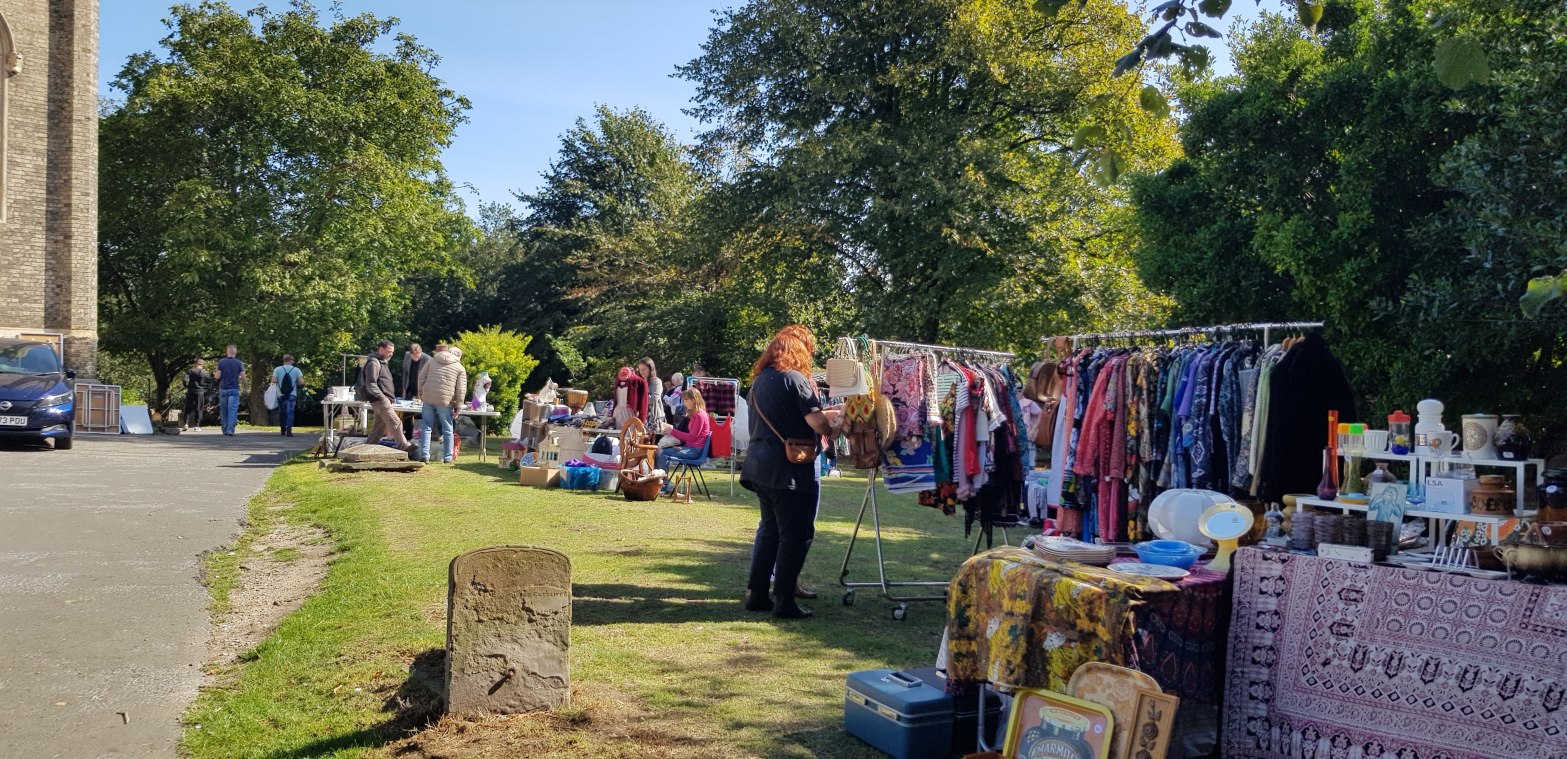
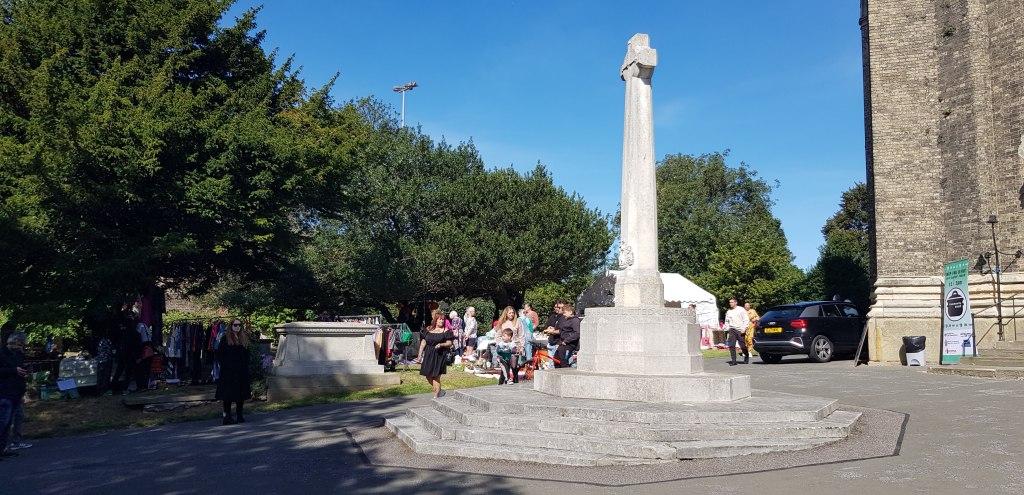
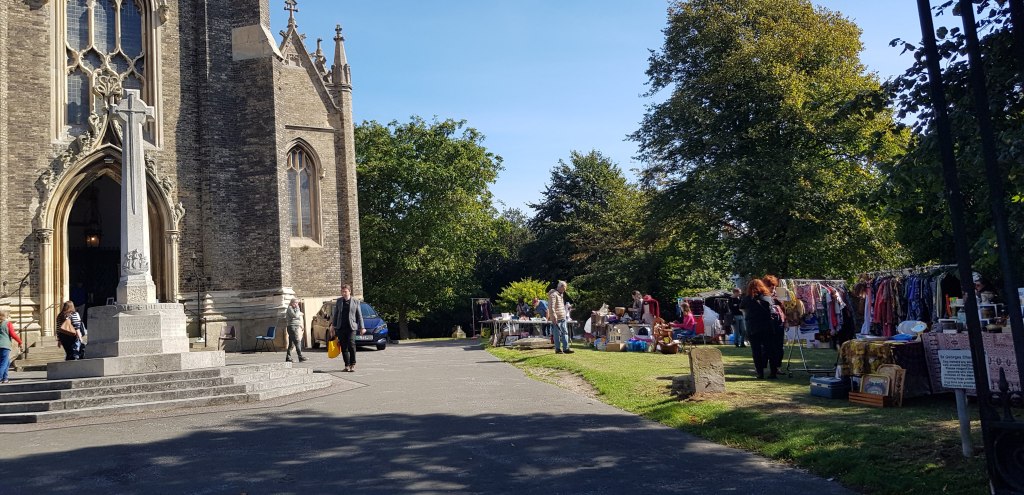
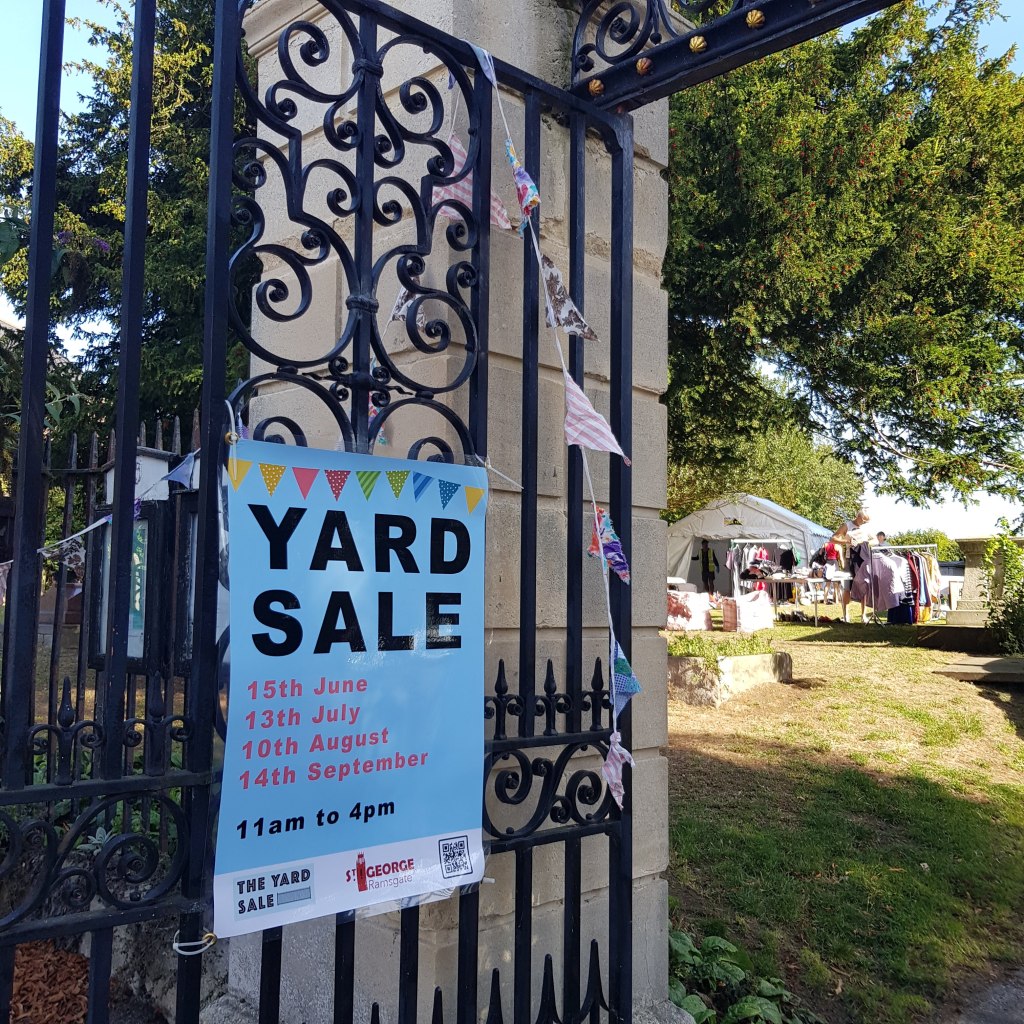
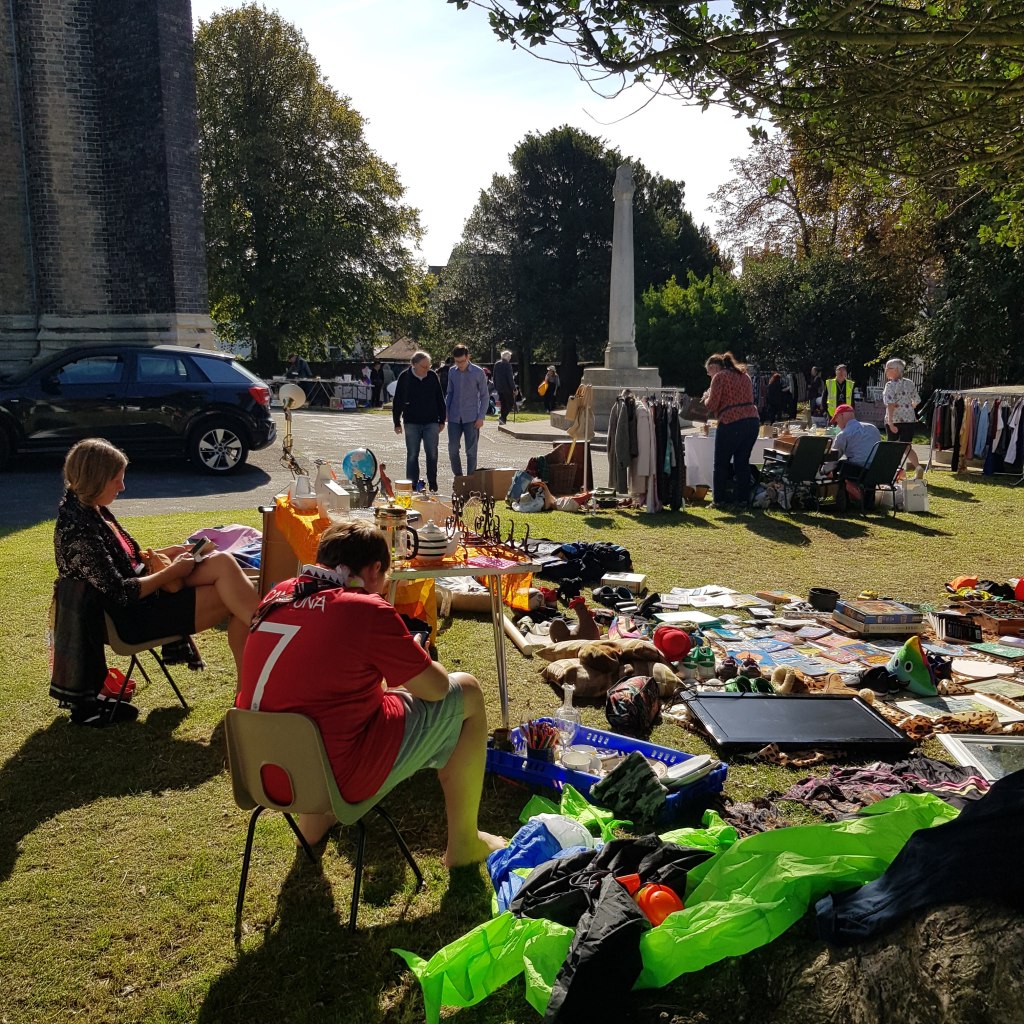
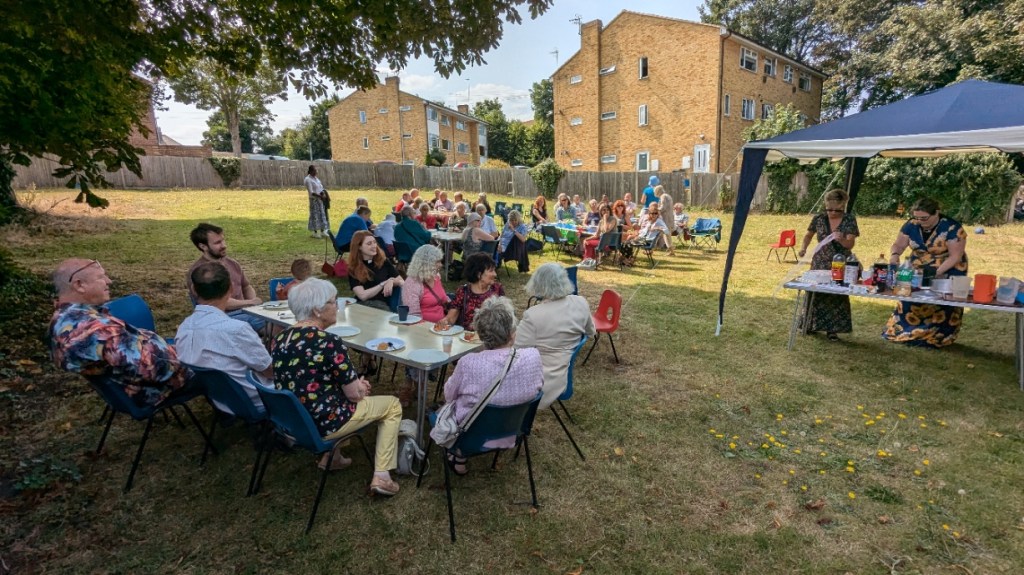
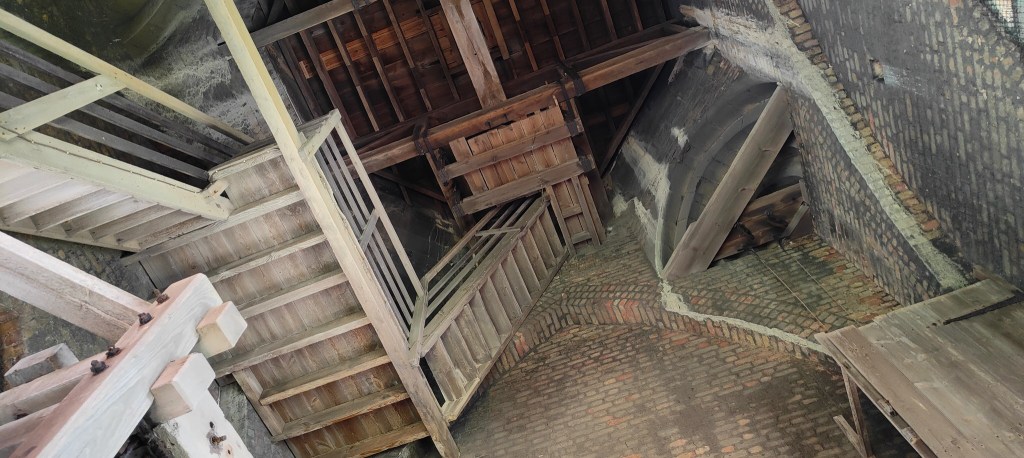
Finally, the weather was kind to us on a Yard Sale day! With over 400 visitors through the gates, it was a fantastic turnout on the 2nd of our 2 Heritage Open Days, which coincided with the final Yard Sale of the season, as well as Ride & Stride. There were 3 fully booked tours of the tower and another 3 fully booked tours of the crypt. Big thanks to Jo Mapp for organising the stalls and entertainment and to Pie Factory for coming along to showcase their bike repair project (check their website for more details) Also huge thanks to our volunteers for the smooth running of an excellent day. Roll on summer 2025 when we will do it all again…
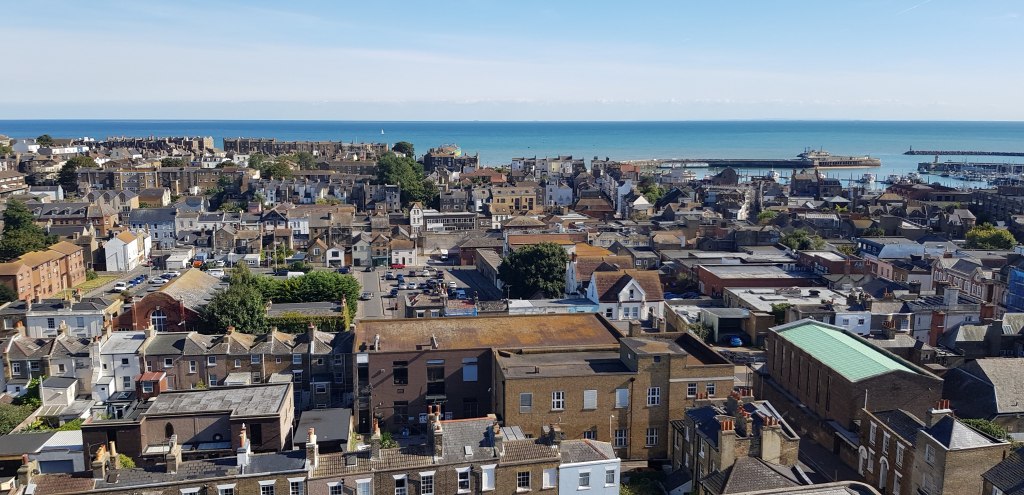
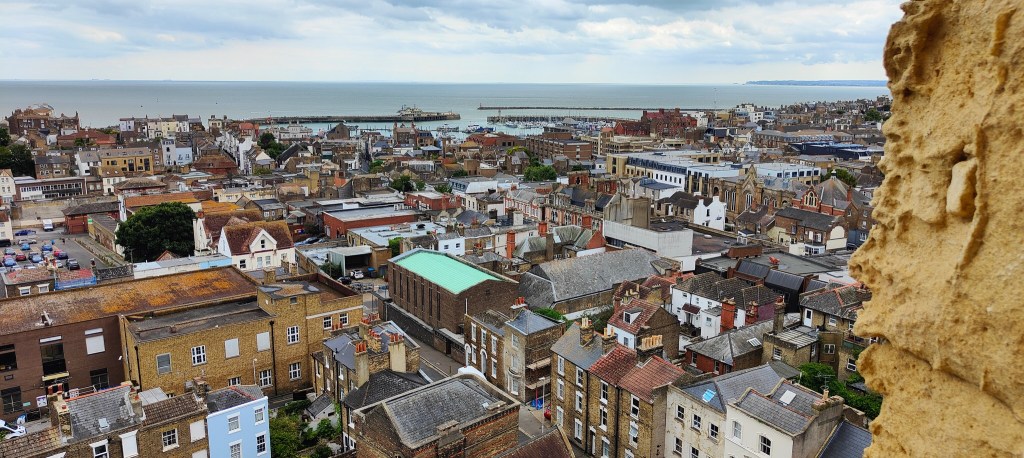
The weather was perfect for good clear views from the tower
God said to Israel: “I will take you as my own people, and I will be your God. Then you will know that I am the LORD your God, who brought you out from under the yoke of the Egyptians.” (Exodus 6:7)
We continue our series on Biblical Visions. This week we look at God’s plan to rescue Israel from slavery in Egypt.
Do you enjoy watching heist movies? The most famous heist movies are the Italian Job, the original 1969 version starring Michael Caine and Oceans 11, not the original, but the remake from 2001 starring George Clooney.
They all tend to follow a similar plot. A master criminal gathers a team of thieves, each with their own expertise. Then he lays out his master plan of how they are going to carry out a daring robbery of a bank or vault of some kind, then the robbery takes place and the aftermath is portrayed.
In each film, there is a key scene in which the plan for the heist is explained by the master criminal. This is the scene you need to pay attention to – otherwise the rest of the movie does not make sense, although it may be still fun to watch.
You could argue that in the Bible, the book of Exodus is a heist movie. God is stealing the people of Israel from Pharaoh! Not that God is a master criminal, rather he is rescuing his people who have in a sense been stolen and ill-treated by the Egyptians, so that they can truly be his people. This is a liberation not a theft.
Nonetheless, the book does follow a pattern a bit like a heist movie. God recruits his team, Moses and his brother Aaron, to take part in the plan and in the passage we have just had read to us he lays out his rescue plan.
Biblical Vision Part 2
As we reflect in our Year of Discernment on what God may be calling us to over the coming years we are looking at some of the passages in the Bible where God lays out his vision for his people. As we reflect on these different visions through the story of God’s dealings with his people we are looking for clues and guidance on what that might mean for our vision coming out of the year of discernment.
So, what is the rescue plan God lays out in Exodus 6?
Before he gets to the plan, God begins by explaining why he is carrying out his plan. He emphasises that he is the God who made the promises to Abraham and his son and grandson, Isaac and Jacob. This plan is a continuation of the plan he presented to Abraham. God has already made Abraham into a numerous nation, but now he sees them oppressed as slaves in Egypt, he realises that he needs to come through on the rest of the plan to bring them into the promised land. Then in verses 6-8, he gives three phases to the plan.
The Heist
Phase 1 is the heist, his plan to liberate them from their slavery in Egypt: Look at verse 6:
I will bring you out from under the yoke of the Egyptians
I will free you from being slaves to them
I will redeem you with an outstretched arm and mighty acts of judgement
They do not have to do anything. God will rescue them, and he does in powerful ways – read Exodus 7-14 to see the amazing story of what God does.
The Prize
You would expect phase 3 to come next, but actually it is described in the last two statements of what God will do, which you can read in verse 8.
I will bring you into the land I swore with uplifted hand to give to Abraham, to Isaac and to Jacob
I will give it to you as a possession.
He will fulfil his promise, and his plan presented to Abraham. They will have a land of their own. You can read the book of Joshua to see how they came into the land.
The Identity
But we’ve skipped phase 2? That comes in between phase 1 and 3 in verse 7, we have the middle two statements of what God will do:
I will take you as my own people
I will be your God
Notice the sense of mutual belonging: you will belong to me, I will belong to you. This is a commitment to a special relationship. And when people enter into a relationship like this they change their identity.
These verses show that Exodus is not so much a heist movie as a romance. It is almost as if God is saying to Israel,
“I will take you as my wife
I will be your husband.”
God is not so much the master criminal, as the knight in shining armour rescuing the damsel in distress from her wicked captor, when they end up married in a happy ever after.
Now, marriage means a change of identity. Traditionally, in our culture, the woman changes her surname to that of her husband’s.
And as they come into this new relationship, the Israelites were to have a change of identity. They would no longer be slaves to Pharaoh, but God’s chosen people. Exodus 19, puts it even more clearly:
“Now if you obey me fully and keep my covenant, then out of all nations you will be my treasured possession. Although the whole earth is mine, you will be for me a kingdom of priests and a holy nation.” (Exodus 19:6-7)
This is the stress of Exodus. Abraham, Isaac and Jacob used to know God as El Shadai, which we translate God Almighty. But now God takes on a new identity, a kind of rebrand. For Moses and from now on he is to be called, Yahweh, which we translate the LORD, with capital letters. Notice how important this is here. Four times, God says, ‘I am the LORD.’
But why the rebrand? Verse 7 probably helps us understand:
“Then you will know that I am the LORD your God,
who brought you out from the yoke of Egypt.”
The old branding, El Shaddai, associated him with the promises made to Abraham, but the new branding emphasises that he is the one who rescues them from slavery in Egypt. He is the same God, but now he is to be seen not just as the God who promises, but the God who cares and who rescues. They owe him, their freedom, their hope, their existence as a nation.
And as they come to understand God more fully, so they come to understand what it means to live as his people. In Exodus 20, when God introduces the Ten Commandments, the foundational statements of the Law, he begins by saying:
“I am the LORD your God, who brought you out of Egypt, the land of slavery.” (Exodus 20:2)
Their motivation for following God’s law, is who God is. And so, they become a people shaped by their relationship with this God. That is what will truly make them into the great nation that God promised Abraham, that is what will help them be a blessing to the surrounding nations who will see the better life that comes from living in God’s ways.
As Moses says in Deuteronomy as part of his last words:
“See, I have taught you decrees and laws as the LORD my God commanded me, so that you may follow them in the land you are entering to take possession of it. Observe them carefully, for this will show your wisdom and understanding to the nations, who will hear about all these decrees and say, “Surely this great nation is a wise and understanding people.” What other nation is so great as to have their gods near them the way the LORD our God is near us whenever we pray to him? And what other nation is so great as to have such righteous decrees and laws as this body of laws I am setting before you today?” (Deuteronomy 4:5-8)
God’s Plan for us
All of this was God’s plan for Moses and his people at that stage of his mission.
But how does this fit with our understanding of what it is to be church today? How can it guide us as we seek to discern God’s will for our churches?
A New Rebranding – 1 Peter 1:3
God rebranded himself, so Israel had a deeper understanding of his nature at the Exodus. In the same way when Jesus comes to perform a kind of new Exodus, God undergoes another rebranding.
He is still El Shaddai or God Almighty, the God who made promises to Abraham, he is still Yahweh or ‘the LORD’ who rescued Israel from Egypt, but now God is also known as Father, Son and Holy Spirit and the focus of his action is not a rescue from slavery to a human institution, but slavery to sin and death.
So, for example at the start of his first letter, Peter describes God in this way:
“Praise be to the God and Father of our Lord Jesus Christ! I his great mercy he has given us new birth into a living hope through the resurrection of Jesus Christ from the dead, and into an inheritance that can never perish, spoil or fade.” (1 Peter 1:3)
Any church vision needs to embrace a desire to truly know the God, who reveals himself in Jesus. If we fail in that, we will fail as a church.
A Special Identity – 1 Peter 2:9
But alongside this is a special identity for us his people. In words based on those from Exodus 19, Peter describes both Jewish and non-Jewish Christians in this way:
“But you are a chosen people, a royal priesthood, a holy nation, God’s special possession, that you may declare the praises of him who called you out of darkness into his wonderful light.” (1 Peter 1:9)
Just as for the people of Israel, we are to see ourselves as those who belong to God having been rescued from darkness. Just like the people of Israel, we are not special because of what we have done, but because of what God has done for us. Our identity, our purpose, our vision needs to be rooted in the work of God in our lives, in that sense that God is dealing with us and working among us.
I wonder how good we are at looking out for that? One of the questions in the questionnaire asked about an important spiritual experience. Most of the answers focussed on the experience of life, church or a special service. Only a few mentioned God at work. Three answers stood out as encouraging in this way:
“I’ve learnt that Jesus loves me and wants me to be a part of his family even though my life hasn’t always been a good one.”
“[During] the sermon shortly after I attended … for the first time, I felt God was speaking to me.”
“My belief has grown as I see many miracles happening in this congregation.”
Perhaps part of our vision needs to be to become more aware and more happy to share what God is doing amongst us. Then we can declare more passionately his praises and be a more attractive and unique place for the world, a blessing to the nations.
A Blessing to the Nations – 1 Peter 2:11-12
Finally, just as in response to a new understanding of God’s identity as their rescuer, they were called to follow his ways, that the people of the world might be impressed, so we as Christians today are called to do the same.
A few verses later, Peter says,
“Dear friends, I urge you, as aliens and strangers in the world, to abstain from sinful desires, which war against your soul. Live such good lives among the pagans that, though they accuse you of doing wrong, they may see your good deeds and glorify God on the day he visits us.” (1 Peter 2:11-12)
As we live out our new identity as those rescued from sin and death, we will want to live lives that resist sin and so show the world the better life that God calls us to. We will want to do good, so that those around, will also want to join us in praising the God who inspires us.
In the questionnaire, when asked what changes God wants to see in the church in Ramsgate in the coming five years, the most popular responses were to do with engagement or service with the local community. That does seem to express something of the thrust of these verses. Indeed, we are doing that in increasing ways, with Play and Praise, Cafe4All, the St. George’s Community meal and having our church used for various concerts. We also look forward to the after school club for secondary school pupils starting soon.
Our vision for the coming years needs to embrace such initiatives, we want to be a blessing to the nations, to do good. But always with a hope that people will see our good deeds and not praise us, but come to praise the God who we belong to.
In last week’s sermon, I spoke about vision statements. We looked at Genesis 12 and saw how God’s vision statement was basically: “I will bless Abraham’s family and bless all nations through Abraham.” However, vision statements by themselves are not enough. There needs to be a plan with various mission goals. For Abraham these were to make his family into “a great nation,” which would involve giving him myriads of descendants and a land for them to live in.
At the start of Exodus, the first of those goals has finally been achieved, Abraham’s family is huge. Yet, the second goal now seems impossible: they are not in the land God promised, but slaves in Egypt. So, in Exodus 6, God sets out the next phase of his mission plan to Moses. Stage 1 would see God bring Israel out of Egypt and in stage 3 he would bring them into the promised land.
What about stage 2? Being a great nation involves more than having lots of people living in a land. It requires an identity, a culture, a set of laws and rules. This is the mission goal that comes into focus for Moses and Israel in the second half of Exodus and is summed up in the verse at the top of this page. The goal was that they would become God’s people and know him as the God who rescued them from Egypt. This would become their identity, the foundation of their culture and the guiding principle behind their laws.
How does this guide our discernment process as churches in Ramsgate? Like the goal of numerical growth, we need to be about growing new disciples of Christ. Like the issue of the land, we need to think about practical issues like buildings, finances and volunteers. But most importantly, we need to ensure that our identity is rooted in knowing Jesus Christ as the God who has saved us from slavery to sin and death, through the power of his death and resurrection.
Paul Worledge
Claire Coleman’s Licensing, Thursday 19th, 7:30pm
It would be great if as many people as possible from St. Luke’s and St. George’s could support Claire at her licensing this week (7:30pm, Thursday 19th September) at St. Martin’s Dover. You can travel by car or train, but it would be good to car share as much as possible because parking is difficult.
In order to let the people in Dover know how many of us are coming for catering purposes, but also to organize car shares, it would be really helpful if you could fill in this online formfor yourself, family or group by the end of Sunday 15th. If you are filling it in for a family or group, please make sure no-one else from the family or group has already filled it in. The form also contains details you will need for parking and / or travelling by train.
Kent Womens’ Convention
A day of encouragement from scripture, worship and prayer just for the ladies. 5th October at St. Nicholas Church, Sevenoaks. See Brenda Clarke for more information.
Summer Fair
The summer fair a couple of weeks ago raised over £550, which will go towards the two churches. Thank you to everyone who supported the event.
Pastoral Care Team
We are exploring the possibility of setting up a pastoral care team, which would include arranging visiting, befriending schemes or offering prayer after services. If you are interested in being a part of a team, then please let Paul know, or fill in this form to express interest.
Tear Fund’s Big Quiz
Put this exciting quiz evening to raise money for Tear Fund in your diaries: Saturday 16th November, 7:30pm, St. Luke’s Hall.
Links to Share:
As churches we are increasingly engaging with the wider community in different ways. Here are two articles to make us think about how we go about that.
What kind of social action?
Many people are positive about the social action we take as Christians. It is something that many would like the church to do more of. But what kind of social action is truly helpful and makes a difference. Read this challenging article on the subject…
Tips for Youth Ministry / Church Life
As we prepare to start an after school club, here are some tips for youth ministry. Actually, a lot of them are just great tips for being part of a church. A quick read…
What’s On – a page which lets you know what is happening this week and gives information about upcoming events.
Notices – You can read the latest notices on this page.
Sermons – Read a transcript of a recent sermon or watch the YouTube version recorded at St. Luke’s. There are now videos for all the sermons over the summer.
Safeguarding Training
If you volunteer in anyway at church the national authorities are strongly encouraging you to take at least the Basic Module in safeguarding training once every three years.
If you have not completed the training in the last three years, then the module can be completed online and takes about ninety minutes. You can access the training by following this link. You will need to first register, to access the training. Once the training is completed, you will be sent a certificate. Please forward that certificate to James (office@stlukesramsgate.org), so that we can keep records of who has done the training.
“Praise be to the God and Father of our Lord Jesus Christ, who has blessed us in the heavenly realms with every spiritual blessing in Christ.” (Ephesians 1:3)
Join us as we begin our series on Biblical Visions, looking at the vision God had for Abraham and his descendants.
We have labelled this year, the year of discernment. As we enter the last third of the year, having spent time, praying, discussing and collecting thoughts and ideas, it is now time to actually discern, to decide what God’s vision is for our churches in the coming years.
But what does a vision look like? It will involve a rational, description and plan of what we want to achieve in the next five years, but hopefully we will be able to come up with a simple vision statement that will encapsulate what we think God wants to be doing with us in the rest of the decade.
To get a flavour of this, I wonder if you can guess which companies had these as their vision statements:
“Communications empowering people to accomplish more.” – Zoom
“A global force of learning through play.” – Lego
“We see a world where everybody is an athlete—united in the joy of movement.” – Nike
“To create a better everyday life for the many people.” – Ikea
“To make the best products on earth and to leave the world better than we found it.” – Apple
“To provide access to the world’s information in one click.” – Google
“To make people happy.” – Disney
Now, you could be cynical and say, that really the main vision of all these companies is really to make as much money as possible for their shareholders.
But the vision statements do seek to show the good that each company is seeking to create for others. They are not about making money, they are about making a difference. And they are ambitious statements, showing they want to have a large positive impact, they perhaps in Biblical language show how they want to bless the world and most of us have been blessed by their work.
When we come to the Bible, vision statements are not on the whole provided by human beings, but by God. After all the Bible tells the story of God’s initiative to bring blessing to the world. It is his vision for transformation that drives the story of the Bible forward and that drives us as his people today.
So, as we come to consider what God’s vision for us in Ramsgate over the next five years might be, it is worth reflecting on some of the vision statements given in the Bible. Today, we start with perhaps the most important one, God’s calling of Abraham, and it is all about blessing.
Immense Blessing – For Abraham, Eph. 1:3, Psalm 1
In the verses we read, Abraham is called to a new life, a way from all that is familiar, his country, his people and family to take part in God’s mission. This is a key moment in the Bible story, the beginning of God’s dealings with Abraham and his descendants that will continue through the rest of the book. Indeed, arguably, the rest of the Bible is about how the promises in these few verses are fulfilled bit by bit.
When you read the verses, that is not surprising. The vision that Abraham is called into, is positive and ambitious. He will be blessed, he will become a great nation and have a great name and through him the whole world will be blessed. It is a vision worthy of a twenty-first century AD multi-national company, given to a twenty-first century BC solitary individual, by the God who created the universe.
But what is meant by the word, ‘Bless?’ Our world today seems increasingly focusses on our inner feelings and emotions. We want to feel and be happy, to be mentally healthy and resilient. Perhaps when you are looking for a spiritual blessing, you are hoping to feel better as a result.
But, I think the idea of blessing is richer and more real than that. To be blessed is to be successful, to be and do the kind of things God has made us to be and do. To flourish and be fruitful.
The first thing God does to humans after creating them is to bless them:
“God blessed them and said to them, “Be fruitful and increase in number; fill the earth and subdue it. Rule over the fish of the sea and the birds of the air and over every living creature that moves on the ground.”” (Gen. 1:28)
This blessing is to do with growth of family and an ability to have power to rule over the world in order to be able to bless it ourselves. It is not an inner feeling but external success, something solid and real.
Later in the first Psalm, we are reminded that blessing comes to those who take God’s word seriously:
“Blessed is the man who does not walk in the counsel of the wicked or stand in the way of sinners or sit in the seat of mockers. But his delight is in the law of the LORD, and on his law he meditates day and night. He is like a tree planted by streams of water, which yields its fruit in season and whose leaf does not wither. Whatever he does prospers.” (Psalm 1:1-3)
Again there is a sense of solidity – a tree planted, of flourishing, a tree planted by streams of water, whose leaf does not whither and of fruitfulness, yielding its fruit. This is substantial, real and wonderful.
When it comes to the New Testament, Jesus begins his first section of teaching in Matthew with the beatitudes, telling us that the people who have God’s attitudes are the ones who will be blessed. But the same sermon teaches us to look for blessing or success not in earthly wealth, but in heavenly rewards, that although less visible are no less real. Indeed, Jesus stresses that earthly riches are not real blessing, because they can be stolen or rot away. It is riches in heaven that is the true treasure and Paul says in Ephesians, that for those in Christ, we have truly been blessed with every spiritual blessing in the heavenly realm!
God had a very specific blessing for Abraham, it was unique to him. But, God from beginning to end wants to show immense blessing to all people, who will come and follow him.
So should expect the vision that God has for us to be about blessing? A blessing for us that involves, a flourishing and fruitfulness as churches.
If that is the case, why over recent times has there been so much decline? Perhaps we should not be presumptuous about God’s blessing. After all, Psalm 1, says it is those who take God’s word seriously to live by that are blessed. Does that truly describe us?
And in Ephesians, Paul says that the blessings are for those that are “in Christ.” Are we truly, ‘in Christ’? Is our commitment and loyalty to him at the heart of our lives or just a bit of an add on? Jesus himself promises that those who ‘remain in him’ will bear much fruit, but he also warns that dead branches will be pruned away.
We need to examine our hearts, rather than presume on God’s blessing.
Even for Abraham, God’s blessing involved letting go. He had to leave his home, his people and his family in order for God to bless him. Are there things God is calling us to let go of in order for him to better be able to bless us?
Even when our hearts are in the right place and we are obedient to God’s call, however, God’s blessing will not necessarily be immediate. At times it may seem impossible.
Impossible Blessing – Faith in the promise, Heb. 11:8-11
Genesis 12:1-3, contain God’s amazing promise to Abraham, but it is not a promise that is fulfilled immediately. It takes hundreds of years to come to pass.
The story of the Bible is the struggle between God’s promise for a greater future and the reality of present futility.
This is particularly clear for Abraham. God promises that he will become a great nation and makes it clear in subsequent verses that this will involve him having a large number of descendants, as many as the sand on the seashore or the stars in the sky. But for Abraham this seems impossible, he is very old and his wife is childless. You can’t have grandchildren if you don’t have children!
But despite the futility of his situation and the seeming lack of blessing, Abraham trusts in God’s promise of impossible blessing. Eventually, God does bless him and his barren wife, Sarah with just one son, Isaac. By the end of Genesis, Abraham’s descendants his great-grandchildren number 70 or so. It is not until hundreds of years have passed that his family has truly grown to the size of a nation – but by then they are slaves in Egypt, without their own land, the land that God promises them.
That futile situation sets up the next stage of God fulfilling his impossible promise – we’ll come to that next week.
The point is, though, that despite the seeming futility of his situation, Abraham believes God’s promise. He has faith in God’s future blessing:
” By faith Abraham, even though he was past age–and Sarah herself was barren–was enabled to become a father because he considered him faithful who had made the promise.” (Heb. 11:11)
Abraham did not focus on what the futility of his situation suggested was impossible, but on the promise that God gave him.
When it comes to God’s vision for our churches, if God calls us into a vision of what seems from a human perspective to be impossible, we must be willing to have faith like Abraham. To trust that the God who brought the universe out of nothing and a child from Sarah’s barren womb can also bring any blessing to us that he promises.
Let’s not be afraid of seemingly impossible visions – as long as they truly are visions from God.
International Blessing – For Outsiders
So, God’s vision for Abraham was for an immense blessing, even though it seemed to be an impossible blessing. But it was also a vision for a blessing beyond Abraham himself. God’s vision was that through Abraham, all nations would be blessed.
God blessed Abraham in order that Abraham could bless others.
This is shown in a number of ways in the story of Genesis, but perhaps most powerfully in the story of Joseph, one of Abraham’s great-grandchildren. Joseph was rejected by his own brothers, sold into slavery and proclaimed as dead to his father, Jacob. He was taken as a slave to Egypt, but through his God given ability to interpret dreams was able to interpret an especially troubling dream of Pharaoh, Egypt’s king. The result was that he was made Prime Minister of Egypt and was able to store up food ready for a terrible famine. As a result when the famine came, Egypt was fed as were many other nations and peoples. Joseph proved a blessing to many nations and was eventually reconciled to his family.
In a sense God’s promise to bless all nations was achieved through Joseph, but it was achieved most powerfully, through Abraham’s most important descendant, Jesus. He too was rejected by his brothers and actually killed. Yet, Jesus was raised up to God, not Pharaoh’s right hand and offers blessing to people from all nations that will come to him. We are part of the representatives of that 4,000 year old promise being fulfilled.
All of this, however, reminds us that God’s vision is not just to bless his people, but for his people to be a blessing to the wider world. Whatever, vision we discern from God, will have this aspect to it. We will want not just to look to be flourishing churches, but churches that are bringing people to share in the blessings Jesus has won for us and blessing our town and its people in real and positive ways.
We are already doing this in a number of ways: Cafe4All, Play and Praise, the opening up of our buildings to the wider community, the community meal and community pastors. There are even plans for new ways, like the after school club at St. Luke’s. Do we see these activities as ways in which we are achieving God’s vision to bless all nations, given to Abraham 4,000 years ago?
The God of Blessing
God created a world and blessed it! He called Abraham and blessed him! More than that his vision was for Abraham to be a blessing.
The question we face as individuals daily and as churches going forward is, how does God want us to be a blessing to his world today? When we can answer that with confidence we will have our vision statement!
As I hope you have picked up, 2024 is a ‘Year of Discernment’ for St. Luke’s and St. George’s. We have been praying for God’s guidance as we consider together where he might want to lead our two churches in Ramsgate in the coming years. We have had joint PCC away days and evenings, discussed big questions in our small study groups, prayed together and more recently carried out a congregational questionnaire. It has been important to give time, space and prayer to our reflections.
Now comes the pointy end of the Year of Discernment. We need to discern! As we pull together all the discussions, questions and thoughts we will be asking God to show us his vision actually for us over the next five years. We’ve planned another PCC day for later in September and we hope we can discern together the broad outline of ‘Vision 2030,’ a plan to achieve what God wants for us by the end of the decade.
As we approach this key moment in the discernment process, I am going to be preaching a series of sermons, called, ‘Biblical Visions’. In it I want to look at some key vision statements that God gives through the Biblical story. Each of the visions was for a particular moment in the life of God’s people, but the underlying values and purposes they reveal will help point us to the kind of vision God has for us. They are also helpful signposts for understanding the whole Biblical story.
We begin this week, with the vision that God had for Abraham. It is a vision that is all about blessing.
Paul Worledge
Prayer Breakfast – Salvation Army – Tomorrow, Saturday 7th September
Do join us as we gather with members of other churches in Ramsgate, for breakfast, friendship and prayer.
Year of Discernment Questionnaire – Deadline Sunday
This Sunday is the deadline for completing the Year of Discernment Questionnaire, if you haven’t already done so, please do so today. Paper copies are available at the back of church. Answer as many questions as you can! Complete Questionnaire.
Showers for Rough Sleepers in Ramsgate
Hardres Street United Church are looking to open the hall showers for rough sleepers, once a week (on a Wednesday between 09h00 and 10h30) and looking for volunteers who would be interested in helping.
Helping being mostly in the hall while people utilise the showers. Starting on 2nd October, but meeting on Wednesday 25th September to discuss.
Please contact Ruth on 0777 8689872 or ruthlucy@live.com if you are interested in helping.
Heritage Open Day and Yard Sale – 14th September
The church is going to be busy this coming Saturday with more tours of the tower and crypt, a Yard Sale and welcoming those taking part in Ride and Stride.
Synagogue Open Day
The Thanet and District Reform Synagogue (on the Margate Road near St. Mark’s) is open from 9:30am to 5pm this Sunday. All welcome.
Concert of Czech Romantic Music, this Sunday evening!
Sunday 8th September, 5pm, St. Luke’s £10 online or on door.
Featuring:
Tomas Visek (CZ) – piano
Tetras String Quartet (Mark and Iva Butler, Stelios Chatziiosifidis, Julia Vohralik)
Programme:
Antonin Dvorak: Humoresques for piano
Josef Suk: String Quartet no.1, op.11, B-flat Major
Antonin Dvorak: Piano Quintet no.2, op.81, A Major
This is a 90mins concert including a little introduction.
In this hour long talk, Glen Scrivener, shows how the fact that the tide seems to have gone out on Christianity in our Western culture provides new ways to reach people with the gospel. Watch video…
AI and church
This interesting article explores the relationship between the growing use of Artificial Intelligence (AI) and the ministry of the church. It raises lots of interesting questions! Just to be clear I do not use AI to write sermons, but some of the tools I use for researching for sermons or for putting together the way the slides in church are displayed probably do use AI. Read more…
Finally, let’s keep celebrating God’s blessing.
Yours in Christ
Paul Worledge
(Priest in Charge, St. George’s Ramsgate)
Weekly Calendar
Sunday 8th September – The Fifteenth Sunday after Trinity
What’s On – a page which lets you know what is happening this week and gives information about upcoming events.
Notices – You can read the latest notices on this page.
Sermons – Read a transcript of a recent sermon or watch the YouTube version recorded at St. Luke’s. There are now videos for all the sermons over the summer.
Safeguarding Training
If you volunteer in anyway at church the national authorities are strongly encouraging you to take at least the Basic Module in safeguarding training once every three years.
If you have not completed the training in the last three years, then the module can be completed online and takes about ninety minutes. You can access the training by following this link. You will need to first register, to access the training. Once the training is completed, you will be sent a certificate. Please forward that certificate to James (office@stlukesramsgate.org), so that we can keep records of who has done the training.
Solomon is celebrated in the Old Testament as the wisest of men. The first few chapters of 1 Kings are very complimentary. We’ve thought about his prayer for wisdom rather than wealth (chapter 2), and last week we had planned initially to look at one particular instance where he resolved a dispute between two women who both claimed to be the mother of a baby (chapter 3). And here in chapter 10, with the visit of the Queen of Sheba, we see a woman completely overwhelmed by Solomon’s wisdom and success. What follows in chapter 4 is a summary that goes like this: God gave Solomon wisdom and very great insight, and a breadth of understanding as measureless as the sand on the seashore. He spoke 3,000 proverbs and his songs numbered a 1,005. From all nations people came to listen to him, sent by all the kings of the world, who had heard of his wisdom (1 Kings 4:30-34).
So this week we are jumping from 1 Kings 2 to 1 Kings 10, and this is where we will be finishing this short series. What we’ve missed out is the memorable story of the baby, the building of the temple plus a grand palace, and then in chapter 11 the reference to Solomon’s 700 wives. In those days, many such marriages were arranged as a way of ensuring peace with surrounding countries. But over time these arrangements turned Solomon’s heart away from the Lord.
After his death it also becomes clear that he was something of a tyrant, imposing forced labour on his own people to build the Temple, and later the Canaanites who had been allowed to stay in the land, but also a heavy burden on Hebrew families from the northern tribes, and so after his death there is an acrimonious split between those 10 northern tribes (known as Israel) and the two southern ones, Judah and Benjamin (thereafter known as Judah). So, it begs the question: Just how wise was Solomon? Clearly he was a shrewd politician. Quite possibly, like some of our prolific modern writers, he used researchers to come up with proverbs and poems for which he then took the credit!
The two books of Kings were written a long time after his death. In fact, the timeline from the death of King David to the exile in Babylon covers a period of 400 years. Now if I was going back 400 years and writing a book about the English Civil War between King Charles 1 and the English Parliament, I would need to do a lot of research. I used to think it was a straight battle between cavaliers (royalists) and roundheads (parliamentarians, led by Oliver Cromwell), but apparently Cromwell was dealing with issues in his own ranks. Some of his people, known as ‘Levellers’, wanted even more democracy than he did. Oliver Cromwell’s statue stands proudly outside Parliament to this day, but he ambushed and shot four of the leading Levellers in order to crush the movement and secure his own agenda. In fact, it was not until almost 250 years later, in1891, that minutes of a debate that took place in Putney were discovered inside a book in one of the Oxford University libraries, revealing the strength of sentiment among those Levellers. In them you find the words of one of the generals of Cromwell’s New Model Army, Thomas Rainsborough: I think that the poorest man in England has a life to live, as the greatest man. I think that the poorest man is not bound to a government that he has not had a voice to put himself under. What I’m trying to say is that much in our past is either unrecorded, suppressed or lost. Getting to the truth is not easy, and the past throws up a complex and often contested story. Historians have a difficult job.
So here’s a writer who is sifting through the various sources, recognising that there were those who thought Solomon was wonderful, and yet others who clearly didn’t. And rather than take sides, he cleverly allows both voices to be heard and in the process he allows you to draw your own conclusions. But he’s not neutral, and there’s a phrase in chapter 10 which you could be excused for not noticing, which we must revisit.
The Queen of Sheba’s visit is a celebrated moment in Solomon’s reign. It’s clearly one of many state visits by the kings and queens of the region, but it’s singled out for special attention. There are those who have turned it into a romance (e.g. the 1959 Hollywood film ‘Solomon and Sheba’). So there’s a story that the queen returns to Sheba (somewhere around Ethiopia). She is pregnant with Solomon’s son, and that son returns to visit his illustrious father 20 years later, only to find that Israel is not what his mother described. It has become decadent, and no longer worthy to be called the people of the supreme God. So he steals the Ark of the Covenant from the temple and takes it back. To this day Ethiopia claims to have the Ark, but they say it’s hidden away. It’s not the only theory about the Ark (2 Chronicles 35 contradicts the Ethiopian claim, and you might prefer the Steven Spielberg version!), but it’s certainly interesting that the Ark of the Covenant is only mentioned once after Solomon’s reign.
And so to the visit. The queen comes with a list of carefully crafted questions, and Solomon answers them all. She is impressed by what she hears and sees, which probably doesn’t include the conscripted labour force from the northern tribes, and what the text of this chapter doesn’t give you either is any examples of the king’s wisdom. What it says is … when she saw all the wisdom of Solomon and the palace he had built, the food on his table, the seating of his officials, the attending servants in their robes, his cupbearers, and the burnt offerings he made at the temple of the Lord, she was overwhelmed (10:4-5). It seems that she was given a tailor-made tour of the best bits.
The text keeps referring to Solomon’s wisdom, but all the examples it gives are about his wealth, and you get the sense that Solomon is one of the world’s great businessmen. Now you can find numerous books and websites with titles like ‘10 secrets of a successful business’. We doff our caps to successful people all the time. They usually rise early, work late and skimp on holidays. Unlike us mortals, they see an opportunity and exploit it to the full. We remind ourselves in church that God’s wisdom is different to human wisdom, but in practice we’re often only interested in those people who are successful and wealthy.
So here’s the phrase for you to notice. This is the Queen of Sheba’s parting shot: Praise be to the Lord your God, who has delighted in you and placed you on the throne of Israel. Because of the Lord’s eternal love for Israel, he has made you king, to maintain justice and righteousness (9). How ironical! The king’s primary task was to look after his people. That phrase ‘justice and righteousness’ is a classic phrase the prophets used to reprimand the nation’s leaders: You turn justice into bitterness and cast righteousness to the ground … let justice roll on like a river, righteousness like a never-failing stream (Amos 6:7 & 24).
I wonder what happened when the queen said that. Maybe Solomon shifted awkwardly. She was probably saying more than she knew. If you’d reminded her of her words later, she would probably have forgotten, but the writer has retained them in his final edit. He lets the words linger in the midst of this celebration of opulence. God’s kings were to be champions of righteousness and justice, generous to foreigners and good shepherds of their own people, but this king had fallen at the first hurdle.
It’s probably no surprise that the nation divided after Solomon’s death, for he had accumulated sumptuous amounts of wealth for the few whilst exploiting the many. And Solomon’s glory did not impress Jesus as it impressed the Queen of Sheba: Consider the lilies of the field. They do not labour or spin. Yet I tell you, not even Solomon in all his splendour was dressed like one of these (Luke 12:27).
So what do you want from life? You may not be a powerful leader like Solomon, but you may share his aspirations. Perhaps we need a new breed of hero, people who are driven more by service than wealth. Such people already exist, but they are the unsung heroes.
William Carey is one such hero from Baptist history. Information filtering through about life in India had concerned him, so in the 1790s he went there, where he was confronted with babies being sacrificed in the Ganges River, in Bengal alone 600 widows being burned on their husbands’ funeral pyres every year, and the caste system which still exists to this day. He worked hard. It was 7 years before he saw his first convert, and through his 41 years there he only saw 700. But he learnt umpteen languages, translating the whole Bible into 6 and the NT into 23. He built a printing press, and when it burned down, he raised money in Britain to build another. He harassed successive governments until the killing of children, the burning of widows, and the burial alive of lepers were made criminal offences. He understood the meaning of righteousness and justice.
Almost 1000 years after Solomon, a group of men in search of wisdom came to Jerusalem. They met the king who had recently renovated the temple, but quickly realised that he was not the source of the wisdom they sought. So they travelled further until they came to an ordinary house in Bethlehem. There they found a toddler, and they bowed in worship and presented their gifts.
About 30 years ago former Archbishop of Canterbury, Donald Coggan, produced a lent series for the Scripture Union. He entitled it “A king with a difference”. The substance was this. Kings have palaces, but this king had nowhere to lay his head. Kings have territory, but his kingdom was not of this world. Kings have armies, but when one of his follower attacked the high priest’s servant, this king said that those who live by the sword will die by the sword, and he told us to love our enemies. Kings have servants, but this king came not to be served, but to serve, and to give his life as a ransom for many.
The fear of the Lord is the beginning of wisdom, and King Jesus offers the wisdom our planet needs. So may you find what this queen never found. The way of Jesus seems a very far cry from the chapter we’ve read, but it’s the power of God for everyone who believes. In the words of the NT apostle: What seems to be God’s foolishness is wiser than human wisdom, and what seems to be God’s weakness is stronger than human strength (1 Corinthians 1:25). May we all invest in this superior wisdom!
The Book of Ephesians is a letter in the New Testament of the Christian Bible, traditionally attributed to the Apostle Paul. The Apostle Paul is an incredibly interesting man who took joy in the murder of Christians before having an encounter with Christ himself and dedicating his life in thankfulness to the mission of God. It is addressed to the Christian community in Ephesus,a significant city in ancient Asia Minor (modern-day Turkey), known for its wealth, commerce, and the temple of Artemis, one of the Seven Wonders of the Ancient World. The letter primarily serves to instruct and encourage the Ephesian believers by addressing various theological and practical issues. It emphasizes the nature of the church as the body of Christ and focuses on themes such as unity, grace, spiritual maturity, and ethical living. The first half of Ephesians discusses God’s plan for salvation and the church; the second half (chapters 4-6) offers encouragement and practical guidance for living out the faith.
The Armor of God This armour is for a spiritual war against the unseen darkness of the world, we are to be warriors of peace and love and kindness and growth against a darkness of destruction and death and lies and cruelness and unfairness. This call to prepare ourselves in the armour of God and fight for a battle of peace, not using weapons but using words and acts of goodness is given in the context of Ephesians where Paul is emphasising unity. We are to do this as an army with community and support not by ourselves. I thought to myself when looking at this and thinking of Jacobs baptism I thought its also quite needed for parenting. We need community, we need peace, we need purpose, we need encouragement for all the challenges and joys that raising a family brings us.
Breakdown of each piece of armour 1.Belt of Truth – Importance of truth in our lives – in a world where deep fakes and lies are shared so abundantly we end up with everything being deniable. Nothing being trustworthy. We need to listen to the truths – thruths God speaks over us – such as that when we accept Jesus we become children of God with a heavenly inheritance, loved, accepted and cherished.
Breastplate of Righteousness – Guarding our hearts and living righteously in a way where you live for the good of others
Footwear of the Gospel of Peace – Being prepared to share and stand firm in the Gospel – walkig peace with us wherever we go
Shield of Faith – Protecting ourselves from doubts and challenges
Helmet of Salvation – Assurance of our salvation and its transformative power – we are saved through Jesus Christ, the Lord our God prepares a room for us in heaven, we can be sure of that.
Sword of the Spirit – The Word of God as our offensive weapon against lies and deception C. The role of prayer in spiritual warfare (v. 18)
The importance of continual communication with God
Collectively praying for one another for strength and perseverance in battles
V. Purpose – Purpose – ‘the reason for doing something or the reason that something exists’
Three things we might accidentally do with this armour aside from fully putting it on and using it– these mistakes are that we either think the armour doesn’t have a purpose – or we don’t, or we wear it and stand still forgetting to actually get out the on the battlefield. we don’t think it really has a purpose, so we don’t put it on – or we put it on but think we don’t have a purpose.
What’s wrong with thinking ‘there is no need for the armour of God today’? • We deny the terrible darkness in the world – which is there and if we deny the dark and the evil in the world then are we fully understanding the God who has saved us and desire us to be in the light. Although in our own lives we may see no need for the armour, what about the lives of others less priviledged than us.
What’s wrong with thinking ‘I would wear it if I had a purpose’? Is that you do have a purpose, you are a beloved child of God, adored and cherished and we read in Mark that Jesus welcomed children with open arms beckoned them to come to him and said the kingdom of heaven belonged to them.
The third possibility is that we can put the armour on and think that we’re done or think we have to wait before we use it. This reminded me of a discovery that I just found fascinating growing up. Can anyone name the army that was discovered in 1974?
Once we’ve put on this armour, we do not want to stay still like a statue, frozen in time, not reacting to the world around us, not learning afresh from God, not reaching out to people. We want to be living breathing warriors of peace for god.
When you think there is no need for the armour of God remember we are fighting against evil rulers and authorities of the unseen world.
When you think you have no purpose – remember you are a child of god called into community and equipped with the full armour of God.
When you forget the importance of your purpose that God has equipped you for Pray in the spirit at all times and of every occasion and for your community of believers. Enourage others in the fight as you yourself are encouraged.
I don’t say these thoughts because I think people are bad at them, I say them because I’ve experienced each of these thoughts in my own life. When I first became a Christian I wasn’t sure why passages like this were relevant today – I would have thought like the top one that there is no purpose today for the armour of God
But as I grew in faith and understood the story of Jesus more and more I then questioned my own purpose in all of this. I felt similar to how I had done as a child – coming out of all those films wishing I had some great quest or adventure to embark upon.
And then when I had realised God’s purpose in the world and his purpose for me I then had to remind myself again and again of the truth that God has equipped me and that God had equipped me for where I was. It was very tempting when I was working back to back shifts in a café and a bar to think – maybe one day if I ever become a vicar that’s when I will live out my purpose, but actually, God was calling me then and there in the café I worked in and in the bar I worked in to help people in the bar get home safely by ordering cabs, to speak with those who were lonely, to pray for healing for my bosses, to share the gospel with customers and to be a witness to those around me. I want to encourage each of you today that you have a purpose as who you are and where you are today, whether that’s as someone who is retired, working in construction, spending a lot of time alone in your job you can be a prayer warrior. now, and God is equipping you for it, not with violence, or fear or judgement, but peace and righteousness and salvation and truth and faith. that doesn’t mean you can’t work towards something else, I did end up becoming doing what I am now but that doesn’t mean I have only just found my purpose.
Before we finish I would like you all to close your eyes and i’m going to ask you to visualise something then while we have still got our eyes closed I am going to pray.
Visualise wearing that armour. Now I want to challenge you, and this might not be relevant to you, but it might, that if when you visualise that you are alone I want to encourage you to ask the Lord to help you grow in unity. Because we can’t wear this uniform by ourselves its meant for an army, so picture yourself again but in a sea of people, not just people in this church but people in every church, every believer across the globe.
Father God, Help us to be fully equipped in the armour of God and stand in unity more and more each day with our fellow believers, our brothers and sisters in Christ. Amen
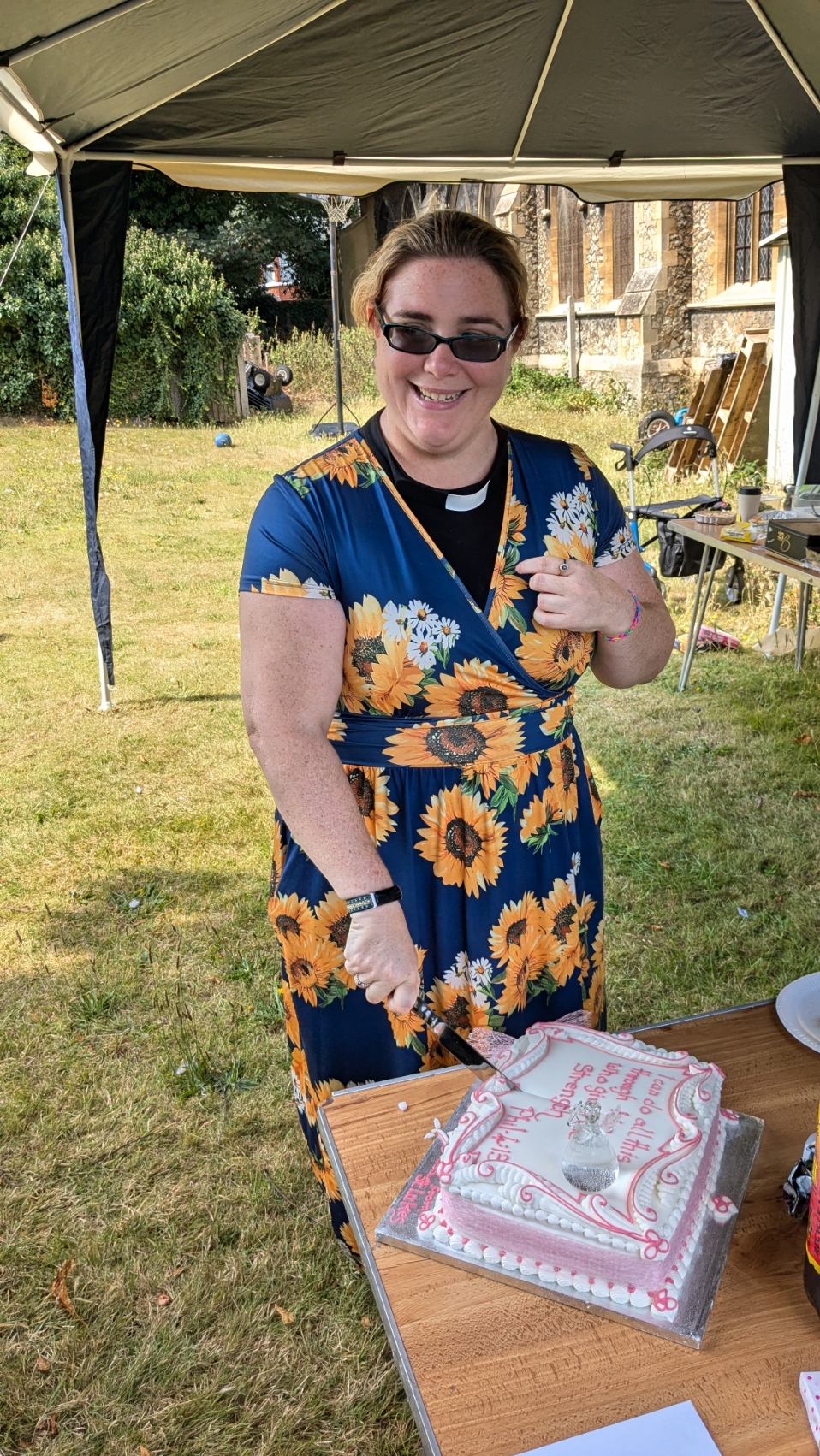
Thank you to all who attended and contributed to giving Claire such a good send off last Sunday. We raised nearly £900 from contributions from the two congregations. With this money we bought flowers, a home communion set and gave her a cheque for over £600 to help her set up in her new role.
We continue to pray that she will have a wonderful and flourishing ministry as she starts out as a Team Vicar in the Dover Team of churches based at St. Martin’s. More information to follow about attending her licensing, which will be on 19th September at 7pm at St. Martin’s Dover.
A climb up the iconic St George’s lantern tower will reward you with the best views of Ramsgate as well as inland across Thanet and out over the Channel. The crypt will also be open for some fascinating insights to local history.
The annual Ride and Stride event will take place on the 2nd Heritage Open Day on the 14th September, which will also see the last Summer Yard Sale of the 2024 season.
We look forward to welcoming many new and returning visitors to St George’s.







 St. George's Church Ramsgate