Thy Kingdom Come is an initiative encouraging churches to extra prayer between Ascension Day and Pentecost (9th -19th May, this year). It will start with an Ascension Day service at 12pm at St. Luke’s (after Cafe4All).
We truly want God’s kingdom to come into the lives of those we love, into our community and town. In its basic form we commit to praying for five people every day for 10 days straight
This year we want to encourage prayer triplets, something that could naturally come out of study groups and/or volunteer groups/ friendship groups. We want to encourage these prayer triplets to meet at least a couple of times during those 10 days and pray together for each person’s five.
As well as this, we will have a Thy Kingdom come focus in our morning prayer sessions, prayer stations at St. George’s, and some opportunities for prayer walks as we pray for God’s kingdom to come. See the time table below:
Saturday 11th
Morning prayer at St. George’s 9:30-10:00
St. George’s Church Open – 10:00-12:00 Thy Kingdom come prayer stations
Monday 13th
Morning prayer at St. Luke’s 9:30-10:00
Tuesday 14th
Morning prayer at St. George’s 9:30-10:00 (prayer stations accessible in this time)
Wednesday 15th
Prayer walk (10:15 – 12) – Meet at St. Lukes at 10:15 where we’ll prayer walk to St. George’s for 11, have access to the prayer stations and walk back to St. Luke’s for midday
Thursday 16th
Morning prayer at St. Luke’s 9:30-10:00
Friday 17th
Prayer walk (6:45 – 8pm) – Meet at St. George’s at 6:45pm where we’ll walk down into town, to the harbour and back to St. George’s by 8pm.
Saturday 18th
Morning prayer at St. George’s 9:30-10:00
St. George’s Church Open – 10:00-12:00 Thy Kingdom come prayer stations
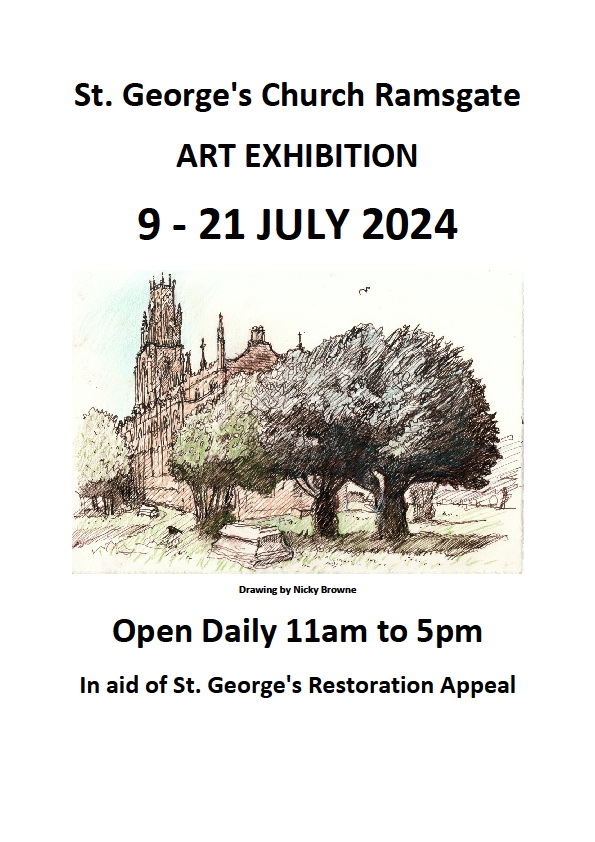
Thanks to all those who made our 2nd Annual St George’s Spring Parade such a special day despite the awful weather. It’s been fantastic to work with GB Carnival again – big thanks to Teresa and all the team, and to Samba Ya Wantsum for providing the beats to keep us all moving along.
After a joint service with St Luke’s the parade set off on a tour of the town centre, led by our enormous green dragon blowing smoke from her nostrils.
Big thanks also go to Jenny Harris for her wonderful soup and delicious onion rings and to the Friends of St George’s for providing cakes and drinks after the parade. Thanks also to our funders – Canterbury Diocese, Ramsgate Town Council, Creative Lives, The Arts Council and UK Government.
One of the quandaries I sometimes have is that because of Jesus’ grace heaven will include people that I might not ordinarily want to hang out with. How do we get rid of our prejudices and accept that the good news of Jesus is for all? I’m not alone in this pondering.
Peter – the rock that Jesus was to build his church on – had a dream to teach him that God’s love was to be extended beyond the Jews and to include Gentiles too. Breaking his own prejudices. It was against Jewish law for Jews to associate with Gentiles (Acts 10:28) and yet God puts Peter in the path of Cornelius. Cornelius was a centurion in what was known as the Italian Regiment, he was God fearing and gave generously to those in need and prayed regularly (Acts 10:1-2).
An angel gets Cornelius to reach out to Peter (Acts 10:1-8). Peter is prepared for the encounter in a dream (Acts 10:9-23). Then as he meets Cornelius his eyes are opened to the realisation that ‘God does not show favouritism but accepts from every nation the one who fears him and does what is right’ (Acts 10:34-45). As Peter shares what Jesus has done for the whole world (Acts 10:34-43) God’s Spirit is poured out in Cornelius’s household and Peter baptises them in Jesus’ name.
Cornelius was an upstanding citizen but of a different background to Peter, but how prepared are we to welcome as brothers and sisters those that might not be so upstanding but have equally encountered Jesus through the power of his spirit? How is God challenging us today?
Claire Coleman
Thy Kingdom Come
Thy Kingdom Come is an initiative encouraging churches to extra prayer between Ascension Day and Pentecost (9th -19th May, this year). It will start with an Ascension Day service at 12pm at St. Luke’s (after Cafe4All).
We truly want God’s kingdom to come into the lives of those we love, into our community and town. In its basic form we commit to praying for five people every day for 10 days straight
This year we want to encourage prayer triplets, something that could naturally come out of study groups and/or volunteer groups/ friendship groups. We want to encourage these prayer triplets to meet at least a couple of times during those 10 days and pray together for each person’s five.
There will also be the normal daily prayer sessions special Thy Kingdom Come events – check out the calendar and website for more information.
St. George’s Charitable Giving
The PCC wish to review who we give money two in the coming year. We plan to give 2.5% of our basic church income to three charities, one local, one national and one international. Over the last couple of years, the charities have been:
St George’s community meal (local)
Macmillan’s Cancer Support (national)
Christian Aid (international)
We are open to suggestions for charities for the coming years. Please collect a form from the back of church, complete it and return it to Sue Martin. Alternatively use the attached form, fill it in and return to Sue by email.
Paul’s celebration BBQ
On Sunday 19th May we will be holding a celebration BBQ for Paul who has been at St Luke’s for 20 yrs. It will be held in the field behind St. Luke’s church after their service at about 12.30/1pm. St. George’s members are welcome to join in. There are forms in both churches to sign up to indicate your attendance, to contribute food and to indicate dietary requirements.
Training for Open the Book
ACTS are seeking to use Bible Society’s Open the Book in local Primary Schools. It involves acting out Bible stories in school collective worship / assembly. If you are interested there is a training session at Birchington Baptist on Saturday 11th 10:30am-2pm.
I enjoy listening to a history podcast, called the Rest is History. They recently did a fiver post series on Luther. In this blog, Graham Tomlin – an expert on Luther – gives the series 9/10. But he has one quibble. Read blog (6 minutes read). You can also check out this Podcast which discusses in more detail some of the understandings of Luther’s teaching and ideas. Listen to Podcast (90 minutes).
What would Christians 200 years ago have thought about Christians today?
David Sandifer takes us back to the attitudes of Christians in the early nineteenth century, at a time when Christians were shaping the moral outlook of the nation. Although, we may be quick to dismiss their way of thinking as irrelevant to modern times, he wonders whether we need to look afresh at ourselves from their perspective. Read article.(15 minute read)
Finally, let’s remember that Jesus’s good news is for people from all nations, ethnicities and backgrounds.
What’s On – a page which lets you know what is happening this week and gives information about upcoming events.
Notices – You can read the latest notices on this page.
Sermons – Read a transcript of a recent sermon or watch the YouTube version recorded at St. Luke’s. There are now videos for all the sermons over the summer.
Safeguarding Training
If you volunteer in anyway at church the national authorities are strongly encouraging you to take at least the Basic Module in safeguarding training once every three years.
If you have not completed the training in the last three years, then the module can be completed online and takes about ninety minutes. You can access the training by following this link. You will need to first register, to access the training. Once the training is completed, you will be sent a certificate. Please forward that certificate to James (office@stlukesramsgate.org), so that we can keep records of who has done the training.
What counts as victory? Is it your team winning the FA cup or Premiership? Achieving that promotion or job you have always longed for? Winning the hand in marriage of the person you love? Overcoming a life-threatening illness? Or perhaps if you were Ukrainian finally forcing Russian forces to leave your country?
In many cases, victory requires someone or something to be defeated: an opposing football team, other candidates for the job, a life-threatening illness or the Russians. Sometimes those that need to be defeated are mere competitors, but other times they are enemies who are out to destroy us.
This week, we celebrate St. George’s day. In the legend, St. George rescues a maiden in distress from a fearsome dragon who is certainly an enemy out to devour her. His victory over the dragon achieves the maiden and her village’s salvation. His victory becomes their victory.
Paul ends his long chapter reflecting on the resurrection (1 Corinthians 15) by emphasising the victory Jesus has won. It is not a victory over a competitor, but over the ultimate enemy of all humankind: death.
Many people claim that religion is not for them. They conceive of the Christian faith as a take it or leave it pastime, only relevant to those who enjoy spiritual activity. But, whether due to illness, an invading army or a dragon, death is the inevitable fate of us all – our greatest enemy. If Jesus has indeed defeated death, then belonging to him so as to share in his greatest and most important of all victories is surely a worthy goal. Everyone should want this victory.
Paul Worledge
This Week’s Sunday Service – 11am – St. George’s Church
St. George and Victory
This Sunday is a joint service at St. George’s church. It will be an All Age service with interactive activities and talks for young and old. There will not be a service at St. Luke’s and unfortunately, we are not able to livestream this service.
After the joint service if you want to take part on the parade, please meet outside the main church door, where you will be directed by stewards down to the top of the pedestrianised part of the High Street. The parade will then set off from there by 12:30pm and will go to the bottom of Harbour Street, then back up the High Street. There will then be lunch available in St. George’s church hall at about 1:30pm.
Planning for Thy Kingdom Come
Thy Kingdom Come is an initiative encouraging churches to extra prayer between Ascension Day and Pentecost (9th -19th May, this year). We would love to mark this with different prayer activities. It would be great to gather a small group to make this happen. Contact Claire to show interest.
Firestarter Event, Friday 2nd May, 7-9pm, St. Philip’s Cliftonville, CT9 3JJ
This event is seeking to unite churches across Thanet in mission for God. There are events for church leaders during the day and an evening event to which everyone is welcome. It will take place at St. Philip’s, Cliftonville, CT9 3JJ.
You can find out more and say you are planning to come using this Facebook Event page.
St. George’s Charitable Giving
The PCC wish to review who we give money two in the coming year. We plan to give 2.5% of our basic church income to three charities, one local, one national and one international. Over the last couple of years, the charities have been:
St George’s community meal (local)
Macmillan’s Cancer Support (national)
Christian Aid (international)
We are open to suggestions for charities for the coming years. Please collect a form from the back of church, complete it and return it to Sue Martin. Alternatively use the attached form, fill it in and return to Sue by email.
BBC Sound Recording in the Church Yard
Last week Steve Ladner from the BBC conducted an interview about John Le Mesurier in the churchyard, where his ashes are buried. You can listen to the five-minute video on BBC Sounds.
Links to Share:
Marriage as Martyrdom
In this post a theology lecturer describes one of her seminars. What really provokes the students? The idea that marriage requires sacrifice. Read more (6 minutes)
Church of England Video on going Net Zero
The Church of England is committed to going Net Zero by 2030. But how might this be achieved. This video highlights some of the work already being done. Watch Video
Finally, let’s live our lives trusting and following the one who has won the victory over death.
Yours in Christ
Paul Worledge
(Priest in Charge, St. George’s Ramsgate)
Weekly Calendar
Sunday 28th April
Joint Service (St George’s, 11:00am) – Reading: 1 Cor. 15:50-58
Monday 29th
Daily Prayer (St. Luke’s Church) – 9:30-10:00am
Craft Group (St. George’s Hall, Soup Kitchen) – 2:00-3:30pm
What’s On – a page which lets you know what is happening this week and gives information about upcoming events.
Notices – You can read the latest notices on this page.
Sermons – Read a transcript of a recent sermon or watch the YouTube version recorded at St. Luke’s. There are now videos for all the sermons over the summer.
Safeguarding Training
If you volunteer in anyway at church the national authorities are strongly encouraging you to take at least the Basic Module in safeguarding training once every three years.
If you have not completed the training in the last three years, then the module can be completed online and takes about ninety minutes. You can access the training by following this link. You will need to first register, to access the training. Once the training is completed, you will be sent a certificate. Please forward that certificate to James (office@stlukesramsgate.org), so that we can keep records of who has done the training.
“One thing I do: forgetting what is behind and straining toward what is ahead, I press on toward the goal to win the prize for which God has called me heavenward in Christ Jesus.” (Philippians 3:13-14)
So, after our lives have ended, what will come next? At one level it’s apparent that our material ‘waste’ will be reconstituted into something different. In funeral services the words of committal still echo those of Ecclesiastes 3:20… we come from dust, and to dust we shall return, which prompted one child to deduce that somebody was either coming or going under the spare room bed!!
Are you driven by your past, your present or your future? Psychologists talk a lot about this, but it’s not a new idea. The Apostle Paul underwent appalling hardships during his travels, but he pressed on because of the goal that he believed lay in the future. So this morning we’re talking about the next life, reflecting on what it will be like, but also whether the prospect of being with Christ is the driving factor in our lives.
Paul has spent a long time in 1 Corinthians 15 talking about the resurrection of Christ and the resurrection of the dead. If there is no resurrection, then what’s the point of living a godly life? We may as well eat, drink and be merry, for tomorrow we die. So in verses 35-49 he tries to describe the life to come. Ultimately he is describing the indescribable, so it’s not a detailed picture, but he offers some clues about resurrection bodies.
OUR BODIES WILL BE DIFFERENT verses 35-41
Paul makes a parallel with nature, and contrasts the seed with the plant. Unless you’re an expert, you may not be able to differentiate one seed from the next. At first sight who could possibly know that a single acorn could become a mighty oak tree?
But do you ever wonder what you might look like in the next life?
Hopefully I’m going to be different. In this life, I am defined by my skeletal eyes and lack of hair. When I walk down the street wearing a hat and dark glasses, you don’t recognise me. You think, who’s that handsome fella, and then I take them off and you say, Oh, it’s him!!
Jesus, during the 40 days after His resurrection, makes for an interesting study. In some ways He’s still the same … He talks to Mary outside the tomb, he cooks fish by the lake and even eats. Thomas is encouraged to touch his crucifixion wounds. But He’s also different. He passes through locked doors and vanishes when two people recognise Him as He breaks bread with them. He is the same Jesus and yet His body is different. The Gospels are careful with their language, talking about his post-resurrection ‘appearances’, because it’s a resurrection, not a resuscitation. He is no longer there 24 hours-a-day as once had been the case. Now He comes and goes, appearing unpredictably in order to convince His followers that He really is alive.
In verses 39-41 Paul flags up the variety we see in this life, so what might the future hold? I find this world amazing enough. I’m told there are …
360+ dog breeds
200 types of owl
3,000 species of snake
45,000 different types of spider
And we humans are also incredibly diverse
I get the impression that there will be even more texture to life in heaven. Maybe our resurrection bodies will have distinctive new abilities. For a long time our kids used to love films like X-Men where you encounter mutants with amazing powers – Wolverine with his adamantium skeleton, Storm with her ability to control the weather. Wouldn’t that be exciting? No more walking sticks, no more glasses, no more limitations – instead a whole host of improvements, plus the prospect of showing God off to His future creations.
But the strange thing is that we don’t seem to like difference. The history of our human race is about small-minded tribalism and large-scale violence. We seem to prefer people who are like us, rather than broaden our minds by embracing difference. The majority of my church members in East London were of Jamaican origin, and I heard their stories of discrimination, rejection and even violence over many years. They were good people, but they were not well-received when they came here. If you’re not familiar with that, try watching Three little Birds on BBCiPlayer.
We used to have church lunches quite regularly in London. People would bring their favourite national dishes and after the service we would eat each other’s food, acclimatising our palates to an array of amazing flavours. Did you know that the word companion literally means someone you eat bread with? Well, we found food a wonderful way to expand our minds and build bridges with people who were different to us. Maybe eating food together is a stronger way to build fellowship than singing songs together.
Unlike us, God loves difference, and it looks like we’re going to get even more of it in heaven, so we may as well get used to it now.
OUR BODIES WILL BE ENDURING verses 42-44
Years ago somebody said to me that when I reached my mid-50s the decay would start to set in. Not me, I thought, but sure enough, whilst at 50 I still had good muscle tone, by the age of 55 I was on the slide and having to work hard to slow the decline. Life is cruel like that. It takes years for us to stand on our own two feet and take on the world, but then, as we get older, we begin to feel a whole host of chronic pains. I can’t remember the last time my back didn’t hurt.
It sometimes feels like we peak far too early and then we drift into a long, meandering demise. We accumulate so much experience and wisdom and responsibility, but then young people see us oldies as dinosaurs, out of touch with the real world. Their world doesn’t involve cash or the BBC or even Facebook now, and they look at you blankly when you talk in feet and inches rather than centimetres. Oscar Wilde had a point when he wrote that there are only two important things in life – youth and beauty.
But, says Paul, the future is mind-blowing. Ageing and decay will be history, for our new bodies will be powerful and beautiful and immortal.
Just in passing, Christians debate whether it will be a level playing field in the next life. 1 Corinthians 3:10-15 could suggest that those who have lived faithfully and served diligently will be rewarded with more (perhaps bodies with greater capacity), but the text isn’t explicit, and that debate can wait for another time.
EMBRACING THE FUTURE verses 45-49
Paul suggests a logical development. The physical first, then the spiritual. The first Adam became a living being, the second Adam (Jesus) a life-giving spirit. Our origins are limited, but our destiny is beyond our imagining! Our focus can either be on the familiar now, or on what’s yet to be, on what is temporary or on what is permanent.
Now it can be hard to work this out. We are physical beings, after all. We all need to eat and drink, to sleep, to wash our bodies and our clothes. If we have children, we have to attend to their needs. We can’t drop out of this life. But what we can do is embrace the way of life that Jesus taught us – love, kindness, gentleness, patience, helping others to experience God’s love.
But a word of caution! Sometimes following Jesus means challenging evil and pushing for change in this present life, and thank God for those people who did and who still do.
In the early 1800s only 11% of adult males had the vote, and the government feared that the revolution in France might trigger one in England. In 1817 the government turned down a petition from 750,000 working-class people calling for better representation in parliament, and then, in August 1819, 60,000 gathered in St. Peter’s Field (Manchester) to protest publicly. The local magistrates over-reacted and sent in both the local yeomanry and the 15th Hussars. 15 people died and over 600 were injured and, recalling the Battle of Waterloo 4 years earlier, a local paper dubbed it the Peterloo Massacre. The government’s outrageous response was to tighten the laws against political gatherings!
What doesn’t get remembered from that period is that in 1818 the government gave money for 50 new Anglican churches to be built. Many of those new churches still stand today. But many feel that the reason the government funded church buildings was that they saw us Christians as a safe pair of hands. We preached about future joy and were rarely a voice for change in the present
Anyway, this contrast between Adam and Jesus is a theme Paul regularly returns to, whether it’s Romans 5 or Philippians 2. There are two gardens:
In Eden, Adam, told by the serpent that eating the fruit would make him a god, gladly succumbed to the temptation.
In Gethsemane, Jesus, tempted to bypass the way of the cross, resisted resolutely with sweat like great drops of blood.
So I wonder how much difference any of this will make to me or any of us? A glorious future awaits, but right now we are called to take up our cross, knowing that a better day is coming. Will we choose to be shaped by the glorious destiny that Paul has described? Will we invest in the temporary things that we see now or in the permanent reality of what is yet to come?
The story is told of a missionary couple returning to the US after a lifetime of Christian service in Africa. It was early in the 20th Century, and the then US president, Theodore Roosevelt, was returning on the same ship from a few weeks of big game hunting. He was the focus of attention throughout the voyage and was greeted by a huge crowd as he disembarked. By contrast, the arrival of the two missionaries went unnoticed. They found lodgings for the night, but the disgruntled husband complained to his wife: the president received a rapturous welcome when he got home, and he had only been shooting animals! We have been serving the Lord. His wife advised him to go and pray while she prepared food. When he returned his face had brightened. He had heard God’s reassuring voice: you’re not home yet!
I guess that’s the Christian life in a nutshell.
This world is not my home, I’m just a-passing through
There may not be accolades in this life, but ultimately we look forward to being at home, in the eternal presence of the Jesus to whom we owe our salvation. And so, as we often finish our services, I say to you, Go in peace to love and serve the Lord, and you say to me … in the name of Christ, Amen.
“One thing I do: forgetting what is behind and straining toward what is ahead, I press on toward the goal to win the prize for which God has called me heavenward in Christ Jesus.”
Philippians 3:13-14
So, after our lives have ended, what will come next? At one level it’s apparent that our material ‘waste’ will be reconstituted into something different. In funeral services the words of committal still echo those of Ecclesiastes 3:20… we come from dust, and to dust we shall return, which prompted one child to deduce that somebody was either coming or going under the spare room bed!!
Christians talk about heaven and being with Christ, but we struggle to visualise it. Many of us grew up with ideas of living in ‘mansions’ (John 14:2), thereby imagining some kind of continuity with this life. Will my mansion have an en-suite bathroom, a sizable garden and a good view?! Will the really good Christians get a penthouse?!
Paul has already gone to great lengths in 1 Corinthians 15 to emphasise both the reality and importance of Jesus’ resurrection. Our future hope depends on the events of Easter Sunday being historically true. But now, in verses 35-49, he moves on to reflect on what the next life might look like. Of course, it’s impossible for him to be precise, but he offers a few pointers. The implicit challenge is this – what drives the way that we live now? Is it that glorious future reality, or the passing distractions of this life?
Bruce Stokes
St. George’s Day Celebration and Parade,
Sunday 28th April
To mark St. George’s day this year, there will be a joint service at St. George’s on Sunday 28th April at 11am, followed by a St. George’s day parade (like last year).
Electoral Roll and Annual Meeting
St. George’s electoral roll, is a kind of membership list for the church that enables you to vote at our Annual Meeting (APCM). If you are not already on the electoral roll, have been attending St. George’s for six months or more, are baptised and over 16, then please fill in one of the electoral roll forms, available at the back of church and return to Mark Ogden by Sunday 28th April. The annual meeting will be on Monday 20th May at 7:00pm in church.
Parenting for Teen’s Course
Bible Reading Fellowship have produced a course to help people with parenting teens. If you are interested in taking the course or even running a course, then please check out their website, then let Paul know if this is something you want to do.
As we reflect today on our resurrection bodies, in this short article, Pete Portal questions what it means to run after success and how people do that in our modern culture. Read 10 minute article.
Write your Will for free online
Will writing can be time-consuming and difficult – and that’s a big reason why many people put it off. To make it easier, the Church of England has partnered with Farewill, the National Will Writing Firm of the Year 2022, to offer a free online will writing service, which you can do from home in less than 30 minutes. If you have questions, Farewill’s specialist team can help you over the phone or live chat 7 days a week.
Making a will and keeping it updated is the only way to ensure a person’s wishes are carried out after their death, giving them peace of mind that they can continue supporting the family, friends and charities they love. In using Farewill, there is no obligation for anyone to leave a gift in their will to their church. However, if someone decides that they can, that gift – great or small – will help the church’s ministry and mission thrive for the benefit of future generations. You can view and share a legacy special edition of the Parish Resources newsletter by clicking here.
What’s On – a page which lets you know what is happening this week and gives information about upcoming events.
Notices – You can read the latest notices on this page.
Sermons – Read a transcript of a recent sermon or watch the YouTube version recorded at St. Luke’s. There are now videos for all the sermons over the summer.
Safeguarding Training
If you volunteer in anyway at church the national authorities are strongly encouraging you to take at least the Basic Module in safeguarding training once every three years.
If you have not completed the training in the last three years, then the module can be completed online and takes about ninety minutes. You can access the training by following this link. You will need to first register, to access the training. Once the training is completed, you will be sent a certificate. Please forward that certificate to James (office@stlukesramsgate.org), so that we can keep records of who has done the training.
“But Christ has indeed been raised from the dead, the first fruits of those who have fallen asleep.” (1 Corinthians 15:20)
The Christian belief in life beyond death is one we can have confidence in because it is rooted in the historic event of Jesus’ actual resurrection. He is the first fruits of those who die, meaning that our life beyond death will be ultimately like his, a bodily physical resurrection, to a much better transformed life in close relationship with God. Yet, there is a consequence to how we live this life. God will judge the dead. It’s never too late to turn back to Him and receive his amazing grace and start living life for him now, but we do need to align ourselves with God in this life, if we want his blessings in the next.
Death makes a mockery out of everything. The illness, incapacity, indignity, discomfort, and pain that sometimes precedes death is not the worst of it. The grief and sorrow, the abandonment and regret, that are sometimes felt by others, for a time at least, they’re not the worst of it either. The worst that death does is emptying life itself of meaning. Thanks to death, life is like a tale told by an idiot, full of sound and fury, signifying nothing. Thanks to death, we are all living our own personal versions of the Bohemian Rhapsody, composed of dozens of parts – a number of which we find incomprehensible, and none of which really relate to one another – and ending not with a bang but a whimper: ‘Nothing really matters, anyone can see, nothing really matters to me’. The words we live by, our life motto, might as well be taken from the end of the passage from the Bible we have just heard read: ‘Let us eat and drink, for tomorrow we die’. All this is due to the fact that ‘the last enemy to be destroyed is death’. The oldest truth, according to the author Marilynne Robinson, is “right out of [the book of ] Genesis”: it is the truth that “we are not at ease in the world, and sooner or later it kills us”.1 One generation rises, matures, ages, faces the Grim Reaper, comes off second best, and gives way to a new generation, which rises, matures, ages, faces the Grim Reaper, with the same outcome, and so on around the treadmill, ad infinitum. Vanity, vanity, all is vanity, sayeth the Preacher. Once the prospect of death has deprived us of meaning, life becomes a waiting room for death, and all we are left with in the meantime, for as long as we can afford it, is entertainment, and consumerism.
That is where we are, and always would be, were it not for the remarkable news shared with us by the apostle Paul in the fifteenth chapter of his first letter to the Corinthians. This news was not of his making; rather he was passing on what he had in turn received. In communicating this news, he contemplates the cliff edge of hopelessness in a series of sentences beginning with the word ‘if’; and he rescues us from falling into despair with two sentences beginning with the word ‘but’. After discussing these, I want to add a short postscript about a verse from the reading that particularly jumps out at me.
Let’s first take a look at the sentences starting with ‘if’: 1. If there is no resurrection of the dead, then not even Christ has been raised. (verse 13) 2. If Christ has not been raised, our preaching is useless and so is your faith. (verse 14) 3. If the dead are not raised, then Christ has not been raised either. (verse 16) 4. If Christ has not been raised, your faith is futile; you are still in your sins. (verse 17) 5. If only for this life we have hope in Christ, we are to be pitied more than all men. (verse 19) 6. If there is no resurrection, what will those do who are baptised for the dead? (verse 29) 7. If I fought wild beasts in Ephesus for merely human reasons, what have I gained? (verse 32) 8. If the dead are not raised, ‘Let us eat and drink, for tomorrow we die’. (verse 33)
I don’t know what you thought as you heard this list. For myself, I have to say that I got distracted by wondering what Paul could have possibly meant by asking the sixth question down, ‘what will those do who are baptised for the dead?’ It seems unlikely that he was referring to proxy baptisms undergone by the living on behalf of the dead, not only because this would have been highly unorthodox, but also because there is no corroborating evidence that anyone in the early church actually practised proxy baptism. The books I have read about this speak of forty possible interpretations of this verse2, so I don’t suppose we’re going to be able to solve the riddle today. I will just say that, to me, the most likely explanation is that Paul is asking ‘if there is no resurrection, what good would it do those who postpone their baptism until the imminent prospect of death?’, simply because we know that this was a practice of the early church. But in any case, we can see the general direction of Paul’s argument here: ‘if there is no resurrection, what would be the point of doing that thing with baptism that some people do with baptism?’
Moving away from the distraction of that sixth question, this is the same point that Paul is making throughout: what would be the point of anything? What would be the point of him putting his life at risk to do the work of an apostle of Jesus Christ, to the extent of facing down the lions in the Ephesian amphitheatre if necessary, if there were no resurrection? What would be the point of Christians pouring a lifetime of hope in Christ, if there were no resurrection? Because in that case there would be no forgiveness of sins, no truth in Christian preaching, and no secure basis for Christian faith. In that case, you would have to feel sorry for the poor, deluded Christians. You might as well just eat and drink, and die tomorrow, because death would always have the final say, and death would strip everything and everyone of all meaning… if … there were no resurrection.
Then Paul follows his ifs with a but: But Christ has indeed been raised from the dead, the firstfruits of those who have fallen asleep. (verse 20)
And he follows that with another but: As in Adam all die, so in Christ all will be made alive. But each in his own turn: Christ, the firstfruits; then, when he comes, those who belong to him. (verse 22)
With these sentences starting with the word ‘but’, Paul says that resurrection is the undoing of death. Death makes a mockery of everything, but resurrection imbues everything with indestructible life and meaning.
Another thing that is clear from these verses is that resurrection is not a human achievement. Sometimes you hear people using the word ‘resurrection’ as a metaphor, and in doing so they place it within the realm of human possibility. Sports teams are ‘resurrected’ if they start to enjoy success after a season of constant losses. Once I heard someone describe the start of a new romantic relationship, after the termination of a previous one, as a ‘resurrection’. The word ‘redemption’ is sometimes used in a similar way. One of my favourite TV game shows brings back losing contestants to play each other in what it calls a ‘redemption week’. You did badly first time around, but here’s a chance to do better and ‘redeem yourself’.
Well, that’s not how the apostle Paul thinks of ‘redemption’, and it’s certainly not how he thinks of ‘resurrection’. Death is indeed the last enemy to be destroyed. ‘But Christ has been raised from the dead, the firstfruits of those who have fallen asleep’ (verse 20). The Gospels tell of others who were raised from the dead before Christ: the daughter of the synagogue ruler, the son of the widow of Nain, and Lazarus the brother of Mary and Martha. These miracles were likewise outside the sphere of human possibility, and were brought about by the Lord himself. They are probably best described in terms of re-vivification, rather than resurrection, because the people raised went on to live the remainder of their normal mortal lives, ageing and eventually dying like all of us will.
The resurrection of Jesus was different to that of Lazarus and the others in that he was the first to have risen to immortal life. This does not make his resurrection any less real than that of Lazarus– in fact it makes it more real, hyper-real. No-one who saw Jesus after his resurrection said, ‘Hello, Jesus, how good to see you again’. Instead they tended to react in the kind of way Peter, James and John did at the transfiguration, in wonder and worship.3
And it’s no accident that Jesus happened to be the first to be raised to immortal life. Without his resurrection to immortal life, there’d be no resurrection to immortal life. Once again, the oldest truth is right out of the book of Genesis: all of us have walked in the footsteps of Adam, in disobedience and selfishness, and that way leads to death. Christ, however, is the firstfruits of the undoing of death. He was not raised from death “merely as an individual … for himself alone … His resurrection is the assurance and guarantee of ours”.4 For us, resurrection is not a state of affairs that is within our power to attain. It’s not part of the cycle of nature. We might as well believe that a team of monkeys armed with a set of typewriters could reproduce the works of William Shakespeare line for line. The cycle of nature, as we experience it, leads inexorably towards death and dissolution, just as the literary output of the monkeys would tend towards being gibberish.
Resurrection is not a human possibility, but it is the promise of God to inject our lives with meaning they could never otherwise have. It is his promise to put grammar in place of gibberish, to give us beauty for ashes, to give us, in place of the Bohemian Rhapsody, the Apostles’ Creed.
And how can we believe that it is true? The apostle Paul tells us that the resurrection of Christ is our guarantee of all this. We long for hope, and truth, and faith, and forgiveness, and because of the resurrection of Christ, we know we may have these things. If Christ had not been raised, all preaching would be useless, and so would our faith; our faith would be futile, and we would still be in our sins. Hope, truth, faith and forgiveness would all prove illusory. But Christ has indeed been raised from the dead. The battle with death and despair has been fought and won, by God. There is more to hope for than this life only.5 Death makes a mockery of everything, but resurrection restores meaning to it all.
And now for my postscript: you will have noticed that so far I’ve been moving backwards and forwards through the text of I Corinthians chapter 15 verses 12 to 34, following the ‘ifs’ and ‘buts’ the apostle Paul uses to explain how foundational the resurrection of Christ is to the Christian life. I haven’t felt the need to comment on every verse, though I do think every last verse in this amazing chapter of Scripture is worthy of study and meditation. But there is one verse I think I’ve been circling around for a while now that deserves our full attention for a few minutes near the end of what I have to say. It is a verse that became particularly important to me a few years ago, in the run-up to and aftermath of the deaths of my father-in-law and my own father in 2021. Both of them were widowers and died full of years after periods of poor health and cruel incapacity. The amazing verse in this amazing chapter of I Corinthians, that provided me with insight and consolation in the face of these experiences, was chapter 15 verse 26, ‘The last enemy to be destroyed is death’, and I want to close by briefly sharing with you this insight and this consolation.
The insight is that death is the worst, most powerful and final enemy of humanity, and that it wreaks havoc on our all-too-human desire to live comfortable and carefree lives. I hope that no-one among us subscribes to a health and wealth caricature of Christianity, but even if we don’t, it’s easy to wonder where God is, and what he is doing, whenever we face obstacles, misfortunes, trial and tragedy. We read in 1 Peter that we are not to be puzzled by any painful trials we suffer, as though something strange were happening to us, because in them we participate in the sufferings of Christ (cf. 1 Peter 4:12-13). That is where God is, and what he is doing, in the face of our trials, and one day he will reveal his glory and bring this present chapter of history to a close. In the meantime, behind every painful trial lies the unholy, un-natural, and miserable trinity of sin, death, and hell. They rage against us, and will continue to do so until we are done with this mortal life.
The consolation contained within the fact that ‘the last enemy to be destroyed is death’, is that death will finally be destroyed. It will be mocked in the end; it will have no choice but to let its captives go. Did you notice how the deaths of those who belong to Christ are described in verse 20? Or have you noticed how the deaths of the faithful departed are described on the gold plaque next to the lectern at the front of St Luke’s Church? (You are welcome to go up there and see for yourself anytime.) They are described as those who ‘have fallen asleep’. This sounds a lot like a euphemism for dying – there are a lot of euphemisms used for dying – but, in fact, it is a profoundly Christian way of thinking about death, because it implies that those who have fallen asleep will one day wake up. And the thing that makes this way of thinking Christian, rather than simply make-believe, is the resurrection of Christ. “He has transformed death, for his followers, into sleep”,6 because his resurrection is the assurance and guarantee of ours.
So there will be an end to the reign of death over humankind. From the beginning of its reign through to the end, it has and does make a mockery of everything. Life and meaning will be restored, however, not by the power of our positive thinking, but by the working of God’s mighty strength in the resurrection. Hope, truth, faith and forgiveness will be secured. The raising of Christ is the promise, and the firstfruits, of all this. The resurrection will make a mockery of death in the end. This is our confidence, our joy, and our consolation in the face of every trial.
2nd Annual St George’s Day Parade to be held on 28th April
The dragons are gathering ready for the 2024 parade… 11am – St George’s Day Service in St George’s Church 12 noon – Parade gathers outside the church 1.30pm – Lunch for all participants in St George’s Hall
After the success of last year’s parade, St George’s Church are working in partnership again with Great British Carnival to bring another spectacular community parade and celebration to Ramsgate. In preparation for the parade there will be free costume making workshops on Saturday afternoons, 20th and 27th April, 2 – 5pm at St George’s Church Hall, Broad St, Ramsgate
the first fruits of those who have fallen asleep.”
(1 Corinthians 15:20)
What we believe about death effects how we live our life. For starters, if you believe as a fundamental truth that the totality of life is contained in the short span of time we live on this earth, that death marks the end and that there is nothing beyond, then we will want our lives to be focussed on self-fulfilment, completing “bucket lists”, enjoyment and fearing death beyond all else.
In the face of the death of loved ones, such a clear-cut view of death is rarely expressed. Most people want to find comfort in some kind of otherworldly spiritual life beyond death. Such beliefs, however, rarely reflect on any consequences in death for our actions in life and offer little understanding or justification for what such a life beyond death might be like. As such these views have little impact on the way we live our lives.
Alternatively, the belief in reincarnation does at first glance seem to encourage living a good life now, in order to have a better next life. Yet it also encourages a sense of entitlement to present privileges and status. Thus, it promotes the despising of those less well off: they deserve their position in society, it is the result of their actions in a previous life.
The Christian belief in life beyond death is different. It is one we can have confidence in, because it is rooted in the historic event of Jesus’ actual resurrection. He is the first fruits of those who die, meaning that our life beyond death will be ultimately like his, a bodily physical resurrection, to a much better transformed life in close relationship with God. Yet, there is a consequence to how we live this life. God will judge the dead. It’s never too late to turn back to Him and receive his amazing grace and start living life for him now, but we do need to align ourselves with God in this life, if we want his blessings in the next.
St. George’s electoral roll, is a kind of membership list for the church that enables you to vote at our Annual Meeting (APCM). If you are not already on the electoral roll, have been attending St. George’s for six months or more, are baptised and over 16, then please fill in one of the electoral roll forms, available at the back of church and return to Mark Ogden by Sunday 28th April.
The annual meeting will be on Monday 20th May at 7:00pm in church.
Beetle Drive and Games – This Friday
Friday 19th April, 7:00-9:00pm, St. George’s Church Hall
Tickets are £1, which includes snacks and a drink. They can be bought from Elaine.
St. George’s Day Celebration, Sunday 28th April
To mark St. George’s day this year, there will be a joint service at St. George’s on Sunday 28th April at 11am, followed by a St. George’s day parade (like last year).
Depression and Anxiety Self-Help Group
The group meets this Wednesday, 17 April, from 6-7.30pm in the Perry Room in St Luke’s Church Hall. Our theme will be Setting emotional boundaries. The group is open to anyone 18 and above who experiences depression and/or anxiety. All meetings are free.
Prayer for the Nations
Join us as we hear first-hand, to pray for worship, and celebrate the cultures, peoples and countries of the world every third Friday at 7:30 pm to 9pm (next one is Friday 19th) at 45 Northdown Rd, Cliftonville, Margate CT9 2RN. Ring the bell at the bookshop door. The prayer focus for April is Rwanda.
Parenting for Teen’s Course
BRF have produced a course to help people with parenting teens. If you are interested in taking the course or even running a course, then please check out their website, then let Paul know if this is something you want to do.
Growing Faith Hub (Helping children and Young people grow in Faith)
The next training session for the Growing Faith Hub isat St Mary Bredin onThursday 2nd May 12-2pm (lunch provided). This training is entitled ‘Your Church and Community’ and will focus on how best to engage as a church within your local community. If you would like to attend, please email Jen, including any dietary requirements and also let Paul know you are going.
Links to Share:
Easter, just another spring festival?
This animated video from the Bible Project gives a powerful summary of the last days of Jesus as told in Luke 19-23. Watch 4 minute video.
How should we understand God’s ordering of violence in the Old Testament?
In this long video, there is a helpful discussion about one of the most difficult questions for us to answer as Christians: ‘How can a God of love order violence in the Old Testament?” Watch hour long video…
Finally, let’s continue to live out the implications of Jesus’ resurrection from the dead.
What’s On – a page which lets you know what is happening this week and gives information about upcoming events.
Notices – You can read the latest notices on this page.
Sermons – Read a transcript of a recent sermon or watch the YouTube version recorded at St. Luke’s. There are now videos for all the sermons over the summer.
Safeguarding Training
If you volunteer in anyway at church the national authorities are strongly encouraging you to take at least the Basic Module in safeguarding training once every three years.
If you have not completed the training in the last three years, then the module can be completed online and takes about ninety minutes. You can access the training by following this link. You will need to first register, to access the training. Once the training is completed, you will be sent a certificate. Please forward that certificate to James (office@stlukesramsgate.org), so that we can keep records of who has done the training.
Thomas had a point! I mean if some people came to you saying that one of your friends who had recently died, had started appearing to you, would you believe them? You would at least think they were pulling your leg to start with.
But, Thomas still does not believe them even though they are insistent and even, though all eleven of them agreed – and some women and others as well. Thomas was right to question their testimony, but was he right to refuse to believe despite the overwhelming witness of those close to him?
Thomas was going beyond questioning. He was refusing to believe, doubt was ruling his heart.
“Unless I see the nail marks in his hands and put my finger where the nails were, and put my hands into his side, I will not believe.” (20:25) he said!
DOUBT – demolished
But then a week after people first started talking about the resurrection, Jesus appeared to Thomas and demolished his doubt.
Heart locked – Jesus enters anyway
Demands to see – Jesus appears
Refuses to listen – Jesus speaks
Demands to touch – Jesus lets him#
Will you allow your doubts to be destroyed by the resurrected Jesus?
FAITH – revived
Four results of faith
“Blessed are those who have not seen yet believe.” (20:29)
Lord and God – 20:28
“Thomas said to him, “Lord, we don’t know where you are going, so how can we know the way?”
Jesus answered, “I am the way and the truth and the life. No-one comes to the Father except through me. If you really knew me, you would know my Father as well. From now on, you do know him and have seen him.” (John 14:5-7)
The response of Thomas in 20:28 is the climax of the gospel and a model response for us to follow.
This is what the reader should make of the resurrection.
Compare Mary, ‘Rabbonni’ (20:16)
To claim Jesus as God, is to make a bolder claim about him that Moses, Budda or Mohammed would ever make about themselves. Moses and Mohammed both claimed to be God’s spokesperson and Budda claimed to discover enlightenment. But they all died and stayed dead. Only Jesus appeared to his followers and spoke with them after death. The resurrection shows he is the only way to God!
Spirit of truth – 14:17; 15:26; 16:13; 20:20,29
“You are a king, then!” said Pilate. Jesus answered, “You are right in saying I am a king. In fact, for this reason I was born, and for this I came into the world, to testify to the truth. Everyone on the side of truth listens to me.” “What is truth?” Pilate asked. … (John 18:37-38)
The cross seemed to show that power overcame truth. Those in power, the Jewish leaders and Pilate thought they had stopped Jesus’ uncomfortable message of truth. But, the resurrection shows that the truth has not been destroyed. In fact the resurrected Jesus comes to give the apostles the Holy Spirit, why? To lead them into truth.
In Jesus’s teaching of the apostle’s before his death he tells speaks three times about the Spirit of truth:
“”But when he, the Spirit of truth, comes, he will guide you into all truth” (16:13a)
In a world, where there are so many competing claims to truth, the resurrection points us back to Jesus as the one who we should go to for truth.
Peace – 20:19, 23
Three times he says, ‘Peace’ in this passage (vs. 19, 21, 26).
The phrase, ‘Peace be with you’ is only used in two other places in the New Testament and one of those is in a parallel scene in Luke.
“I have told you these things, so that in me you may have peace. In this world you will have trouble. But take heart! I have overcome the world.” (John 16:33)
We often lack peace, because of the troubles of the world. In recent years, there seems to be more to worry about, more troubles in the world.
Yet, Jesus, who was killed by a troubled world, rose from the dead. He proved that the troubles of the world do not have the final say. He showed that when we trust in God, our future is ultimately secure – even if things may be tough on the way.
Life – 20:31
John concludes his gospel, by concluding that when we allow the facts of the resurrection to destroy our doubts, so that we believe, then we gain life.
He says, he wrote these things so that we would believe.
But what kind of life?
In the news this week, it was announced that a man in Liverpool is now the oldest man in the world at 111 years old! That’s fantastic, but when Jesus talks about giving us life, he doesn’t just mean we are going to live for a very long time.
Jesus says earlier in John:
“The thief comes only to steal and kill and destroy; I have come that they may have life, and have it to the full. I am the good shepherd. The good shepherd lays down his life for the sheep.” (John 10:11)
We have life to the full, because Jesus gave up his life for us. Fullness of life, is a life lived knowing the God who loves us and being guided by the shepherd who died for us. He leads us into green pastures and ultimately he leads us to God’s eternal home, not a care home, but a place where life will be more abundant and more amazing than we can possibly imagine, because we will be in an even closer and deeper relationship with him.