Thank you to all who attended and contributed to giving Claire such a good send off last Sunday. We raised nearly £900 from contributions from the two congregations. With this money we bought flowers, a home communion set and gave her a cheque for over £600 to help her set up in her new role.
We continue to pray that she will have a wonderful and flourishing ministry as she starts out as a Team Vicar in the Dover Team of churches based at St. Martin’s. More information to follow about attending her licensing, which will be on 19th September at 7pm at St. Martin’s Dover.
A climb up the iconic St George’s lantern tower will reward you with the best views of Ramsgate as well as inland across Thanet and out over the Channel. The crypt will also be open for some fascinating insights to local history.
The annual Ride and Stride event will take place on the 2nd Heritage Open Day on the 14th September, which will also see the last Summer Yard Sale of the 2024 season.
We look forward to welcoming many new and returning visitors to St George’s.
What is your legacy? I wonder if that’s even a question You have asked yourself? It’s probably more of a question that you might ask towards the end of your life. It is a question I guess I’ve been pondering as I leave Ramsgate and move onto a new chapter. If this chapter of Ramsgate was written down – what would be the legacy that’s left. And actually as Christian’s what is the legacy we leave with our friends and family?
When my mum was living with terminal cancer, we befriended a lot of people through the hospice movement and so we did attend an awful lot of funerals. It was amazing having the opportunity to listen to peoples stories to see the legacy that is left behind. There was one funeral we attended, that of a former Navy fighter pilot, mum turned to me and said what kind of legacy do I leave behind? I’ve done nothing of that sort. A bit tongue in cheek I said – I am your legacy. But in many ways that was true. And echoes this quote from Billy Graham – the Legacy one can pass onto one’s children and grandchildren is not money or other material things accumulated in one’s life but rather a legacy of character and faith.
That’s the legacy I hope to leave behind, one where peoples character and faith is developed and grown. And it’s not a legacy just for those in leadership, but I think it’s a legacy for everyone who believes and trust in Jesus. We’re gonna think about this this morning: what is the kingdom Legacy we leave with people? Not just at the end of our life, but with every encounter we have.
Our Reading today in kings is about a kingdom legacy. David’s earthly life has come to an end; his son Solomon will take over as King. Before David dies, he charges Solomon with this, it’s a bit earlier in chapter 2 of 1 kings. He says: so be strong act like a man and observe what the Lord your God requires: walk in obedience to him and keep his decree and commands, his laws and regulations, as written in the Lord of Moses. Do this so that you may prosper in all you do and wherever you go and that the Lord may keep his promise to me: ‘ if you’re descendants watch how they live and if they walk faithfully before me with all their heart and soul, you will never fail to have a successor on the throne of Israel.’
David’s legacy is one of faithfulness to God – if you read David ‘s story you know he didn’t always get it right – But he knew how to repent and his heart was one that was seeking after God.
So this is the legacy that Solomon has to continue – continue to walk with God in his God-given role as king of Israel.
In chapter 3, v3 we see that Solomon does show loyalty to God, he’s obedient. (Deut 6:5 – You shall love the Lord your God with all your heart and with all your soul and with all your might.) he worships God through offering sacrifices.
A bit of a sidenote here. Other places in the Bible – offering sacrifices if you are not one of the Levites, one of the Priestly order, is a definite no no. However, in this period history there is no temple at this point and it has been usual to use high places for worshipping God. The wording here is thought to be that Solomon is offering it not performing it himself. There is an abundance in the sacrifice he’s bringing. so not only do we see Solomon’s loyalty, and see him worshipping God, we see him acknowledging God’s faithfulness in v6, and displaying humility (v7-9), knowing that he only has the position he has because of God.
We see here an incredible thing happen . Solomon offers his worship to God and God speaks to him – there is an encounter. And God says: ask for whatever you want me to give you.
I wonder what you would ask for ?
When God asks this question, he promises to answer it and it stimulates faith and character . In the new Testament we’re encouraged to ask. Matthew 21:22 – If you believe, you will receive whatever you ask for in prayer.
John 14:13-14 – And I will do whatever you ask in my name, so that the Father may be glorified in the Son.You may ask me for anything in my name, and I will do it.
Solomon in response to this question – simply put what can I do for you, asks for Wisdom. This could be a selfish request, but when we come to God’s response to this request, it seems unlikely that that is the case. Wisdom isn’t just knowing the right answers, having knowledge. One commentator says that this is Wisdom, he says: the way the Wisdom books (son of Solomon, Job) In the old Testament will put it is that reverence of God is the beginning of Wisdom meaning that Wisdom is listening to God and doing what God says.
Solomon asks for Wisdom as he begins his life as King, he asks for it in humility and trusts for a response.
Do we expect to encounter God when we worship? Do we feel confident asking God for things? And when I say things in the context of this passage in kings, I mean things that would help to advance God’s kingdom, his legacy?
Do we even think that we’ve got a right to ask things of God – to ask to meet with him in a new way? Do we ask him for specific gifts? Do we ask how our gifts can be used?
We have been doing that in this year of discernment and in the prayer of the year we are asking for things. And as we’ve been asking these questions, we’ve been trying to listen to see a direction forward.
I wonder How do you hear from God? How do you listen? Do we make time? This will look different for all of us, but it’s interesting to share with each other how we do that, how we hear from God how we take direction and guidance.
Some of us might be captivated by part of the Bible we reading and not be able to escape it.
A number of years ago I was serving in Central Asia and the story of Job kept coming up time and time again – it was in the sermons in my fellowship group that I attended, it came up in my own personal Bible studies and I can remember thinking maybe God‘s trying to get me ready for something – that maybe there will be some hardship coming but I know that God is with me through that. it wasn’t long after that I did have three significant losses and I really did feel that God was with me through all of that and he prepared me for it. It doesn’t mean it didn’t hurt, It doesn’t mean that it wasn’t Painful. But I knew God had prepared me for it.
Other ways of hearing may come through Something strongly resonating in a sermon, through a song, in the liturgy, which gets you thinking and pondering. Do we make space for that. To listen to God, to minimise distractions.
In the context of this passage, if we read on Solomon realises that this encounter happened in a dream – in a vision. It happens rarely but it still can and does happen today .
The important thing when we ask and receive from God is our motivation
Solomon seems to be motivated to ask for wisdom for the good of his kingdom and the legacy he continues.
And we can infer that from God’s response to Solomon‘s answer. God saw that Solomon wanted kingdom Justice. He wanted Wisdom to be able to rule in a way that would bring justice and fairness to others, and that asking for wisdom wasn’t about his own status.
Because of that motivation God gives him more than just Wisdom he promises, prosperity and honour. But actually, it is conditional on his kingdom obedience. Just as in David’s charge to Solomon, when David remembers the promise that God gave him, that his legacy would continue but was dependent on his descendants walking faithfully.
I have to give a spoiler alert here. So although after we have this passage, we see Solomon’s Wisdom put to good use. Solomon actually ends life not pursuing God, he didn’t maintain the kingdom legacy and actually after Solomon the kingdoms break apart and you get the northern kingdom and the southern kingdom. Solomon began the decline of the kingdom as it was. And yet there continued to be promises that there would be a renewed kingdom and an extended kingdom.
And this is the kingdom that Jesus came to fulfil Jesus is the fulfilment of the kingdom Legacy. When we look at the genealogies of Jesus in Matthew and Luke, we can trace through both sides of his family that he was a son of David. He was of a kingly line. Jesus was the perfect example of obedience. his kingdom, brought about by his death and resurrection and Ascension, is one where he reigns forever.
And we are to carry on the kingdom legacy of loving the Lord our God with all our heart soul mind and strength. In Romans we read that if you declare with your mouth that Jesus is Lord and believe in your heart that God raised him from the dead you will be saved and then in John 1 verse 12 we read – yet to those who did receive him, those who believed in his name, he gave the right to become children of God. So for those of us who believe and trust in Jesus, we are his children we are carrying on the kingdom legacy.
That should impact what we say and what we do and how we are.
What is your legacy? my desire would be that my legacy is a legacy of the kingdom – that I’m known as someone who listens to God, someone who obeys, someone who seeks the Kingdom values of loving God with my whole being and looking out for the other, and someone who tells the kingdom truth.
My prayer is that all of us will have the greatest legacy of being able to pass on to future generations the legacy of character and faith that comes through Jesus Christ and that will impact the world.
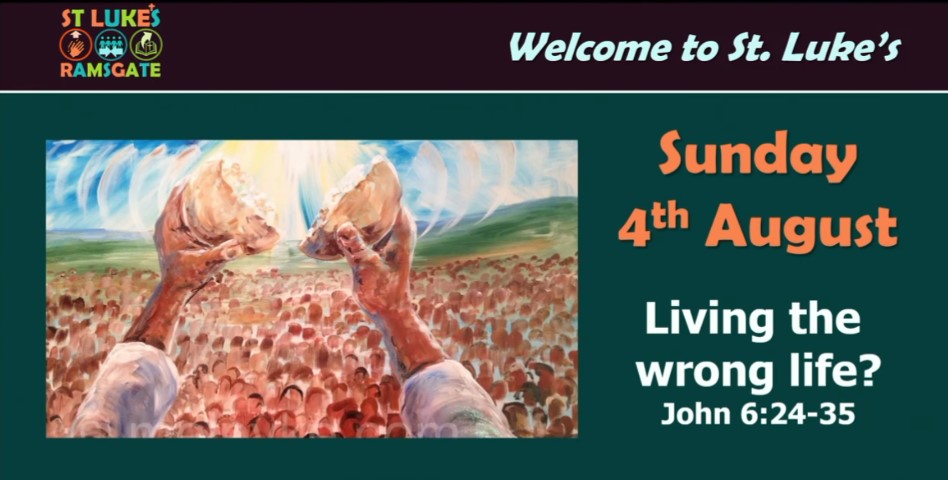
This Sunday in our morning worship, using John 6:60-69, we see Jesus answering questions from the crowds and disciples in the wake of his radical statements about who he is after feeding the 5,000.
Fifty-one years ago, the day after Britain joined the European Economic Community, Edward Heath, the Prime Minister at the time, made a speech at a banquet held in celebration of the event, with the Archbishop of Canterbury sitting by his side.
(In case you’re worried, let me say that I am not telling this story in order to make any kind of political point. Bear with me on this one – I am only telling this story to shed light on the Bible passage we have just read, John chapter 6 verses 60 to 69, and to introduce three questions and three answers contained in that reading.)
And this is part of what the Prime Minister said back then:
“Today we … have achieved a fresh unity in Europe, a unity for which humankind craves. Whether it is that unity that leads eventually to the nation-state, it is still something greater, something greater than themselves which humanity wants, something in which they themselves can share, which gives them their ultimate goal. And so we are creating a unity of a new kind.”(1)
I said I was not going to be making any kind of political point, and I genuinely mean it, I won’t. We must leave that to the politicians. Yet in speaking about “something greater than themselves which humanity wants, something in which they themselves can share, which gives them their ultimate goal”, the Prime Minister himself seems to have stopped talking politics and started talking theology, as if he were less P.M., more archbishop. At that very point in the speech, the actual Archbishop of Canterbury interjects by saying “hear, hear”. You can see it all on YouTube.
Whatever view we take of the last fifty years of European history, whether we are pro or anti, and whether or not we have a view at all, surely we should all be able to agree that the Prime Minister was claiming far too much in this speech. If it is the case that human beings in their very essence crave something greater than themselves, in which they themselves can share, which gives them their ultimate goal – if that is the case, then it was far and away too much for the Prime Minister to promise that European co-operation would provide the answer to that desire. That would be to turn politics into theology, and to make a man, or a movement, into a Messiah.
In the Bible reading we heard in church last week, a great crowd of people, having been fed by Jesus with bread and fish, start chasing him around in anticipation of obtaining more. He tells the crowd in John chapter 6 verse 33 that “the bread of God is he who comes down from heaven and gives life to the world”, and then in verse 35 that he is the bread of life, and that anyone who comes to him will never go hungry, and anyone who believes in him will never be thirsty. Finally Jesus says, in verses 53 to 56, that “unless you eat the flesh of the Son of Man and drink his blood, you have no life in you. Whoever eats my flesh and drinks my blood has eternal life, and I will raise him up at the last day. Whoever eats my flesh and drinks my blood remains in me, and I in him.”
What does Jesus mean by saying all this? Well, for one thing, he cannot be talking about receiving his body and blood in the Lord’s Supper, for the very good reason that Holy Communion had not yet been instituted. If he had been talking about Holy Communion, something that no-one knew anything about at that time, you might expect people in the crowd to respond by saying ‘This is a hard saying. Who can understand it?’ Yet that is not what they said. They appear to have understood all too well what Jesus was saying. Their response, and the first question of three I want to highlight from our Bible reading today, was in verse 60: ‘This is a hard saying. Who can accept it?’
So what did Jesus mean in saying “I am the bread of life – eat my flesh and drink my blood”? He meant essentially this: There is a unity for which humankind in its very essence needs … a need for something greater than themselves, something in which they themselves can share, which gives them their ultimate goal. That unity is to be found, and that goal is to be reached, by one means and by one means only, which is by being united to Christ. — Hear, hear! — ‘I am the bread of life. Eat my flesh and drink my blood’ means that he is the ultimate answer to all human need, and the true endpoint of every human aspiration.
All this is way past the politics of food supply. All this is from a man who is indeed the Messiah. Yet ‘I am the bread of life’ was a claim that is too big for many people to accept. The crowd were willing to follow Jesus all the while they thought a constant supply of bread and fish was on offer. Not so many followed once it was clear that he was calling for a deeper, closer, personal union: “eat my flesh, and drink my blood, remain in me, and I will remain in you”. I want your whole life, and in return I will give you my life. “From this time”, we read in verse 66, “many of his disciples turned back and no longer followed him”.
And Jesus let them go. In verse 61 he asks the second of three questions in this passage: “Does this offend you?” He goes on to say, in effect, that if they were offended by these words, they would be likely to be even more offended by all those series of future events that would be inaugurated by the crucifixion and would culminate in the ascension.(2) Jesus knew, and said in verse 65, that no-one can come to him unless the Father has enabled him. He knew people well enough not to entrust himself to anyone, we read elsewhere in the Gospel of John, and he knew what was, and what was not, within their hearts (cf. John 2:24-25).
So he let go, those who wanted to go – and the question for him then became whether he would have any followers left at all. That is the third question in the passage, which is directed to the twelve who were closest to him, and appears in verse 67: ‘You do not want to leave too, do you?’ What kind of leader would he be without followers? There would indeed come a time when all his disciples would flee in fear of their lives, when he was unjustly condemned to death and crucified. At that time he walked a lonely path, forsaken even by his Father as he bore the weight of the sin of the world upon his shoulders. Yet in our reading today, the apostle Peter articulates the faith the twelve had come to share, a faith that would be tested by the cross but renewed by the resurrection; a faith that would build a community of those who did not leave and go their own way, but who stayed put and stayed united under one common confession. That faith is expressed in three answers, given one after the other, which we read in verses 68 and 69.
First we read that Simon Peter answered Jesus, ‘Lord, to whom shall we go?’ Yes, I do know that this is another question, but here Peter is answering a question with another question. The answer is in the question: for those that have come to know Jesus, having been enabled by God to do so, there is no other like him to whom they may go. The biblical commentator Leon Morris writes: Why would anyone “who has come to know Jesus’ life-giving word … ever forsake him [?] When a person once knows Jesus, none else can satisfy.”(3)
‘To whom shall we go?’ is one of Peter’s rock-bottom statements, and we would do well to remember and repeat it whenever we are at or near rock-bottom. Even if in a thought experiment we did want to throw in the towel and depart from the path of Christian discipleship, to whom else would we go? Needy people may latch onto anything or anyone that comes along if they think their needs can be fulfilled by doing so, but we, having shared in the Holy Spirit and tasted the goodness of the word of God, cannot be content with that. What do we honestly think our options are? We must know, as Peter knows, that in the final analysis, Christ is all we have, and that we are good for nothing and for no-one else. Or, to state the matter more accurately, we must know that nothing and no-one else is good enough for us, and that is perfectly fine, because in Christ all the fullness of God dwells bodily, and we are complete in him (cf. Colossians 2:9-10).
The next answer given by Peter builds on what has gone before. ‘You have the words of eternal life’. He says this in recognition and acceptance of what Jesus has previously said in verse 63: “The words I have spoken to you are spirit and they are life”. This is a recognition that we cannot gain life on our own. “If Jesus is divine revelation come down from heaven like bread to nourish people, his purpose is to communicate to them the principle of eternal life”.(4) We feed on him in our hearts by faith with thanksgiving in the Word as much as we do in Holy Communion. Perhaps you know the old saying that man shall not live by bread alone, but by every word that proceeds from the mouth of God. This is itself a saying of Jesus Christ. So let us, like Peter, hang on his every word, in the knowledge that all his words are life-giving.
I am not advocating a “mere knowledge of the stories about Christ”, but rather that through reading the Scriptures “we recognise Christ truly as our redeemer and trust in him, so that solely because of his obedience, by grace, we have the forgiveness of sins … and have eternal life”.(5) For the truth is that Jesus does not speak the language of self-help and positive thinking. Instead, he speaks a language understood by people who know from bitter experience that the answers they require do not all lie within their own grasp. It is a language of grace, and of hope, coming to us from the outside. The words of eternal life are, that God helps those who know they cannot help themselves.
Finally Peter says, ‘We believe and know that you are the Holy One of God’. Jesus Christ was as much flesh and blood as anyone else who has ever walked the planet. Yet Peter and the twelve staked their lives on the insight that he was this, and much more besides: that he was God in the flesh, come to redeem the world from sin and death. And it has been given to us to believe this of him.
The title ‘the Holy One of God’ is rare in the New Testament. In fact, it only occurs in two other places, Mark chapter 1 and Luke chapter 4, where a demon-possessed man says to Jesus, ‘I know who you are, the Holy One of God’. Here in John chapter 6, this spiritual insight arises not from the opposition of devils but from the submission of a disciple, and it represents one of the highest points of recognition on the part of the disciples in the Gospels, along with Peter’s confession in Matthew chapter 16 that Jesus was the Christ, the Son of the living God, and Thomas’ cry in John chapter 20, ‘My Lord and my God’.
And it makes sense of everything that has gone before. If Jesus were not the Holy One of God, then there could certainly have been other rabbis to whom the disciples could equally well have gone. If he were not the Holy One of God, it would have been far too much to claim that he had the words of eternal life.
We might say that Ted Heath was right, that there is a unity for which humankind in its very essence needs, a need for something greater than themselves, something in which they themselves can share, which gives them their ultimate goal. It is just that the project he offered, was nowhere near big enough to answer that desire, just as no other political or social project within the sphere of what is humanly possible has ever been big enough to answer that desire. These are human projects after all. Yet what is impossible with man is possible with God, and that possibility arises from union with Christ, we remaining in him and he in us. He alone is the answer to all our questions. To whom else would we go? He has the words of eternal life, he is the Holy One of God.
(1) https://cutt.ly/jegdwdhB (2) cf. Leon Morris, The Gospel according to John, pp. 383-384. (3) Ibid., p. 390. (4) R.E. Brown, The Gospel According to John I-XII, p. 300. (5) Kolb and Wengert, Formula of Concord, p. 495.
Jesus is more than super-human. But what does that mean?
All Age Intro: Olympic Top Trumps Who would win…? In which category?
Usain Bolt Won 8 gold medals including both 100m and 200m in three successive Olympic games. He still holds the 100m and 200m world records. He ran 100m in 9.58s.
Laura Kenny In terms of her 5 gold medals, is the most successful, female cyclist in Olympic history.
Michael Phelps Won 28 medals including 23 gold medals, top US swimmer. Nearest anyone else has come is 9 gold medals.
Categories: cycling, swimming, running
We would describe these people as kind of super human. Human beings like you and me, but absolutely superb in certain areas, better than anyone else at cycling, swimming or running. They can do things beyond what normal human beings can do. In top trumps, they win hands down in their category.
Jesus, top trumps… (So far in Mark’s gospel)Makes Mark’s gospel has been showing us the things that Jesus was doing. Jesus was clearly a human being like everyone else, but he seemed to be super human, to be able to do things that went beyond what normal human being can do. So far Mark has already shown us Jesus:
Making lepers clean, Making lame walk, Casting out a legion of demons Calming a storm Bringing back a girl from the dead Feeding 5,000 people with a pack lunch… and now, Walking on water…
Jesus seems superhuman, but is superhuman the right way to describe him? Is there something more going on? If so, what does that mean for us?
Jesus walking on the water Re-tell the story… With props…?
Three questions: Why did Jesus make the disciples go off without him? Why does Jesus walk on water? Why were the disciples completely amazed?
Why does Jesus walk on water? Card – turn around – ‘I am…’ Jesus healed people to make them better. Jesus cast out demons to set people free. Jesus calmed a storm to save them from drowning. Jesus raised the girl to bring her back to life. Jesus fed people because they were hungry. Jesus did all these things to help people. But walking on the water did little to help anyone, if any miracle was done just for the sake of showing off this was it! So, why does he walk on water?
It seems that at this moment, Jesus does seem to want to show them something about himself, to really push their understanding of who he is even further. So, what is he trying to show them?
Well, the fact is walking on water is not just super human. Usain Bolt can run incredibly fast, but he cannot walk on water. Michael Phelps can swim through water at incredible speeds, but he cannot walk on water.
Jesus is doing what no human being can do unaided. But that is the point. Jesus is not acting as a human, but as God.
In the Old Testament, the part of the Bible that talks about before Jesus came, the scriptures from which the disciples would have learnt about God, there is a book called Job and in chapter 9, Job reflects on how much greater than man God is and includes this line: “He alone stretches out the heavens and treads on the waves of the sea…” (Job 9:8)
In walking on the water, Jesus was revealing that he was not super-human, rather he was human, but also Divine, man and God combined. He was pushing his disciples to think more deeply about who he really was.
Some commentators also suggest that the details of the story also point to this idea that Jesus was showing himself to be God. The fact he was passing them by, when they spotted him, rather than just coming to them, shows that he was mimicking what God did when he revealed his true character to Moses, by passing by him. Some also argue, that when Jesus says, “Take courage! It is I! Don’t be afraid!” The words he uses, for ‘It is I’ are literally, ‘I am’, the words used by God to describe his name, when he meets Moses in the burning bush. Certainly, the only other time he says, ‘I am’ in Mark, is when he is asked directly by the Sanhedrin, “Are you the Messiah, the Son of the Blessed One”?
The disciples main need was not help crossing the lake, it was help to understand that Jesus was far more amazing than they had so far realised. He wasn’t superhuman, he was God with us.
Why were the disciples completely amazed? Why card… turn around hard heart… This leads us to the next ‘Why’? Why were the disciples completely amazed. After all, they had already seen Jesus do some amazing miracles. Only the day before they had been involved in helping to feed 5,000 people with just a packed lunch.
His answer is that they had not really grasped what Jesus was doing with the miracle of the loaves. Because in that he was also acting more like God than man.
In the Old Testament, Israel’s origins are bound up with God acting in power to rescue them from being slaves in Egypt. He forced Pharaoh, the king of Egypt to let them go, by sending 10 plagues on Egypt. Then when Pharaoh chased Israel after they had left and trapped them by the Red Sea, God made a path through the sea, so Israel could cross on dry land, but drowned the Egyptian army that followed them. Then when they were in the wilderness, God made sure they had food to eat by providing a special food called Manna for them to collect every morning.
So, Jesus feeding masses of people in the wilderness, should have been a sign to the disciples that he was more than superhuman, he was behaving like God, giving manna for Israel in the wilderness. If they had realised the true significance of that miracle, then they would not be surprised that if Jesus is the God of the Old Testament, who fed the people in the wilderness, he also has the power to treat the sea as though it is dry land, as he made it so Israel could cross the Red Sea and escape Pharaoh. The sea was no barrier to Jesus, just as it was no barrier to the God of Moses, because Jesus is not just super-human he is the God of Moses.
Why didn’t the disciples grasp the significance of what Jesus had already done? Mark tells us it was because their hearts were hard. Even those who had invested everything in following Jesus, seemed unable to grasp who he really was. The truth was just so amazing, so out there, so hard for them to take on board. When it came to understanding who Jesus was, they were out of their depth, they were all at sea.
But the story continues, the disciples stick with Jesus, and bit by bit they come to understand who he really is.
You may be struggling to truly grasp the centrality of Jesus, few people understand straight away. But, if you keep coming to church, meeting with other Christians, praying and reading the Bible, then in the end God will enable your heart to be softened, and your mind to understand who Jesus really is, and in him you will find true connection with God.
Why did Jesus make the disciples go off without him? Why? Rejected crown… So, to the final, ‘why’. Why did Jesus make the disciples go off without him? After all they end up quite helpless without him there with them.
Notice that he did so before dismissing the crowd. He wanted to separate them from the crowd, then to move the crowd on.
In John’s gospel, we are told that the crowd wanted to make Jesus king, and that would not be surprising after seeing him do such an amazing miracle. Here was someone who seemed super-human, surely he could act as our political leader and solve all our political problems? The disciples might easily have gone along with this idea, even later on it seems to be the kind of thing they are hoping for. Without the full understanding of Jesus’ divinity, it is easy to try and use Jesus’ superhuman powers, to fit into your agenda.
Do you come to Jesus in order to make you feel better or improve your mental health, do you come to Jesus, because you think it will make you richer, do you, as some do, try and use Jesus to bolster your political cause?
When we see Jesus as just super-human we enlist him for our cause. When we come to understand that he is the Almighty God, we realise that he has come to enlist us to his cause.
Even Jesus, realised the pressure on him to fit into people’s expectations. So, Jesus does not ride the wave of his success, he does not play to the crowd. He dismisses the crowd and goes up the mountain by himself to pray, to commune with God, to embrace his divine nature and divine purpose.
When we find ourselves, excited by our success or pressurised by those around us to fit into their agendas, we need to make prayer a priority. Like Jesus, we need to turn again to God in prayer, in order to re-orient ourselves and seek his direction and his purpose for our lives.
How do we view Jesus? Superhuman or God with us?
If we see him as superhuman, then we just view him as a better version of ourselves:
a good man,
a great teacher,
a miracle maker.
These are all admirable characteristics, just as Usain Bolt, Laura Kenny and Mark Phelps have admirable characteristics. We may admire him, even want to learn from his teaching. But ultimately he is just another man, we have no reason to follow him instead of other great human teachers, religious or otherwise.
But, when our hearts are no longer hardened, when we come to realise that Jesus is not just superhuman, but the God who created the universe, come to live among us, then we see that his life, his teaching, his death and resurrection are not just good stories, but the transformational moment in human history. We see that a relationship with him has the power to utterly transform our very existence.
Then even if like the disciples, life feels like a hard slog and that we aren’t going anywhere, we can discover that Jesus is still with us, and as the Divine God, we can be confident that the future is in his hands. we can hear his words to us: “Take courage! I am! Do not be afraid!”
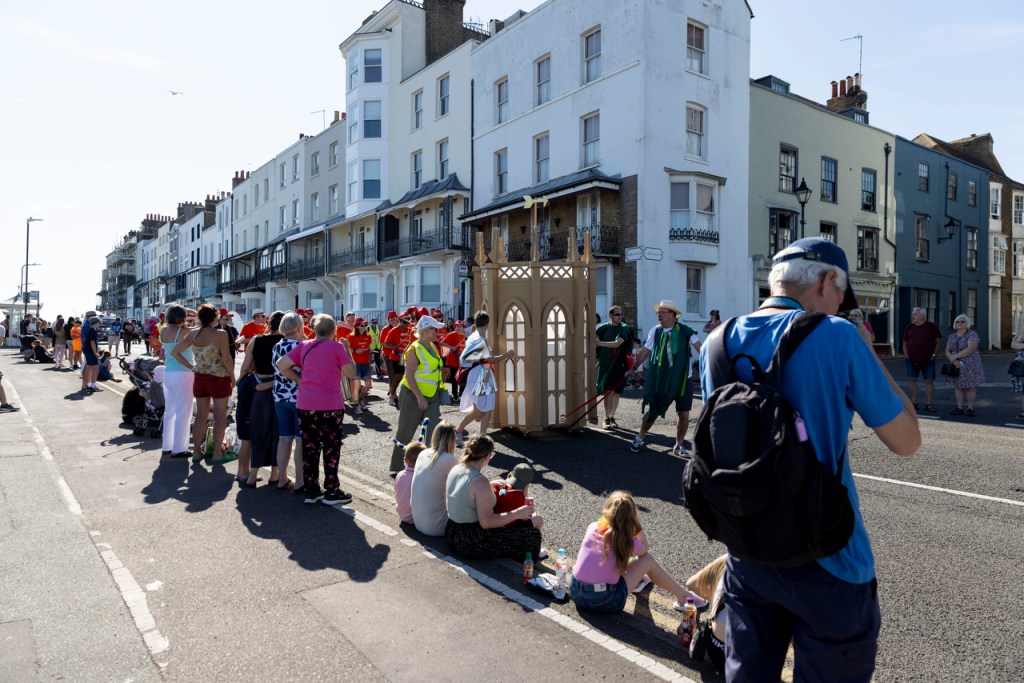
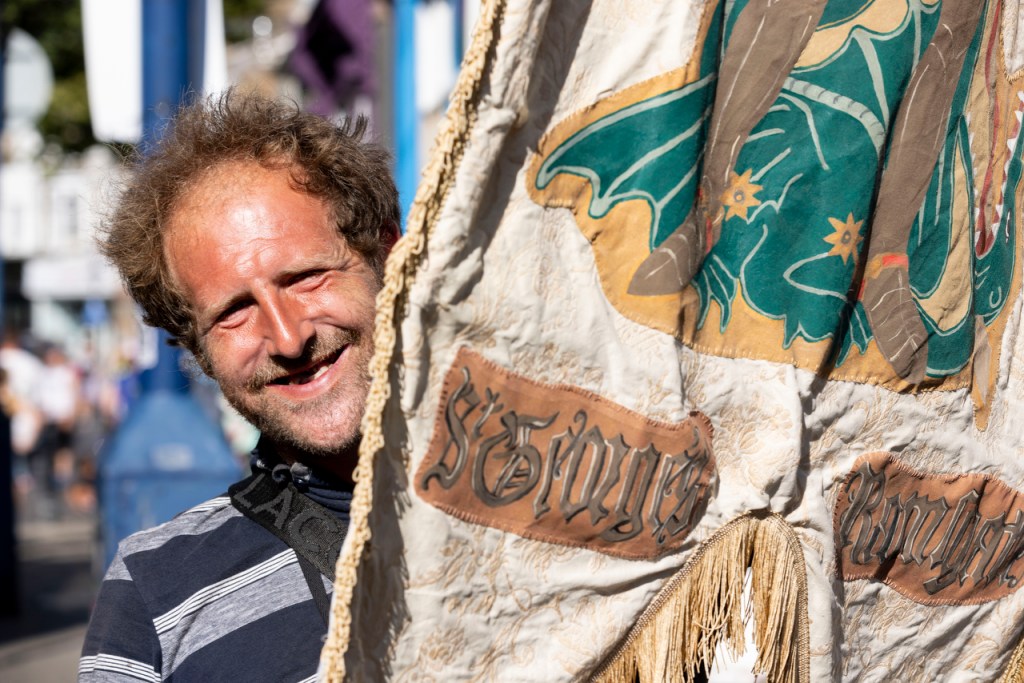
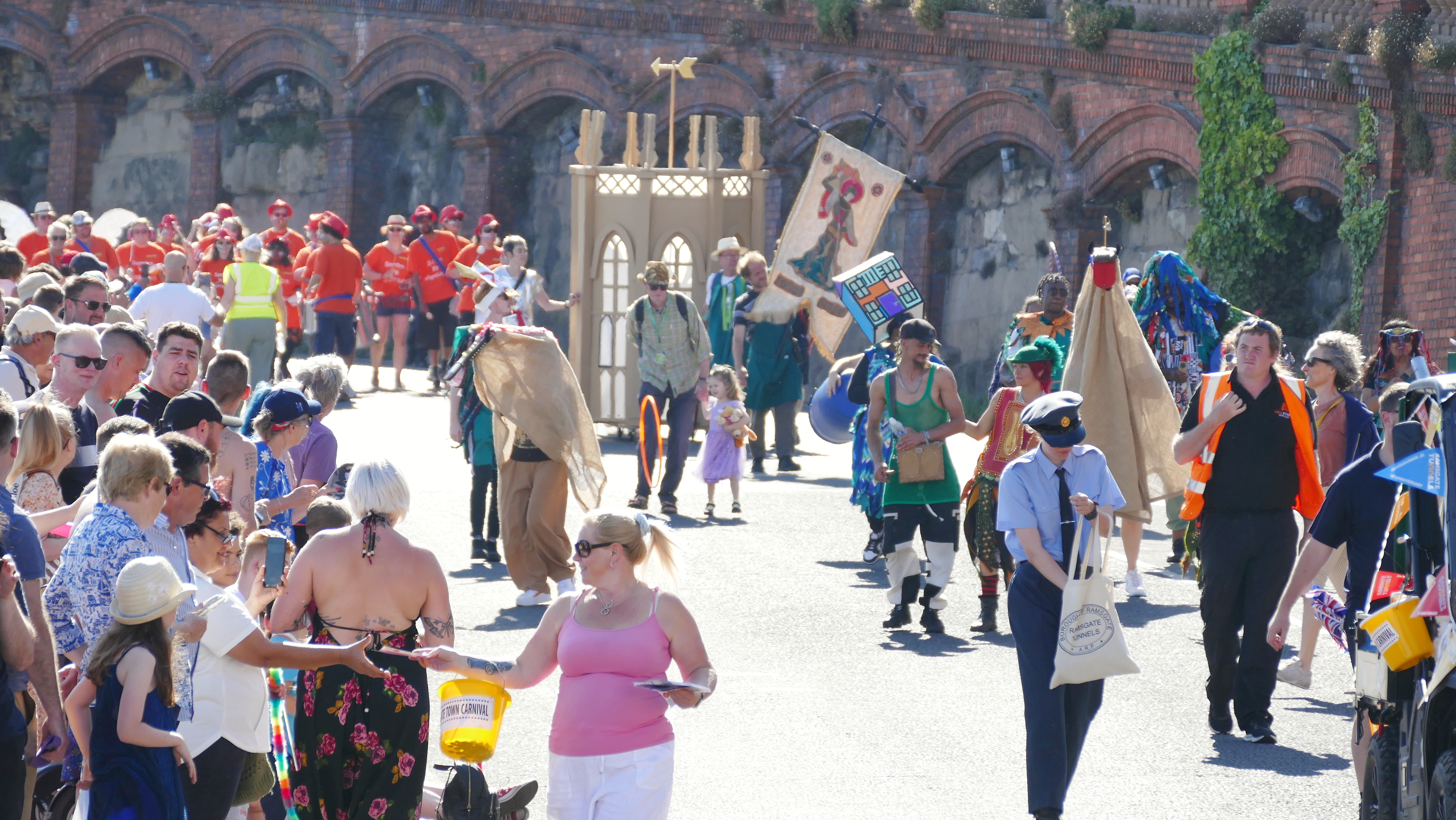
A big thanks to GB Carnival for including us, as well as to Mark Ogden, Mark Wilkins, Stephen and Jemima for pulling the lantern, and to Alan for carrying the flag. It was lovely for St George’s to participate in this years Carnival.
“Taking the five loaves and the two fish and looking up to heaven, he gave thanks and broke the loaves.” (Mark 6:41)
At the feeding of the 5000 the disciples’ role in organizing the people, distributing the bread and loaves, and collecting the leftovers teaches us to participate in God’s work to provide for others and to trust in God’s ability to meet our needs whilst working to show compassion and generosity to those around us.
Eating and Feasting, we look at the Miracle of the feeding of the 5000.
Eating – Feasting what’s the difference?
Well eating is defined as put (food) into the mouth and chew and swallow it, feasting is enjoy a plentiful and delicious meal in the company of others.
Our passage today, is interestingly the only miracle of Jesus that is told in all four gospels. The feeding of the 5000 shows God’s abundance, power, authority and compassion. It is the feeding of the 5000 found in Mark’s gospel. I want to give you some deeper context into when this feeding of the 5000 took place and what has happened immediately before as we encounter some hungry disciples and 5000+ people hungry without food.
Context
Before the feeding of the 5000 took place, Jesus had shown the 12 disciples his authority over sickness(1), death(2), demons(3), and the elements of nature(4). After these powerful displays, they faced two difficult events: the gospel of Matthew shows the disciples then heard of the shocking execution of John the Baptist and then the rejection of Jesus by those in his own town.. At a time when they might wish to wallow, worry or hide for protection, the disciples are sent out without Jesus, together in pairs and told not to take food or money but to live through the generosity and hospitality of others while they preach and are give authority over impure spirits. SO they’ve anointed the sick, seen healing and preached And that is where we come into this passage. With the 12 disciples, here called Apostles, gathered around Jesus telling him all they had done and taught, and You can the imagine the spilling out of stories as the different pairs tell Jesus who they anointed who they prayed for, this person said this, then John said…
And – then ‘because so many people were coming and going they did not even have a chance to eat, he said to them, “Come with me by yourselves to a quiet place and get some rest” So they went by themselves in a boat to a solitary place. A quiet time of rest phew finally is probably what the disciples were thinking after such an up and down time of events.
(1) Mark 5:25-34
(2) Mark 5:21-24, 35-43
(3) Mark 5:1-20
(4) Mark 5:35-41
Point 1 – God’s Provision
God’s provision, God provides. Many of us are familiar with the story of the feeding of the 5,000. For some, this might be a new and exciting story, but the significance of the miracle goes far beyond the physical act of feeding a large crowd with a few loaves and fish. It is a testament to the power and compassion of Jesus even in times of scarcity and need.
‘You’re not you when you’re hungry’ is a popular tag-line for a Snickers chocolate bar, I’m sure we can all feel ourselves get a little grumpy sometimes when we are hungry. In our house we use the word hangry, when your hunger is causing you to become angry . I’ve learnt that to keep both my boys happy and yes I’m talking about both my husband and two year old son, I have to carry a ridiculous amount of snacks and deal with a ridiculous amount of crumbs. I’m often told how similar my son in to his Dad and they are never more similar when they are both hangry, the eyebrows come out the tone of their voice goes high, they get stroppy with each other and as soon as they’ve eaten its like butter wouldn’t melt. Well Research studies have backed up that hunger negatively affects us and has an impact on our emotions and our actions. I’m sure after all that had taken place with the disciples they were VERY hungry and now here are 5000 more people, all starting to get hungry. It says that after Jesus taught them, taking compassion on them as they were like sheep without a shepherd.
Mark 6:39-41
Then Jesus directed them to have all the people sit down in groups on the green grass. So they sat down in groups of hundreds and fifties. Taking the five loaves and the two fish and looking up to heaven, he gave thanks and broke the loaves. Then he gave them to his disciples to distribute to the people. He also divided the two fish among them all.’
Jesus took a seemingly insignificant amount of food from the crowd, it wasn’t made out of thin air it was already there, and multiplied it to meet the needs of thousands. He wasn’t complacent with this miracle, he organised the people, involved the disciples, provided a plentiful where they all ate and were satisfied and then the disciples collected up 12 bowls of leftover food. Just as we see good stewardship in everyone being organised into groups we also see it with the food being collected up after.
I’d say it’s a little less Eating e.g putting food in the mouth chewing and swallowing and a little more like feasting, there’s life giving teaching, people have been kept all together rather than scattering off in loneliness and there’s a special meal provided by a miracle.
Point 2 – A glimpse of heaven
At this point, if we were to end the sermon, honestly, I think we would be left with a challenging question: If it’s so easy for God to provide, why are people hungry? Why are people having no other choice that to eat every meal in loneliness, Why are people not regularly included in great feasts of celebration and joy now?
Well our world now is not how it was originally intended. God walked with Adam and Eve in a garden before sin entered in the world, and every plant other than the tree of knowledge was available to them for food. Good food nourishing food that had not come from exploitation but was growing straight from the earth and eaten in God’s presence. But when sin entered the world and Adam and Eve left the garden, humanities struggle with food then began and the world was broken by sin, suffering and death and striving became part of life. But that wasn’t the end of our story, through God’s love he sent us his son. And in the death and resurrection of Jesus, a man free of sin, death itself was conquered pointing toward the promise of eternal life in God’s presence in the new heaven and new earth, the new creation after the second coming of Jesus. So while we still live in a broken world now, with hunger and sin and loneliness, the future of a new heaven and new earth has been won for those who accept Jesus as their saviour.
Therefore this miracle of God’s abundant provision with everyone in one group eating outdoors together in God’s glorious creation, can be seen as a glimpse of our eternal life with God. Our world today has hunger, fear, striving, and disaster, and is not how it was originally made. It is under the influence of evil, and this miracle is a glimpse of what the new heaven and the new earth will look like, what we can all look forward to in confidence in the time of waiting.
In this waiting – God invites us to participate.
Point 3 Invited to participate
So in the feeding of the 5000 we see that God is powerful and generous and gracious, he knows the peoples physical needs and has compassion for them feeding not only spiritually by teaching them but also by feeding them. We then see that the feeding of the 5000 is a glimpse of the future, the future that we are waiting for, where there will be a new heaven and new earth, no more hunger. The final point of the passage we will look at before we think of its impact on us today is that in the passage Jesus also invites others to participate in the miracle.
The disciples here (also called apostles in the passage which means they had been sent by Jesus, if you remember earlier they have just come back from a mission in pairs and haven’t eaten yet. The disciples here offer a solution to Jesus after they spot that people miht be getting hungry and Jesus pushes them to use their own initiative but not not necessarily their logic.
Mark 6:35-39
By this time it was late in the day, so his disciples came to him. “This is a remote place,” they said, “and it’s already very late. Send the people away so that they can go to the surrounding countryside and villages and buy themselves something to eat.”
Spot the logic,
But he answered, “You give them something to eat.”
They said to him, “That would take more than half a year’s wages[e]! Are we to go and spend that much on bread and give it to them to eat?” “How many loaves do you have?” he asked.
“Go and see.”
When they found out, they said, “Five—and two fish.” Then Jesus directed them to have all the people sit down in groups on the green grass.
Logically it does make more sense for people to leave and get themselves food. But Jesus wants them to use their initiative faithfully, with confidence in Gods provision. And this is a challenge for me as I’m a very logical person.
The disciples are challenged to have to rely on God. And the disciples’ role in distributing the food and collecting the leftovers teaches us about the importance of participating in God’s work of providing for others. For us reading it, it serves as a reminder of the call to service and generosity. Jesus could have easily performed the miracle Himself, but He chose to involve His disciples in the process. Similarly, we are called to be instruments of God’s love and provision in the world. We are called to serve others with humility and generosity, sharing our resources and blessings with those in need.
Application – The World, The Church, Us.
The world’s relationship with food is broken. Global hunger is increasing but at the same time billions of tons of food are wasted each year. You have only got to look back to the effects of Covid 19 when hoarding food became a real issue. Not only is there a lack of food, but also a lack of community and time to enjoy meals together. Has food in our society simply become about putting food in our mouth and chewing and less about feasting in the enjoyment of others. St. George’s and St. Luke’s are doing an incredible job in addressing these issues with cafe for all at St Luke’s and Community meal at St George’s not to mention the countless food people share together between them at other times. On a personal note, the first interaction we had here with you as a church was food parcels being delivered to our house which blessed us and meant we could bless our family and friends who were moving us in. So my challenge for you as we see what a blessing feasting and not just eating can be is, I hope, is simple: Eat with others, enjoy the food you eat, and say yes to invitations to community meal or café for all. See the communion we take together as a feasting of our church all together in remembering our Lord and saviour Jesus Christ. Let’s be people that feast and invite others to feast with us because we have the best reasons to celebrate.
Conclusion
The feeding of the 5000 is an amazing miracle showing God’s provision and showing Jesus as the incredible teacher he is to get people to participate with him, Let us leave space in our lives for God to work miracles through us as we bless those around us.
Let’s pray
Father God thank you for your provision, thank you that Jesus teaches us to this day, we pray Holy Spirit, help us to see your work of power, grace and provision in our lives and in the lives of others as we participate to bless our communities. Amen
This week’s email is a notice sheet for the whole of the summer. Do check below for important information about what is happening over the summer and what to look forward to in the autumn! There will not be any normal weekly emails until September but do watch out for occasional Summer Updates.
Imagine getting in from a busy day, where you’ve not even been able to stop for breakfast, lunch or dinner, and as you sit down to eat your hot plate of foot, feet up and telly on, KNOCK KNOCK goes the door.
Last week, we looked at Herod’s panic, thinking the man he was manipulated into killing, John the Baptist, had risen from the dead upon hearing stories of Jesus. In this passage, the disciples return from being sent out on their first mission in pairs. They eagerly tell Jesus of their preaching, driving out demons and healing the sick. However, as much as their spiritual hunger seems fed, their physical stomachs are rumbling.
Jesus sees this need and tells the disciples to come to a quiet place with him for rest, but before they even get there, the crowds descended, like sheep without a shepherd, to be by Jesus’ side. The peace and quiet that was almost within the disciple’s grasp is quickly taken away from them.
After Jesus teaches the people many things, the disciples say to him that he should send the people away to buy food from surrounding villages as its very late and the place is remote. However, whilst the disciples try to find a solution to everyone’s hunger with earthly logic, Jesus responds with heavenly abundance.
At the feeding of the 5000 the disciples’ role in organizing the people, distributing the bread and loaves, and collecting the leftovers teaches us to participate in God’s work to provide for others and to trust in God’s ability to meet our needs whilst working to show compassion and generosity to those around us.
Beth Keenan
Summer Celebration Service – 21st July, 6:30pm, St. Luke’s
This is an informal contemporary service where we will be using the year of discernment psalm to help us focus on Seeking God and dwelling in his presence. All welcome.
Sailors’ Church Services
The Sailors’ Church will be holding evening services at 6pm on every Sunday in August. Everyone welcome. Bring a friend!
We will be arranging a lunchtime event to say farewell to Claire.
Summer Fair – Saturday 31st August, 1-5pm
Do support this great joint event with St. George’s at St. Luke’s. See Charlie if you would like to volunteer to help. Find out more…
Heritage Open Day, Saturday 7th September
Tomas Visek Concert, 5pm, Sunday 8th September
A special concert at St. Luke’s with this international pianist and supporting quartet. Tickets £10, light refreshments included. Tickets available online. Find out more…
Ride and Stride and Yard Sales, Saturday 14th September, 10am-6pm
The Town Council is currently preparing a Neighbourhood Plan for Ramsgate. The Neighbourhood Plan will contain planning policies against which planning applications for development proposals will be considered.
There is an opportunity for you to let us know if you agree or not with the current draft vision. To do this please click hereto find out more and complete the form or check out one of the leaflets at the back of church.
Church Door Challenge
Join the #ChurchDoorChallenge on social media this July and August, showcasing the hospitality, history, and diversity of churches across the country.
We have over 16,000 church buildings in England, including over 300 in our diocese, each with a unique community offering, surrounding, and story.
This summer, we’d love to see some wonderful photos and videos of your church doors and entrances posted on your social media channels. We’ll then share our favourites on our diocesan channels (don’t forget to tag us so we see them), and the national comms team will do the same on national Church of England social channels. The posts will encourage people to take a look for themselves or find a church service in their area using AChurchNearYou.com.
Share yours between 4 July and the end of August, using the hashtag #ChurchDoorChallenge.
Freelance Web designer / developer and Virtual Assistant needed to set up a new website and registration page for a Webinar series due to go live on 14th October 2024. If you have the relevant skills, please call Julia Arnheim 01843 31 91 66 (mornings or 5-6pm).
Links to Share:
Journey to the Promised Land
Watch this dramatization of the Israel’s journey to the Promised Land in the style of the Office sitcom. Watch the pilot episode (30 mins.)
Two Truths and One Lie about evangelism
In the first of a series of 60s videos from the Church of England Evangelical Council, evangelists answer the question: “What are two truths and one lie about evangelism?” The first one is from Glen Scrivener. Watch Video
What’s On – a page which lets you know what is happening this week and gives information about upcoming events.
Notices – You can read the latest notices on this page.
Sermons – Read a transcript of a recent sermon or watch the YouTube version recorded at St. Luke’s. There are now videos for all the sermons over the summer.
Safeguarding Training
If you volunteer in anyway at church the national authorities are strongly encouraging you to take at least the Basic Module in safeguarding training once every three years.
If you have not completed the training in the last three years, then the module can be completed online and takes about ninety minutes. You can access the training by following this link. You will need to first register, to access the training. Once the training is completed, you will be sent a certificate. Please forward that certificate to James (office@stlukesramsgate.org), so that we can keep records of who has done the training.
Join us for our joint summer fair at St. Luke’s church from 1pm to 4pm on Saturday 31st August. The fair will take place inside and outside the church on the corner of St. Luke’s Avenue and Hollicondane Road, CT11 7JX. Money raised will go toward St. Luke’s and St. George’s church funds.
cream tea with strawberries silent aucton cake stall book stall ‘pocket money’ stall games and contests cards, knitted toys and other crafts.
Free entry and free activities for children. Tables (£10 each) available to other sellers: contact Charlie: crharley13@gmail.com