This week YI will not be meeting in St. Luke’s church hall Sunday evening but will instead will be joining other Youth groups in Thanet at ‘The Event’.
Games, food, worship and bible teaching still feature, but we’ll be together with other friends from the area. This month we are at Queens Road Baptist Church in Broadstairs, 6pm – 8pm.
Peter and Charlie will be taking a group, so do get in touch.
St. George’s Annual Meeting will take place in the church at 7pm on Thursday 25th May. It is a great chance to celebrate all that God has been doing amongst us over the last year (see the annual report below), to elect and pray for those involved in key governance work and to think ahead to what God might be doing with us in the future.
There will also be a report from our Regeneration Officer, Jemima Brown.
At the annual meetings for St. Luke’s and St. George’s, rather than laying out a vision for the coming year for the churches I am asking people to come up with questions for me to consider when I go on Sabbatical for June, July and August.
Thinking of good questions can be quite challenging, but they can also be more useful than statements or ideas. At the St. Luke’s annual meeting, 10 questions were asked, which you can read on the St. Luke’s website if you check out the report on the annual meeting.
Many of the questions express the specific concerns of the questioner:
How can we engage our families more?
How can we make the church fully accessible to all?
How can we develop prayer ministry?
Others were broader and more open ended:
What things might be preventing discipleship? What are our current limitations?
How do we take church out as well as having a passion for new people to come in?
Perhaps you could ask a really broad question:
What next?
Whether specific or broad they are all good questions.
A Question for the Risen Jesus
Our reading comes from the very start of the book of Acts. The apostles who had spent three years or so with Jesus, seeing him do amazing miracles, hearing incredible teaching and being trained by him to go out on mission. Then they went through the trauma of seeing Jesus arrested, crucified and buried. Finally, Jesus rose again and Luke says in Acts that over 40 days he proved to them that he was indeed alive again.
All of this must have been utterly mind blowing for them, but as the incredible truth of what had happened sank in they began to have questions.
I wonder what question you would have asked the resurrected Jesus?
I suspect it wouldn’t have been their question:
“Lord are you at this time going to restore the kingdom to Israel?” (1:6)
Clearly, despite the life changing experience they had just been through, the disciples were still caught up with the concerns of the Jewish people, to have their own kingdom. What they hoped the risen Jesus would do next was to restore the kingdom to Israel.
As a 21st Century British person, it is hard for me to really grasp what they were really thinking.
I am sure Jesus did understand what they were thinking and he tells them that they can’t know the answer to the question, ‘At what time.’
Instead, Jesus goes on to answer a different question, which is: ‘What next?’
Indeed, I think the whole point of Acts 1:1-11 is to answer the question: given that Jesus has died and risen from the dead, what next? Arguably, the whole point of the book of Acts is to show us: What’ next.
What next? The Timeline
Acts 1:1-11 lays out a kind of timeline in answer to the question.
Resurrection of Jesus
Witness the resurrection
It starts with the resurrection of Jesus and those 40 days after the resurrection. The emphasis here is that this was a time, when Jesus appeared to the disciples on numerous occasions, thus proving beyond what must have been considerable doubt that he was alive, that he had risen bodily from the dead. After this 40 days, there was no way they could doubt the truth of the resurrection.
This was also a time of teaching and preparation for what was next.
Ascension
Then comes the ascension. Jesus leaves, by going into heaven.
This ascension at the start of Acts suggests two things.
First, this is part of the passing on of the mantle.
In 2 Kings, the Prophet Elijah is taken up into heaven by chariots of fire, leaving his disciple Elisha behind. Elijah’s prophetic ministry on earth is over, but Elisha’s now begins. Indeed, Elisha is promised twice the Spirit of Elijah.
This is in fact where we get the phrase passing on the mantle. “Mantle” is a word meaning “cloak”. When Elijah is taken up to heaven, he leaves his cloak behind and Elisha picks it up before he sets off to start his ministry.
So, in a sense the Ascension is Jesus passing on his earthly ministry to his disciples. He is passing on the mantle to them, so that they will now go and do what Jesus did.
Secondly, the ascension is actually the enthronement of Jesus. He does not just disappear into the clouds, he goes to sit at God’s right hand to take up the rule over the whole universe.
Peter is clear about this at the end of his Pentecost sermon:
“For David did not ascend to heaven, and yet he said, “`The Lord said to my Lord: “Sit at my right hand until I make your enemies a footstool for your feet.” Therefore let all Israel be assured of this: God has made this Jesus, whom you crucified, both Lord and Christ.” (Acts 2:34-36)
The other week we saw the coronation of King Charles III. It was an impressive ceremony designed to show Charles’s authority as king over the United Kingdom and beyond. Yet, it is also a ceremony that points to the idea that Charles is subservient to a greater king, to the one who rules not on a throne on earth, but to the one who sits at the right hand of God. The ascension shows that Jesus is King and Lord of all!
Wait in Jerusalem (1:4, 12-14). Joined together in prayer.
What are the disciples to do after the ascension? Jesus tells them in 1:4, that they are not to leave Jerusalem, but to wait for the Holy Spirit to come.
In 1:12-14, this is what we are told they do. They return to Jerusalem and meet together in the upper room to pray.
There is something remarkable about this. Firstly, Jerusalem must have been in a sense the last place they wanted to be. It was ruled by the very people who had had Jesus crucified. It would have been much easier for them to have returned to Galilee, to their home, where there would have been much less of a threat. Yet, the whole passage stresses that Jerusalem is the place where they are to start.
Secondly, their focus is on prayer. They don’t race into activity or action, they do as Jesus says and they wait for the Holy Spirit. They do not try to act in their own strength, they wait for God’s power.
Thirdly, they do so together. There is a unity here that is surprising. Not only does this involve the disciples, but also the mother and brothers of Jesus. The gospels do not tell us much about Jesus’s relationship with his mother and brothers, but John does tell us that his own brothers did not believe him. Now here are the two distinct groups together, united in their desire to wait on God’s empowerment for what would come next.
Pentecost
What next? First the resurrection, then the ascension, then Pentecost. Jesus promised and did send the Holy Spirit. What is the prime role of the Spirit in this passage? To empower the disciples to be witnesses to Jesus and his resurrection. And that is what the rest of the book of Acts tells us about.
Witness to the resurrection:
Jerusalem & Judea
They start out in Jerusalem on Pentecost itself, telling the people that Jesus has risen from the dead. We read about the growth of the church in Jeursalem in Acts 1-7.
Samaria
Then in Acts 8 we read about the word of God coming to Samaria
Ends of the Earth
Before the rest of the book tells us about its spread around the North Eastern Roman Empire and eventually to Rome itself.
But that is just the start of the story. It is a story that has continued for over 2,000 years, with people hearing, trusting and following the resurrected Christ’s in all parts of the world from Korea to Kenya, Austria to Australia and Canada to Colombia. Even in our two churches are believers from every inhabited continent in the world.
Return
The story continues, because we are still waiting for the true end. As the disciples watch Jesus ascend into heaven, they are told that he will return as he went. As ruler of the whole universe. He will come as judge and saviour.
Does this answer the apostle’s question?
So that is the timeline: Resurrection – Ascension – Pentecost – Return. Jesus answers the question, “What is next?”
But does he answer the Apostle’s question?
“Are you at this time going to restore the Kingdom to Israel?”
Given the timeline, we could ask when the kingdom comes?
Does the Kingdom come in the Ascension?
Yes, because Jesus is now enthroned as king.
But he’s not king of an earthly Israel in Jerusalem, but ruling from God’s right hand.
Does the Kingdom come through their witness?
Yes, because when people hear the good news about Jesus and truly believe and choose to follow him, Jesus becomes enthroned in their lives as their king.
But this is not limited to Jerusalem or Israel. Jesus tells them to be witnesses to the ends of the earth.
Does the Kingdom come when Jesus returns?
Yes, because then his rule will be complete. Everyone will see him for who he truly is and every knee will bow, however reluctantly can confess that he is Lord of all.
But again this is not just limited to Israel!
Jesus does not answer their question, because it is the wrong question.
They wanted to know when the Kingdom would be restored, but Jesus shows that the Kingdom coming is a process not a moment or event in history. It is like the growth of a tiny mustard seed into a great bush.
They were concerned about Israel, but Jesus’s vision is much greater. He is concerned for the whole world, because as Isaiah says,
“It is too small a thing for you to be my servant to restore the tribes of Jacob and bring back those of Israel I have kept. I will also make you a light for the Gentiles, that you may bring my salvation to the ends of the earth.”” (Isaiah 49:6)
What next for us?
So Jesus sets out the ‘What next’ for the apostles just before his ascension. So, what next for us living in Ramsgate in the Twenty-First Century.
Clearly we need to understand ourselves as being between Pentecost and Jesus’s return. Our main mission is to witness to the truth.
But, the disciples were not told to rush straight into the mission. So, I think we can learn from the overall timeline set out in Acts 1:1-14.
Witness the Truth – Read the Word
Firstly, they spent 40 days witnessing the amazing truth of the resurrected Jesus.
Of course we cannot do that, but the witness did not stop when the apostles died out. They passed on their experience to others who took up the witness. We too can hear their witness by reading the Bible. Luke himself, says he wrote his gospel based on eye witness accounts. If we are to continue the witness today, then we need to listen to the apostles and the amazing thing is we can do just that by reading the New Testament!
Wait – Pray Together
Secondly, the apostles were told to wait for God’s power. So they went and prayed together.
In the same way, we cannot be effective witnesses, without praying together with others. That’s why we need to gather together on Sundays as prayer is a part of what we do together. But why not also meet with others and pray? Or join in with the Thy Kingdom Come prayer initiative, either by signing up to one of the slots to pray at home, but in a sense together with others on the list or if you are able to try joining us at one of the extended daily prayer meetings.
Witness to the Truth – Share the Word
Finally, we do need to actually take the plunge and be witnesses where we are. It is probably harder today to witness to Jesus in the UK than it has been for many years. I saw a survey saying that the UK now has one of the lowest proportion of people who believe in God of any country in the world. We can fear offending people by even mentioning our faith.
But Jesus did not send the disciples to where it would be easy to talk about Jesus, but to Jerusalem, the city that had called for his crucifixion. Where to claim the one that they crucified was God’s Messiah was deeply offensive.
We need to pray for wisdom and courage to share the word in our society here in Ramsgate. But we need to do it, because they need to know Jesus the ultimate king who they will one day answer to.
What’s next for us? I hope and pray that as a church we can be increasingly engaged and excited by the good news we read about in scripture, devoted to meeting together and to prayer and increasingly effective in our evangelism.
Please pray! The 18th May is Ascension Day, when we remember Jesus ascending to heaven 40 days after his resurrection. During the ten days after this, his disciples spent time in prayer as they waited for the coming of the Holy Spirit. God answered their prayer and kept his promise. The Spirit came ten days later at Pentecost (celebrated on Sunday 28th May this year).
Inspired by their example, we want to encourage more prayer today. Over the period from Ascension Day to Pentecost, the Thy Kingdom Come initiative encourages people to engage in extra prayer. We want to join in with this!
If you have not already done so please sign up for one or more hour slots over the 10 days to pray at home. You can sign up on the big sheet available at the back of church, either at Cafe4All or one of our daily prayer meetings or after the service this Sunday.
Cards are available with guidance for your prayers. “Thy Kingdom come here” gives suggested prayers for each day of the week based on the Lord’s prayer. “Pray for 5 Pledge” allows you to write in 5 people to pray for to come to know Jesus. Alternatively you can look at one of the following websites:
In addition we will be starting our daily prayer meetings 30 minutes early for extended prayer over this season. All are welcome to join us either at 9:00am for the full hour or 9:30am for the normal time of prayer:
Our bible study this week looks at the question ‘Does God care when we hurt?’ In this time we will have worship, reflecction and prayer, followed by sharing food and conversation with each other.
Then at 6:30 our doors remain open for anyone who wants to come and there will be a variety of games and activities available.
We’d be delighted to welcome any young people from Year 6 to 13.
Increasingly people say they want to be ‘Spiritual’ but don’t believe in organised religion. We are not saved by organised religion, but we do need it to help us in our discipleship. In Exodus 18, Moses is given advice on how to organise the people of God.
It’s increasingly popular for people to say that they believe there is some kind of Spiritual force, but they don’t believe in organised religion. People don’t want to let go of the idea that there is some kind of force bigger than themselves, but they don’t want to have to be part of something, committed to something or in some way controlled by something outside themselves.
We are increasingly private, individualised people, valuing freedom above all else. Being blessed by some spiritual force is great, allowing your life to be guided by it is increasingly unacceptable. Having a religious experience is fantastic, belonging to a religious community is scary.
Part of this stems from the failures of religious institutions. So often, churches fail to live out the truths of the gospel and the news and social media love to emphasise the church’s failures whilst staying silent about its successes. When the church’s reputation is at such a low ebb, it’s no wonder that people want to avoid it.
But is it really possible to know God and not be a part of his church? Can you really separate spirituality from any form of community and can you have an effective community without it being organised in some way?
God’s Good News is not about an Institution
It has to be said, first of all that God’s good news, that his salvation does not come through any institution. The Bible makes it clear throughout. It is not the church that saves us, but God.
So, in the Old Testament, the Bible makes clear that the people of Israel were not saved from slavery in Egypt by any institution or organisation, but by God acting.
The first 17 chapters of the book of Acts, relate how God heard the people crying out because they were being treated so badly as slaves in Egypt. God sent Moses and God sent 10 plagues on the Egyptians, until finally, Pharaoh, the King of Egypt, agreed to let God’s people go. The people did nothing. Even Moses was just God’s spokesperson to Pharaoh and the people.
When after leaving Egypt, the people were trapped by the Red Sea and pursued by the Egyptian army, it was God who did the impossible and created a crossing on dry land for His people, but drowned the Egyptian army when they tried to follow.
It was God who provided them with water in the wilderness and food to eat, when it looked like they would starve. Again and again in the first 17 chapters of Exodus, it is God’s actions that save the people – not any clever organisation or institution.
All this is summed up in chapter 18, when Moses says to his visiting father-in-law, Jethro:
“Moses told his father-in-law about everything the LORD had done to Pharaoh and the Egyptians for Israel’s sake and about all the hardships they had met along the way and how the LORD had saved them.” (Exodus 18:8)
The New Testament also emphasises that we are saved not by the church or any religious organisation, but we are saved by Jesus. In fact Jesus’s name means, “God saves…” The New Testament makes it clear that we are forgiven and gain eternal life not through anything the church does or we do, but by Jesus’s once and for all sacrificial death on the cross.
So in baptism we ask: “Do you turn to Christ as Saviour?” Not do you come to the church for salvation. Institutional religion does not save, God does. That is indeed, Good News!
God’s Good News calls us to be Disciples
God saves us from our sin, from his judgement for our sin and so from death itself. But he doesn’t just save us from things, he saves us for things.
In the next part of Exodus, in chapters 19-24, the emphasis switches from God’s saving work to God giving a Law for his people. In chapter 20 he gives the 10 commandments, but before that he explains why he wants the people to obey his commands. If you look at 19:5-6:
“Now if you obey me fully and keep my covenant, then out of all nations you will be my treasured possession. Although the whole earth is mine, you will be for me a kingdom of priests and a holy nation.’ “” (Exodus 19:5-6)
Israel were not saved from being slaves in Egypt by following rules and regulations, but they were saved to become a people who lived by God’s laws, to show the rest of the world how good a thing it is when you do that!!
Similarly, Jesus did everything necessary to save us, but he saves us so that we can become his disciples. His last words at the end of Matthew’s gospel are:
“Therefore go and make disciples of all nations, baptising them in the name of the Father and of the Son and of the Holy Spirit, and teaching them to obey everything I have commanded you. And surely I am with you always, to the very end of the age.” (Matthew 28:19-20)
This is reflected in the baptism service: “Fight valiantly as a disciple of Christ…” Disciples are those who are eager to learn how to live to follow Jesus and to put that learning into practice in their lives.
Growing Disciples needs Organised Community
So if Jesus saves us to become his disciples, what has this to do with organised religion? The answer is I think that in practice without organised religion we cannot grow in our discipleship. We cannot become the kind of people God wants us to be.
Exodus 18 sits between Exodus 1-17 and Exodus 19-24. It is a bridge between God’s salvation and God’s law-giving and it is all about organising God’s people to enable their growth as disciples.
At first glance, Exodus 18 is a family re-union. Moses is in the wilderness with the people of Israel and Jethro his father-in-law comes to visit. One the first day, Moses shares all that God has done and they celebrate God’s great salvation.
Then the next day, Moses gets back to work and Jethro watches.
Moses takes a seat and the people come to him one to one, with their disputes and issues wanting to know what God thinks. That in itself was great, they wanted to follow God’s ways and Moses was God’s spokesman, so this seemed like a way to grow in discipleship.
Except there were a lot of people. Moses had to sit there making judgements from noon to dusk and all the people stood around waiting to be seen.
Jethro takes one look at this and says, “What you are doing is not good.” He says you are going to wear yourself out and all the people out. This will just end in disaster!!
But, Jethro was a constructive guy. So, he gives Moses a solution, which has three prongs to it:
Teach God’s Ways
Firstly, Jethro can see that Moses is God’s spokesperson. That he is the one with the direct access to God, who can bring the people’s problems to God and God’s solutions to the people.
The problem is that Moses is doing that one on one. One person at a time. Rather than respond to each individual issue, he needs to teach the people God’s commands and instructions. In other words, he needs to show the people as a whole the key ideas of how to live for God.
In the next few chapters, we learn what Moses taught the people and it is focussed on the 10 commandments given by God.
But, the same principle extends into the New Testament. Jesus taught his disciples and the people. He did so with memorable and profound sayings and parables. He wanted to ensure we could all understand how we were to live to follow him, how to obey his commands.
These teachings of God are in the Bible and so today, we encourage all Christians to read them for themselves and we teach from the Bible Sunday by Sunday. It is only by reading and hearing from God’s word, that we can grow to be true disciples of Jesus, to become the people God wants us to be.
Together not Alone
Secondly, Jethro, sees that what Moses is doing is ‘not good’ because he is doing it alone.
The only other time the phrase, ‘not good’ is used in the Pentateuch, the first five books of the Bible is in Genesis 2, when God says that it is not good that Adam is alone. He needs a helper!
Jethro is kind of saying the same thing to Moses, “You can’t do this alone. It is too much for you and so it is bad for you and for the people! You’re going to get overworked and they’re going to be frustrated that they cannot get the answers they want.
So, Jethro tells Moses he needs to appoint other leaders to deal with the simple cases and so that he only has to deal with the difficult ones. That way he won’t be overburdened and the people will not be frustrated.
One of the things that puts people off organised religion is that very quickly some people who take on official roles within the church can be overburdened, either because they take on too much alone and don’t encourage others to help or because others just leave them to do it without offering to support.
I think this is a particular problem when the church is in a situation of decline. We need to be constantly thinking about how we can overcome this issue. How we can spread the load, so that people are not left to do things alone.
That’s one of the reasons we are having volunteer Sunday today. We have teams in place, but most of the teams could do with a few more people, so that a few are not overwhelmed. If you are a regular at St. Luke’s do go around after the service and talk to people who are representing their teams and see if there is a place where you can serve in a small way and so help make sure that others are not overburdened!
Appoint God-fearing leaders
But, the people he appoints need to be God-fearing leaders. If they are to be trusted to tell people what God says, then they need to be people who care about what God wants and are eager to do what God wants. They need to be trustworthy, motivated by a fear of God and not a desire to get things for themselves.
The church today may have a bad reputation, but it is not because organised religion is bad, it is usually because the appointed leaders are not the kind of God-fearing people that should have been given the role in the first place.
Let’s pray for God to raise up really God-fearing and trustworthy leaders at every level of leadership in our churches from small group leaders and Sunday School leaders up to Bishops and Archbishops.
We also need to take seriously the need to check and carefully discern who should be given leadership roles within the church.
Do you believe in organised religion?
If you have accepted and grasped the salvation that God has won for you in Jesus Christ, then you will surely want to be serious about growing as a disciple of Jesus.
And if you are serious about growing as a disciple of Jesus, you will want to be part of his organised people. Learning from the Bible, God’s teaching for his people and part of an organised structure that spreads the load and ensures everyone is given the support they need to grow as a Christian.
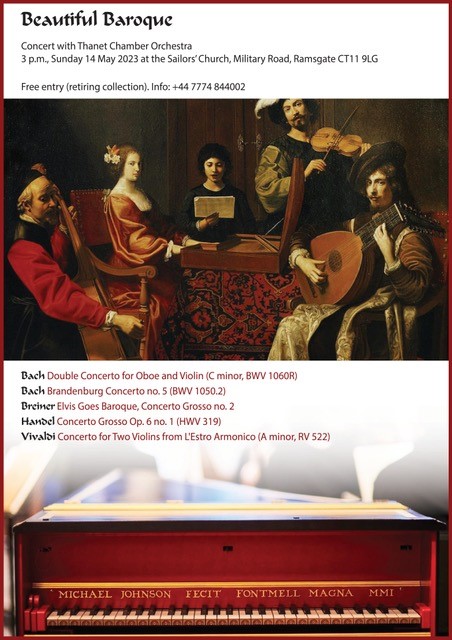
On Sunday 14th May at 3pm in the Sailors’ Church, Thanet Chamber Orchestra will be performing a free concert with Petra (St. George’s organist) playing her harpsichord.
The concert will include:
Bach, Double Concerto for Oboe and Violin (C minor, BWV 1060R)
Bach, Brandenburg Concerto no. 5 (BWV 1050.2)
Breiner, Elvis Goes Baroque, Concerto Grosso no. 2
Handel, Concerto Grosso Op. 6 no. 1 (HWV 319)
Vivaldi, Concerto for Two Violins from L’Estro Armonico (A minor, RV 522)





 St. George's Church Ramsgate