“Honour your father and your mother as the LORD your God commanded you, so that you may live long and that it may go well with you in the land the LORD your God is giving you.”
(Deuteronomy 5:16)
There is increasing interest in the question of how to live a long and healthy life. Even Netflix has muscled in on this interest with a new show called, Live to 100: Secrets of the Blue Zones. The idea of ‘Blue Zones’ comes from a study published in 2004 that identified Sardinia’s Nuoro Province as the place with the highest concentration of centenarians. Since then other ‘blue zones’ have been identified around the world, areas where there are an exceptionally high number of people living to over 100. What can we learn from the people in these areas? You’ll have to watch the Netflix show!
The Bible also gives advice. The Ten Commandments tell us how to live a long and happy life: honour your parents.
Why does honouring your parents bring about a long and healthy life? We respect and learn from those we honour. Our parents are the best people to learn from, because they have decades more life experience in the culture we live in, but also because they are the ones that care most about our well-being. In addition, if we help to create a community that honours and cares for its elders, then we will reap the benefits of being part of that community in our old age.
What is true of our earthly family, is also true of our Christian family. Paul often speaks of himself as ‘a father in Christ’ (1 Cor. 4:15) to those in the churches he founded and encourages older women to be good teachers and role models for younger women (Titus 2:3-5). This matters, because as Christians we do not just want to grow up to live a long and happy life, but to take hold of the eternal life given to us in Jesus Christ.
What’s On – a page which lets you know what is happening this week and gives information about upcoming events.
Notices – You can read the latest notices on this page.
Sermons – Read a transcript of a recent sermon or watch the YouTube version recorded at St. Luke’s. There are now videos for all the sermons over the summer.
Sunday 29th (Note the clocks go back at 2am on this day!)
Eucharist (St George’s, 9:30am) – Reading: Mark 12:1-12
Light Party – St. Luke’s Church, 31st October, 4:30-6:30pm
A great alternative to Halloween, for all ages. Food, fun and treats (no tricks). Fancy dress, please (but not scary). Children must be with an adult at the party. Please sign up on the sheet at the back of church, if you would like to come and on the separate sheet, if you can offer to bring some food to share on the night.
Petra playing at Canterbury Cathedral
The English Chamber Orchestra with Richard Cooke conducting as part of Canterbury Festival. Haydn’s Creation (amazing piece) starts at 7.30pm Canterbury Cathedral, 4th November. Petra is on fortepiano. Tickets from £10. Find out more.
Prince of Egypt – the West End Musical
Prince of Egypt (PG) the spectacular Dreamworks West End musical about Moses is showing at Thanet (Westwood Cross) Vue cinema on: Thursday 19th October at 7pm and Sunday 22nd October at 2.30pm. Find out more.
Quiz Night in support of ACTS (Active Christianity in Thanet Schools)
This is a fundraising event at St. Philip’s Church, Saturday 4th November, 6:30pm for 7:30pm start. Bring your own food and snacks (wine and beer allowed). Come as a table of 8 or make a table on the night. Tickets £5 donation to ACTS. Book via email: acts.schoolswork@gmail.com. Payment on booking by BACS to ACTS or at the door.
This is a powerful, thoughtful and reflective initial response to the horrors occuring in Israel and the Gaza strip from a Christian writer, who has some personal connections. Read more.
The Transition to Fatherhood
The birth of a child is the birth of a father.The birth of the first child marks the transition to fatherhood in men’s lives. This is a developmental milestone, a new phase in adult life with unfamiliar tasks and responsibilities. The transition is more striking for most men who become fathers now than it was for their fathers and grandfathers. Read more…
Finally, let’s make sure we honour both our earthly and spiritual parents.
“Six days you shall labour and do all your work, but the seventh is the sabbath to the LORD your God.” (Deuteronomy 5:13-14a)
Many people today worry about work-life balance. How can you avoid work taking up so much of your time and energy that little is left for other important aspects of life? We recognise that work should not be allowed to dominate our lives, yet increasingly we live in a society where many people are being pushed into working longer hours than ever.
Mark 3:1-6 Jesus had been making waves. His teaching had increasingly been challenging the accepted religious teaching of his fellow Jews and his popularity was growing.
The key religious teachers of the day, the Pharisees did not like it and were increasingly looking for a way to discredit Jesus.
And so one Sabbath, there they all were gathered in the Synagogue at Capernaum. Jesus was speaking and they were watching. Looking for reasons to condemn him.
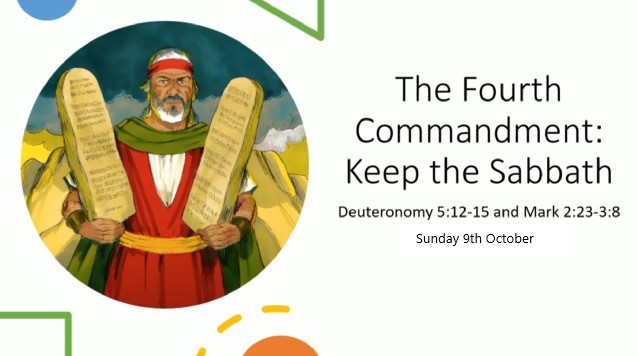
The biggest issue was obedience to the Sabbath. The insistence that no work be done on one day a week. It was a unique Jewish tradition, that helped to mark them out from the other nations along with circumcision. It was also the fourth of the ten commandments, the foundational laws for the people.
But what counted as work? The Jewish teachers had worked at and agreed a complicated list of rules and regulations to clarify what could and could not be done on the Sabbath. Every conceivable eventuality had been thought of. For example, one rule taught:
“If a building fell down on the Sabbath, enough rubble could be removed to discover if any victims were dead or alive. If alive, they could be rescued, but if dead, the corpses must be left until sunset.”
And the guidance was clear. You can’t pick wheat on the Sabbath, but Jesus’s disciples had and Jesus had refused to stop them. It was also clear that you can’t work to cure ill people on the Sabbath, unless the condition was life threatening. Yet, Jesus was known to have healed people on the Sabbath. The rules and regulations were put in place by generations of Jewish teachers to ensure the Sabbath was kept, but Jesus did not seem to care about this Jewish tradition.
So, with the Pharisees watching, Jesus acts almost deliberately provocatively. There is a man there with a shrivelled hand. Not a life threatening condition. Jesus tells him to stand up in front of everyone. He does so. Then Jesus asks a couple of questions, which cut to the heart of the issue:
“Which is lawful on the Sabbath, to do good or to do evil, to save life or to kill?”
No-one responds. No-one wants to engage with Jesus. Mark says that Jesus looks around with anger and grief at their stubbornness. They refuse to accept that their whole way of interpreting the Sabbath is wrong, that they have turned what is meant to bring people joy and freedom has been made by them into a straightjacket of rules and regulations. A way to judge people, rather than a gift of life.
In defiance, Jesus commands the man with the shrivelled hand to stretch it out. It is completely restored, yet another miracle demonstrating the blessing that Jesus brings, but for the watching Pharisees the final straw. They go out and begin to plan (presumably on the Sabbath) how to kill Jesus. It seems for them the Sabbath is more about killing than saving a life.
This story is one of many in the gospels, where Jesus falls out with the religious teachers of the day over following the Sabbath. If the Pharisees way of following the Sabbath was wrong, then how are we as Christians to understand the fourth commandment today? Does Jesus’s unwillingness to follow the Pharisee’s regulations, mean that the whole idea of the Sabbath is irrelevant and can be ignored? Or do we still need to take it seriously and follow the commandment carefully? Is Sabbath observance one of the ways we express holy resistance in today’s world?
Sabbath Foundations
To help answer that question it is important to understand the reasons given for Sabbath observance. Interestingly, the Ten Commandments are listed in two places in the Old Testament. Once in Exodus 20 and once in Deuteronomy 5. Mostly, the wording is exactly the same, but whilst both command not working on the Sabbath, it is in the fourth commandment, that the wording is most different. The difference is mainly around the reasons given.
Holy Identity – Exodus 20:8-11; Genesis 2:1-3
In the Exodus 20 version, the reason for following the Sabbath is because it is the pattern that God set down in Creation.
Right at the start of the Bible, the Creation is described through God’s work over six days. But then radically, it says that on the seventh day, God stopped working and rested. He called that day, ‘Holy’ in other words set apart or special.
The seven day pattern of work and rest is rooted in the very person of God, the Creator of heaven and earth. Since we are made in his image, we too are called to rest one day in seven. It’s part of who we are.
God does not exist just to create, work and achieve, he also exists to rest and enjoy what he has done. In the same way, as human beings our identity, our value, our reason for being is not tied up in what we do, but in the fact we are made in the image of God.
Perhaps our children’s TV programmes are quite unhelpful in this regard. When you have programmes like Postman Pat, Fireman Sam and Bob the Builder, you are subtly implying that people are defined by the work they do.
The Sabbath helps us to recognise that we are more than what we do or achieve. By putting aside a day a week to stop working and focus on God, we regain a deeper understanding of our true identity as made in the image of God.
Holy Freedom – Deu. 5:12-15
But, the Sabbath is about more than that. Deuteronomy gives us a different reason for the Sabbath. The last part of the commandment says:
“Remember that you were slaves in Egypt and that the LORD your God brought you out of there with a mighty hand and an outstretched arm. Therefore the LORD your God has commanded you to observe the Sabbath day.” (Deuteronomy 5:15)
The Sabbath is designed to set us free from overwork. When they were slaves in Egypt, before any of the plagues come on Egypt, Moses goes to Pharaoh and asks him to let the people have a three day holiday from their work to go and worship the LORD.
But Pharaoh responded, by asking why they wanted to take the people away from their labour? He then responded by making the Israelites work even harder, forcing them to make bricks without providing them with straw.
If God had rescued them from such an exploitative and hard task master, then, they were not allowed to let work dominate their lives. They were to express the freedom, God had given them, by setting aside one day a week, when they did not work.
The command was given to prevent an enslaving addiction to work, but also to give them a regular time to celebrate the freedom God had given them and praising him. The Sabbath is all about freedom.
When we fail to observe the Sabbath, we become enslaved to work and we forget about the God who sets us free.
Lord of the Sabbath
So, the description of the commands in the Ten Commandments, help to give us a positive understanding for the Sabbath command. It is rooted in both the nature of God and the story of his salvation of Israel, a story of freedom. So, how does this help us untangle the debate between Jesus and the Pharisees and how we should follow the commandment as Christians today.
A Question of authority
In the gospels, the debate is fundamentally about who has authority to interpret the Old Testament commandments. Jesus says elsewhere that he has not come to destroy the law and nowhere does he say that the command to obey the Sabbath is no longer relevant. But he does interpret the law in a fundamentally different way to the teachers of his day.
In the first part of our reading from Mark’s gospel, Jesus is challenged about his disciples plucking ears of corn on the Sabbath. Jesus sees no problem with this. Certainly, it is not the kind of work a farmer would do on a non-Sabbath day. However, it did break the regulations given by the Pharisees.
Jesus’s response is not to argue the details of what counts as work, but that one who has God given authority is able to interpret the Law in an appropriate way, even when it goes against the accepted norms of the day. He does this by telling a story of David, God’s appointed king, when he and his men eat the bread that was meant to be reserved for the Priests. The point Jesus is making is that he as the Son of David, has the authority to interpret the Sabbath laws in the right way. He makes this point explicit at the end, by calling himself, ‘Lord of the Sabbath.’ In other words, as God’s appointed person, his understanding of the Sabbath Law has more authority than theirs. Rather than judging him by their legalism, they should be welcoming him as God’s anointed king and be eager to learn from him.
A Question of identity and freedom
So, how does Jesus’s understanding of the fourth commandment differ from that of the Pharisees. I think it is best summed up by what he says in 2:27:
“”The sabbath was made for humankind, and not humankind for the sabbath;”
The Pharisees had turned the Sabbath into a kind of test as to how well you could follow the Law of God. As such it had become a burden, a stick with which to beat others that you looked down on or disagreed with.
Jesus wants us to see that it is a gift from God, for our good. Therefore it is appropriate to enjoy free snacks and for people to be healed on a Sabbath, because these are signs of the blessing of God.
So, we should seek to keep the Sabbath, because God commands it for our good. It sets us free from being constantly at work and helps us to see that our identity is not rooted in what we do or achieve, but who we are as children of God.
Sabbath Application
So, what does this mean for us as Christians today? What might following the fourth commandment in Jesus’s way look like? How can we make sure we embrace the freedom and the identity that following the Sabbath brings.
Personal Application
In our personal life, this does call for Holy Resistance. For many of us, there are constant pressures to work harder or longer: fear of not having enough money, fear of letting people down, fear of upsetting people by saying, ‘No.’ when they ask us to do something, fear of failure through not working hard enough. With so many things to fear it is hard to carve out a day each week to be free from whatever our work is and give space to be with God.
What we need is faith. We need to trust that God will provide our needs, that he loves us unconditionally, that he wants us to say ‘no’ to too much work, that he doesn’t care about our success or failure, but our faithfulness. When we choose to trust in God, we can say ‘no’ to working every day of the week.
And we need to do that. We need to show that holy resistance. If you are a student, you need to organise your week to have a complete day off each week from your studies, trusting that God has given you enough time in the rest of the week to complete your studies.
If you have a boss, who is trying to increase your work to every day of the week, you need to be willing to say, ‘No.’, trusting that even if they fire you, God will provide another day off.
Where possible, we should seek to have Sunday as our day off work, so that we can share it with other Christians, but I know that for many people, that is not always possible, for those with contracts that insist you work some Sundays, nurses, doctors and vicars! But we need to make sure we guard another day each week as a day of complete rest. I try hard to guard Wednesdays as a day where I avoid doing anything that is at all to do with work.
This can be hard, but when we do this, we find freedom from the pressures of overwork and a better sense of an identity not rooted in our jobs.
Political Application
But as well as our personal action, we should be concerned about the wider society. The Deuteronomy version of the command in particular stresses that they should not make servants or animals work on the Sabbath, that they need rest to.
Where we have any political influence we should be working to encourage employment that does allow regular rest for at least a day each week and does not drive people to have lives dominated by work. Increasingly, our society has been so obsessed with economic growth, consumerism and making money, that Sundays as a special day of rest for people has been lost. It’s not good for our society and forces too many into exploitative work patterns when it is not necessary.
We also need to be aware of the economic pressures that push people into overwork and encourage our politicians to work to limit that.
More than any other of the Ten Commandments, the fourth commandment has a political dimension. Because the Sabbath was made for humankind, we should seek to see it applied for the benefit of humankind.
Sabbath Hope
Jesus challenged the teaching of the Jews of his day about the Sabbath.
The first Christians did not abandon the Sabbath as a result, but they did change the day of the week from a Saturday to a Sunday. Why? Because that was the day Jesus rose from the dead. The day, in which he rested from his mission and became the first to receive the future resurrection body.
The Sabbath is not just to remind us of God’s salvation in the past or to help us embrace the freedom and identity we have in the present, but it is also a pointer to a better future, to the eternal rest, that one day God will provide for us who put our hope in the resurrected Christ.
A great alternative to Halloween, for all ages. Food, fun and treats (no tricks). Fancy dress, please (but not scary). Children must be with an adult at the party.
Please sign up on the sheet at the back of church, if you would like to come and on the separate sheet, if you can offer to bring some food to share on the night. Alternatively contact Charlie Harley: crharley13@gmail.com .
“Six days you shall labour and do all your work, but the seventh is the sabbath to the LORD your God.”
(Deuteronomy 5:13-14a)
“Six days you shall labour and do all your work, but the seventh is the sabbath to the LORD your God.” (Deuteronomy 5:13-14a)
Many people today worry about work-life balance. How can you avoid work taking up so much of your time and energy that little is left for other important aspects of life? We recognise that work should not be allowed to dominate our lives, yet increasingly we live in a society where many people are being pushed into working longer hours than ever.
Not that more work means we achieve more. A 2014 study from Stanford University suggested that productivity plummets after working 50 hours a week, whilst other experts suggest 35 hours as the optimal work time before productivity begins to decline.
So, why do so many of us find ourselves working longer hours? Partly it is the belief that we need more money to live a better life. We end up committed to lifestyles and mortgages that demand we work enough hours to pay our way. When worries about having enough money are allowed to drive your life, then taking on excessive workloads tends to follow. Not that this is simply the result of individual decisions. We are all at the mercy of economic forces, that are in turn driven by cultural attitudes. These forces push people into taking on multiple jobs or longer hours just to avoid going into debt.
What is the solution? The Ten Commandments give one: guard one day in seven as a day, when no work is done. It is a rule not just for individuals, but for society. A command to prevent work dominating and enslaving people and giving them no time for the relationships that really matter: family, friends, church and most importantly God. Applying this in our society is not straightforward and should not be done legalistically, but it is a law given for our good, so let’s work to bring about a holy pattern of work and rest in our lives and our society.
Paul Worledge
This Saturday
Churches Together Prayer Breakfast (Salvation Army) – 9:00-10:00am
What’s On – a page which lets you know what is happening this week and gives information about upcoming events.
Notices – You can read the latest notices on this page.
Sermons – Read a transcript of a recent sermon or watch the YouTube version recorded at St. Luke’s. There are now videos for all the sermons over the summer.
Our Harvest Service will be an All Age service on Sunday 1st October starting at 10:00am. We are hoping that this will be an opportunity for both the 9:30am congregation and Sunday School families to join together in a short service of thanksgiving. There will be a simple Holy Communion in the choir stalls before this service at 9:30am.
We will also be having a special collection, which will go towards the Christian Aid’s Libya Floods appeal. £25 could provide one emergency kit with vital supplies for families who have lost everything in the floods.
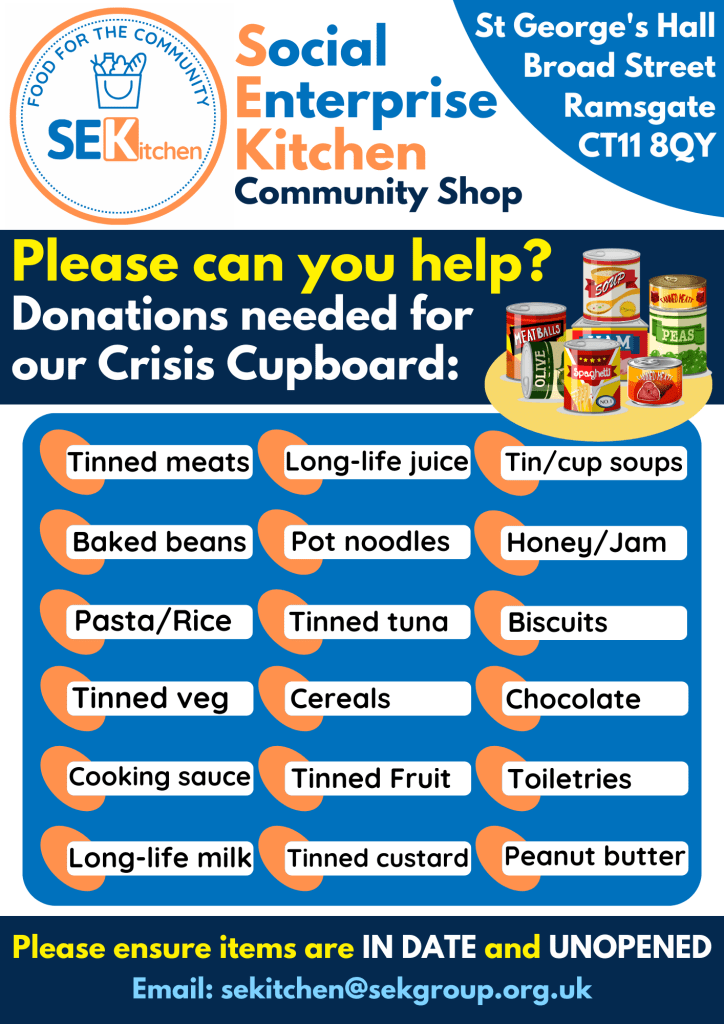
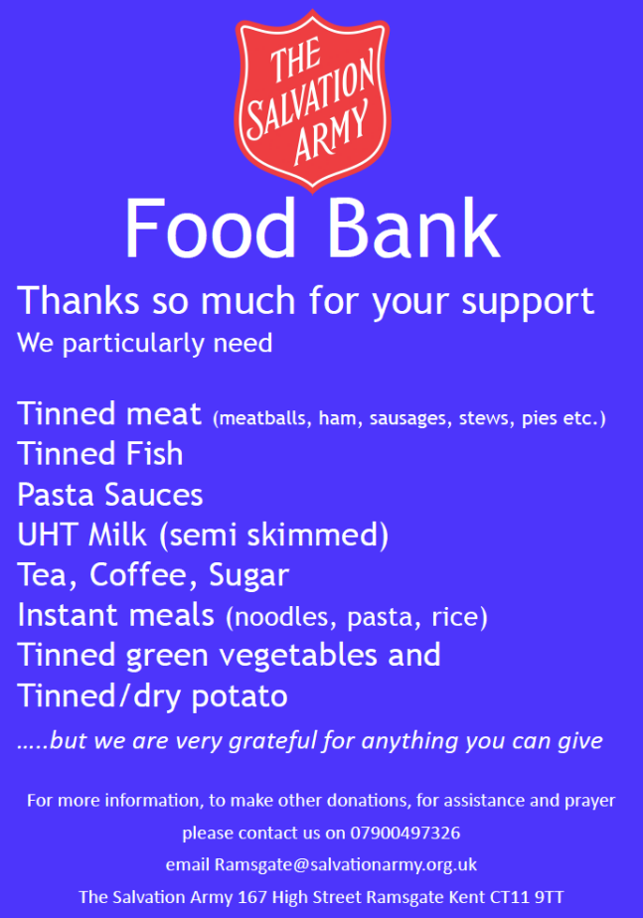
We will be collecting non-perishable food items at the service, which will be donated to the local Salvation Army Food Bank. Please bring some to offer at the service.
Light Party – St. Luke’s Church, 31st October, 4:30-6:30pm
A great alternative to Halloween, for all ages. Food, fun and treats (no tricks). Fancy dress, please (but not scary). Children must be with an adult at the party. Please sign up on the sheet at the back of church, if you would like to come and on the separate sheet, if you can offer to bring some food to share on the night.
Claire
As many of you know, Claire our curate is awaiting an operation at the end of October but has been struggling with ill health. In order to ensure that she is well enough for the operation, her doctor has advised that she be signed off work for the few weeks leading up to the operation as well as afterwards. This unfortunately means that Claire will not be around until the end of November at the earliest. Please do pray for Claire, for good health, patience and strength through this frustrating time for her.
Intercession for the Nations
YWAMs next open time of intercession is coming up soon, Friday 20th October, 7:15 for 7:30pm, at Tehilla House of Prayer, 45a Northdown Road, Cliftonville. Please come and stand with us in prayer for all the nations with blue and white flags. These nations include Argentina, Uruguay, Finland, Greece, Micronesia, San Marino, Israel, Somalia, El Salvador, Guatemala, Nicaragua & Honduras. Please the attached invitation. We’ll be listening for the doorbell to let you in.
Destiny Africa Choir – Performances in Thanet
A few years ago, St. Luke’s hosted a children’s choir from Uganda. Unfortunately, we were not able to do that this year, but they are performing at two venues in Thanet (ring the venue to reserve a ticket):
Friday 20th October, 7pm, St. Andrew’s Reading Street, Broadstairs.
01843 609513.
Sunday 22nd October, 7pm, New Life Family Church, Margate.
Tearfund shares what their research showed them about the church as a cost-effective and transformational answer to poverty. Read more.
La Deuda (The Debt)
This touching short film (15 minutes), which is in Spanish and filmed in Mexico is based on the story of the Unmerciful Servant (Matthew 18:21-35). Watch the video.
Finally, let’s make sure we guard a day of rest each week.
We are thinking today about giving thanks and that’s one of the good things of harvest. It gives us an opportunity to give Thanks. Harvest is quite traditional in British history as being a time of celebration. It goes back to a time when we all relied on agriculture and farming for our food and so landowners would have a massive celebration for all the workers for all the hard work that’s been done in gathering in the harvest and giving Thanks for all the food. In biblical times there were 2 types of harvest mentioned where there was specific celebrations in the faith of the Jewish people to remember God as creator and provider of all the things that people had been given at the harvest times. The celebration was about recognising Gods provision and praising his name.
I wonder how thankful we after for what we have.
As as it’s harvest time, I thought I would think about some of our favourite food or maybe not so favourite foods and how easy it might be to give thanks for things that we don’t always or might not always appreciate. I have here a lucky dip so I need help to select an item to share what that is, and then I want us to say whether we like it or not so let’s play this kind of game. So let’s look at what we have and cheer if you like it and boo if you wouldn’t appreciate it.
It’s sometimes hard to be thankful for things that we don’t always appreciate, but I wonder how good we are at even showing Thanks for the things that we do enjoy and are grateful for and when we say thanks is it just because of habit or is it because we really truly appreciate what we’ve been given and are grateful and thankful.
Our reading today was about 10 lepers, who encountered Jesus. Jesus was going about his business, and he’s been doing miraculous things and teaching them amazing truths about who he was and what he’d come to do, and he’s walking along this this way, and there’s some lepers that are approaching him, but they keep their distance because leprosy was a really contagious disease and it was a disease that meant you were an outcast, so you didn’t live with your family. You lived in communities with other people that had this skin condition and in the Jewish faith, it was a condition that meant that you were unholy, so you couldn’t go to worship in the synagogue or be in society.
These lepers stand before Jesus and ask him for mercy, ask him to have pity on them. They don’t outright ask for healing, but they obviously want something from Jesus. Yes, I’m going to heal you. He doesn’t immediately heal them on the spot. He tells them to show yourselves to the priests. In the book of Leviticus, there are things that you need to do if you’ve been healed from leprosy, you have to show yourself to a priest and they would say whether you were clean, able to enter society again and worship God with everybody in the Jewish community or whether you had to remain an outcast.
So Jesus tells these 10 lepers to go and show yourselves to the priest, and were told that on the way that they were healed by faith, and it says that they heard what he said, they went, and showed themselves to the priest, knowing that in the state of leprosy that they wouldn’t be accepted his book, trusting that something might happen and it does on the way, they were cleansed.
This happened to all 10 lepers but we then only hear about one of them. We are told that one leper saw that he had been healed and seeing that he’s been healed. He returned to Jesus where we’re told that he bowed down. He praised and thanked Jesus, and then we’re given this little footnote that he was Samaritan and Samaritans were actually quite despised by the Jews. They were kind of rivals. In saying this one was a Samaritan, it’s assuming that the other nine were Jewish. They’d kind of experienced the same healing but they carry on on their way and show themselves to the priests and re-entering society, but it was this Samaritan that had seen he was healed and went back to the source of the healing to show his thanks and his gratitude.
When he is on his knees before Jesus, Jesus said were not all ten cleansed?, where are the other nine, has no one returned to give praise to God except this foreigner!.
We are quite challenged, there’s so many things that we can give thanks for, the good food, for the ability to have choice and variety for friends, for family, for colleagues, for our health. We put this in the big context of giving thanks for all these things, because of Jesus is Love and provision for us, and for the entire world. I wonder whether sometimes we just carry on with our every day and we forget to thank Jesus for being Jesus. Do we see him in the provision of our friendships and relationships and food and health.
Do we give thanks because of Jesus, because we know him?
Do we give thanks for everything in every circumstance, our opening verse said in everything give thanks in other versions it says in all circumstances, even in the good the bad and the ugly that there are things that we can give thanks for in those situations and we told to do it because that’s what we have been commanded to do.
So let’s be like that one leper who saw what Jesus had done for him, he came back to him and gave him the praise and thanks that he was due.
Let’s make efforts to look at our own lives and circumstances, and to see God in that, giving him thanks for who he is and for all that he has done and will continue to do for us.
The 3rd commandment instructs us to not misuse the name of the Lord our God. How do we not only refrain from misuse, but actively seek to honour and glorify the name our God.
Good morning, it is a joy to be here with you this morning, thank you to Paul and Claire for inviting me.
As Claire said my name is Charmaine, as our commandment this morning is about God’s name, I thought I would have a look at the meaning of some names. Its slightly hard to pin down the meaning of Charmaine – the one I like is ‘filled with delight’. Slightly easier is my middle name, Fiona, which is Gaelic and means fair or blonde (not quite sure of the suitability of that one!!). I also looked into some names you may know – Claire – which apparently means illustrious. Now I know my parents didn’t chose Charmaine because of what it means but rather because my mother liked the name. However in the Bible names were often very important. For instance prophets often were asked to name their children a name that reflected the message God was sending to his people – for instance the prophet Hosea named his daughter Lo-Ruhamah – meaning ‘not loved’. That is hard name to have to carry around. Often in the Bible people are renamed by God given a name that reflects something of who they are in his story – like Abram who God renames as Abraham meaning father of many nations. Names can have great significance in the Bible.
This morning we are looking at the 3rd commandment in your series on the 10 Commandments. “You shall not misuse the name of the Lord your God, for the Lord will not hold anyone guiltless who misuses his name.” So far God has set in place the commandment that we are to have no other gods before him. He is our only God and we are to have no idols. We are not to worship anything we have created ourselves. Today’s commandment focuses on the name of God.
God’s name is something he has revealed to Israel. Back at the beginning of Exodus when God appears to Moses from the burning bush, Moses asks him what he is to tell the Israelites if they ask him what God’s name is and God answers:
Exodus 3:14 –
14 God said to Moses, “I am who I am . [b] This is what you are to say to the Israelites: ‘I AM has sent me to you.’ “
15 God also said to Moses, “Say to the Israelites, ‘The LORD, [c] the God of your fathers—the God of Abraham, the God of Isaac and the God of Jacob—has sent me to you.’ This is my name forever, the name by which I am to be remembered from generation to generation.
God reveals his name to his people – he is the I AM – the God who has always been and will always be. He is the God who is – the I AM.
And it is an immense privilege for the Israelites, and today for us, to know God’s name. In fact Israel held God’s name in such reverence, that they did not dare even speak his name, instead they used the consonants YHWH, which today we translate and use as the word LORD – in fact no one really knows how it is pronounced as Israel never said the personal name of the Lord – that was how much they revered it. YHWH or the LORD, the covenantal, faithful God.
It is an amazing privilege to be able to know the name of God. To be called into a relationship where we know him by name. As the people of God, Israel had been given the privilege of knowing the name of God. As Christians we have even a greater privilege that we get to call God, Father, and we get to call his Son, Jesus. These are intimate names, names that reflect a close relationship. Jesus teaches us, to call his Father, Father along with him, but as he does he also teaches us to have reverence for his name. In Matthew 6 as he teaches the Lord’s prayer he teaches both intimacy and reverence – we are able to call God Father – great intimacy and yet we are to hallow his name – to honour and respect his name. We are not to use God’s name casually, even the right to call him Father we must remember it is a great honour. Which is why God gives us a commandment about the use of his name. His name is powerful, it is an honour to use it, we are not to misuse it.
I want us to think about 3 ways in which we use God’s name.
Firstly a don’t: The most obvious way to not misuse God’s name is to not use it as a swear word. We do not use the name of our Lord – any of his names as a swear word or an exclamation. It is so prevalent around us that sometimes it is easy for us to slip into the habit and not even realise. And even more easy for us not to realise that others are doing it even if we don’t ourselves. How common using the name ‘Jesus’ as a swear word has become is that if you look it up in the dictionary – this is the definition you would find:
[as exclamation] an oath used to express irritation, dismay, or surprise
Most dictionaries will also give you a short description of Jesus the person.
And I am sure this is one of the most common ways that we see Jesus’ name misused in the world around us, whether that is at work, school or with friends and family.
However it is not only the name Jesus we misuse – we also misuse the word God – often saying things like ‘God knows’. Without really thinking about what we are saying. Have you ever felt inclined to reply – ‘He does’ when someone says that.
These names are precious to us, they are the names of our God, and we want them to be revered and honoured. The name of Jesus is powerful, it is the only name by which we can be saved. It is a name through which people are saved and healed.
I don’t have many regrets in my life, but there is one thing about my working life before I started working in churches that I do regret. I had colleagues who swore quite a lot and they would always apologies for using words like the F word but never for using the name of Jesus, and I really regret that I never had the courage to say to them that I didn’t care what words they used as long as they didn’t take the name of my God in vain.
Jesus’ name is precious to us and is to be used with honour and reverence and intimacy but not as a swear word.
Secondly, We can name drop
Now that sounds a bit strange really doesn’t it – its not like we’re going to go around saying ‘guess who came for dinner last night – God’. But we do name drop – we use God’s name to justify things. We’ve done it through the ages. Many wars have been fought in the name of God – for which God probably did not will it to happen. And today we can easily do the same – claiming God is on our side to help us justify our position. Apparently during the American Civil war, a woman said to Abraham Lincoln ‘Oh Mr President, I feel sure that God is on our side… don’t you?” to which Lincoln replied ‘Ma’am, I am more concerned that we should be on God’s side.”.
But there are two ways I think we do it even more. Its not so much that we put God’s name to things that are not of him but even more we don’t give him the honour and credit that is due to him.
Do we take time to thank God for what he has done for us? To give him the credit when something goes well – because honestly it really is him and not us on our own we would accomplish so little. We need a smaller picture of ourselves and a bigger picture of God – and that happens not so much by lowering ourselves but by elevating God. We need to keep reminding ourselves of who he is and what he has done and is doing and is going to do. Keep a picture of a big God in our minds and remember to give him the honour – to accept it and pass it on to him untouched by our own egos.
I know in my own life I can be very good at asking God for things but less good at remembering to thank him. It’s why we say grace – a reminder that all things, including the food we eat comes from him.
And thirdly and this one really made me think – we need to make sure we don’t live an inconsistent life. We bear the family name of Christ – Christ-ians. We bear his name. do we live up to the family name. And so we need to live in a way that brings honour to his name. So often we don’t –
Titus 1:16 says They claim to know God, but by their actions they deny him. They are detestable, disobedient and unfit for doing anything good.
And we do the same – we claim to be Christians and to know God but so often our actions say anything but. And the worse thing is that it doesn’t just make us look foolish or hypocritical it can actually lead to others mocking God. They look at our behaviour and they mock God because it reflects on him how we behaviour.
We need to live lives that honour God and the name that we bear – that of Christ.
The name of our God is powerful, majestic and awe-inspiring. The name of Jesus is the name of our King, the name of our saviour. It is a great privilege that we get to call him by name, that God reveals his name to us and calls us into relationship with him. Intimacy, relationship, love and grace.
It is a privilege and one we are to honour by giving glory to the name of our God, resisting the ways of the world and standing out for being those who do not misuse it but rather bring honour and glory to it through our lives, our words and our actions.
Our Harvest Service will be an All Age service on Sunday 1st October starting at 10:00am. We are hoping that this will be an opportunity for both the 9:30am congregation and Sunday School families to join together in a short service of thanksgiving. There will be a simple Holy Communion in the choir stalls before this service at 9:30am.
We will also be having a special collection, which will go towards the Christian Aid’s Libya Floods appeal. £25 could provide one emergency kit with vital supplies for families who have lost everything in the floods.
We will be collecting non-perishable food items at the service, which will be donated to the local Salvation Army Food Bank. Please bring some to offer at the service.