Youth Initiative is our provision for young people connected to our churches in Ramsgate to grow in friendship and faith. As part of this for the past three terms they have led an evening service.
This term our youth led evening service on Sunday 17th July 6pm is being held at St Luke’s and is being supported by a visiting Mission Adventures outreach team from YWAM Holmsted Manor. They will be taking the lead, ably supported by the youth from YI.
The service on the 17th July is for all ages and is a more interactive and informal style of worship. It would be great to encourage our youth and the Mission adventures outreach team, joining together and worshipping our awesome God.
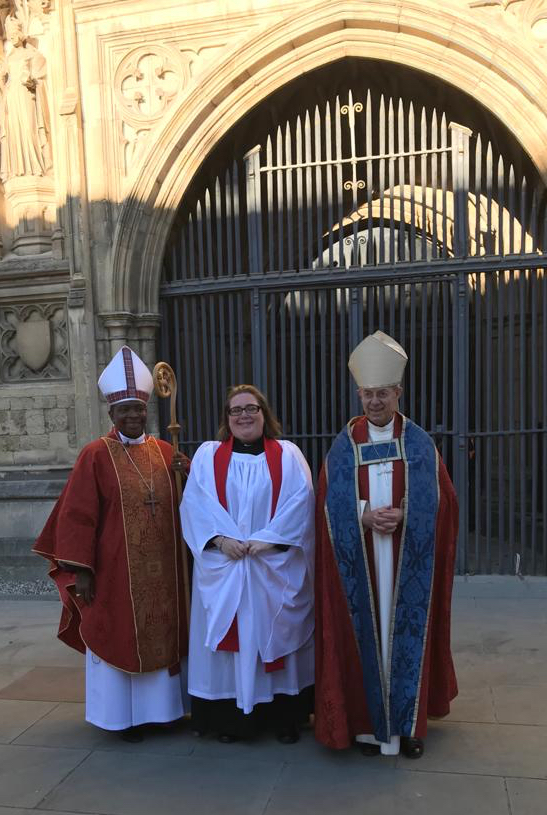
This has been a special weekend for our curate Claire, who serves at St. George’s and St. Luke’s churches. She was ordained priest on Saturday 2nd July at Canterbury cathedral by Bishop Rose. She presided over her first communion at St Georges church this morning and enjoyed a picnic lunch with members of both churches at the St Luke’s vicarage.
Claire writes: I want to thank everyone for their prayers, support, cards, kind words, gifts and the fantastic bring and share picnic. It has been a fabulous weekend. It is a joy to serve in these churches and a real privilege to be part of this family of believers in Christ. Thank you all so much.
Picnic lunch with members of St George’s and St Luke’s to celebrate Claire’s ordination.Wonderful spread – thank you
Is the internet a good thing or a bad thing? The internet is communication on supercharge, but just as face to face speech can be used for good or bad so can the internet. What we need is wisdom to speak for good in both face to face relationships and online. God’s wisdom in Proverbs can help us with this.
The sermon as preached at St. Luke’s on the same day.
Is the Internet Good or Bad?
Our world has changed dramatically and unpredictably over the last 30 years with the development of the internet or worldwide web. Suddenly, the sharing of information and communication has been supercharged in a way we have never dreamed of.
But has this been a good thing? Is the internet a force for good or bad?
Tim Berners-Lee, created the World Wide Web over 30 years ago,
“While the web has created opportunity, given marginalised groups a voice and made our daily lives easier, it has also created opportunity for scammers, given a voice to those who spread hatred and made all kinds of crime easier to commit.”
Is the internet a force for good or bad? The answer is both! At its most fundamental level the internet provides new tools and means of communicating ideas. But what was true for communication dominated by networks connected by word of mouth is also true for communication supercharged by an electronic devices. Speech can be used for good or bad.
The Bible is very clear on this. For example James warns us of how destructive our speech can be:
“The tongue also is a fire, a world of evil among the parts of the body. It corrupts the whole person, sets the whole course of his life on fire, and is itself set on fire by hell.” (James 3:6)
And yet, the good news of Jesus is also spread through speech:
“”How beautiful are the feet of those who bring good news!” (Romans 10:15; quoting Isaiah 52:7)
So how can we use speech for good and not evil. Whether it is on the internet or face to face, we need God’s wisdom. What the Bible has to teach about speech is just as relevant in the internet age as it was in the Iron age. Proverbs is full of Wisdom about how to speak. Its ancient wisdom of 3,000 years ago can give us wisdom for using the internet which is only 30 years old.
Wise and Foolish Speech (vs. 4-7)
So we come to Proverbs 26, which has a lot to say about how we speak or rather how we shouldn’t speak. Verses 1-12 of Proverbs 26 in particular focus not so much on wisdom, but folly and it is important that we understand the difference, before we apply that understanding to speech.
Wisdom and Folly, 2 key differences:
I think Proverbs presents two key differences between the wise and the foolish that we have seen over the last two weeks.
Want to Live for God
Firstly, the wise are people who want to live for God and are eager to obey God in their everyday living, whereas a fool does not really care whether what he does is pleasing to God or not.
For example Proverbs says,
“A wise man fears the LORD and shuns evil,
but a fool is hotheaded and reckless.” (14:16)
Want to Learn
Secondly, the wise have a desire to learn, whereas fools already think they know it all. The wise have a humility that accepts that others and God may know better, whereas fools have a pride that thinks they already know everything. For example:
“The way of a fool seems right to him,
but a wise man listens to advice.” (12:15)
Notice, that growing in wisdom and being a disciple are closely aligned. A disciple is someone who wants to learn and in particular wants to learn how to live to please God in their everyday lives. This is the essence of what being a Christian is all about.
Secondly, notice that wisdom is not the same as intelligence and foolishness is not the same as being stupid. You can have a PhD, but not want to live for God or want to learn about how to live a better life, whilst you may struggle to read, but still want to live to please God and learn from others how best to do it. It is perfectly possible to be wise and illiterate and foolish and be a Professor!
A Wise Response to Fools?
But, if we are seeking to be wise, how should we respond to fools in conversations and discussions? If we are a disciple how should we talk with people who reject Christianity, but want to discuss it with us.
Proverbs 26:4,5 show us that there is not an easy answer! One tells us not to bother talking to them, the other tells us to talk to them. These two Proverbs seem to contradict each other. As perhaps, verse 7 implies, you need wisdom to apply Proverbs! As is also clear, you cannot simply take one Proverb as a guide to what to do without taking into account the wider wisdom teaching.
However, what these two Proverbs also show us is not so much a contradiction, but a dilemma when it comes to speaking with fools.
Don’t Answer Them
The first Proverb tells us not to answer a fool:
Do not answer a fool according to his folly,
or you will be like him yourself.” (26:4)
With the wider understanding of Proverbs about fools we can understand this. They don’t share your aim in life, to live for God, so why would they take your advice. Also, they think they know better than you, so again they are not going to listen to you. Both these points suggest not speaking to fools.
In Luke’s gospel, Jesus is brought before Herod. Herod questions him, but Jesus refuses to answer him. He remains silent. Jesus was following the wisdom of the Proverb, Herod had shown his disregard for God’s ways and killed the one chance he had to learn from God when he had had John the Baptist beheaded. Herod was a fool and Jesus did not answer him!
Do Answer Them
Yet, this is not always the wise way to respond. The second Proverb says:
“Answer a fool according to his folly,
or he will be wise in his own eyes.” (26:5)
This Proverb argues that it is precisely because fools think they know best that you should answer them in order to show them their folly and stop them being wise in their own eyes.
Jesus again illustrates this in many places in the Gospels. For example when the Sadducees approached him with a clever argument that they thought proved that there was no resurrection of the dead, Jesus showed them how their argument was based on wrong assumptions about both God and the resurrection of the dead. He wanted to stop them being wise in their own eyes.
Do we debate?
So how do we respond to fools, either online or in person.
Do we answer their questions or not waste our breath?
Each situation will be different. In particular, you need to decide is there any chance that this person will listen to the argument and consider it or are they just out to cause trouble?
Yes, we do need to argue the case for following Jesus, but we also need to be wise about when and with who we do it.
Let’s be real about the dilemma and pray for wisdom to make the right choice in our day to day lives.
Quench Quarrels
Debates are one thing, quarrels are another. Debates tend to be over basic issues of understanding, but quarrelling is about personal disagreements. They can lead to division within families, churches and groups that can be very destructive.
Indeed, the Proverbs in 26:17-22 use quite destructive language. This is where misuse of the tongue can be quite devastating and special care needs to be given.
In contrast, Jesus came as the Prince of Peace bringing reconciliation between us and God, by covering over our sin, through the great sacrifice of his death on the cross. He likewise teaches us to forgive others in response and so cover over sin and bring peace in our relationships with one another. So as Christians we are called to be peacemakers:
“Blessed are the peacemakers,
for they will be called sons of God.” (Matthew 5:9)
We are called not to cause quarrels, but quench quarrels. I want to point out 4 ways to help quench quarrels from the Proverbs in chapter 26 and a couple of others.
Don’t Join In
Firstly, we are warned not to join in with quarrels not already ours:
“Like one who seizes a dog by the ears
is a passer-by who meddles in a quarrel not his own.” (26:17)
The image here is of two dogs fighting. If you try and pull one off the other by its ears, you will just end up enraging the dog more and probably be severely mauled yourself! It’s best to keep out of other people’s quarrels!
Jesus illustrates this. In Luke 12 a man comes to him who is quarrelling with his brother about an inheritance and asks Jesus to join on his side.
Jesus responded by refusing to get involved:
“Jesus replied, “Man, who appointed me a judge or an arbiter between you?”” (Luke 12:14)
Instead he tells the parable of the rich fool about the dangers of being greedy for money. He doesn’t engage with the issues of the quarrel or take sides, but he does promote the attitudes needed to help bring about peace.
Don’t use Humour as a Smokescreen
Secondly, we must be careful not to use humour as a smokescreen for wrong speaking:
“Like a madman shooting firebrands or deadly arrows
is a man who deceives his neighbour
and says, “I was only joking!”” (26:18-19)
Here the issue seems to be that someone says something that is hurtful, deceitful or confusing, but then claims it was just a joke. Jokes are good. We start our staff meeting with jokes, but we need to be careful how we use comedy in our personal relationships. Too often jokes are used to put others down in our culture. But, whether it is funny or not demeaning others is not acceptable and can be quite destructive.
As Christians we need to avoid those kind of personally demeaning jokes, because they tend to cause hurt and resentment and stoke quarrels and broken relationships.
Control your Anger
Thirdly, we need to control our anger. Like joking, carefully controlled anger can be appropriate and necessary, as Jesus shows us when he cleared the temple. Yet, when anger is a knee jerk response, it is usually quite harmful and can again cause greater disagreement and break down of relationship.
“A fool gives full vent to his anger,
but a wise man keeps himself under control.” (29:11)
The Bible teaches that God is slow to anger and if we are seeking to be wise or true disciples, then we must imitate God in this way. We must keep our anger under control.
Stop Gossiping
Fourthly, the Proverbs here are very clear that gossip is something that fuels quarrels and division:
“Without wood a fire goes out;
without gossip a quarrel dies down.” (26:20)
In other words if we want to help bring peace and quench quarrels, then we need to stop gossiping and listening to gossip.
Gossip is one of those things that is so easy and so common. Yet, in reality it is something that is deeply anti-the Christian gospel.
Peter picking up on one of the Proverbs says,
“Above all, love each other deeply,
because love covers over a multitude of sins.” ( 1 Peter 4:8, cf. Proverbs 10:12)
Jesus died to cover over our sins, to expunge them from God’s memory and our conscience. That is the heart of the gospel. Gossip does the opposite. It increases the knowledge of another’s wrongdoing and so creates a deeper mistrust and anger between people.
We may think gossip is not too serious a sin, but the Proverbs here compare it with arson! What is more in Romans 1 it appears in a list of sin that includes murder!
If we are serious about being peace keepers, if we are serious about the gospel of Jesus, then we will be serious about cutting out gossip.
———————————————————————————————————-
Bonus material (not included in the sermon that was preached).
Treasure Truth
Quarrelling, joking, anger and gossip can all involve spreading truth, but usually a distorted or one-sided version of truth. As we move on to verses 23-28, we consider when speech deals in more deliberate deceit.
Here we need to remember that as Christians, just as we are to be peacemakers with the way we speak we are also to be concerned with what is truth and not lies.
After all John’s gospel in particular reminds us:
“The Word became flesh and made his dwelling among us. We have seen his glory, the glory of the One and Only, who came from the Father, full of grace and truth.” (John 1:14)
Jesus brings us truth in every sense, but the enemy the devil is about deception and distortion of the truth. Also from John’s gospel, Jesus says:
“When [the devil] lies, he speaks his native language, for he is a liar and the father of lies.” (John 8:44)
So as Christians we need to be concerned with truth, not just in the big picture issues, but also in our day to day engagements.
See through the disguise
Yet, we also need to be aware that the people we encounter or the internet posts we read may not have this same concern for truth. We need to be careful not to be naïve.
Verse 23, in particular makes this point about people:
“Like a coating of glaze over earthenware
are fervent lips with an evil heart.” (26:23)
In other words, just as a pot made of clay might be made to look like one made of silver, by coating it with a silver glaze, so some evil people may make themselves look good, by using kind speech.
Wisdom means being discerning and not being easily fooled. There are plenty of people that can make themselves seem kind, charming and wonderful on first meeting, but whose intentions are deeply troubling.
Several years ago, we had a 14 year old turn up to our youth group. He had an incredibly charismatic personality and lots of the young people were soon deeply enamoured with him within the first week. Two weeks later, we discovered that he was a deeply predatory paedophile, who had been put in social care locally.
Whilst we do not want to assume the worst of everyone we meet, neither should we allow ourselves to be charmed in a way that means we don’t take the kind of precautions and safeguards we always should.
As Jesus says,
“I am sending you out like sheep among wolves. Therefore be as shrewd as snakes and as innocent as doves.” (Matthew 10:16)
This is one of the reasons it is important that as many of our volunteers as possible undergo the safeguarding training that is being promoted at the moment.
See through flattery
One form of charm that is particularly seducing is flattery:
“A lying tongue hates those it hurts,
and a flattering mouth works ruin.” (26:28)
We all like to be praised and our good points pointed out, because it boosts our ego and pride. Yet, we need to be careful that people do not use flattery to make us lower our guard to their evil intentions.
Again the New Testament is very aware of this as an issue. Paul writes in Romans:
“I urge you, brothers and sisters, to watch out for those who cause divisions and put obstacles in your way that are contrary to the teaching you have learned. Keep away from them. For such people are not serving our Lord Christ, but their own appetites. By smooth talk and flattery they deceive the minds of naive people.” (Romans 16:17-18)
Watch out especially when people are telling you how wonderful you are!
Seek to be truthful
But as well as being on the watch for these subtle forms of deception in others, we also need to watch ourselves, that we are not acting in similar ways, that we are people of truth not distorters of truth or liars.
In the context, I think verse 27 is a warning, that deception will eventually rebound on the deceiver:
“If a man digs a pit, he will fall into it;
if a man rolls a stone, it will roll back on him.” (26:27)
Interestingly this is often the plot of many sitcoms. One of the characters tells a lie, then we watch them as their deception leads them into more and more trouble. It can be highly amusing to watch!
But, as Christians, our ultimate motive, is that we know that even though some people will get away with lies and deceit in this world, they will have to answer to the one who is the Truth and judge of all. Eventually, they will fall into their own pit!
———————————————————————————————————–
A Wise Tongue?
Whether we are communicating through the age old networks of face to face interactions with others or over the ultra-modern internet age, wisdom in the use of our speech is so important, perhaps even more important than ever.
The Internet can enable distortions of truth to be spread on an industrial scale. After all Putin has charmed and flattered the Russian people into supporting him and his wicked war in Ukraine, enabled by the power of modern communications. Through the spreading of false rumours and distortions over the internet, Trump helped to fuel the violent attack on the capital in the USA.
As Christians we need to be wise to these wicked techniques and seek to be those who quench quarrels and treasure truth, seeking God’s wisdom and guidance about when to challenge and when to stay quiet.
Proverbs are written to help form a wise character. In this talk we consider two things to embrace and two things to avoid as we seek a wise character formation.
This sermon was preached at St. Luke’s Ramsgate on the same day, which is the recording here.
Character Formation – Why it matters 23:23, 15
As we saw last week, Proverbs is a book full of short sayings, that are designed to persuade us to choose the best ways to live.
Yet, more than just seeking to help us choose the right ways, they want to shape us into the right people. The first verse that was read today says:
“Apply your heart to instruction
and your ears to words of knowledge.” (23:12)
In other words, the Proverbs are there to train our hearts.
Now if you want a good job, then you go to school and university or college in order to train your mind, so that you are able to take on challenging tasks.
If you want to be an elite athlete or sports person, then you train your body so that it is fit and strong enough to take on the challenging of competing at a high level.
If you want to be a successful singer, then you train your voice so that you can sing in tune and expressively no matter how difficult the music is.
Proverbs claim to be there not to train our mind or our body or our voice, but our heart. Now when the Bible talks about our heart it is not talking about our feelings or emotions, or about our romantic love. It is talking about the control centre of our self, the part of our body which sets our direction and way of life. Perhaps the English word that comes closest is the word, ‘character.’ When it says, ‘apply your heart to instruction’, it is talking about our character formation.
And the kind of character we have is so important. Proverbs want us to avoid ending up with a foolish character and to develop a wise character. And this matters, because a wise character will seek to live a righteous life, which we saw last week is a life that leads to ultimate joy.
So, this training is worth investing in:
“Buy truth and do not sell,
wisdom, discipline and understanding.” (23:23)
We should want it for our children:
“My son, if your heart is wise,
then my heart will be glad;” (23:15)
And we should want it so that we can be like Jesus:
“And the child grew and became strong;
he was filled with wisdom,
and the grace of God was upon him.” (Luke 2:40)
So how can we gain this kind of character formation for ourselves and our children? These verses can give us some pointers. I want to show us two things to embrace and two things to avoid.
Character Formation – Embrace Instruction – 23:12
Firstly, lets return to that initial verse:
“Apply your heart to instruction
and your ears to words of knowledge.” (23:12)
You can only grow in wisdom if you embrace instruction, if you listen. Yet, we live in a world, where we have so many sources of advice and instruction. Who should we listen to?
Not your own
Firstly, it is important that we do not just listen to ourselves or our own opinions:
“The way of a fool seems right to him,
but a wise man listens to advice.” (12:15)
Sadly, I think this is where so many people fall down. They think they already know best, they assume that their views are the correct ones. So many people are happy to tell you what they think, but seem totally uninterested in what you think.
Today this is a massive block to so many to hearing the good news about Jesus. People have already made up their minds about Jesus, faith or whatever and they are not interested in hearing anything that disagrees with them.
Social Media does not help. Facebook, Instagram, Twitter, will not help you with your character formation. They are designed to feed you only with the points of views of people you already agree with.
Your character will never move towards wisdom, if you already think you know it all.
Many Counsellors
Actually, what we really need is as diverse a mix of advisers or counsellors as possible.
“Plans fail for lack of counsel,
but with many advisers they succeed.” (15:22)
It is good to listen to people you might disagree with, they may have insights that you have not thought about. The more advice you can receive the more likely you are to properly understand the situation and make the right decision.
This section of Proverbs is called, the ‘Sayings of the wise’
It is introduced in 22:17:
“The words of the wise:
Incline your ear and hear my words,
and apply your mind to my teaching;” (22:17, NRSV)
It actually bears many resemblances to a similar collection written at the time of Solomon, by an Egyptian called, Amenemopet. Some of the sayings are exactly the same. It seems that the writers of the Bible are not afraid to find wisdom in sources outside of the people of God. As Christians we should not be afraid to listen to wisdom from the non-Christian world around us.
Yet, we do not just accept everything the world says. These sayings are not exactly the same as the 30 sayings of Amenemopet. The Biblical writers have selected and weighed them against the framework of Proverbs.
Parents and God
Because ultimately, Proverbs says, along with the rest of the Bible, that the best character formation comes from listening to our parents and to God and especially to our parents, when they have listened to God!
For the Proverbs are foundationally rooted in the fear of the LORD, trusting that he knows best and that following his ways is the best way to live:
“The fear of the LORD is the beginning of wisdom,
and knowledge of the Holy One is understanding.” (9:10)
Character Formation – Embrace Discipline – vs. 13-14
So, character formation means embracing instruction and advice from others and especially our parents and God, but it also comes from discipline. This is where maybe it gets controversial! Look at verse 13-14.
“Do not withhold discipline from a child;
if you punish him with the rod, he will not die.
Punish him with the rod
and save his soul from death.” (23:13-14)
Firstly, of course this raises the question as to whether corporal punishment, that is using physical violence to punish a child is appropriate. Over recent years our society has moved away from corporal punishment within schools and in most homes. That is a new development, which is not necessarily a bad thing. It is perfectly possible to punish children without violence and it probably helps create a less violent world.
However, the context of the world that Proverbs was written in was that parental discipline would have assumed the use of a rod for some kind of corporal punishment.
There are two other important issues around discipline we need to address.
Firstly, we need to distinguish between discipline and abuse.
Discipline means punishing the child for their ultimate good. It is about character formation. That is clearly the idea in Proverbs. It will be upsetting for the child, but it will not cause them permanent harm, rather it aims to form a character within them that will cause them to follow the ways of life and avoid destructive ways.
A basic example of this is if a child runs into the road without looking, a good parent will tell the child off, because they want to make sure they don’t run into the road and so get run over and killed. Discipline is an important part of parenting, it is a sign of a parents love for the child.
Abuse is different. Abuse means punishing the child or whoever, either as an expression of your uncontrolled anger or in order to control them for your own benefit or sense of power. Punishment done with this kind of attitude is not an expression of love and does more harm than good. It is certainly not the kind of behaviour commended here or anywhere in the Bible.
Secondly, some people and parents are wary of disciplining children or other people for fear of damaging their self-esteem. I think this can depend on the foundation of your self-esteem.
If your self-esteem is fundamentally rooted in the idea that you are basically a wonderful person, then any criticism or discipline for doing wrong will feel like an attack on that basic idea. This form of self-esteem is fragile and resistant to discipline and criticism.
But, if your self-esteem is rooted in the unconditional love of others, then you will be able to accept criticism and discipline, because it will not damage your self-esteem. This will free you to grow as a person to develop a wise character that hears and learns from criticism and discipline.
And this ability to accept discipline and criticism is really important to character formation:
“He who ignores discipline despises himself,
but whoever heeds correction gains understanding.” (15:32)
So, where is your self-esteem rooted. Is it founded on a belief that you are basically wonderful, or a belief that you are unconditionally loved? If we want to grow as people, we need to root our self-esteem in the latter.
And that is in a sense what it means to become a Christian. We accept that God loves us so much he sent his Son to die for us. This is the foundation of our value and self-worth. So we are able to accept his discipline to become more like the kind of people he wants us to be, we become, disciples.
Character Formation – Avoid Envy – vs. 17-18
So, character formation means embracing instruction and embracing discipline.
More quickly, it also means avoiding some things.
The first thing we are to avoid is envy:
“Do not let your heart envy sinners,
but always be zealous for the fear of the LORD.
There is surely a future hope for you,
and your hope will not be cut off.” (23:17-18)
Two Problems: Driven by Competition or Despair
Envy is when we look at others and feel that they are doing better than us. This has two dangers. Either our motive in life will be to seek to compete with them and in some way beat them. This is not a wise driving force in life, it could lead us to behave in foolish ways.
Alternatively, it may lead us to despair and think that following God’s way is a waste of time and so mean that we give up on following him and so move away from a wise character and possibly into silly behaviour.
Two Anti-dotes:
There are however, two anti-dotes given. The first is ‘fear of the LORD.’ In other words stop fearing being second best, but rather fear not living as God wants. This is the way to grow in wisdom to form a good character.
The second is hope. Sometimes it looks as though the wicked are doing better than us now, but we need to have the long-term view. God will bless you with eternal life and treasures in heaven, if only you stick with him, whereas the wicked will be cut off.
Don’t let envy destroy your character formation.
Character Formation – Avoid Excessive Party-goers – vs. 20-21
The second thing to avoid is hanging out with ‘Excessive party-goers’:
“Do not join those who drink too much wine or gorge themselves on meat,
for drunkards and gluttons become poor,
and drowsiness clothes them in rags.” (23:20-21)
Not parties altogether
Now this is not saying we should never drink alcohol or eat meat. The phrase, ‘too much’ is here. It is not saying partying in itself is wrong. It can be good to attend parties in order to build relationships with others. After all this is what Jesus did:
“The Son of Man came eating and drinking, and they say, `Here is a glutton and a drunkard, a friend of tax collectors and “sinners”.’ But wisdom is proved right by her actions.”” (Matthew 11:19)
The warning
The warning I think is to avoid hanging out with people for whom partying is their main and regular focus in life. If we are sucked into their attitude and lifestyle, it will corrupt our character, make us focus on just having a ‘good time’ and leave us unable to lead productive and good lives. Once again it takes our hearts to a different place from fearing God.
Paul has a warning about this in Philippians:
“For, as I have often told you before and now say again even with tears, many live as enemies of the cross of Christ. Their destiny is destruction, their god is their stomach, and their glory is in their shame. Their mind is on earthly things. But our citizenship is in heaven. And we eagerly await a Saviour from there, the Lord Jesus Christ,” (Proverbs 3:18-20)
Wisdom finds its ultimate joy not in partying, but in our eternal hope.
Wise Hearts, Wise Words – vs. 16
So are you serious about character formation?
Are you concerned about your own character formation and that of your children?
Will you embrace instruction and discipline and avoid envy and excessive party-goers and other things that will lead you away from finding true joy in following God.
When we do that we will bring joy to others.
“My son, if your heart is wise,
then my heart will be glad;
my inmost being will rejoice
when your lips speak what is right.” (vs. 15-16)
And one other thing we will do is we will learn to speak with wisdom, but that is next week’s topic!
Unfortunately, the concert planned for 23rd July has had to be postponed. However, there is a concert on 16th July, 7pm at St. Luke’s, with the Thanet Light Orchestra. Tickets will be £10 on the door, under 18s will be free and we may be selling some cheaper tickets ahead of time.
We are bombarded with pithy little sayings put together by advertising agencies that want to make us better consumers. Isn’t it better to listen to pithy little sayings written to make us better people? That’s where Proverbs comes in…
A version of the sermon recorded on the same day at St. Luke’s
What do you desire? Why do you desire it?
An Old Testament scholar went to speak about the book of Proverbs at a church in Beverly Hills, California. She wasn’t expecting there to be many people there or much enthusiasm for the topic. Yet she was pleasantly surprised to discover a large enthusiastic audience.
Talking to one of the participants, she asked why there was such enthusiasm. The response was:
“Oh, most of us work in Hollywood. We write commercial and advertising copy. And when we were in training, they told us to read Proverbs… But now I see that most of what we write is aimed at the people Proverbs calls, ‘fools’.”
The book of Proverbs is full of short pithy and memorable sayings that want to make a point and persuade us to live a certain way. The world of advertising is pretty similar. Except rather than teaching us wisdom they generally work to persuade us that true happiness comes from buying their stuff!
Expedia advert:
One recent advert, for Expedia seeks to question this messaging from the advertising industry. It features Ewan McGregor walking through studios creating adverts. As he does so he gives a short speech which is remarkably similar in style to the sayings in the book of Proverbs:
“I doubt any of us would look back on our lives and think,
I wish I’d got a slightly sportier SUV
Or bought an even thinner TV
Or found a trendier scent
I wish I’d discovered a crunchier crisp
Found a lighter light beer,
Or had an even smarter smart phone.
“Do you think any of us will look back on our lives and regret
the things we didn’t buy
or the places we didn’t go?”
The last part in particular is similar to the Proverbs and works in a very similar way. It is all about promoting:
A Desire: ‘To Go on holiday’ – something that will bring you happiness and joy.
A Choice: between ‘buying stuff’ and ‘going on holiday,’ with the implication that ‘going on holiday’ is the better choice.
And also a Perspective: He wants you to imagine that you are looking back on your life and deciding what was the thing you had most wish to have done. The underlying philosophy is life is all about enjoying what you can while you can. It is the ‘bucket list’ perspective, what are the things you want to do before you die.
Of course although the advert is set up to mock advertising that tries to make you buy stuff, it is really trying to achieve a very similar aim, it wants you to buy holidays!
We are constantly bombarded by these advertising proverbs, but what we so easily forget is that they are not designed to make us better people, but better consumers. They don’t want to help us live good lives, but to spend our money.
The Proverbs in the Bible may not be performed by great actors like Ewan McGregor, accompanied by great cinematography and amazing music, but they will do you much more good – if you’ll take the time to read and reflect on them.
In fact in contrast to adverts, Biblical Proverbs come from a very different perspective, offer an alternative and more fundamental choice and want to create a very different desire and delight within us.
The Perspective of Proverbs:
The Expedia advert implies that what really matters in life is having great experiences through visiting lovely places. The best holiday I have been on was to visit my sister in Vietnam. The beaches were truly stunning and it was wonderful to experience something of a very different culture. Yet, I remember reflecting at one point on the holiday, that as wonderful a place as this was, that what made the holiday really good was being part of a happy family.
It’s not stuff or holidays that really matter, but relationships and especially our family relationships. This is where wisdom really begins to matter. The first of Proverbs proper starts:
“A wise son brings joy to his father,
but a foolish son grief to his mother.” (10:1)
When we learn wisdom, we bring joy and happiness to the family and community around us. This is one part of an important perspective of Proverbs. Life is not about amassing great experiences, but helping to enable great families and communities.
In fact the whole book is rooted in the perspective of ordinary family life. Back in chapter 1, it is couched as instructions from a father to a son:
“Listen, my son, to your father’s instruction
and do not forsake your mother’s teaching” (1:8)
Yet, that is not the only important and distinctive perspective in Proverbs. The verse before says:
“The fear of the LORD is the beginning of knowledge;
fools despise wisdom and instruction.” (1:7)
Behind the family setting, is a relationship with God, that acknowledges him as our Creator who wants the best for us. True wisdom comes from living in fear of him.
This perspective is not obvious in every Proverb, but it is always there and sometimes obviously so.
In the Proverbs we had read it says:
“The fear of the LORD adds length to life,
but the years of the wicked are cut short.”
(10:27)
“The way of the LORD is a refuge for the righteous,
but it is the ruin of those who do evil.” (10:29)
Biblical Proverbs give a very different perspective to the Proverbs of adverts. They promote the importance of interpersonal relationships and even more fundamentally, they take God seriously rather than ignoring him completely.
Spiritual Perspective for Everyday Life:
Yet, in bringing this new perspective like adverts, they remain rooted in the everyday life.
Just look at the topics covered in Proverbs 10:
Happy families (10:1)
Wealth and poverty (10:4)
Attitudes to work (10:5)
Education (10:14)
Communication (10:11)
Proverbs reminds us that our everyday decisions are fundamentally effected by our relationship with God. If our faith is just about doing spiritual things for the sake of our souls, then it is not a truly Biblical or Christian faith. No the fear of God should impact every aspect of our lives. Proverbs is a great aid in helping us see how!
The Choice of Proverbs:
So, like adverts, Proverbs sets things in a perspective. They also offer us a choice.
Most of the Proverbs we read offer contrast. Notice, the word, ‘but’ appears in the middle of nearly all of them. In fact this is very common in the early chapters of Proverbs. In chapters 10-15, 163 out of 183 sayings are contrasts!
In chapter 10 they contrast a number of different things:
Riches and Poverty
Laziness and Diligence
Hatred and Love
The main contrasts, however, are between the wise and the foolish and the righteous and the wicked.
How are we to understand this. Do we see the world in this black and white way, everyone is either wise or foolish or righteous or wicked? The truth is that most of us are wise some of the time and foolish some of the time. It’s not that straightforward.
But the Proverbs are not set up to help us label people, but to see the choices we face day by day. The wise and the foolish are not two distinct groups of people, but rather two distinct choices that each of us may make at any moment.
The same can be said for the righteous and the wicked. In fact the point of many of the Proverbs in chapter 10 is to highlight the choice we often face between righteousness and wickedness. They want to persuade us that choosing righteousness is the wise choice.
Righteousness is of course closely associated with the fear of the LORD and so wisdom. It means as those who are saved by faith in Christ, we desire to live the way God shows us. As disciples of Christ we want to be obedient to all he and God commands.
To choose righteousness, to obey God is wise, because it leads to better outcomes. That is the thrust of many of these Proverbs.
First of all look at what righteousness brings:
Life – 10:2
Blessed by others 10:6, 7
Safety, Security 10:9
Success – 10:24
Joy – 10:28
In contrast look at what wickedness brings:
Wealth, but with no lasting value – 10:2
Cursed by others – 10:6, 7
Punishment – 10:9
Overtaken by what you dread – 10:24
Failed dreams – 10:28
When you put the choice like this clearly, righteousness is the right way to go! To misquote Ewan McGregor from Trainspotting, choose ‘Righteousness, choose life!’
But, people don’t really believe the Proverbs, because they do not ultimately have the same perspective or faith as the writer of Proverbs. They don’t believe in or take seriously the God who created them and made them. They think they can go their own way, that life is about making the most of the now before you die. Such an attitude is fed by modern adverts, but is nothing new. It is the ‘bucket list’ perspective.
Yet, they will also often point to what seems to be the experience of life around them. Aren’t there many examples of the wicked who are wealthy, healthy and strong?
Objection: Is this always true?
In fact the rest of the Bible contains a number of places that seem to question what at first glance seems to be the simplistic attitude of the Proverbs.
Yet, even Proverbs is not quite that simplistic. It accepts that people will become rich through wickedness and that the wicked will be around for a while:
“Ill-gotten treasures are of no value,
but righteousness delivers from death.” (10:2)
“When the storm has swept by, the wicked are gone,
but the righteous stand firm for ever.” (10:25)
It envisages that the wicked may be successful for a time, but that their ultimate fate is to lose everything. This is the perspective that belief in God as the ultimate true judge brings.
It is also the perspective that comes from following Jesus. After all Jesus more than anyone else was the ‘Righteous-one.’ When he was baptised, God the Father declares: “This is my Son with whom I am well pleased” which can perhaps be seen as a Trinitarian form of 10:1: ‘A wise son brings joy to his father.’ It certainly shows that he was the ‘Righteous -one.’
Yet, despite this he faced the terrible death of crucifixion. If you stopped the story on Good Friday it would contradict all that Proverbs is teaching here. But the story did not end there. Jesus faced the storm of the cross and his death and burial and yet still, God brought him through to life in the resurrection, so that he will indeed stand firm for ever.
The basic gospel narrative shows us that in the short term, these Proverbs can seem to be wrong, but in the eternal perspective, God will ultimately bring life to those who choose righteousness, to those who trust in and live for him.
In fact the gospel also reminds us that even if you’ve been choosing wickedness your whole life, God still offers you the chance to change track and choose righteousness and so to choose life.
The Desire Promoted by Proverbs
So what about desire and joy?
The choice to follow righteousness rather than wickedness is often presented as a choice to abandon pleasure and joy for something serious and boring. Yet, this is the attitude of the fool:
“A fool finds pleasure in evil conduct…” (10:23a)
Yet, to challenge that belief the Proverb goes on:
“but a man of understanding delights in wisdom.” (10:23b)
In fact, seeking righteousness is just as much about desiring to have joy and happiness in life as those who seek that in drugs, sex, wealth, stuff or going on holiday. The difference is that such a choice in life will be ultimately more successful.
As 10:28 says:
“The prospect of the righteous is joy,
but the hopes of the wicked come to nothing.” (10:28)
Like any advertising campaign, Proverbs through its carefully crafted slogans wants to create in us a desire, but not a desire to spend our money on things that offer temporary pleasure, but a desire for righteous living and wisdom. It’s not a choice to give up on happiness for righteousness, but to discover that righteousness is the only true root to happiness, the only way that will truly succeed.
As Jesus says,
“Blessed are those who hunger and thirst for righteousness, for they will be filled.” (Matthew 5:6)
So what will you choose?
So will you choose wisdom and righteousness? Will you take on the perspective that is framed by the fear of the LORD? If so then that should begin to show itself in our day to day lives.
As we study the Proverbs, they can help us desire such wisdom and righteousness more and more. Why not decide to take one Proverb a day and perhaps learn it off by heart or meditate on it through the day. See if bit by bit your outlook, desires and choices change.
And perhaps as you grow in wisdom, you may bring greater joy to both your earthly fathers and your father in heaven.