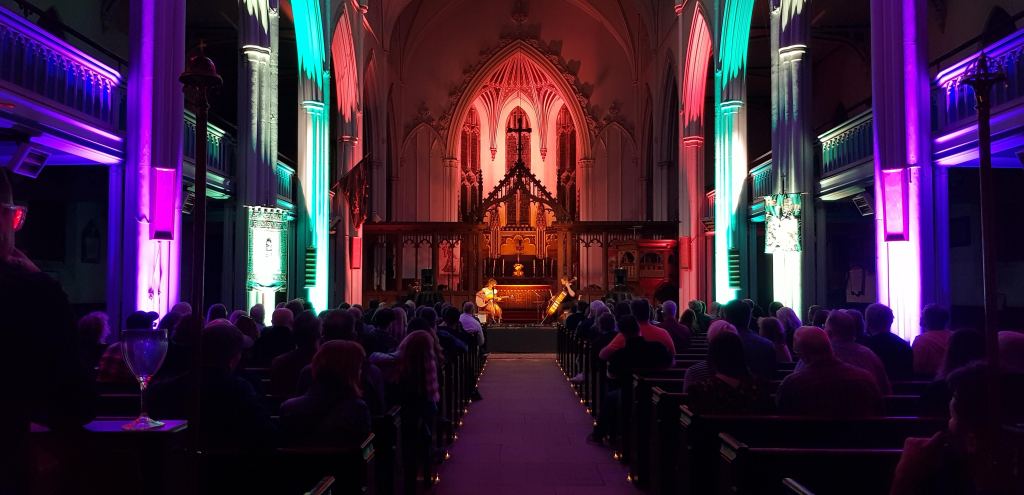
On Sunday 26th November – from 5pm please join us for a celebration of light at St George’s Church Ramsgate. Free Entry – although donations are welcome in aid of the St George’s Restoration Fund. This year, St George’s Church are joining the Ramsgate Christmas light switch on in Ramsgate town centre’s High Street. After the switch on, we are inviting people to make their way up to St George’s Church where we’ll be marking the end of the 1st year of Project 200 and the start of the festive season in 2023.
After the Christmas lights have been switched on, GB Carnival and their band Samba Ya Wantsum will lead the way from the town centre up to St George’s, where visitors will be welcomed to the church to warm up with hot drinks and mince pies. The facade of the tower will be lit by James Brown AV and there will be a performance by Free Range Orchestra with animations by the students of University for the Creative Arts.
We invite friends, families, schools, organisations, Church Hall users, businesses in the town and those who are in sympathy with the restoration of our beautiful church to exhibit a small decorated tree in the 2023 Christmas Tree Festival. Please contact us at the church by Saturday 25th November if you would like to exhibit a tree.
For many people Christmas is the time when family and loved ones visit to enjoy the festivities together. It is also a time when Christians celebrate the greatest visitor of all: Jesus Christ. As the Son of God, he visited us from heaven to reconcile the world to God. You are invited to visit and celebrate with us this Christmas at one or more of the services and events listed below.
Carol Service (St. George’s)
Thursday 21st, 7:00-8:00pm
Join us in the beautiful setting of the town centre church, for carols, creating a crib scene and the tree of remembrance.
Midnight Service (St. George’s)
Christmas Eve, 11:30pm-12:30am
Welcome in Christmas Day itself with this special Holy Communion.
Christmas Services at our linked churches:
Service of Remembrance (St. Luke’s, Hollicondane Road)
Saturday 16th, 6:30-7:30pm
A chance to come and remember and give thanks for the lives of loved ones who, who we will be missing this Christmas.
Family Carol Service (St. Luke’s, Hollicondane Road)
Sunday 17th, 11:00am-12:00pm
A carol service for all ages.
Carol Services (Sailors’ Church, Harbour)
Friday 22nd, 3:00-4:00pm and 5:00-6:00pm
Join us for Christmas at the beautiful Royal Harbour’s church. This was so popular last year that we are going to repeat the service at 5:00pm.
Crib Service (St. Luke’s, Hollicondane Road)
Christmas Eve, 4:00-5:00pm
An interactive retelling of the Christmas story for young children.
Traditional Carol Service (St. Luke’s, Hollicondane Road)
Christmas Eve, 6:30-7:30pm
9 lessons and carols by candle-light, not suitable for young children.
All Age Service and Communion (St. Luke’s, Hollicondane Road)
Christmas Day, 11:00am-12:00pm
An informal Christmas Day celebration for all ages.
Sometimes people say things that upset others, often without even realising they have done so. There is hurt and upset. Is one side being oversensitive or the other side being insensitive? How do we deal with such situations?
Sometimes there can be arguments over church policy. What to spend money on or not. What kind of music we should sing or not. When to put the heating on. How do we resolve such disputes? The Bible does not pronounce on these issues, but people can be quite passionate about them and sometimes fall out if they don’t get their way.
Sometimes there can be disputes about roles. Who is responsible for what. Concerns that people are not doing what they said they would. Or that someone is taking over my role. How do we deal with such situations.
Sadly, such disputes can lead to people leaving the church, upset that they haven’t been treated well or got their own way. They may then complain to others outside the church, through gossip or on social media with the hope of ‘winning’ the approval of the court of public opinion for their case, rather than trying to deal with the issue within the church.
What are we meant to do?
What’s going wrong in Corinth?
The church in Corinth give us a good case study of how not to do it!
In this letter, Paul is writing to the church and is challenging them about what is going wrong. In the reading we had this morning, he is especially upset with them:
‘Do you dare to…’ (vs. 1)
‘I say this to shame you…’ (vs. 5)
‘You have been completely defeated already…’ (vs. 7)
What is going on? There are disputes within the church, probably of a more serious nature than the ones I have listed, but still relatively small issues, that would be dealt with in what we might call a ‘small claims’ court, that rather than dealing with sensibly or in a low key way within the church, they were taking each other to the public courts.
Now Paul is not talking here about more serious cases, properly criminal cases. The church in recent years has been rightly criticised for not taking issues of child sex abuse to the police, but trying to deal with them as an internal matter. Paul is clear in his letter to the Romans, that God has put in place the rulers of this world to deal with such criminal behaviour.
No, Paul is dealing with smaller issues, perhaps people who have failed to pay a bill in full or to complete work that was promised. Those kind of small claims issues – not murder of abuse. Paul is saying, that their failure to deal with such issues within the church was an utter disaster. They seemed to be more concerned with their personal gain, getting their own way, winning their dispute, than they were with building up and maintaining the church community.
What matters more to you: Church Community or Personal Gain?
And that is a challenge to us. What matters more to us, the Church Community or our Personal Gain?
In challenging the Corinthians in their disastrous behaviour, he touches on and hints at why the church community really matters and should be more important to us than our personal gain.
Church as holy
Firstly, he reminds them that they are the ‘holy ones’. This is the word translated, ‘saints.’ It does not refer to especially good Christians, but to all true Christians.
Paul has already reminded us in the letter, that the community of believers is God’s temple. In other words, his holy house. As such, if your actions damage the community, they are sacrilegious. Just as we might feel that if someone vandalised the church building it was in some way worse than other vandalism, because it is God’s house, so the New Testament would say that to damage the church community is an act of vandalism on God’s building. Paul puts this very bluntly in 3:16-17:
“Don’t you know that you yourselves are God’s temple and that God’s Spirit lives in you? If anyone destroys God’s temple, God will destroy him; for God’s temple is sacred, and you are that temple.” (1 Corinthians 3:16-17)
But also, to be holy is to be called to be set apart from the world, as an example of what it means to live for God. A lot of people love the fact that St. George’s lantern tower is lit up at night – a beacon of light, especially in the dark evenings of this time of year.
But the community of God’s people is meant to be a beacon of good. That is why in the previous chapter, that we looked at last week, Paul was so keen that people who persist in serious sin are put out of the church, so as not to corrupt it from its calling.
More positively, in a passage that also talks of the church as God’s temple, Peter says that the church community is called to:
“Live such good lives among the pagans that, though they accuse you of doing wrong, they may see your good deeds and glorify God on the day he visits us.” (1 Peter 2:12)
In this passage, Paul says something even more radical about what the holiness of the church means. He says that we are to judge the world and to judge even angels in verses 2 and 3.
What does this mean? It could mean that by living the good life of faith, we show up the unbelief and corruption of the world. That certainly fits with what I have said about being a church community as holy.
It could also refer to the fact that at the end of time, we will sit with Christ, when he comes to judge the world. This fits with some of the imagery in Revelation:
“To him who overcomes, I will give the right to sit with me on my throne, just as I overcame and sat down with my Father on his throne.” (Revelation 3:21)
Whatever Paul means by this statement, the point Paul is making is something like this:
‘How can you go to those outside the church to judge your cases, when they will be judged by you?’
‘How can you rely on the judgement of those whose values are not in line with the values of Christ, who will one day judge them?’
‘How can you rely on the judgement of those outside the church, when you are called to live by a totally different set of values in order to show up the unbelief and corruption of the world?’
‘Don’t you realise the church is set apart, holy and distinct from the world? How can you allow the unholy to judge the holy?’
Do you value the church community above your personal gain, because you have come to see it as God’s holy temple, which is to be built up and not vandalised?
Church as family
But secondly, we also need to remember that the church is our spiritual family. Sadly, this point is a bit lost in translation. The Greek uses the word, ‘brothers’ in verses 5,6 and 8, but for some reason the NRSV mostly translated it ‘believers.’ The NIV does a better job at using the word, ‘brother.’
By putting their behaviour as one brother taking another to court in verse 6 and the idea of defrauding your brothers in verse 8 brings home the seriousness of what is going wrong.
It is wrong to exploit strangers and to fall into disputes with strangers, but it becomes even more wrong to do that to family. But when you do it to other members of the church community you are doing it to family.
Do you value the church community above your personal gain, because you have come to see it as family?
Church founded on the cross
Thirdly, we need to see the church and our behaviour as shaped by the cross.
In the first few chapters, as Paul wrote to encourage unity in the church, he focussed on the wisdom of the cross. Their church was founded on the message of the cross, that Paul brought to them:
“For I resolved to know nothing while I was with you except Jesus Christ and him crucified.” (1 Corinthians 2:2)
The message of the cross does not fit with the thinking of the world, especially a world focussed on personal gain:
“For the foolishness of God is wiser than man’s wisdom, and the weakness of God is stronger than man’s strength.” (1 Corinthians 1:25)
The point is this. On the cross Jesus utterly gave up all personal gain for the sake of others. He gave up all his rights, in order to win a place in God’s eternal home for all who believed in him. He paid the price, that we sinners may gain the reward.
If that is the basis of our faith, the cornerstone of the church, then surely as Paul says in verse 7, we should be willing to be wronged and cheated rather than allow disputes that threaten to destroy or undermine the work of Christ.
And how can we preach Christ crucified to those outside the church, if we come before them arguing for our personal gain at the expense of our brothers and sisters in Christ?
Do you value the church community above your personal gain, because you have truly understood the church as founded on the cross of Christ?
Dealing with disputes:
So, with a clearer understanding of the church as holy, as family and as founded on the cross, we can come to the question of how to deal with disputes. Remember we are talking about disputes not crimes. Actual crimes need to be reported to the police and safeguarding concerns to the safeguarding officer or me or straight to the Diocesan safeguarding officers.
When it comes to other disputes, however, I want to suggest as Christians that there are four levels to dealing with disputes. We should consider the lowest levels first and only move to the next level if it is really necessary.
Let it go? – vs. 7
The first level is to ask ourselves: Should I just let it go?
Yes, I may have been hurt, I may have lost out, but as Paul suggests in verse 7, in the interests of harmony and peace and following the example of Christ, is it best not to worry about this dispute and let the other person win, without even complaining?
This is probably the best way to act in many occasions, especially for smaller issues and one off problems. Let grace abound!
However, for more serious issues, or a recurring problem, which may suggest that there is a sin in the other that needs addressing or in order to protect the wider church, there are cases where you need to deal with the dispute.
Resolve one to one – vs. 7; Mt. 18:15-17
So, the second level is to seek to resolve the dispute privately on a one to one basis. If you can do this, then you will avoid the defeat of having lawsuits that need to be judged, as Paul puts it in verse 7.
Jesus makes this point in Matthew 18:15-17:
“If your brother sins against you, go and show him his fault, just between the two of you. If he listens to you, you have won your brother over.” (Matthew 18:15)
Of course it may be that as you talk to them with an open mind, you discover that you also are at fault or you have misunderstood the situation and things can be happily resolved. It may be that they accept what has gone wrong, apologise appropriately and commit to doing better in the future. These are the kind of resolutions you long for!!
To tackle someone in this way and to reach a positive resolution really helps to build the church up – it encourages holy behaviour and deepens relationships.
If, however, they do not listen to you and you still feel you are in the right and that is serious enough to justify involving others then you may need to go to the next level.
Resolve a few to one – vs. 7
This is still just about avoiding the kind of situation Paul calls a defeat in verse 7, but now others are being involved as Jesus suggests for the next step:
“But if he will not listen, take one or two others along, so that `every matter may be established by the testimony of two or three witnesses.'” (Matthew 18:16)
Again in taking others along, you may find that they make you realise that you are partly or wholly in the wrong and not the other person! But that could be a good thing!!
Assuming you are right and the other person is wrong, however, then in bringing more people to testify to them, the hope is that they will see the error of their ways and change without having to make the issue any more public.
If, however, they refuse to accept there is a problem, and the issue is serious enough, then you may need to take it to the fourth level.
Submit to church’s judgement – vs. 4; Mt. 18:15-17
The fourth level is the kind of tribunal Paul is talking about. For things to come to this is a kind of defeat, a failure of the earlier stages to resolve the situation, but on occasions it will be necessary.
Jesus says:
“If he refuses to listen to them, tell it to the church; and if he refuses to listen even to the church, treat him as you would a pagan or a tax collector.” (Matthew 18:17)
Here, Jesus encourages the dispute to be resolved within the church, as Paul argues for in 1 Corinthians 6. The vision in 1 Corinthians 6 is that the church would appoint someone they consider wise enough to make a judgement in such matters to decide disputes. It could be that as Jesus implies, there may be more than one person involved in making the decision.
But the point is that whatever decision is made, needs to be respected by all parties. It could be in bringing a dispute to this level, even if you have found others to agree with you that the final conclusion goes against you or doesn’t completely give you what you want. The important thing, however, as Jesus and Paul suggest is to submit to the ruling and accept the result.
Ultimately, as Jesus warns and as Paul has also hinted at at the end of chapter 5, those who continue to sin, despite the warnings of the church need to be put out of the church for the sake of the wider community. That is never the aim of this process, but it may sadly become the ultimate result.
Dealing with Disputes
The church community is special. Founded on the cross of Christ, it is holy, it is family. We need to value it above our own personal gain.
There will be disputes that arise within church communities. Some of these will be unimportant and others more important. We need to deal with them wisely, always seeking the right resolution, being willing to humbly accept we might be in the wrong and not rushing to escalate the dispute, but dealing with necessary issues, in the hope of real reconciliation and spiritual growth for all involved.
“Therefore, let us keep the Festival,not with the old bread leavened with malice and wickedness, but with the unleavened bread of sincerity and truth.”
(1 Corinthians 5:8)
You may have spotted that we are using the same opening verse as last week. It is a verse that encourages us to live transformed lives as Christians, to give up old ways that are characterised by malice and wickedness and to take on the ways of Christ that are based on sincerity and truth.
This transformation should also show itself in the way we live together as a community of disciples. This week we are looking at the next section of Paul’s first letter to the Corinthians, where he challenges them about the way they are treating one another (6:1-8).
As he challenges them, he reminds them of their new identity as Christians and so their new relationship with God and one another. Firstly, he describes them as ‘saints’ in verses 1 and 2. Other translations might use, ‘the Lord’s people’ or ‘the holy ones.’ It is a word commonly used in the New Testament to describe Christians that emphasises that they are set apart from the rest of the world to be God’s people. As such, they are expected to behave in a way that is distinctive from the world around, to live in ways that show we are trying to follow Christ’s example.
Secondly, the section refers to our fellow Christians as, ‘brothers and sisters.’ This reminds us that as children of God, we are now part of a new family and so we should show a similar care to fellow Christians as we would expect to show to our own earthly family.
When we see that those in Christ are both ‘saints’ and ‘brothers and sisters’ then we understand why we cannot exploit others and especially our fellow believers. Rather, we should work for reconciliation where problems occur and to love and care for those fellow believers God has placed us with.
Paul Worledge
This Saturday – Urgent Updates!!
Churches Together Prayer Breakfast
Due to illness, this now has a new venue: Salvation Army, but with a simpler breakfast than normal. 9am to 10am, Saturday 4th November.
This is still going ahead!!! Please join us for the annual coffee morning in support of Samaritan’s Purse Christmas shoebox appeal at St. Luke’s Church Hall. Enjoy tea and cake and catch up with friends. If you would like to make up a shoebox with gifts suitable for a child, you can bring it along on the day or collect a box on the day to fill at home.
What’s On – a page which lets you know what is happening this week and gives information about upcoming events.
Notices – You can read the latest notices on this page.
Sermons – Read a transcript of a recent sermon or watch the YouTube version recorded at St. Luke’s. There are now videos for all the sermons over the summer.
A big thank you to all those who helped to make this year’s Light Party such a great success. It was a joy to see families and children from St. Luke’s and elsewhere having a great time in a way that celebrates the light of Christ rather than the horrors encouraged by Halloween.
Church Finances
If you have not already picked up a letter about Church Finances, then please do so this week. We are encouraging people to respond by today, if possible and we will say a prayer to give thanks for the extra donations offered. If you haven’t yet responded, then please do so as soon as possible.
Please note that next Sunday 12th November is Remembrance Sunday. As we host the town’s Civic celebrations, there will not be a service at 9:30am, but there will be a short service at the war memorial in front of the church at 10:45am, followed by a Remembrance Day service in the church, where we will be joined by ex-service personnel, town councillors and various scout and cadet groups.
Coming Up
In the coming weeks, there are some key events occurring at St. George’s in the lead up to Christmas:
Let there be light, from 5pm, Sunday 26th November:
Refreshments, entertainment and a celebration of the 1st year of Project 200.
Christmas Tree Festival, 2-5pm, 8th to 17th December
Christmas Services at St. George’s
Below is a list of the Christmas Services that will be happening at St. George’s this year. Please be thinking and praying about who you might invite.
Carol Service, Thursday 21st, 7:00pm
Midnight Service, Christmas Eve, 11:30pm
Note, there will also be services at St. Luke’s and the Sailor’s Church.
ACTS: Cakes, Coffee, Craft and Art Exhibition
Saturday 18th November, 12-4pm, St. Peter’s Baptist Church.
Every penny raised will go to the continuing work of ACTS & Inspiration Creative, 2 Thanet charities supporting and working with local children & young people.
Sunday 19th November, 3pm in St. Luke’s Church. Tickets £5 in advance. £10 on the door. Music from Rossini, Bethhoven, Strauss and more. All proceeds in support of St. Luke’s.
October is over and it was Black History Month. This is a short article that came through right at the end of the month that talks about some inspirational Black Christians. Read more…
How to Pray for Israel and Gaza
This guide from Tearfund helps individuals, churches and groups to pray for the recent conflict in Gaza and Israel. Join us in prayer. Read more…
Finally, let’s make sure we live the new transformed lives as a true community of Christ.
Our Bible reading today is about church discipline. It is not an easy topic, because if immediately brings to mind incidences of where church discipline goes wrong or fails.
Our Bible reading today is about church discipline. It is not an easy topic, because if immediately brings to mind incidences of where church discipline goes wrong or fails.
I think broadly speaking there are three ways that church discipline goes wrong.
Abuse of power
Firstly, it can be used an abuse of power. Rather than disciplining, demoting or even expelling people in the church because they are acting clearly against the teachings of the Bible, there are many cases when it is used by people in power to assert their position, get rid of people who disagree with them or is just aimed at people they do not like.
I’ve recently been listening to a podcast about the rise and fall of one of the Mega Churches in the USA. The pastor of the church led a church that grew rapidly and amazingly. In the end, though, the whole church fell apart when allegations of bullying behaviour emerged and were upheld.
There was one incident, where two members of the leadership group were forced out of their positions because they disagreed with the main pastor. The next day the pastor described them as being thrown under the bus for the sake of the growth of the church. But the reality was it was for the sake of getting rid of people who disagreed with him. Such church discipline is an abuse of power and sadly it happens all too often. Church discipline can be an excuse for an abuse of power.
You might be tempted to think that we should not have church discipline at all.
Failure to protect
At the same time there are plenty of examples of church discipline not being exercised and that leading to disastrous results. In recent times, this has been most clear when wider church denominations have failed to act on allegations of their clergy being involved in child sex abuse.
Because those clergy were not investigated and not forced to leave their roles more children were tragically abused.
Lack of church discipline, merely leaves the people of God open to exploitation and harm. You cannot abandon church discipline just because it is sometimes misused!
Grace forgotten
A third danger is I think more subtle. An over focus on church discipline can lead to the impression that you can only become part of the people of God, if you first make yourself good enough to meet the standards that are being enforced by church discipline.
This of course is completely false. Jesus welcomed tax-collectors and sinners. Paul who wrote our present passage said, ‘Christ Jesus came into the world to save sinners – of whom I am the worst!’ He also emphasises elsewhere that we are saved by grace not works.
Church discipline may be necessary at times, but it should never be allowed to obscure the great truth that we are saved by grace.
What was going wrong in Corinth?
So, what is going on in 1 Corinthians 5 and what does it teach us about church discipline today?
1 Corinthians was a letter written by the apostle Paul to the Christians in Corinth. He has already challenged them about their lack of unity, to remind them about the centrality of Christ’s death on the cross and the role he has played in founding and encouraging them into the faith.
Now, however, he wants to challenge them about a specific issue.
Sexual Immorality of an Individual
The presenting problem is that a member of the church is involved in sexual immorality. The Greek word translated ‘sexual immorality’ is porneia. It is a broad word that covers all kinds of sexual wrong doing and it is where we get our word, ‘porn’ from.
In Corinth, sexual immorality of all kinds was rife and Paul will have more to say on that issue, but this case he says is one that would be condemned even by the generally sexual immoral of Corinth, a man is sleeping with his father’s wife.
Such behaviour was indeed condemned not just in the Old Testament law, but also Roman law. It is also illegal to marry your father’s wife in this country, whether your father is still alive or not – although since 1986, an exception was introduced so that you can do so if you are both over twenty-one and if before the age of 18 your father’s wife did not act as mum or step-mum to you.
We don’t know, what the situation was in this case and certainly the Old Testament laws that Paul would have based his understanding on does not allow such an exception. Whatever the details of the situation, Paul is clear that such behaviour should not be tolerated in the church.
Arrogance of the Church
In a way, though, that was not the big issue. The problem was the attitude of the rest of the church to the situation.
Paul says, they were ‘arrogant’ about it or ‘proud.’ At the least this means they did not think anything should be done about it, despite Paul’s past teaching against things, at worst it may mean they saw such behaviour as something to be commended.
But why was the church so unconcerned by such sin. Why were they not mourning the fact that there was such serious sin amongst them.
We cannot be sure and people have offered various suggestions.
Some have suggested that the man in question was a key figure in the church, perhaps a talented and popular teacher. Because of his talents and popularity, people did not want to challenge him or risk losing him from the church. In our world too, we are often too easily taken in by talent, charm or success. Bishop Peter Ball, who was Bishop of Gloucester in the 1990s got away with terrible sex abuse, because no-one in power could believe that accusations against such a charming, talented and successful man could be true. Both Jesus and Paul warn of so called christian teachers or leaders who are really wolves in sheep’s clothing. They look like the real deal, but at heart they are wicked.
A more likely possibility is that the church in Corinth, took the idea that we are no longer under the Law to an extreme, so that this man’s behaviour was a breaking free of the rules and regulations of the past and should be celebrated as the new liberation they had in Christ. In the next chapter, Paul quotes a phrase that they used, “I have the right to do anything.” But for Paul such an attitude is way off. Not everything you can do is beneficial for your or others and wrong behaviour often enslaves you again to the power of sin.
Distortion of the gospel
What has gone wrong both with the individual and the church as a whole is that the gospel has been distorted. It has become: “Jesus died for my sins, so I can carry on sinning!” “I am saved by grace not works, so I don’t have to worry about doing good works.”
It may be that Paul was writing around the time of Passover and so he introduces an illustration from that festival. Passover was a celebration of God’s rescue of Israel from Egypt, of freedom from tyranny and enslavement. They were rescued, though, not to return to Egypt, but to live a new life as God’s people. And God gave them the Ten Commandments to show them that this new life involved a new ethical way of living.
When the Jews celebrated the Passover festival they removed all the bread that was leavened, in other words contained yeast, from their houses. Because the rescue meant fleeing quickly from Egypt, and so there was no time to allow the yeast to raise the bread. For the Jews this annual clearing out of the old leavened bread to have unleavened bread instead became symbolic of purifying themselves from wrong ways of living.
Paul is saying that as Christians, Jesus has become our Passover. He died to rescue us not from slavery to Egypt, but slavery to sin, to bring us into a new life not just forgiven for our sins, free from the guilt of our sin and the condemnation of our sin, but free to live a new life of sincerity and truth. The gospel announces that we can be forgiven free of charge, but it also calls us into a new better life. It is not true that anything goes. The true celebration of the gospel means moving into the living of a transformed life. That is what the Corinthians seem to have failed to grasp and that is what the church discipline needed to address.
Fundamentally the gospel is not about toleration, but transformation.
The aims of Church Discipline:
So, Paul says that the offender needs to be disciplined.
But, what is Paul aiming for in this disciplining? What makes it appropriate church discipline and not an abuse of power or a failure to understand grace.
Salvation of the Offender – vs. 4-5
Firstly, Paul wants the salvation of the offender. At the end of verse 5, he says,
‘so that his spirit may be saved on the last day.’
The sexual sin that this man was caught up in, put him outside the Kingdom of God – at least until it was repented of and stopped. Paul will later say that serious unrepented ongoing sins show that we are not saved.
Paul hopes that the act of church discipline will ultimately encourage the man to repent and turn back to Jesus for true salvation.
The discipline he imposes is ‘to hand this man over to Satan for the destruction of the flesh.’ Such a phrase, especially in the lead up to Halloween, might suggest all kind of weird and wonderful images. But I think it basically means what Paul calls for in verse 13, quoting the Old Testament, ‘expel the wicked person from among you.’
To kick someone out of the church, means to return them to the world without Christ, the world that Jesus says is ultimately controlled by the ‘Prince of this world’ i.e. Satan. The aim for the man is that in seeing that his sexual behaviour has led to him losing his place within the church, he will give up his sin and seek forgiveness once more and so ultimately be restored.
Church discipline always needs to aim for the repentance and ultimate salvation of the offender.
Protection of the Church’s Culture – vs. 6-7
Secondly, it is about the protection of the church community’s ethics. We are not called to be a people where anything goes. Sin is ultimately corrupting of individuals, relationships and communities. God knows best and calls us out of our old sinful lives into a better life.
If, however, persistent sin within the church, particularly amongst prominent members, is not disciplined, then it influences the wider church to think that anything goes. Just as a small amount of yeast works in a lump of dough to change the whole lump and make it rise, so one or two people engaged in consistent unrepented sin has a disproportionately bad effect on the whole community.
This is not just about sexual sin, although, that is what is highlighted here. Paul also goes on to list six different kinds of sin that show the kind of people whose negative influence needs to be removed from the church.
Why does Paul choose these particular examples? Partly, they expand on some of the 10 commandments. We have been doing a series on the 10 commandments and we looked at the first five. Actually, some of the remaining five are implied by the kinds of people Paul mentions here.
But, Paul also chooses examples that probably reflect the particular culture of Corinth at that time. The kinds of behaviour that members of the church in Corinth would be most likely to fall into.
So quickly, let’s look at the list of 6:
Sexual immorality. This arguably links to the 7th commandment, as adultery is a specific example of sexual immorality. Corinth, however, was a city renowned for its sexual licence.
Greedy. The Greek word literally means the ‘more havers.’ This links with the 10th commandment about coveting. Corinth was a city where there was a particularly grasping culture. People wanted more power, more status, more money.
Swindlers. This links to the 8th commandment: do not steal. Perhaps this is a more subtle example. The word probably means those who seek to gain wealth at the expense of others, either by theft or trickery. Again in Corinth, people were on the make constantly trying to find ways to get more out of others by overcharging, underpaying or whatever means possible.
Idolaters. This links to the 2nd commandment. Corinth was full of pagan temples and idolatry would have been the norm. Paul tackles this issue in detail in chapters 8 to 10.
Slanderers. This links to the 9th commandment, to give false testimony against your neighbour. Perhaps in an attempt to increase their own status, people were keen to put others down whenever they could.
Drunkards. This does not link with one of the commandments, although the New Testament condemns alcohol abuse for the lack of self-control that it produces – a lack of self-control that can lead to breaking any of the commandments, even murder!
All six of these may have been particular issues in Corinth. They are certainly issues in our world today. Paul says, that such behaviour cannot be tolerated in the church. If someone is consistently behaving in these ways they need to be challenged and if they refuse to change, then they need to be disciplined by in some sense being removed from the church community. Otherwise, the community as a whole will be drawn into similar behaviour.
The aim of church discipline is about the salvation of the offender, but also the protection of a church culture that promotes transformed Christian living.
Church Discipline: Inside not Out
Paul is clear at the end, that this all applies to those inside the church. It is discipline for a purpose – the salvation of the offender and the protection of a church culture that promotes transformed Christian living.
We are not to shun those outside the church caught up in such behaviours, as though we are too righteous to be tainted by them. Far from it, Jesus welcomed tax-collectors and sinners, they were the lost sheep that needed to be welcomed back into the fold. But, once in the fold the expectation needs to be of lives transformed.
Our past sin in no way bars us from becoming part of God’s family, from moving from outside to inside. But once inside we need to seek God’s help to live by God’s family values. Values that do not tolerate sexual immorality, greed, swindling, idolatry, slander or drunkenness. In that movement, there needs to be patience, people take time to change and transform. Church discipline should not be quick to condemn new members who are in the process of kicking old habits.
Where church discipline is most necessary is with those inside the family who blatantly disregard those values that need to be put outside the church family. Especially if they have prominent roles within the church.
“Therefore, let us keep the Festival,not with the old bread leavened with malice and wickedness, but with the unleavened bread of sincerity and truth.”
(1 Corinthians 5:8)
For the Old Testament people of God, the most important festival day was that of the Passover. On that day, they remembered how God had rescued them from being slaves to the oppressive Egyptians and led them out of Egypt on a journey to a new life as his people. This involved sacrificing a Passover lamb, whose blood was used to protect them from the angel of death in the final plague sent on the Egyptians. So, each year, they sacrificed a lamb to remember the events, but they also ate unleavened bread. This recalled the rushed departure from Egypt when there was no time to use yeast to make the bread rise. So, yeast was banned during the annual celebrations. To use it was to fail to effectively rejoice in God’s great rescue.
In 1 Corinthians 5, Paul plays around with these facts to make a different point. For Christians, Jesus is the ultimate Passover lamb. His sacrifice rescues us from the oppression of sin and death. How then do we ‘celebrate it’? By throwing out the figurative leavened bread of ‘malice’ and ‘wickedness’ and replacing it with the metaphorical unleavened bread of ‘sincerity’ and ‘truth’.
If we believe we have been rescued by Jesus’s death and resurrection, then Paul says our lives will be changed, there will be a fundamental transformation to our approach to life. As Christians we are called to live good and honest lives, not to win a kind of righteous victory for ourselves, but because of the victory God has already won for us in Jesus.
Such a transformation has implications not just for us as individuals, but also for the church community. How do we encourage one another in such transformed behaviour? What do we do if a member acts in a particularly wicked way? Those are the questions Paul addresses in the rest of chapter 5.
What’s On – a page which lets you know what is happening this week and gives information about upcoming events.
Notices – You can read the latest notices on this page.
Sermons – Read a transcript of a recent sermon or watch the YouTube version recorded at St. Luke’s. There are now videos for all the sermons over the summer.
Light Party – St. Luke’s Church, Tuesday, 4:30-6:30pm
A great alternative to Halloween, for all ages. Food, fun and treats (no tricks). Fancy dress, please (but not scary). Children must be with an adult at the party. Please sign up on the sheet at the back of church, if you would like to come and on the separate sheet, if you can offer to bring some food to share on the night.
Petra playing at Canterbury Cathedral
The English Chamber Orchestra with Richard Cooke conducting as part of Canterbury Festival. Haydn’s Creation (amazing piece) starts at 7.30pm Canterbury Cathedral, 4th November. Petra is on fortepiano. Tickets from £10. Find out more.
Church Finances
This Sunday there will be letters in church for all those who attend St. George’s and have agreed to receive a letter about our church finances. Please take the one addressed to you. If there is not one addressed to you, but you would like to read about and consider giving regularly to St. George’s, then please take one of the unaddressed letters.
Please join us for the annual coffee morning in support of Samaritan’s Purse Christmas shoebox appeal at St. Luke’s Church Hall. Enjoy tea and cake and catch up with friends. If you would like to make up a shoebox with gifts suitable for a child, you can bring it along on the day or collect a box on the day to fill at home.
Thanet Light Orchestra Concert
Sunday 19th November, 3pm in St. Luke’s Church. Tickets £5 in advance. £10 on the door. Music from Rossini, Bethhoven, Strauss and more. All proceeds in support of St. Luke’s.
Quiz Night in support of ACTS (Active Christianity in Thanet Schools)
This is a fundraising event at St. Philip’s Church, Saturday 4th November, 6:30pm for 7:30pm start. Bring your own food and snacks (wine and beer allowed). Come as a table of 8 or make a table on the night. Tickets £5 donation to ACTS. Book via email: acts.schoolswork@gmail.com. Payment on booking by BACS to ACTS or at the door.
Dynamics of shame, dis-honour and vengeance swirl around the decision makers in the Israel-Hamas war. Steven Firmin explores how redemptive justice could restore a relationship of peace. Read more…
Agnostic Professor Becomes a Christian
Journalist and professor Molly Worthen talks to Belle and Justin about what led her to embrace faith after researching the good, the bad and the ugly of Christian history. Watch video… or listen to the podcast
Finally, let’s make sure we live the new transformed lives God has called us to.
Now traditionally in Judaism when the story of Esther is read, its an interactive story – which means you get to take part. Esther is basically a story of good guys and bad guys! So when you hear the name of Haman I want you to stamp your feet and boo. When you hear the name Esther I want you to clap your hands and cheer.
The story of Esther begins with a big party. The king who is called Xerxes, throws a big party and invites all the important people, all the politicians and military leaders to the party – a party that lasted 7 days!! On the last day the king decides he wants to show off his beautiful wife Queen Vashti, so he sends for her to come to the party – she has been having her own party with the wives. Now no-one says no to King Xerxes – he always gets what he wants but Queen Vashti says no – she is not coming to be shown off. Well the king is very angry with her and after some bad advice, he sends her away. But now he needs a new queen. So they hold a beauty pageant, bring all the beautiful young girls, who go through a lot of beauty treatments – it was the Persian equivalent of The Bachelor except the girls didn’t get an option of playing – they had to.
And now we meet Esther (cheer clap!) Esther is a young Jewish girl who is taken to be part of the beauty pageant. Her cousin Mordecai advises her to keep quiet that she is Jewish and because Esther is a wise young girl she listens to his advice. She also listens to the advice of the person in charge of the beauty pageant and because of this, and because Esther is very beautiful, the king chooses her to be his next queen.
Now the king has a prime minister, called Haman (boo, stamp). Haman gets cross with Mordecai and decides that the way to punish him is to destroy all the Jewish people, not just Mordecai – but Haman doesn’t know that his new queen Esther is Jewish.
As we heard in our reading Mordecai comes to Esther and tells her of Haman’s plan and asks her to go to the King and ask him to save her people. Esther reminds Mordecai that no one goes before the king without his having first asked them to come before him. Access to the throne room of the king is by his permission and if you do you die.
Mordecai then tells Esther “if you remain silent at this time, relief and deliverance for the Jews will arise from another place, but you and your father’s family will perish. And who knows but that you have come to your royal position for such a time as this?”
If you have come to your position for such a time as this?
This is Esther’s decision – will she risk her life for her people?
Esther then shows us great wisdom, she doesn’t rush into it but instead she calls on her people to fast for 3 days, as she will with her maids. Now the story doesn’t tell us whether prayer was part of the fasting, but it may have been. At the end of the 3 days she is going to go to the throne room and approach the king, as she says to Mordecai – “if I perish I perish”
Esther has set her face towards this end, she will risk all if it means a chance at saving her people.
We left Esther having made the decision to go to the throne room of the king uninvited, we pick up now as she approaches the throne room, and we see she finds favour with the king, he allows her to approach and asks her what her request is. Esther doesn’t launch immediately into the situation of her people, instead she invites the king with Haman to a feast. She does this again when at the feast the king asks her again what her request is, her reply come again tomorrow evening.
And that evening she tells the king, that her life and the life of her people is in danger and that Haman is behind it. And in a reversal of fortune the king has Haman hanged on the posts that he had prepared for Mordecai and the Jewish people are saved and Mordecai becomes prime minister in the place of Haman.
Esther is a biblical hero. She mediates on behalf of her people in the throne room of the king and brings about their salvation. She points us to the Biblical Hero Jesus, the one who stands in the throne room of the King of Kings and mediates on our behalf, the one who brings about our salvation.
The story of Esther is unique because God is not mentioned once. But as we read or hear the story we can see God behind the scenes. Things happen in a way that only God could be behind them, moving at the right time. Esther is a story that reminds us that even when we can’t see God at work directly, he is still at work behind the scenes. Esther may not be like other biblical heroes but she takes her role seriously, she is willing to die for her people and in that way she points us to the ultimate saviour Jesus, the one who did die that his people may be saved.
As Project 200 comes to the end of the 1st year of our 5-year regeneration project, St George’s are delighted to now be working with Heritage Lab. This work should be of great help with defining the scale of what we want to achieve and how best to go about it. 2023 has been a brilliant summer in which we’ve enjoyed welcoming new visitors to the church and hosting some fantastic concerts.
In this 1st year of Project 200 we have made a good start on engaging our local community and establishing the regeneration of St George’s within the wider regeneration of Ramsgate. The next step is to clearly express the vision of what we will do at St George’s and from what sources we should seek funding. Once we have clear proposals, we will need to consult internally to decide the direction of travel and once this direction is decided to communicate and consult more widely and find funding to achieve our goals.
“Honour your Father and your Mother as the LORD your God commanded you, so that you may live long and that it may go well with you in the land the LORD your God is giving you.” (Deuteronomy 5:16)
When I first thought about speaking on the fifth commandment, ‘Honour your parents.’ I wondered if there was much to say. In many ways the command is straightforward.
But preaching on it raises some key issues.
Firstly, as we shall see this command has a kind of unique status and position compared with the other commandments.
Secondly, I am preaching to a congregation with a great variety of unique experiences with their parents.
There are some here who may still live with parents, who are still healthy and well. Others may have elderly parents that need increasing care, whilst many will no longer have living parents. Many will get on well with their parents, whilst others will have difficult or no relationships with one or more of their parents.
My own context is that I have reached the age of 53 and both my parents, my stepparents and my wife’s parents are still alive and relatively healthy. I am probably fairly unique in having such a healthy parental situation at my age.
It could be argued that it is impossible to preach a sermon on this topic that is relevant to everyone. Indeed, if you no longer have living parents you might argue that this sermon is not worth listening to. Someone even said to me about the sermon on the Sabbath that it seemed irrelevant to them, because they do not work!
But I think we all need to see sermons as not just helping us deal with our own life situation but equipping us to guide and support others in their lives. We need to learn from Christ not just for our own benefit, but so that we can offer true Christ-like wisdom to others.
Additionally, we can also apply our understanding of family life to the community life of the church. As we think of our earthly parents, we also need to apply this understanding to those in our church who may in some way be like parents to us.
So, let’s get stuck in with why this command is so unique among the ten commandments.
The Two Great Commandments and the FifthCommandment
Where does the fifth commandment fit? It is often said that the Ten Commandments are summed up by the two great commandments.
Jesus says the greatest commandment is:
“To love the Lord your God, with all your heart, with all your soul, with all your mind and with all your strength.”
The second is:
“To love your neighbour as yourself.”
The first four commandments clearly refer to loving God: no gods before me, no idols, do not misuse God’s name, keep God’s Sabbath.
Whereas the last five are clearly to do with how we treat our neighbour: do not murder, do not commit adultery, do not steal, do not bear false witness, do not covet.
What about the command to honour our parents?
Is it part of the command to love God? No, your parents are not God. They are people like you and me.
So, is it part of the command to love your neighbour? Not really, because that says to love your neighbour as yourself, to treat others as equal to yourself. But the command says, to honour your parents. To honour someone is to treat them as having special value and to be due special respect. Honour is something you give to God, to show it to every neighbour would be to make it meaningless. But you are to honour your parents, to treat them in some way like God. Perhaps this command has more to do with loving God than it is to do with loving your neighbour?
It seems to me that this command with its focus on honour and its position in the ten commandments seems to be saying to us: Our parents are not God to us, but they are more like God to us than any other people in our lives.
This makes some sense. God created us, gave us a home to live in and provides for us freely, without charge. Parents do the same for their children. Together they bring them into existence, provide a home for them to grow up in and provide for them freely, without charge. Parents are not God, but they are like-God to us.
Let’s explore what this means in practice.
God is greater than our parents
Although the command is to honour our parents, we need to remember God is greater than our parents and deserves more honour than them. The command to honour our parents comes after and is subject to the commands about God.
Jesus, who elsewhere criticises people for not taking the fifth commandment seriously, makes this point provocatively in Matthew,
“Anyone who loves his father or mother more than me is not worthy of me; ” (Matthew 10:37)
In our secular world, which hates allowing God a look in, struggles with such statements. We understand the fifth commandment and see valuing our parents as right and proper but have forgotten the first four commandments and God’s rightful place in our lives.
To a secular mindset, this statement seems deeply shocking, but actually it is deeply liberating.
No human parent is perfect. Your parents are sinners like you and me. Instinctively, most parents are loving and caring, but many of us make a poor job of bringing our children up. In fact, many psychologists work on the basis that most people’s mental health problems are caused by their parents.
If your parents are the only people in your life who play the role of god, then it will be very hard for you to escape any negative influence they have on you. But when you put their role as subservient to the true and living God, then you can look beyond our parent’s influence, corrupted by sin as it may be to the perfect example and model of Jesus and our Father in heaven.
More than that, if you feel abandoned or have been abused by your parents in some way, you may well feel devalued as a human being, because you have not received the love from your parents that you need.
But if you are able to look beyond them to the God, who is so much more honoured and wonderful than them, but has loved you so much that he sent his only Son to die on the cross for you – he made the ultimate sacrifice out of love and commitment to you, then you can find value and meaning despite the failed love of your parents.
It is only when we realise that God is to be honoured and loved more than our parents that we can be released to flourish and mature to become the kind of people God really wants us to be, rather than limited to our upbringing.
Without realising that people often end up doomed to repeat the mistakes of their parents. God is greater than your parents.
Your parents have a god-like role in your life
Nonetheless, our parents are to be honoured. This is right, but it also leads to the blessing of long and happy lives, as the command promises.
So, what does that look like and how does it lead to a long and happy life? It will look different at different stages of our lives. Everyone’s lives look different, but I want to consider three broad areas of life.
While we’re growing up
To honour our parents while we are still young and growing up in the home, will mean being obedient to them. It is at this stage of life that our parents are most ‘god-like’ to us. We have much to learn and they have much to teach us. They are responsible for protecting us when we are at our youngest and most vulnerable to the threats of the outside world. We are totally dependent on them to provide our food, our clothing and a home to live in. Not to mention the emotional support and reassurance we need.
As we grow, we will gradually gain more independence and a good parent will encourage and enable that to happen at just the right pace. But increasingly from late childhood through the teenage years,
the child’s desire for freedom and independence and the parent’s desire to protect and guide will clash. Parents as Paul says need to be careful not to anger their children, but for children and teenagers in the context of this difficult transition, honouring parents will most clearly show itself through obedience. Paul states it clearly:
“Children, obey your parents in the Lord, for this is right.” (Ephesians 6:1)
Mostly, parents want their children to flourish, and a happy life is found in following the instructions of the parents who want the best for you – even and perhaps especially when you think they are wrong.
This obedience is of course, subject to prior obedience to God and there may be occasions where there is a clear need to obey God rather than parent. But that will be exceptional.
When we marry
As we move on in life and out of the home setting, obedience is no longer the main focus of honouring our parents.
Interestingly, when we marry, the Bible says that in some sense, we ‘leave our father and mother’:
“For this reason, a man will leave his father and mother and be united to his wife, and they will become one flesh.”
(Genesis 2:24)
Such an understanding does not negate the need to honour our parents, but it does signal the need for the relationship to change and become in some sense more distant.
This may be a time, where boundaries need to be drawn with parents, as children carve out emotional space time and energy for the new commitments that marriage and possibly children will bring.
But in negotiating the boundaries of this new relationship, parents are to be honoured. They may not have as much of our time, but they should still have some of our time and be invited to be involved in our children’s and their grandchildren’s lives in appropriate ways.
It may be also, that in this new phase of life, where the relationship has more distance, that honouring may involve dealing with any resentments, upsets or hurts from the past. For some it may even be that honouring our parents means attempting a full reconciliation after what may have felt like an irreversible falling out in our younger years. That may feel costly, but as Christians we know the great price that Jesus paid to be reconciled to us. In the same way, especially with parents we should seek reconciliation if at all possible.
Of course, sometimes such attempts may fail or be rejected by parents. If so, then at least your attempt at reconciliation expressed your desire to honour your parents in your life.
When they need our help
As time goes on parents grow older and may need our support as they enter a season of poor health before dying. At this time, honouring our parents may need a lot more time and commitment from us. Every situation is different. For some, it will mean regular visits and involvement in their care and support or even having them to come and live with you. Often trained medical care will be needed and a nursing home may be the only appropriate place. Yet we can still visit, and our visits may be needed more than ever.
This is an essential part of honouring our parents. Paul, in the context of teaching about caring for widows, warns Timothy:
“If anyone does not provide for his relatives, and especially for his immediate family, he has denied the faith and is worse than an unbeliever.” (1 Timothy 5:6)
A long and life-giving relationship of honour
Our relationship with our parents lasts as long as our lives overlap. It will change and develop and the meaning of honouring them will change over that time.
But the more we work to show honour to our parents, the more we influence our society and our family to do the same. In the end, supporting and enhancing such a culture will rebound on us and as we grow old, we too will reap its benefits.
This special command about how we should treat the special people in our life turns out to be for our good after all.