What is MOPP? It is a new idea for a once a term meeting (six times a year) to introduce opportunities at St. Luke’s and St. George’s to explore the Christian faith and grow as a disciple.
The first MOPP meeting will be at 7pm of Monday 27th February in St. Luke’s Church Hall. Please click the button below to book a ticket, so that we can plan for the catering (free of charge, donations for food welcome on night).
Meal (7pm) – The meeting will be a chance to relax together over food.
Options (8:00pm) – We will share different options for meeting in small groups in the term ahead. The options for the coming term will include studies on prayer and a Christianity Explored course.
Prayer and Praise (7:45-8:00pm for praise and 8:20-9:00pm for prayer) – For those who want to stay on the second half of the meeting will include a time of praising God and praying for his work in the church.
The season of Lent leads up to Easter (when we celebrate Jesus’s death and resurrection) and is associated with self-examination, penitence, self-denial, study, and preparation for the Easter celebrations.
Ash Wednesday services enable us as a church to gather and mark the beginning of Lent. The service gives space for doing just those things that are associated with this season, self-examination, penitence and assurance of eternal life through Jesus’ sacrificial act of love that first Easter.
As part of the service we are marked on the forehead with a cross of ashes as we remember Jesus’ forgiveness and commit once again to our own spiritual growth.
Our Ash Wednesday service this year is on Wednesday 22nd February at 7:30pm at St. George’s church and will probably last about an hour. So come reflect and refocus on our need for Jesus’ love and forgiveness during this season of Lent.
Our next social for St. George’s and St. Luke’s is happening on Friday 17th March in St. George’s Church hall on Broad Street, from 7:00-9:30pm.
Tickets cost £1 to take part in the quiz and beetle drive and do include snacks and drink. But if you do want to bring extra snacks and drink of your own feel free, but just no alcohol please.
Teams will be formed on the night once you arrive, so everyone with a ticket is welcome. There are only 60 tickets available for this event, so first come first serve.
Tickets can be bought from Amanda O at St. George’s and Peter E at St. Luke’s.
In this All Age talk, Claire takes us through Paul’s teaching on who has helped the Corinthians grow, showing it is not so much the preacher that matters, but the message of the gospel and the power of God.
It seems appropriate today to be talking about, and asking the question – how do we grow?
It is great to welcome our baptism family to Saint Georges this morning. In baptism we are welcoming them into the family of faith. The promises that the parents and godparents are making this morning are all about this. About this child growing in faith.
Both of our readings this morning come from a place of wanting spiritual growth for those listening. In our reading from Matthews Gospel v33 Jesus says ‘strive first for the kingdom of God and his righteousness and all these things will be given to you as well’ and Paul in the letter to the Corinthians is longing for them to grow in the faith
Paul’s letter
As a church we have been looking at Paul’s letter to the church in Corinth. He wants them to grow in faith, he’s heard about their quarrelling behaviour and he’s writing to address that. He wants them to know that because of Jesus – his death and resurrection – they are new people, they should no longer be reflecting the world or the flesh as it is also put, but they should be reflecting Jesus because they’ve got his spirit living in them.
Two pictures of growth
In the verses we read from Paul‘s letter today there are two pictures of growth given. One is a picture of a child growing from infancy into maturity (to adulthood), first having milk before moving on to solid food, and the second is the image of seeds being planted in a field and growing.
Still infants
In the first image Paul is saying to the church that when he first told them the good news about Jesus it was brand new. They were given milk because they were baby Christians. This new way of life was different to the way of the world that they had been living. But he would expect them to mature and move on to solid food, growing more mature in their faith. But Paul is saying that they’ve not grown up, they’re still infants, still needing milk. He says this because they’re still behaving by the worlds standards not by Gods standards. There is still jealousy and arguing. If they truly were letting Gods spirit work in them their behaviours would not be that of arguing and jealousy.
How does your garden grow?
The second image Paul uses is a field with seeds being planted.
If I wanted to plant something what would I need?
Paul come and help me please…
I need soil, an area to hold the soil, something to help me dig, water, and seeds. Also we need time. These seeds will apparently grow between 14 to 28 days. We need to wait. If Janet had come and planted seeds too. Is her plant likely to be any better than Paul’s? Maybe. But probably not. They would have used the same equipment, the same tools.
This is the arguement the church have been having . My faith is better because Paul planted the seed of faith in me….. mines better because Apollos taught me… Paul wants them to realise their arguing is stupid. Growth isn’t about who told them about Jesus or who continued to teach them, but is about God.
God vs their leaders
Paul wants the church in Corinth to know that it Is God who gives the leaders their tasks, that its God who makes the seed of faith grow and that it’s God who is the one their trust is in. The leaders are only servants of God, they are sharing and teaching about faith, but compared to God they’re irrelevant. They are to be faithful to God’s teaching receiving recognition for that, but ultimately it is God that makes the seeds of faith grow. The church in Corinth Paul says are God’s field and God will help the seed of faith grow, whoever planted it and encouraged it, by the power of his spirit at work in the hearts of humankind.
You are Gods field. What decisions are you needing to make to help you grow?
Are we growing?
As Christian’s don’t we want to grow in faith, to allow Gods spirit to work in us changing our attitudes and behaviours and actions to reflect Jesus to the world. I would hope we would. That We want to be people that show love, even to the unloveable, that bring peace into situations, who show Gods joy even in times of difficulty, who remain patient even when we’re at our wits end, maintaining self-control. People of Gods spirit are to be kind and gentle, striving to do good – being full of integrity, and are faithful in what we commit to do and to God, living lives in obedience to him.
What areas do we need to grow more Christlike, to be more in step with Gods spirit?
God’s spirit is at work in us are we going to let him? Are we going to produce fruit, behaviours and actions that show we are of Gods spirit and not the world?
Baptism is a start of the journey of faith, we trust God for growth in faith, let’s grow from milk to solid food and be a field that is full of beautiful plants, showing we are Gods people, people with his spirit. Amen.
At St. George’s and St. Luke’s churches we want to provide opportunities for people to meet with God.
As well as our Sunday services, we meet four mornings a week for Daily Prayer. This is an informal service of 30 minutes where we reflect on God’s word and pray for our churches, our community and the needs of the world.
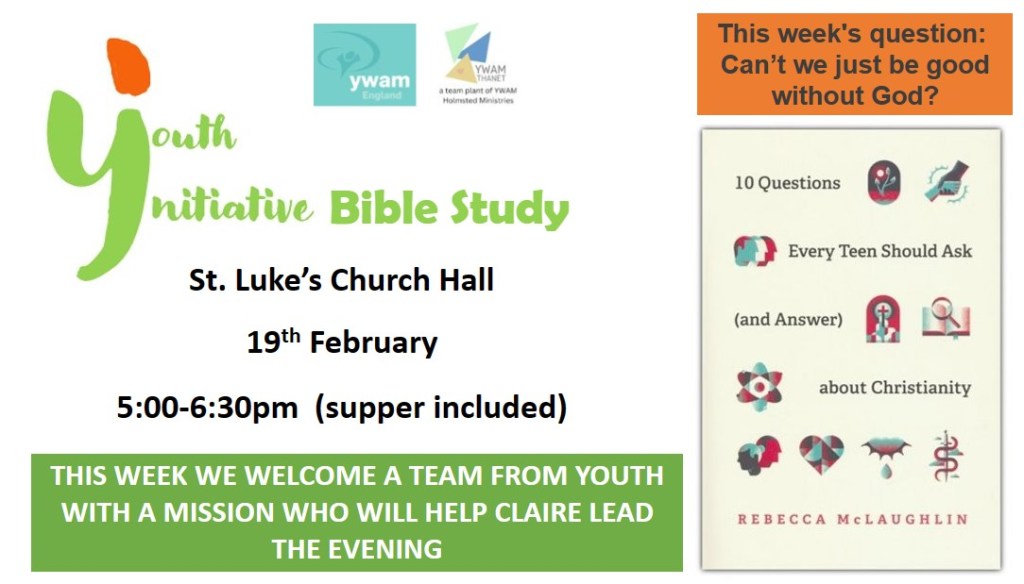
As it is the start of the school holidays, YI will not be meeting this week. We’ll be back on the 19th with the support of a team from YWAM who are visiting Ramsgate as part of their discipleship training school. More information next week.
“So let us stop going over the basic teachings about Christ again and again. Let us go on instead and become mature in our understanding. Surely we don’t need to start again with the fundamental importance of repenting from evil deeds and placing our faith in God.”
In the summer of 2004, we had three children under 5 and Fiona was 8 months pregnant with Anna. One day Fiona’s parents came to visit and we decided to go to Sandwich. From there we went on a walk by the river, grandparents, small children and 8 month pregnant wife!
As we went, some concern was expressed about the clouds forming. But I said with great confidence and wisdom… that’s nothing to worry about it. Somehow, my confidence and persuasiveness carried the day and we wandered further along by the river.
Then the lightening started, then the rain came. There we were, three small children, grandparents and an eight month pregnant wife desperately trying to stay dry and hoping that the lightening wouldn’t strike us – and that Fiona wouldn’t suddenly go into labour!!
It’s a day my father in law will never let me forget!!
It just goes to show that no matter how confident and persuasive someone may be, it does not mean they are right!
Of course these days, we all have smart phones. In a similar situation, we would have looked at our phones, which would have linked us into a system involving satellites, super-computers and carefully constructed weather modelling programmes that would let us know whether a thunderstorm was likely or not. Smart phones are great in part, because they give us access to far superior wisdom at least when it comes to weather!!
Faith by the power of God
In verses 4 and 5 or our reading, Paul says:
“My message and my preaching were not with wise and persuasive words, but with a demonstration of the Spirit’s power, so that your faith might not rest on men’s wisdom, but on God’s power.” (1 Corinthians 2:4-5)
He is writing to a group of Christians in Corinth and he is reminding them how they came to be Christians. It was not he said, because he had been the best most persuasive speaker around – quite the opposite, he was there in fear and trepidation and useless at public speaking compared to other speakers. It was not his talent that had brought them to faith, but something else: “the power of God.”
Jesus says something similar to Simon Peter, when he comes to realise who Jesus really is:
“Jesus replied, “Blessed are you, Simon son of Jonah, for this was not revealed to you by man, but by my Father in heaven.” (Matthew 16:17)
What Paul and Jesus are saying, is that faith does not come through human persuasion, but a miracle of God. In verse 12, Paul goes on to say that our understanding comes by the power of God to the work of the Spirit:
“We have not received the spirit of the world but the Spirit who is from God, that we may understand what God has freely given us.” (1 Corinthians 2:12)
Just as a smart phone connects us into a far superior source of weather forecasting, the Spirit connects us to the mind of God, so that we can understand the message of what he has done for us in Jesus on the cross and so put our trust in Jesus. The Spirit does what no man can do through persuasion. It is by the work of the Spirit that we come to faith.
Sometimes people say that when they hear a sermon, it is as though God is speaking directly to them. At other times, people are overcome with emotion during a sermon or church service. For others there is a gradual realisation that the preaching that once seemed strange and odd is now making sense. All of this is not because of the persuasive nature of the preacher or preachers, it is the work of God’s spirit connecting us into the wisdom and mind of God, that we can understand what he has done for us in the crucifixion of Jesus Christ.
When that happens it is exciting and wonderful! Perhaps God is doing that with you now? Maybe you need to respond and acknowledge the faith that God is giving you and take the step of faith to give your life over to him!
Or maybe you need to learn to think less of the preacher and rejoice more in the God who by the power of His Spirit has brought you to trust in Christ as your saviour!
The Argument in 1 Corinthians
And that last point is part of what Paul is trying to get his readers to do! At the start of the letter he had appealed to the Corinthians to stop dividing over which preachers they said they followed. They were following worldly attitudes in judging between and boasting about which preachers they thought were best!
In the rest of chapter 1, Paul goes on to challenge this kind of boasting by showing that the message of the cross turns the kind of things the world boasts about on their heads. It overturns the worlds thinking on wisdom. Indeed, the kind of people God chooses to be in the church does the same. So, Paul concludes with a quote from Jeremiah in 1:31: ‘Let the one who boasts boast in the Lord.’
And that is what Paul says he did when he came to preach. Notice in 2:1-5, Paul is talking about himself and his preaching to them. His aim he says was not to impress them with his great preaching style or compete with the philosophical teachers that were so popular. He came with a focus on Jesus and his crucifixion.
In fact, the start of chapter 2 is Paul directly addressing their criticism of him. He seems to be saying to the Corinthians, ‘You judge me by the standards of the day, but I don’t care about the way the world judges, I came to bring you the message of the cross. And God in his power used that to bring you to faith!”
So at the start of chapter 2, Paul is defending himself, but by chapter 3, Paul turns things around from self-defence to challenge his readers. He says to them, “You are still worldly!!” In other words, their attitudes, even their criticism of him and their breaking into different fan groups of different Christian preachers, all fundamentally stem from worldly attitudes and assumptions, rather than attitudes and assumptions rooted in God.
How does he move from defence of his preaching to challenging their worldly attitudes? He does so by contrasting the wisdom of God and the wisdom of the world. So, let’s look at the rest of chapter 2 and what he says about this contrast:
The Contrast:
Eternal verses Temporary – 2:6-7
Firstly, he reminds us that the wisdom of the world is temporary, but God’s wisdom is eternal.
Our society is often very critical of the attitudes and outlook of former ages. For example, the present call to remove statues of slave owners today reminds us that what was once thought acceptable: slavery, is now completely condemned by modern society. That attitude then has proved to be only temporary.
I was talking to a lady who is now 100. She remembers that before the second world war on bonfire night, children would run around on the beach at Ramsgate throwing fireworks at each other! What was acceptable then would be seen as a health and safety disaster today!
Human attitudes are constantly changing and evolving. But it raises the question, what today that we assume to be acceptable, right or OK, will be condemned by future societies?
Human wisdom is only ever temporary.
But God’s wisdom is eternal. It may be hidden to many, but it has always been there as part of God’s plan from the beginning of time. Because God never changes, it never changes. His wisdom is eternal.
Glory Forming verses Glory Destroying – 2:7b-8
But secondly, Paul says something amazing. The ultimate eternal goal of God’s wisdom is for our glory! The birth, life, death, resurrection, ascension and return of Jesus is all for one ultimate purpose – our glory!
As Christians we may be despised by the world and the attitudes of our age, but we know what the world does not know, that God will bring us to glory!
In contrast, it was human wisdom and especially the wisdom of human rulers that sought to destroy glory. When Jesus came to live among us and preached the wisdom of God, it was so radical and challenging to the human wisdom of the time, that they crucified him! They could not see that he brought them the wisdom of God, so in their so called human wisdom they sought to destroy ‘the Lord of glory’. What greater judgement of human wisdom could there be?
Thirdly, Paul says that through the wisdom of God, we have Spiritual insight compared with the unspiritual ignorance of the world.
None of us is fully able to know what another is thinking. Paul says only a person’s spirit knows what is going on in a person’s mind.
It is the same with God, only his Spirit truly understands what is going on with God. Yet, the amazing truth as Christians is that we are given God’s spirit so that we can understand what God has done!
Non-Christians do not have this Spirit, so it is no surprise that they don’t understand God’s message. They are left in ignorance. They cannot understand the gospel message or the importance of the cross.
Two Lessons:
So, what lessons are we to take from this contrast between God’s wisdom and worldly wisdom.
Don’t let the world judge you
Firstly, it means that we should not let the world judge us – at least not by worldly standards.
If non-Christians do not have the Spirit, then they are in ignorance about God’s ways and attitudes, they are missing out on a big part of the picture of life, which means they cannot judge us properly.
Imagine being a musician, playing the piano and producing a wonderful piece of music. Then a deaf person comes up to you and tells you that you are mad to be sitting at the piano just pressing random keys down in strange ways!
The deaf man does not understand what you are doing, because he cannot hear the music the piano produces. In the same way non-Christians may think we are mad to live the way we do as Christians, but they aren’t seeing the overall picture, they do not have the spirit of God.
That is not to say we should never listen to the criticism of non-Christians! They do see some of the picture and their criticism may be valid and worth taking into account. But having listened, if we have satisfied ourselves that in the light of what we know by the Spirit of God it is not valid, then we can rest easy.
The point is do not let the judgement of the world, stop you from living for Christ – because ultimately the world is ignorant.
Don’t live by the world’s attitudes
Secondly, if as a Christian by the Spirit, you have been led to understand the good news of what God has given you through the death and resurrection of Jesus. If the wisdom of God that comes from the Spirit is so much better than the human wisdom of the age, because it is eternal and glory forming and gives you insight that others do not have, then how can you continue living by worldly attitudes?
We have the mind of Christ, we have the Spirit at work in us, how can we continue to live in the same ways as the rest of the world? That is the question that Paul will come back to again and again as he challenges the Corinthian church about the man ways they are going wrong!










 St. George's Church Ramsgate