With the death of Queen Elizabeth, feelings of great sadness and grief can emerge as well as a sense of uncertainty and concern as we enter into an unfamiliar new era. How can we respond? The book of Lamentations was written at a time of extreme grief and insecurity for God’s people. Yet, it’s central verses hold out a sense of hope in such circumstances.
This talk given at St. Luke’s on the same day.
How do you feel about the Queen’s death?
How do you feel about the Queen’s death. At the start of his speech on Friday, Charles her son said he had “Feelings of profound sorrow.”
Although, she was not our mother, it may be that for you as well, the loss of the queen as a person brings a deep sense of sorrow and grief.
At the same time, her death brings to the end an era for our nation. For most of us she has been queen for the whole of our lives. 70 years is a very long time and through all the many changes, she has been a great constant. As one columnist wrote: “The one element in our collective life that stayed reliably the same has gone. We enter a new future now.” (Jonathan Freedland in the Guardian)
Such a change of era can leave us with feelings of uncertainty and unease, especially at a time like ours, when our lives are facing so much turmoil: coming out of a pandemic, the cost of living crisis and the war in Ukraine.
So, how should we deal with these feelings?
Lamentations
One way is to turn to the Bible and in particular to the book of Lamentation. It is not a ‘How to guide’ of how to live, but a poem, which was written at a time of total and utter catastrophe and despair for the people of God around 2,500 years ago.
They had not just lost a monarch, their whole city had been destroyed, including the temple which stood at the centre of their identity and national life and expressed God’s support and presence for them. Not only that much of the population had been forced to move to a foreign land. This was an unimaginably bad catastrophe and the book of Lamentations expresses the deep sorrow they experienced in profound and moving ways.
Yet in the centre of the book are these verses of hope. As we face a difficult period in our national life, that comes nowhere near the struggles they were facing, let’s see what we can learn about seeking hope in the midst of sorrow and uncertainty.
Acrostic / Mnemonic
The poem is an acrostic, in the original language, each set of three verses starts with the same letter, then in the next three verses it moves on to the next letter.
To help, I am going to use a similar device as we explore what this poem is saying – a mnemonic, where the first letter of each point spells out a word. The word I am going to use is the word, ‘Queen.’
Quest
“The LORD is good to those who wait for him, to the soul that seeks him.” (3:25)
We all need a ‘quest’ or to seek something in life. It gives direction and purpose and if it is the right quest, it can help us and others in life.
On the queen’s 21st birthday, before she became Queen, she said what her quest was for life:
“I declare before you all that my whole life whether it be long or short shall be devoted to your service… God help me to make good my vow, and God bless all of you who are willing to share in it.” (Princess Elizabeth, 21st April 1947)
It was a commitment rooted in faith and seeking after God.
And it was tested powerfully while she was still young. She became queen at only 25 years old, much sooner than she had hoped and facing the death of her father at only 56. At a moment of deep sadness, she was thrust into a life of demanding service. Yet, she could do it because she also sought God, his help and blessings.
If we are going to cope with the sorrows and challenges of life in ways that are good and flourishing, then the first thing we need to do is to seek God, because only in him do we find our ultimate comfort and security.
Unfailing
“The steadfast love of the LORD never ceases, his mercies never come to an end;” (3:22; NRSV)
The word for ‘steadfast love’ is sometimes translated, ‘loyalty’ or ‘devotion’. The queen exhibited this in her role over 70 long years, never failing in her service, even doing her duty to welcome the new Prime Minister a couple of days before she died.
King Charles III:
‘Her dedication and devotion as Sovereign never waivered, through times of change and progress, through times of joy and celebration, and through times of sadness and loss.’
Yet, unfailing as the queen was, no person can be totally unfailing in their love and concern, because we all one day will die. That’s why we need to seek God as our ultimate source of comfort and security. Only he is truly unfailing, he will never let us down, not even by dying.
Eternal
“For the Lord does not reject forever.” (3:31)
God’s love is unfailing, yet at times we may feel that he has rejected us. That was certainly true for the people of God when Jerusalem was destroyed. Yet, the poet sees beyond the temporary to the eternal. The Lord does not reject for ever.
So, we need to take the long view. After all, that is what Jesus did. Even though he faced God’s rejection and judgement on the cross, he knew that in the end the rejection would not last, that God would not reject him forever. God proved the point by raising Jesus from the dead.
When the queen died, many people noticed the rainbows that appeared in our rather stormy weather at the time. In the Bible the rainbow is a reminder that God’s love will always be there. He will not reject forever. He can see us through even the storms of death, if we are willing to seek him.
Emotional
“Though he brings grief, he will show compassion, so great is his unfailing love.” (3:32)
The queen in many ways was a distant figure, not showing many signs of emotion, but those who were close to her would have seen the more emotional side:
King Charles III: ‘And, as every member of my family can testify, she combined these qualities with warmth, humour and an unerring ability always to see the best in people.”
Yet, the queen’s presence and sympathy at moments of great tragedy were an important help to those suffering great loss. The people of Aberfan in particular remember her sympathy and support when she visited them after the landslide that killed so many including many children.
We can often think of God as a distant figure. Yet, this poem portrays him as a God of compassion, someone who is emotionally moved to act when he sees the suffering of his people.
As Christians we believe Jesus came and lived among us. In Jesus Christ he came and the emotion, most associated with Jesus was compassion, as is the emotion described of God here. When Jesus saw the needs of people he was moved emotionally and acted miraculously. This is what our God is like. This is the God we need to seek, the God who feels our pain with us.
New
“They are new every morning; great is your faithfulness.” (3:23)
And actually, when we seek God, his compassion is experienced every day. Just as the sun rises to bring us a new day, so God’s emotional and loving commitment to us is renewed each and every day – even when we face moments of great sadness, grief or uncertainty.
There is a freshness about God’s support and help, his love for us never grows stale, it is always fresh, whatever we are going through in life.
Queen
We’ve spelt out Queen and we are reminded again of the sadness of losing a much-loved monarch and the uncertainty of a new era without her.
Yet, as we’ve focussed on this poem that looks for hope in the midst of deep despair, we’ve been reminded that in God we have hope. Let’s seek him in all our lives, that like the queen we may have the strength to serve through all the ups and downs of our lives.
“I declare before you all that my whole life whether it be long or short shall be devoted to your service… But I shall not have strength to carry out this resolution alone unless you join in it with me, as I now invite you to do: I know that your support will be unfailingly given. God help me to make good my vow, and God bless all of you who are willing to share in it.”
It is with deep sadness that we learned the news of the death of Queen Elizabeth II on Thursday evening. For many of us she has been a constant throughout our whole lives, a woman dedicated to service of her country and a point of unity and strength for our country. She will be deeply missed.
Such moments stir up all kinds of feelings and emotions in us, both as individuals and communities. At St. George’s we want to offer people the opportunity to mark the Queen’s death in ways they feel appropriate.
Below are some options we want to make available for people to respond:
The church will be open for people to come and sit quietly to reflect, pray or light a candle in remembrance of the queen. It will initially be open, Friday 12-6pm and Saturday 10-3pm.
There will be a book of condolences in the church available for people to fill in.
If people would like to place flowers in memory of the queen, then they can be placed near or affixed to the gates of the church. These will remain in place until the day after the funeral. We will open the main central gates, please do not leave flowers in a way that will block the entrance for cars or people.
We will update this blog with more information as plans develop.
The church will be open as part of Heritage Open Days on Saturday 10th September, from 10am to 3pm. Do come and visit. You can wander round the church at your leisure and see the Dunkirk window which shows the little boats setting sail for Dunkirk from Ramsgate Harbour.
You can climb the tower to the top of the church to see all over Ramsgate, at 12noon and 3pm. Any children under 12 must be escorted by an adult because the stairs are steep.
For the first time in years, you can also go to the Crypt under the church, at 1pm and 2pm, and see where the first Mayor of Ramsgate is buried, and where church services were held during the Second World War.
And you can see our Amazing Invention, our Grade 2 Organ built by William Hill, a famous organ maker.
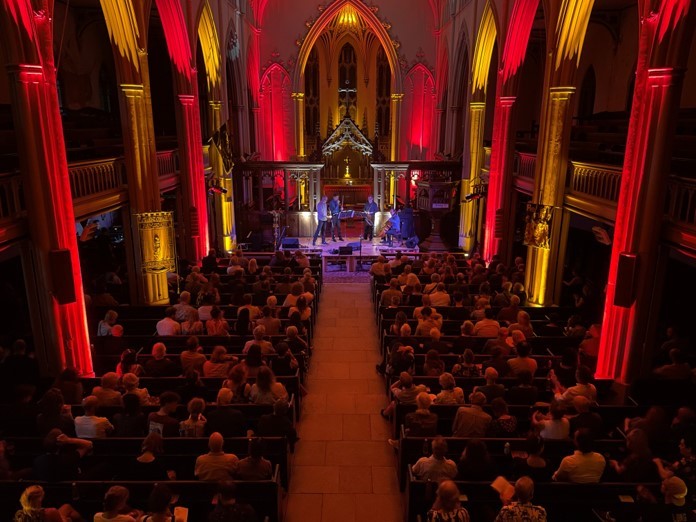
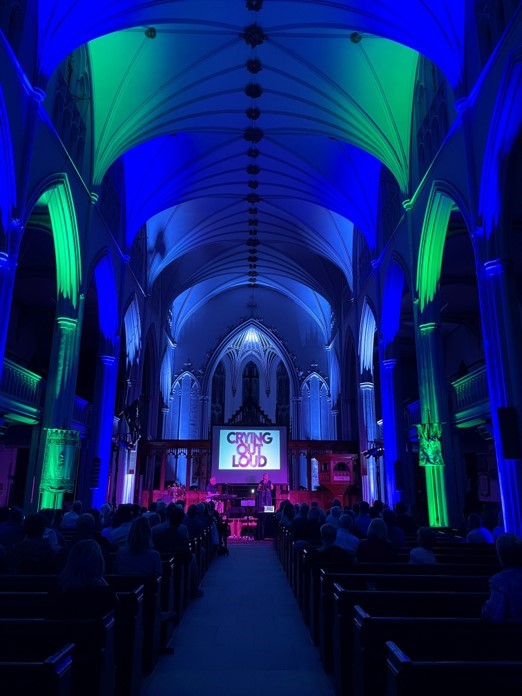
On Saturday 3rd and Sunday 4th September, St George’s church hosted the Ramsgate Festival of Sound. On Saturday over 100 people heard Crying Out Loud, a piece of music written by Naomi Hammerton, exploring the power of our tears and how they can help us to connect with each other. The work was performed by Neptunes Choir and Kings Place Choir.
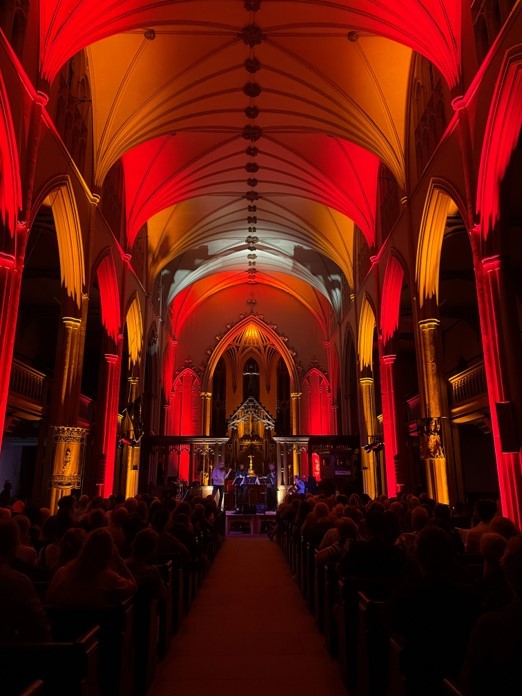
On Sunday, more than 200 people heard several amazing pieces going from the Sea to the Stars – a fabulous piece called Infinity, then the Gagarin Quartet, and finally Anna Phoebe played songs she has written based on her experience of the sea.
As you can see from the photos, the church took on an entirely different hue each night with some amazing uplighters. Many visitors expressed their appreciation of a beautiful church with great acoustics.
When we realise the extent of Jesus’ forgiveness it transforms our lives, for we have been forgiven much.
Version of Sermon preached at St. Luke’s on the same Sunday.
In our readings this morning God led Jeremiah to a potter where he saw him remould ruined clay and God told him that for those who repent who seek God’s forgiveness they can be remoulded, reshaped too (Jeremiah 18:1-11). Paul in his letter to Philemon gives thanks for the church where Philemon serves because of their love for the Lord and for each other. He desires for them to do their duty, living in obedience in service of God because of Jesus’ love (Philemon 1-21). And in our gospel reading we see an extraordinary offering to Jesus showing acknowledgement of His love and forgiveness. This woman knew the weight of her sin and seemed to know what Jesus would do for her. She knew the seriousness of her sin. And showed her gratitude (Luke 7:36-50).
How do we view sin?
I have two stories of events in my childhood that might help us think about that. Because how we view sin affects how we view Jesus’ forgiveness – his love for us.
I came home from school once, I think I was 5 or 6 and said ‘Mummy I’m so ashamed’ …….I don’t remember this, this is one of the stories told round the dinner table at family occasions. But I said – ‘Mummy I’m so ashamed.’ So Mum with her serious and listening face asked me, ‘darling why do you say that?’ – As it turned out I had been playing at school with a friend called Simeon and we’d been pretending to make dinner and we were making grass soup, picking the grass from the bank. A teacher had seen us do this, told us off and probably said words like – you should be ashamed of yourself – this encounter had left me ashamed! Should it?
Another time we were queuing to go out for break a long line of us, people were shoving back and forwards – I gave as good as I was given, except that when I shoved, the girl at the front of the queue had opened the door and fell out. I remember being made to stand in the corner of the cloak room, crying because I hadn’t been the only one shoving, it felt so unfair? Was it unfair? Should I have accepted what I did wasn’t right?
Sometimes we mess up in life and feel sorry for what we’ve done. Sometimes we feel more sorry than we should, other times we might not feel sorry enough. We might not think it was truly our fault and think punishment isn’t fair.
God dislikes sin, but the joy of the Christian faith is that he has provided a way for our sins to be forgiven.
The joy of forgiveness sometimes makes us forget about the seriousness of sin. There are other times when we become obsessed with all the things we do wrong and can feel a sense of hopelessness not fully realising the joy of Jesus’ forgiveness.
God dislikes all sin. Even the small sins come from a place that is not pleasing to God that can be self-seeking. The important thing is that when we do mess up we admit that we messed up and then try and make it right. Whether we think – its not that bad a sin, or whether its something that will drastically affect our lives.
The important thing to note is that there is no sin too big that it can’t be forgiven by our loving God
Today the lady in our gospel reading had sinned. They call her a sinner. It doesn’t say what they were—it’s not important—but we know from her actions that she was very, very sorry. She felt so bad in fact, that she went to see Jesus in someone’s house–when she wasn’t even invited!
Imagine you were in that house. The events unfold. What would have been your feelings and reactions to what happened?
This sinner approaches Jesus – and washes his feet with her tears, wipes them with her hair and pours over oil – what made her do this?
In this story we have Jesus, the woman and the pharisee
I wonder What was the woman feeling that made her approach Jesus, anoint his feet with perfumed oil, weep and wipe tears away with her hair?
This was a big social no no – the oil would be an expense, Jewish ladies wouldn’t unbind their hair in public.
One commentator writes: She was completely oblivious of public opinion in the grip of her deep emotion.
The woman reacted to Jesus’ presence in this way because this woman knew who Jesus was – knew what she had done and she understood Jesus love and forgiveness
How about the Pharisee?
Why did he react with grumbling – questioning Jesus for allowing such a thing?
He hadn’t really understood who Jesus was and what he had come to do.
How about Jesus?
He takes her actions and the Pharisees grumbling and uses the opportunity to teach once more about what he was on earth to do.
He uses this parable…..
“Two people owed money to a certain moneylender. One owed him five hundred denarii, and the other fifty. Neither of them had the money to pay him back, so he forgave the debts of both. Now which of them will love him more?”
A denarii was a days pay – so one owed 500 days worth of wages and the other 50 – both unable to repay.
Jesus wanted those present to connect this story of debt with the knowledge of individuals’ sins and the forgiveness he had come to offer through his future death and resurrection.
He compared the actions of the woman with that of his host. It was usual practise to offer water to honoured guests to wash ones feet – this had not been done. A kiss of welcome might be offered – this was not provided by the host either.
Jesus finishes his teaching moment with this verse:
‘Her many sins have been forgiven – for she loved much. But he who has been forgiven little loves little’
The woman who the world viewed as having great sin was like the person that owed 500 denarii and maybe the pharisee was like the man that owed 50. The woman showed her love in the way she did because she understood how much she had been forgiven, whereas the Pharisee appeared to love Jesus less in comparison because maybe as his sin was less in the world’s eyes he hadn’t fully understood the significance of forgiveness that Jesus was proclaiming he could offer.
What does that mean for us?
It means that we acknowledge the times when we don’t live God’s way – understanding that there is no sin too great that Jesus would not forgive it. So if we need to say sorry to someone, if we need to do something we haven’t done, if we need to say sorry to God – let’s do that
It means living lives of joy and thankfulness because of everything Jesus has done on the cross – the knowledge of our forgiveness through Jesus should be turned into gratitude, love of Jesus, making us people of real joy. Offering our lives, our worship to God – knowing how great God is!
It changes the way we live. Impacts our lives, in how we view Jesus, how we see others through his eyes and with his love and how we care for each other and our friends and neighbours.
Because all of us have been forgiven much we give thanks to Jesus for his love and so live our lives for him.
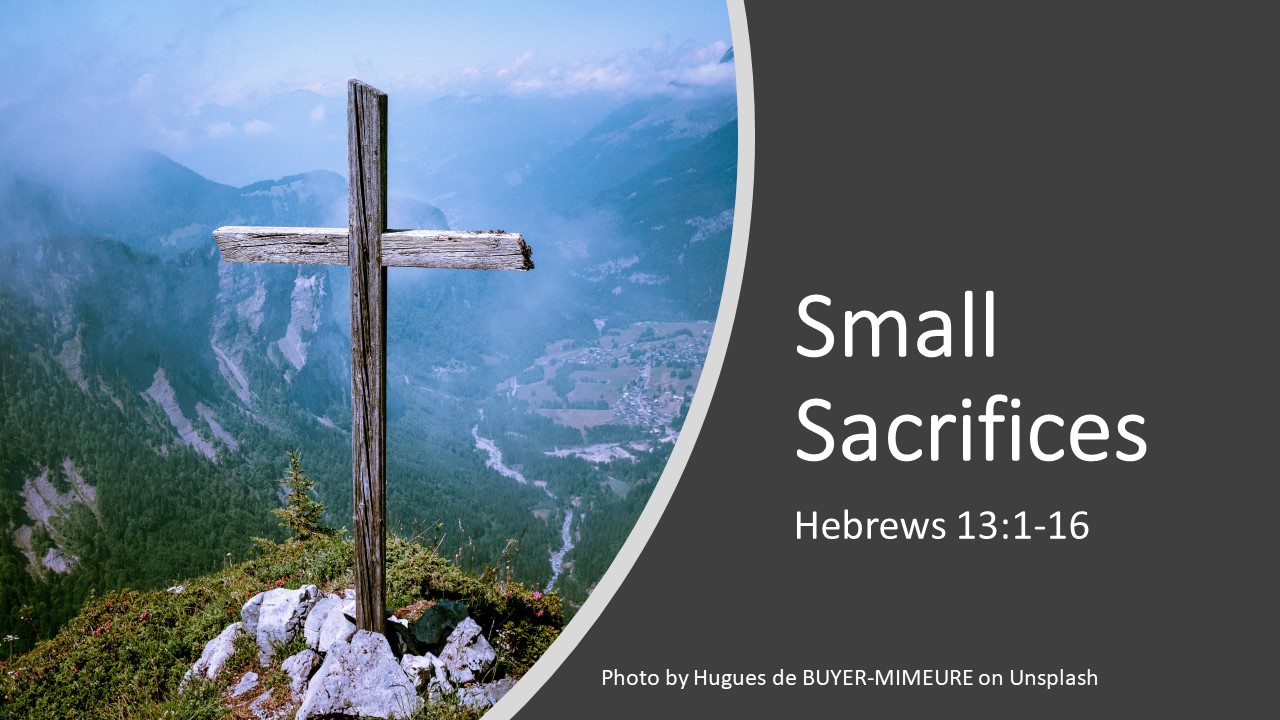
Hebrews 13:1-16 paints a picture of the ‘sacrifices’ of living a Christian life motored by Jesus’ ultimate sacrifice of love for us.
The same talk on the same day at St. Luke’s.
Does the last verse of our reading this morning get your vote for the most underwhelming verse in the entire Bible? ‘Do not forget to do good and to share with others, for with such sacrifices God is pleased.’ It sounds a bit like something you might say to a child as you pack them off on a school trip. Do good and share with others. Is that it? If that is it, we might be forgiven for thinking that here we have an ethic that lacks a certain ambition. ‘Do good and share with others’ sounds a bit weak as a message, doesn’t it? – and not as if it’s going to set the world on fire. If the world hears the church saying no more than ‘do good and share with others’, maybe the world can be forgiven for switching channels.
And how about this: “do good and share with others, for with such sacrifices God is pleased”. If that is true, then wouldn’t you say that God is easily pleased, with fairly small sacrifices on our part? I have titled this morning’s sermon ‘Small sacrifices’, even though I do think there is more to Christianity than doing good and sharing with others, just as there was more to that reading from the letter to the Hebrews than the last verse that was read.
When we look at the passage in its entirety, as I encourage you to do now, by turning back to page – in the pew bibles, when we look at the passage in its entirety, from the start of Hebrews chapter 13 onwards, we will find a set of small sacrifices that are part and parcel of the Christian life being set out one by one, before we come to one big sacrifice that makes all the small ones possible.
So let’s start by looking at these small sacrifices one by one. The first is there in verse 1 of chapter 13: Keep on loving one another as brothers. In other words, Christians ought to love other Christians. Some people might say that this sounds a bit exclusive, and not a very ambitious ethic. I did warn you, we’re talking about small sacrifices, and apart from anything else, we’ve all got to start somewhere. Keep on loving one another as brothers. But what does this even mean? Well, the addition of these words ‘as brothers’ in our English language Bibles helps us to understand what is meant by the Greek term, you might have heard it, philadelphia.
It’s easy for anyone to say that they love humanity in principle, in the abstract, in general terms. Very few would say that they did not, or did not at least think they should try to, love humankind in general. But brotherly love doesn’t work like that. In the context of family relationships, love is never in principle or abstract. Love in the context of family relationships is fierce and it is practical, or it is nothing at all. It is sustained on the basis of close and unsentimental knowledge of another person, with all their faults. Our brothers and our sisters may possibly have seen us at our best, and they are likely to have seen us at our worst. They know all sorts of things about us that we would rather not have broadcast. We trust them because they have our backs, and they love us regardless. When they do not love us like this, we rightly regard it as a kind of betrayal. Hebrews chapter 13 verse 1 tells us to love fellow believers like that, to love them despite all we have gotten to know about them by living with them in Christian community, to love them not sentimentally and in the abstract, but with determination and practicality. It’s not rocket science to do this, it’s not an earth-shattering new teaching we have here in verse 1, it’s just a small sacrifice on our part to keep on loving one another as brothers. Anything less you could say would be a kind of betrayal.
Moving on to verse 2 of chapter 13, we have the second of what will turn out to be six small sacrifices in this passage, over and above doing good and sharing with others. ‘Do not forget to entertain strangers, for by so doing some people have entertained angels without knowing it’. So here we see the exclusivity of Christians loving one another as brothers opening up to welcome potentially anyone from outside the tribe. The Old Testament uses the word ‘strangers’ to denote foreigners, immigrants, non-Jewish people living in the land of Israel without much by way of support networks or social capital. This is what the Levitical law told the Israelites about how to treat such a person: “When an alien lives with you in your land, do not mistreat him. The stranger living with you must be treated as one of your native-born. Love him as yourself , for you were strangers in Egypt.” (Leviticus 19:33-34).
Perhaps here in the letter to the Hebrews, the Jewish Christian community to whom the author is writing takes the place of the nation of Israel in forming the circle of insiders, but the biblical imperative to love the outsider is essentially unchanged. When we put verse 2 together with verse 1, we can see that Christians have to give up any idea of relating to each other within a cosy inner circle. The Christian community must always remain open to outsiders. Those without social capital and support networks must be able to find community within the church. We must welcome newcomers as warmly as we do old-timers.
It may be that doing this goes against the grain, and requires a conscious effort, for many of us. But it’s not too much to ask of non-Jewish Christians like us, who were once ourselves strangers to the covenants of promise, without hope and without God in the world. It’s really a small sacrifice on our part. The door was held open for us, and if we have any communion with Christ, we must hold it open for others. When we do, we will find that the sacrifice was worth it. When in the book of Genesis, Abraham extended hospitality to passing strangers in the desert, it turned out that, unknown to him, he had angels for guests. When we extend a genuine welcome to outsiders, we too will be rewarded for this small sacrifice in all manner of unexpected ways. The inner circles of which we are a part will lose their inward focus and be opened up and transformed. We too may encounter God at the margins of our community.
The third small sacrifice may be found in verse 3 of Hebrews chapter 13. “Remember those in prison as if you were their fellow prisoners, and those who are mistreated as if you yourselves were suffering.” We can start to see a progression here: love one another in Christian community in verse 1; love those on the margins of, or actually outside, Christian community in verse 2; and now love those who are suffering in prison, who are not just social outsiders but actually outcasts.
“Remember” them, we are told in verse 3, which means acting according to their needs, rather than simply recalling their situation. Conditions in the prisons of the first century were appalling. Prisoners were supplied with food, clothing and emotional support only by visiting friends and family. If friends and family did not visit, not only would prisoners be lonely, they would also starve or freeze to death. The love for outcasts that is called for here is not theoretical. If “a brother or a sister is without clothes and daily food”, “what good is it”, asks the apostle James in his letter, if someone says to him or her, “Go, I wish you well; keep warm and well fed”? In the face of avoidable human suffering, it’s not much to ask, it’s really only a small sacrifice on our part, to remember those who have been left behind and forgotten by society, to offer more than words, and to actually do something practical to relieve their suffering.
The fourth small sacrifice in this passage is found in verse 4. “Marriage should be honoured by all, and the marriage bed kept pure, for God will judge the adulterer and the sexually immoral.” Love each other, love the stranger, love the prisoner and outcast, and now love your spouse. Is it really such a big ask of those who are married, to love their spouses? Is it such a big ask for them to remain true to their vows, to forsake all others, and to keep themselves only unto each other, for as long as they both shall live? Everyone will have noticed the a-word that features here in verse 4, which is not much talked about in polite society, even though it drives the plots of many written and broadcast dramas, as do many of the other things forbidden by the Ten Commandments. It is worth remembering that the opposite of adultery is faithfulness, the courage to carry through on a commitment. This will involve the sacrifice of other paths not taken in life, but it’s a small price to pay, don’t you think, for keeping open the path we have taken, for remaining true to our word and for protecting ourselves and our families from unnecessary harm? Marital faithfulness may sound boring, and it may not be the stuff of TV drama, but it is a demonstration of love in action, just as much as is brotherly love, love of outsiders and love of outcasts.
The fifth small sacrifice does not concern what to love as much as it concerns what not to love, and it’s there in verse 5 of the chapter. “Keep your lives free from the love of money, and be content with what you have, because God has said, ‘Never will I leave you, never will I forsake you’.” All of us need some money to get by and live on, but we are warned here to be careful not to love money. Anyone who loves money is a vulnerable position, because we can be sure of this: money does not love us. It is a false mistress; it is fickle, not faithful. It can be gained and it can be lost, and if it hasn’t already deserted us before we die, it will do so completely at that time.
In addition to this, money is a rival to God in the promises it holds out of safety, security, enjoyment and hope for the future. For depictions of the happy life enjoyed by people if only they will spend their money, we only have to look at advertisements on TV, and think about its messaging. But if we turn our attention to the news, and think about the messages it carries, we will learn that money can’t buy us happiness, and that the love of money is the root of all sorts of evil. So choose this day whom you will serve. “No-one can serve two masters”, warns the Lord Jesus Christ in the Sermon on the Mount. “Either he will hate the one and love the other, or he will be devoted to the one and despise the other. You cannot serve both God and money.” Safety, security, enjoyment and hope for the future are promises that money is in no position to make, so it is in truth a small sacrifice to stay away from, or give up, the love of money. We may make responsible and generous use of whatever money we have, while at the same time despising its false promises, and instead being devoted to and trusting God for our safety, security and future.
It’s a small sacrifice, because he has said, ‘Never will I leave you, never will I forsake you’, and consequently we may say ‘The Lord is my helper; I will not be afraid. What can man do to me?’ In the words of Jim Elliot, the famous twentieth-century missionary, ‘He is no fool who gives what he cannot keep to gain what he cannot lose’.
However, I’ve got to be honest and say, the more I think about what is involved in loving one another, loving outsiders and outcasts, and retaining the love of spouses but avoiding the love of money, the more I wonder whether it’s accurate to say that the sacrifices involved are as small as I have been making out. If all of those imperatives are part and parcel of “doing good and sharing with others”, as we can now see that the letter to the Hebrews appears to say, perhaps this ethic of “doing good and sharing with others” is more demanding than it seemed to be at first. Perhaps it now seems so ambitious as to be actually quite difficult if not impossible to attain.
Yet the author of the letter believes that these sacrifices are achievable, on the strength of two considerations, both of which are set out in verses 7 and 8: the example of life set by the Christian leaders known to his readers, and their teaching of the word of God. “Remember your leaders, who spoke the word of God to you. Consider the outcome of their way of life and imitate their faith. Jesus Christ is the same yesterday and today and forever.” The power of the example of leaders who are known to us is of some value to inspire us, provided they are good examples, of course, to make the sacrifices we have been thinking about. But there is a far greater power in this respect in the word of God that has been taught to us, and by the word of God the author of Hebrews principally means the gospel of Jesus Christ. Verse 12 reminds us what is at the heart of that message: “Jesus suffered outside the city gate to make the people holy through his own blood”.
This is the reason I have been describing the efforts we make to live the Christian life as “small sacrifices”. They are small when compared to the sacrificial death of Jesus on the cross, which I described earlier as the one big sacrifice that makes all the small ones possible. The small sacrifices of the Christian life are not made possible merely by the power of example – as if the life and death of Jesus were sufficient to inspire our own efforts to live a good and self-sacrificial life. That way of thinking does not do justice to the words of verse 12: “Jesus suffered outside the city gate to make the people holy through his own blood”.
His is not an exemplary but an enabling power, a power that makes stuff happen, that brings about what it sets out to accomplish: the forgiveness of sins, and the renewal of life. On the cross, the Prayer Book reminds us, Jesus made a “full, perfect and sufficient sacrifice, oblation and satisfaction, for the sins of the whole world”. In the light of that big sacrifice, we are told in Hebrews chapter 13, “let us go to him, outside the camp, bearing the disgrace he bore”. His cross and resurrection are the motor of our Christian lives, and they enable whatever small sacrifices we are able to make in his service, and in the light of his love. If in any respect or to any degree we may be considered holy, it is because he has made us holy through his own blood.
At the end of our lives, we won’t be crowing about our own modest achievements: we will simply say that we are unworthy servants, and we have only done that which it was our duty to do. But there is one thing we will be crowing about, this we can start doing now, and that is this: “Jesus suffered outside the city gate to make the people holy through his own blood”.
This brings us nicely on to the last of the six small sacrifices I said earlier I was going to talk about – I have talked about five up to now, which are in verses 1 to 5 of Hebrews chapter 13, and now I will talk about the sixth, which is in verse 15. “Through Jesus, let us continually offer to God a sacrifice of praise – the fruit of lips that confess his name.” Confess the name of Jesus in singing – yes. Confess the name of Jesus in prayer – yes. Confess the name of Jesus in the creed – yes. Confess his name to one another here in church – yes. Confess his name also in the home and among family and friends, and to strangers and outcasts as well. Confess the name of Jesus in conversation.
In offering to God this sacrifice of praise, it may be that we will have bear just the tiniest postage-stamp sized corner of the kind of disgrace that he bore. If so, it’s a small sacrifice by comparison, don’t you think? “Offer to God a sacrifice of praise … and do not forget to do good and share with others”. And here’s the really amazing part, when you think about it: with such small sacrifices, God – who gave his only Son Jesus Christ to suffer death on the cross for our redemption – with such small sacrifices, as we are able to offer……God is pleased.
There are many things in life that are uncertain, but the writer of Hebrews wants their listeners to know with certainty how ‘the mountain of joy’ is unshaken.
I’m not sure what you made of this Hebrews passage. There is a lot in these verses and on first read this passage can appear confusing.
What is the writer getting at and what does that mean for us? If we look at it closely and remember the history of the Hebrew people then it becomes easier to understand.
This passage can be looked at in two sections.
In the first section v18 – 24 the writer compares two mountains and although the first isn’t named, because of what is said in those verses we can see that in this passage there is a comparison between Mount Sinai a historical place in the ot where Moses was given the Ten Commandments and the Mount Zion – which is often the name used to describe the location of Gods presence for eternity, heaven as we often call it.
Then in the second section v25-29 there are comparisons between the earthly and heavenly location of divine warning (12:25), between the shaking of things on earth and the shaking of things in heaven (12:26), and between that which is shakeable and that which is unshakeable (12:27–28).
Comparisons are a tool used in the bible to try and get serious points across. When we were studying the book of proverbs we saw there the use of comparisons between the fool and the wise person for example. And so we know that the writer has carefully crafted these comparisons to communicate something really important to their hearers.
After Jesus’ death, his rising from the dead and going back into heaven Many of Jesus’ followers had expected Jesus to return soon, definitely in their lifetimes.
When he was with them He’d told them about his death and rising and that he would return On a final day of judgement and they would enjoy eternal life in Gods heavenly kingdom forever. Yet more and more of Jesus’ friends, those who had walked the earth with him, were dying.
Jesus had not yet returned, and the writer of Hebrews wants to encourage them to keep going. Even in persecution and the day to day circumstances, he wants them to keep their eyes fixed on The prize of eternal life. As we saw earlier on in the letter, the Hebrews writer was telling his readers to persevere, to keep running the race – to keep trusting in the death and resurrection of Jesus who brings eternal life. He wants them to reach the prize – eternity with God, made possible because of Jesus’ death and resurrection.
Today’s passage gives a sense that maybe the people this letter was written to are struggling with the intangibility of eternal life and are getting discouraged. And this passage is looking to address that. To renew their confidence in their faith and the future hope.
What does intangible mean? If something is intangible it means it can’t yet be touched or experienced. It’s far off beyond our reach. Maybe seems beyond understanding. Whereas if something is tangible we’ve held it, experienced it right now. It meets the needs of the present moment and can be understood.
I saw a post on facebook yesterday that said it’s 127 days until Christmas – I don’t know if that excites you or fills you with dread. For me Christmas is way too far off to think about yet. The thing is with Christmas We know it’s coming but 127 days seems so far off – you could say it’s intangible. It doesn’t feel quite real. A lot is happening in the here and now. And we can’t think that far ahead. And yet sometimes looking ahead is essential otherwise we get to Christ,as day, no cards have been sent, food has been bought or presents given.
Just before the passage we read this morning the writer uses the example of Esau in the Old testament to introduce the section we’re looking at.- Esau and Jacob were Isaac’s sons. Esau as the oldest son had that birthright of being the oldest son, but his brother was sneaky. One day Jacob had made a stew, it was a good stew and Esau was hungry, he wanted some. He asked Jacob for some stew, but Jacob said I’ll give you some stew in exchange for your birthright. Not a fair exchange. But Esau wanted that stew. He traded something intangible—his birthright—something way off in the future that meant nothing to him in the here and now – for something tangible—a single meal. He couldn’t see past his present hunger to appreciate the true gift of his intangible birthright.
In using this story It seems that Eternal life for the hearers of the letter to the Hebrews might have seemed like it could be far off, or difficult to understand and comprehend, they were caught up maybe in the circumstances they were in. But the writer wants them to be confident in their faith in Jesus, to know the promise of eternal life, that it is true and is coming. And is worth looking ahead to and being prepared.
This will become clearer as we look more at the passage and remind ourselves of some of the history of the Hebrew people and then we can look at what that means for us today
In v18-25 we have a comparison between the mountain of fear and the mountain of joy.
To describe the first mountain the writer uses words that conjure the senses – fire, darkness, storms, trumpet sounds – imagine a cacophony of noise and visual stimulation –
It takes the hearers back to the Old Testament when God met with Moses at Mount Sinai to give him the ten commandments and his presence engulfed the mountain with thunder and lightning, smoke and the sound like a trumpet
This was too much for the people of Israel and they were filled with fear and begged not to hear God’s voice as they found his presence overwhelming (Ex 20:18)
They were also fearful of his anger. In the Old testament we read that God had chosen the Hebrew people to be his special people and that all that had to do to enjoy God’s presence was to be obedient and faithful to God. At yet we read that when Moses was receiving the ten commandments up mount sinai the Israelites got impatient waiting for Moses to return and so got Aaron his brother to make a golden calf for them to worship.
God got angry with their disobedience. He had chosen to reveal his presence to and instantly they turn their backs – In Deuteronomy 9:19 – Moses tells the Israelites that when they did this He feared the anger and wrath of the Lord, for God was angry enough with them to destroy them. Which is why the Hebrew writer quotes Moses in this section saying that Moses- “trembled with fear.” v 21
The first mountain is fear, its a mountain of disobedience or rejecting God’s presence and yet the writer is saying that his hearers need to remember they are not of this mountain of fear but they are of the second mountain.
They are to not fear God’s judgement because they are of the second mountain
What is the second mountain? This is the mountain they belong to – mount zion, the city of the living God, the heavenly Jerusalem, And in that place they join innumerable angels worshipping God, As well as all of humanity who are enrolled in heaven, through belief and trust in Jesus’s sacrifice and offer of forgivness.
And Whilst acknowledging God is the judge of all, and that there will be a final day of judgement when Jesus comes again, the writer reminds his hearers that Jesus, is the mediator of that judgement. In bringing in the new covenant, his sacrifice was perfect, his blood shed perfected any previous sacrifices. When Cain killed his brother Abel in the Old Testament the act is to be condemned but Jesus blood does not bring condmenation but salvation.
And so, there is confidence for the hearers of this that on the day of judgment his hearers will join the angels and those already departed to worship God for eternity. Because of JEsus’ perfect sacrifice. There is joyful fellowship on the second mountain. And It is interesting that although the writing is about eternal life the tense used is the present – ‘you have come to mount zion’. Not that you will come, or that on that final day of judgement you will come but that you have come. It may seem like a far off thing but actually the writer is saying eternal life is not so intangible- it starts when you’ve trusted in Jesus sacrifice and. Forgiveness.
But why did the writer want to make this comparison between the mountain of fear and the mountain of joy?
We might get the answer from the second section of our reading. Which has a few more confusing comparisons. But After the comparison between the mountain of fear and the mountain of joy, he writes……. See to it that you do not refuse him who speaks.
Remember we’ve said that at Mount Sinai the fear had stopped the Hebrews from listening to God’s voice – they didn’t want to hear it and so in this section the writer is warning his current hearers to guard against this attitude and to not stop listening to God.
He doesnt want them To fall into the trap of the Hebrews at Mount Sinaii and let fear and distractions pull them away from following Jesus’ way, from listening to his voice, his guidance, his way. He wants them to keep their eye on the prize.
These verses 25-27 – that talk about warnings from earth and warnings from heaven – show that there is accountability for the way the hearers are living their earthly life, in how they run the race of faith –
Those earlier believers have to continue in their faith and can do so with confidence in JEsus’ perfect sacrifice and so need to listen to him.
And because of that they can be confident that when heaven and earth shake – an image of judgement, using imagery from the prophet Haggai indicating God’s final judgement (2:6) their relationship with God through Jesus will remain – they will remain in his presence.
One commentator said that this section in Hebrews shows that Jesus kingdom gives stability that his sacrifice is firm foundation to build faith and it cannot be shaken. Jesus is Unshakable, unchangeable
And so because of that the Hebrews writer says the only response is worship. He says these words,
Therefore, since we are receiving a kingdom that cannot be shaken, let us be thankful, and so worship God acceptably with reverence and awe,for our “God is a consuming fire.
Meaning – God is awesome in the true sense of the word – he is powerful and mighty and worthy of our praise, of our lives.
So we have seen that in this passage the writer is trying to help his readers grasp the truth that following Jesus assures them of eternal life, a kingdom that can never be shaken and results in joy and worship. And so they are to continue to obey Jesus having accepted him as the author and perfector of their faith. The writer doesn’t want them to think of eternal life as a intangible far off thing or to give in to any current circumstance that might keep them from Jesus promises but keep the eye on the prize – eternal life, living confidently in Jesus kingdom in the here and now and forever .
And The message is the same for us today. Just like Christmas is coming We can be confident that in the final judgement we can stand firm through Jesus’ sacrifice. But we are accountable.
We can know that Jesus is the author and perfector of our faith – and that through his death and resurrection he has paid the debt for our sins, once and for all, offering forgiveness and eternal life.
That he has paid the price for the judgement deserved. we can be confident of Gods eternal kingdom -and that we are not not stop listening to his voice, not rejecting Jesus ways.
What does that mean for us?
That might mean asking Jesus into your life for the first time. If that’s you, do let someone know.
It might mean acknowledging areas of our lives where we are not listening to Gods voice
It might mean shifting our perspectives from seeing life the way the world sees it and seeing it through Jesus’ eyes
Gods kingdom is unshakeable – we can be confident of who Jesus is and so let’s live lives of confidence and worship in gratitude for all God has done through Jesus. Amen