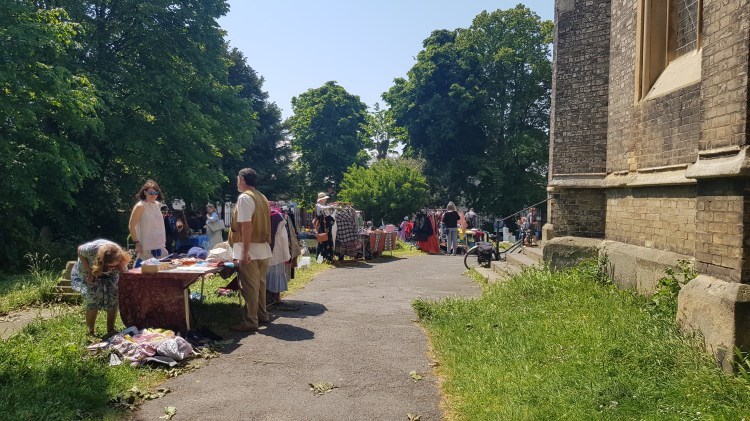
This Saturday from 11am to 3pm sees another Yard Sale take place in the grounds of St. George’s Church. There will be a variety of different stalls hired by members of the local community in the yard, activities in the hall, and the church will be open for tower and crypt tours.
Scroll down to see pictures from last months event.
Our youth provision at St. Luke’s Church hall has now finished until September.
But this Sunday (9th July) we are invited along to the Sailor’s church for refreshments at 5pm and the service beginning at 6pm
We join together for worship as we celebrate Sea Sunday and gather in this beautiful place of worship on the harbour. Worshipping God together – all ages and all denominations – anyone is welcome.
“The Lord will guide you always; he will satisfy your needs in a sun-scorched land and will strengthen your frame. You will be like a well-watered garden, like a spring whose waters never fail.”
Interpreting Bible stories can be challenging. The author simply tells the story and doesn’t tell you what its relevance might be for future generations. The crossing of the Red Sea was an unforgettable event for those who were there, but what might it be saying to us?
The Bible has played a huge part in the evolution of our culture and language. Back in the 1950s, when the New English Bible translation was being put together, one of the editors wanted to give a more contemporary feel to the story of the prodigal son, and in particular the meal to celebrate the son’s homecoming. So he asked a firm of butchers how they would describe such a momentous feast. Oh, that’s easy, they said, we call it killing the fatted calf! Isn’t it funny how we have so many Biblical expressions embedded in our vocabulary: at the eleventh hour, from Jesus’ story of the labourers in the vineyard Jesus’ own words … casting your pearls before swine eat, drink and be merry can be found in Ecclesiastes, Luke & Corinthians a leopard cannot change his spots, said the prophet Jeremiah Isaiah used the phrase like a lamb to the slaughter And Belshazzar’s feast in Daniel 5 introduced the writing’s on the wall
But our society also has deeply embedded Biblical narratives and values that we jettison at our peril. The story of the Exodus and the crossing of the Red Sea is just one of those … • Non-conformist English Christians who fled persecution and discrimination and settled in America for a better life used it of their experience – Benjamin Franklin initially recommended that the Great Seal of the USA carry a depiction of Moses leading the Israelites across the Red Sea. • African Americans who had suffered years of slavery and oppression interpreted their aspirations in the language of the Exodus. For example, on the night of his assassination, Martin Luther King pictured himself with Moses on Mount Nebo looking down on the Promised Land … I may not get there with you, he said, but I want you to know that I’ve seen the promised land. • And then there’s the 20th Century South American Liberation Theology movement, unfamiliar to many of us European Protestants, but where exploited people consciously identified with the oppression of God’s people in Egypt.
The specific story of the Red Sea crossing is very familiar. Those of us who are a bit older will remember Cecil B de Mille’s film The Ten Commandments, with Charlton Heston in the starring role. Others may only be familiar with Disney’s The Prince of Egypt. That moment in both films of Moses holding out his staff and the waters dividing isn’t quite what it says in Exodus 14:21. In the actual text you have a strong wind that blows all night, pushing the flow of the water back and yet somehow reconfiguring it so that there is a wall of water on both sides when they cross. It’s quite hard to picture exactly how that happened with the wind in only one direction, but whatever the fine detail, that moment of crossing marked a change of identity for the Israelites – on the one hand they were leaving slavery in Egypt behind them, and on the other they were about to become God’s covenant people, His light to the nations.
To put it another way, the Red Sea pointed backwards to what the people had been saved from and forwards to what they had been saved for. And when the people of God, whether Jews or Christians, use the word “salvation”, we must all think in terms of both those things … what we’re saved from and what we’re saved for. Many of us grew up thinking that salvation is just about praying the sinner’s prayer so that we don’t go to hell – salvation through fear as you might say. It never occurred to me that I had been saved for something!
In 1 Corinthians 10:1-4, the NT makes a very clear link between, on the one hand, that historic Old Testament story of deliverance and, on the other, Christian salvation which is symbolised in baptism: For I do not want you to be ignorant of the fact, brothers and sisters, that our ancestors were all under the cloud and that they all passed through the sea. They were all baptised into Moses in the cloud and the sea. Now, of course, they weren’t exactly baptised in the Red Sea because they didn’t get wet, so you have to be careful how you handle metaphors, but you can see the parallel – that moment of crossing over from one reality to another. In Baptist churches, where I ministered for many years, we immerse people, so that the water not only symbolises being washed clean, but also the rather startling concept of drowning – we die to the old life and embrace a new one with Christ.
1 Corinthians 10 is an interesting chapter because Paul points out that, although God’s people witnessed the plagues and then this extraordinary miracle where the sea turned to dry land, they still fell back into disobedience. Moses held up the tablets with the 10 commandments and asked the people Will you promise to follow God’s ways, and the people said Yes, but then they didn’t. They were sexually immoral, they grumbled, they were untrusting and they tested God’s patience repeatedly. The golden calf is the best known story from that period, but there were plenty of others. And, as a result, only two of that generation that crossed the Red Sea got to enter the Promised Land – Caleb and Joshua. The rest died in the wilderness because of their disobedience. There’s a saying that it was easier to get the Israelites out of Egypt than it was to get Egypt out of the Israelites!! And we who profess to be Christians, we also experience that struggle within us between the old and the new. For years I misunderstood communion – I thought it was a Passover meal, just looking back to what we have been saved from, but Jesus took a cup and quoted Moses’ words from the foot of Mount Sinai, weeks after they had crossed the Red Sea – This is the blood of the covenant. That communion meal looks back and it looks forward to what we have been saved for!
It’s interesting. People sometimes say: If I were to be given a miracle I would believe. Well, the Israelites witnessed all those extraordinary miracles. God’s intervention on their behalf was both dramatic and undeniable, whether it was the plagues in Egypt, or the cloud by day and the pillar of fire by night, or the Red Sea, or the manna and the quails, or the water from the rock – and yet they still rebelled. They showed little resolve when it came to that other part of salvation – what they were saved for. And in 1 Corinthians 10 Paul warns the believers in the city of Corinth to resist the lure of idolatry, because temptation is no less real for us New Testament believers and no less hard to resist. We are called to live distinctive and pure lives, and despite experiencing God’s intervention, we are all prone to slip back. Those who read the Christian Press will know that some very high profile leaders have been forced to resign in recent times. We’re all vulnerable and we need to take care how we live.
We often pray a version of the General Confession in church. It’s a prayer seeking both forgiveness for the sins of the past and power to live faithfully in the future. The prayer encourages us to examine ourselves. Those innermost thoughts that are best kept secret, the way we sometimes speak carelessly or even maliciously, not to mention our tendency to live indulgently rather than sacrificially: Almighty God, our heavenly Father, we have sinned against You and against our neighbours in thought and word and deed, through negligence, through weakness, through our own deliberate fault. We are truly sorry and repent of all our sins. For the sake of Your Son, Jesus Christ, who died for us, forgive us all that is past and grant that we may serve You in newness of life to the glory of Your name.
Now in particular, Paul talks about meat that has been offered to idols (1 Corinthians 10:23-33). On the one hand, the idols are not real and the meat is no different after it has been sacrificed, but if by eating it you give someone the impression that sacrificing to idols is okay, then, says Paul, don’t eat it. Think through the optics, how other people see the way you live, and show some self-restraint.
We’ve had a lot of talk about optics recently, what Christians used to call ‘avoiding all appearance of evil’. Whatever the truth around Boris Johnson and Partygate, the optics always looked dodgy. The CEO of Thames Water has just resigned. Apparently, she was aware of the optics, so she turned down this year’s bonus of half-a-million, although she did so at the end of a year in which the company has been routinely dumping sewage in its rivers, and she, at the same time, had been accumulating £1.5million in earnings!
Anyway, if you want to summarise all this in a word it’s holiness! In the words of J.B. Phillips, not letting the world around you squeeze you into its own mould. Now that’s not a particularly appealing idea these days. We prefer to pursue happiness. We would rather be happy than holy. But here’s the thing. Jesus’ death saves us from judgment, but it also saves us for holiness. Hence that verse that we began with, about being created in Christ for good works. You are God’s advert to the world of how He wants the human race to live, so live carefully and live faithfully.
When I was growing up back in 1960s and 70s, there was huge interest in the Second Coming of Christ. Apparently, that interest was just as big in the 1800s! People talked endlessly about the rapture and the tribulation and the Anti-Christ and Armageddon. Some Christians writers began to produce Biblical ‘horoscopes’, reading the signs of the times, and encouraging Jews around the world to return to their homeland and rebuild the temple so that all the conditions for Jesus’ return could be fulfilled. The American Tim LaHaye wrote a thriller called Left Behind which sold 70million copies and spawned a film with Nicholas Cage 10 years ago. Once you dip into it, it gets very complicated, but apparently you can’t stop these events happening anyway, so the big question is: In the light of all this, how should I live my life?
One Christian from a few generations back, a man called Harold St. John, bypassed all the speculation and simply remembered what he had been saved for. And so each morning he would pull the bedroom curtains and say: It could be today. And each evening he would draw the curtains with the words: It could be tonight. And in the intervening hours he simply sought to live like Jesus.
The first bishop of Liverpool, J. C. Ryle, used to regularly ordain new priests within the Church of England. On the evening before their commissioning, he would go through the running order and seating arrangements with the ordinands, but then on each occasion he would say this: Tomorrow you will be invited to make vows as you embark on your ministries, and I will repeatedly ask you this question: Will you? But there will come a day at the close of your ministries and your lives, when you will stand before Jesus and He will ask you this question: Did you?
So may we all remember the purpose for which we have been saved, and may we pursue faithful and holy lives, and may our endeavours always be in grateful response to the One who sacrificed everything for us.
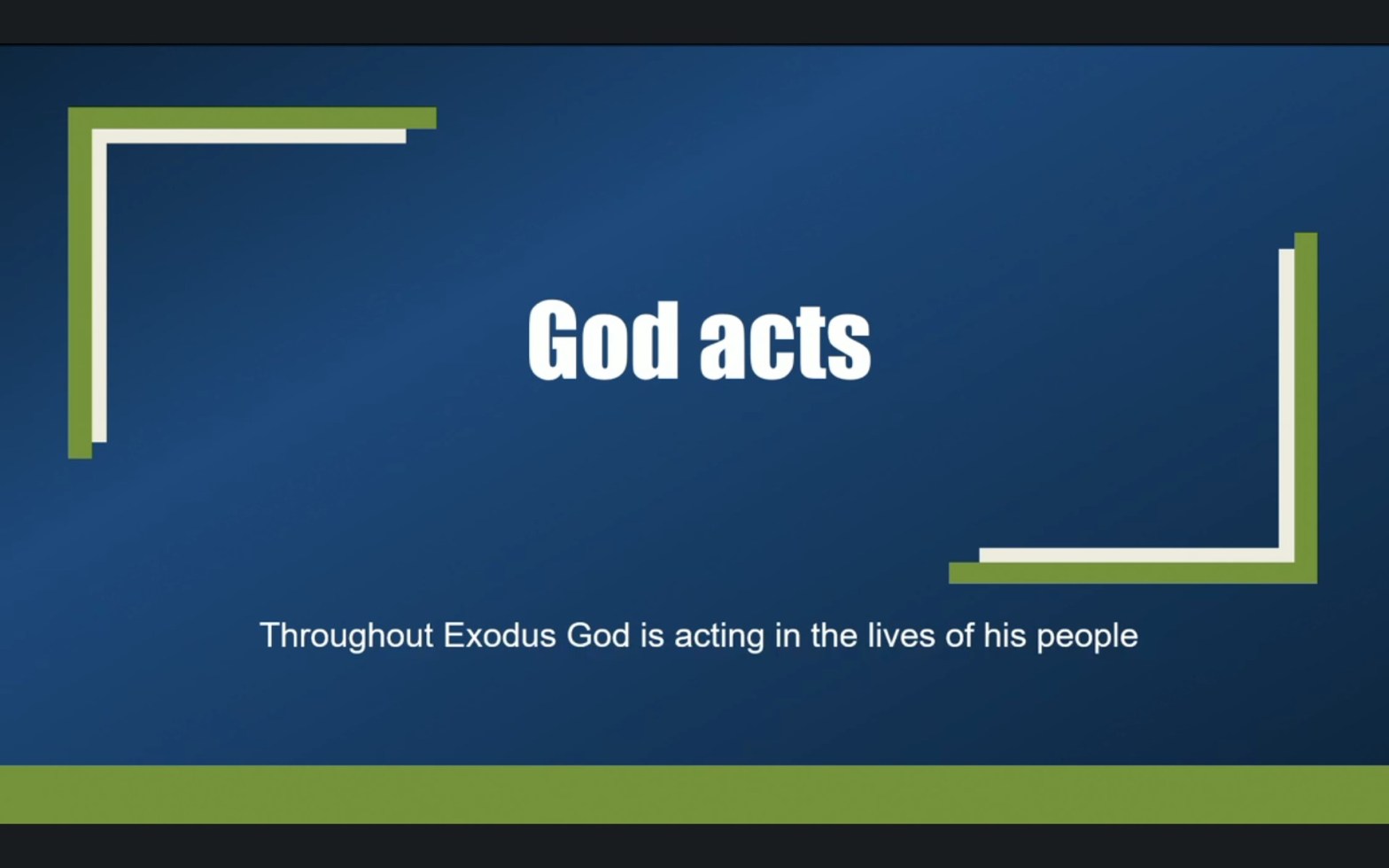
Today’s talk explores how God acted in the lives of his people the Israelites, hearing their cry and bringing them out of slavery to freedom. And helps us to explore how God is still active in our lives even today.
We’ve been looking at the story of Moses and how God has been using Moses to act in the lives of his people. I thought it would be good to recap The Story So Far as we’ve been going quickly through
Last week we were at plague one and this week we’re at plague ten
Before we dig in let’s pray…..
As I said God is active throughout the whole story of Moses . I wonder if like me sometimes when you read a bible passage or hear a passage of scripture read thoughts and questions come to mind….
Thoughts like what?!?! Questions like why is that included here?
In our passage today from Exodus I wonder what questions we had when we heard this? We’re not Egyptians or Israelites living back then so What does this passage say to us?
In Exodus, we discover that the Israelites are living in Egypt, and are in slavery disliked by the Egyptian pharaoh and were in slavery, crying out to God for 450 years God acted at the perfect time in order to rescue his people. And we get this encounter between Moses and God, when God appears to Moses and the burning bush.
Moses is given a message by God. God tells Moses to go to pharaoh, and give a really simple message – let my people go. It’s not a difficult command. It’s quite understandable. Let my people go and yet pharaoh didn’t. So we then get this account of pharaoh hardening his heart, and not listening to God. Colin touched on this last week when we looked at the first page of blood. This plague was God’s response to the rebellion of pharaohs heart. he didn’t listen to God, didn’t realise that God was the king of the whole world bigger than pharaoh himself. We get all these plagues, which is a sign of gods judgement and part of his plan to bring his people out of slavery to freedom.
These plagues began with the plague of blood followed by plagues of frogs gnats, flies, livestock, boils, hail, locusts and darkness. And still Pharoah would not let Gods people go.
He’s plagues, devastated the land of Egypt causing pain, suffering, loss of livestock loss of land and crops.
We get to this point in the story, the passage read today where got ACTS He predicts, telling Moses to go to Pharoah and say that they’ll be one final plague. In a passage today, it helps us to think of God acting in specific ways is very to completely drive out God’s people from Egypt.
In v1 God says to Moses, this will be the time as a result of this last plague that pharaoh will let you go. And not even just an okay he’ll give in and let you all go in a gentle way but it says pharaoh will drive you out completely. A final and complete separation. Full of animosity. Which is echoed in v 8 where God tells Moses Pharoah’s officials will bow down before him, humbling themselves to him and begging them to leave.
Secondly God acts in this story and Gives favour to his people – they have possessions to take with them. Imagery associated with a bride being sent off from her family home to begin a new life. The bible is full of language about Church being God’s bride. Israelites were being given stuff so that they could begin fresh in the new land. Be prosperous.
Thirdly we see how Gid acts and pla Brings judgement – there will tragedy. There will be blood and mourning and grief at the loss of every first born through the whole of the Egyptian society and there will be a contrast between the Egyptian camp and that of the Israelites as one commentator put it – ‘Against such a tragic backdrop, the Israelites will remain unharmed and undisturbed. Not even the empty snarl of a dog will interrupt the quiet of the Israelite settlement, while among the Egyptians the air will be torn by the piercing cries of lament.’
The quiet of the Israelite camp indicates the God makes of waiting for redemption for his people.
Call performs all these acts, and wonders to make himself known to show that he is the king of the universe.
What does that mean for us? that is a story that happened long ago? We see God acting to cause pharaoh to completely drive his people out of Egypt. We see him giving favouritism to his people, bring judgement and make himself known.
What happens next? God says that the Israelites will be saved. when the Egyptians are grieving, the Israelites camp will have no sound in not even a dog snarl will be heard. The reason for this is because they’re told to take some lambs and put the blood of the lambs around the door posts. They were to gather and enjoy the roast lamb and at midnight, the angel of death would pass over Egypt but will not come to the houses that are marked with the blood of the lambs.
This happened, the angel of death came, and all the Egyptian firstborns from pharaohs Palace to the servant maid, to the livestock and animals died. Utter tragedy happens.
And pharaoh, orders the Israelites to go.
In the book of Exodus God’s actions made a difference to the lives of the Israelites. Before they were in slavery, they were beaten, they were oppressed. Their children were killed, and then God brought them out of that he had to cry he brought them through to the other side. God made a difference in their lives.
But what about us? What difference does God mean to our lives? How was he at work to help us?
We are going to use a bit of an illustration. who has heard of gravity?
Do we believe that gravity is working right now? Do we understand how gravity works?
Gravity pulls all objects “downward” toward the centre of the planet.
So if I pour out this water we expect it to flow out completely from the bottle. We might not realise it’s gravity at work but it is.
Taking a step, standing here, when we sat up and got out of bed this morning, buttered our toast, poured out the cereal and milk, gravity as at work
Issac Newton described gravity as a mysterious action at a distance.
We don’t always think about gravity being at work but when gravity is eliminated we notice what it does.
In the story the Israelites put the blood on the door in the case of us we can know God’s redeeming love through the action of Jesus’ death on the cross.
When I tip up this water we expect it to gush out we sit up and pay notice.
Just like gravity God is at work in the world and often we might not be aware or see him at work. Sometimes extraordinary circumstances get us to see God at work because something happens differently to what we expect. We finally understand what Jesus has done for us. When we stop and look at our lives my bet is that we can see God at work.
In our lives, we are sometimes faced with all sorts of difficulties and different circumstances, but we can trust that God is with us, he’s still at work in these difficult times. This is the same God, who worked in the lives of his people who were in slavery in Egypt.
Where can we see God making a difference in our lives where has he made a difference where is he making a difference and where would we like to see him make a difference.
The Israelites cried out to God for help, they cried out in anguish, and he acted.
we can cry out to God
In our lives, we have allsorts of things going on. God knows. God longs for us to draw near to him – he does make a difference.
On Friday 14th July at 6:30pm, St. Luke’s and St. George’s are hosting a film night in St. Luke’s Church Hall. Suitable for all ages – a great event for the whole church family.
Due to copyright, we cannot advertise the name but it is a new up-to-date version of a classic story that has ‘hooked’ generations.
Tickets can be purchased from the social committee. It is £2.50 per ticket which includes a hotdog, drink and popcorn.
Invite friends and family, buy your tickets and come and fly away with us and remain childlike as we watch together.
Maggie who works for Active Christianity in Thanet Schools (ACTS) is running 2 Staff Reflection Spaces as part of their Inset Training days in school. One is in July and the other in September.
They really want to bless the staff on these occassions. It is a great opportunity to show school staff that they are valued, loved and appreciated by church communities and loved by God too!
Can you help ACTS bless the staff by contributing in some way?
They are looking for donations of the following:
Post it notes
Sealed Tea bags (Fruit & ordinary)
Coffee sachets
small candles
Nice pencils
Nice biro pens
Highlighter pens
Small anti bac gel
Lip balms
Individually wrapped biscuits, chocolates or sweets
Either bring into the church and make Claire or one of the churchwardens aware of your donation, or contact Maggie direct on the email in the above picture.