A musical celebration of Love at St George’s Church Ramsgate. Online ticket sales close tonight (Thursday 8th February), tickets can be purchased on the door for £10. We have already sold over 100 tickets, but we can welcome more! Friday 9th February – 7.30 til 9.30pm – Doors and Bar from 7.00pm
Tickets are £8 in advance and £10 on the door. Tickets can be purchased at https://bit.ly/3S546IB With Valentine’s Day around the corner, treat someone you love to an evening of popular vocal music in the beautiful surroundings of St George’s Church Ramsgate. To celebrate the love for our community Coastal Choir will be putting on a concert featuring pop, rock, folk and musical theatre, all on the theme of Love. With support from the BradUKES ukelele ensemble this should be an evening to warm our hearts.
There will be a pay bar, with doors opening from 7.00pm. All proceeds from the event will go towards funding the St George’s Community Meal in 2024. The Community Meal is a weekly event run by a group of volunteers, supported by St George’s Church and held in the Church Hall on a Tuesday evening. We’ve been generously supported by James Brown AV on lighting the interior of the church, and the bar is being provided by The Offy from Whitstable.
“God is spirit, and his worshippers must worship in spirit and in truth.” (John 4:24)
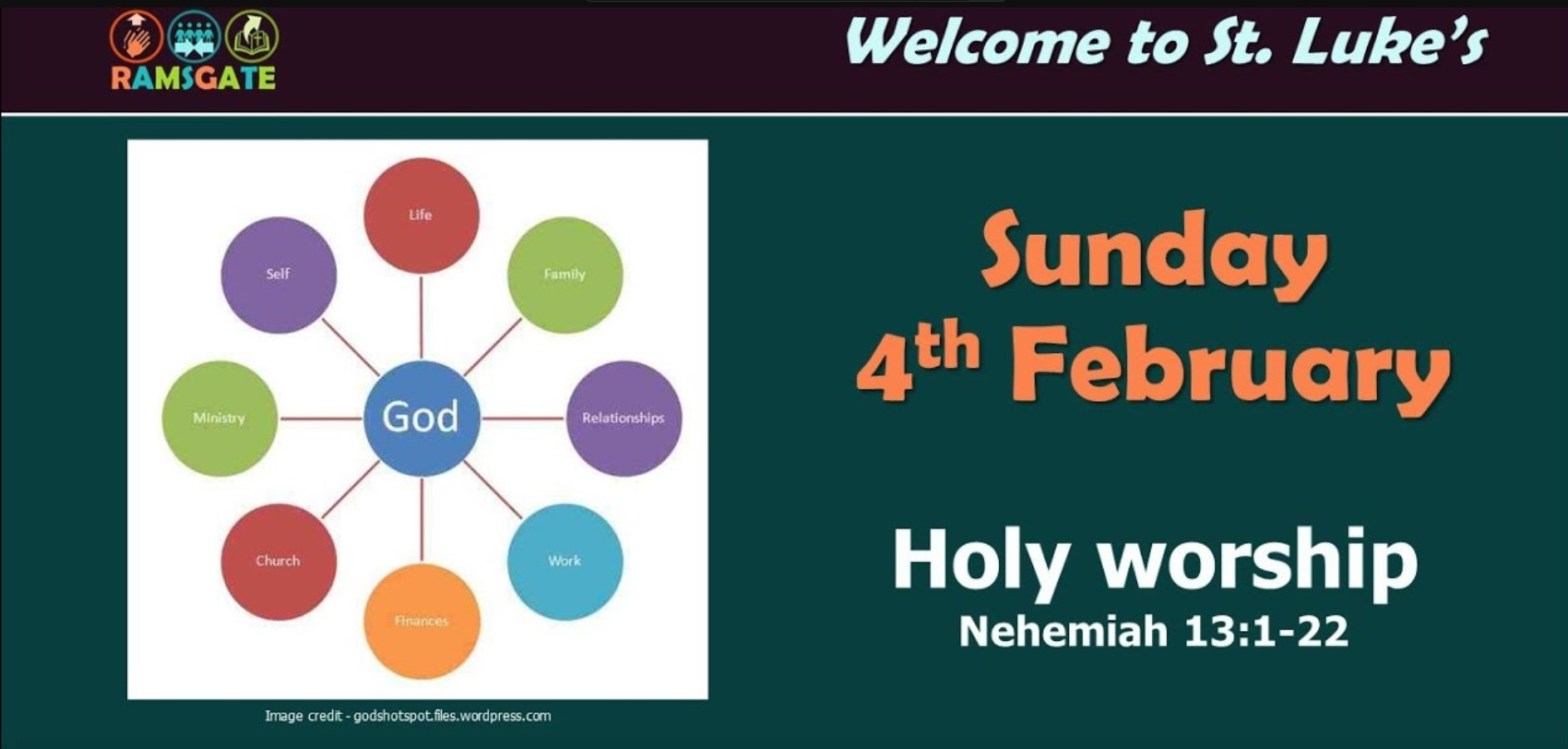
This week is the last in our series on Nehemiah and we are thinking about Holy Worship. The work is completed, the community gather, the word is read, praise to God is given, and they commit themselves again to being the people of God. Yet in ch. 13 Nehemiah returns as the people have not maintained the call to live holy and distinct lives, which it could be argued is because they’re not dedicated to Holy Worship.
Over the last five weeks, we’ve been looking at the story of God’s people using the books, Ezra and Nehemiah and exploring how it speaks into our year of discernment. Ezra begins in the context that Jerusalem had been invaded by the Babylonians and the final tribes that had been present in Jerusalem, not already taken into exile, were taken into exile. The king of Persia issues a decree allowing Zerubabel to take people back to Jerusalem to rebuild the temple of God, and we thought about how God will build his house, how his kingdom will come, how his promises came true in the time of Ezra, and how his promises will come true for us, his kingdom will come, his kingdom will grow, God will build his house.
60 years pass and Ezra is sent to Jerusalem, and he reads the law, that’s his calling, a teacher of the law and the reading of the Lord challenges the people and convicted them and so they study and obey God’s word, changing their behaviours to fit. As we do the same, it makes us know God’s promises and plan as we discover, who is, and who we’re supposed to be.
We then moved on about 12 years, and Nehemiah hears about the state of Jerusalem, about his fellow Jews that are there, And he’s stirred up to pray and fast and to mourn, and we thought about fasting and praying and how we’re called to stand in the gap – to think about the needs of our community, and as we are discerning in this year ahead to think about where we can be standing in the gap, where are the needs in our community.
Last week we saw in chapter 5, the problems of hunger and poverty that existed we saw how Nehemiah dealt with that, and it made us think about how we are called to be living examples, living out kingdom values, loving our Neighbour.
This encounter in Nehemiah is an interlude between the work of rebuilding the walls.
The story of Nehemiah continues with ongoing opposition and particularly tobiah the ammonite features quite heavily and played a part in our chapter today that we’ve just read. Tobiah and another official had been quite destructive in the rebuilding and heavily opposed – in chapter 6 we see ongoing opposition, there were death threats against Nehemiah. Letters sent back-and-forth trying to intimidate him. However the wall is completed they get the job done – the exiles return and there’s a whole list of those who came back and then in chapter 8 onwards Ezra again comes and reads the law. With the rebuilding there was in the wall, a pulipt, a podium built on which the law could be read. Ezra once again reads God’s word to those assembled and this leads to worship to confession and oath taking. all the things we have explored over the last few weeks happen here.
This year as we’re thinking about what is next with our journey with God here in Ramsgate. I imagine we’ll go through similar processes of re centering on God asking him what are we here for.
In these chapters building up to our reading today We have the regathered community of the people of God in Jerusalem again with the completed wall, the temple and the community fully intend to keep God centre. The wall includes a place where the word of God is taught.
At the end of chapter 12, after everything’s been put in order, the wall is dedicated. And it’s in this context that we start with chapter 13 where it says in v1 ‘on that day the book of Moses was read, aloud in the hearing of the people’.
What chapter 13 deals with is the fact that there have become problems with their worship, even in the event of everything that had been done. There were ongoing issues.. I think there are three things in todays chapter that Nehemiah disliked about their worship 1) it was polluted 2). It was limited and 3) it had been demoted.
What is worship? Why do we gather? It might help to think also about what things the world worships. The world often worships, money, pleasure, celebrity status, power. These things are invested in and take the focus.
John 4:23, says: ‘yet a time is coming and has now come when the true worshippers will worship the father in the spirit, and in truth, for they are the kind of worshippers the father seeks.’ There is a sense here, that bringing God the glory, prizing him above Everything else is true worship. Worship is realising it is because of Jesus we have the freedom in life that we have.
One commentator defines worship this way: ‘worship is the act of attributing, reverent, honour homage to God. In the new Testament, various words are used to refer to the term worship. One is prone to worship, which means to bow down to God or kings.’
For us as Christians Jesus is the king of Kings and Lord of Lords. How do we bow down to him – give him worship in the whole of our lives. How do we empty ourselves of our entitlement and self interest and worth built on our own successes and realising where our true successes come from.
Nehemiah sees the worship of those in Jerusalem in chapter 13, as not being true worship. Nehemiah has left Jerusalem and he hears of these things that are going on and so returns to take action.
He has heard that their worship has become polluted – tobiah the ammonite has been given a space in the temple courts, likened to a small warehouse. his own possessions and stuff are being stored there. The items for worship and grain for offerings are removed. Tobiah was someone who was completely opposed to the rebuilding of the wall, had plotted and undermined and issued death threats, and yet the high priest who had intermarried into Tobiah’s family allowed the articles of worship to be discarded. The worship had been polluted – it was not being kept holy for worshipping the creator, God, the God, who had fulfilled his promises, and brought his people back once again to Jerusalem..
Is there anything that resonates for us about how our worship might get polluted? I’m not saying it is but it’s got me thinking but how do we keep it focused on our God who is holy
The second issue Nehemiah had with their worship was that it was limited. The levites had not been provided for as had been the instructions in scripture and so they had to go back to their fields and do other works so that they could survive and live, and therefore the worship had been limited because the Levites, who were there to enable the worship of the people of God were unable to be there. What might limit our worship?
Lastly the worship was demoted – other distractions were getting in the way of worship. The people of Judah were treading wine presses, bringing in grain, loading it onto donkeys selling food, not keeping the Sabbath holy.
Difficult isn’t it in this day in age because a lot of things happen now on Sundays. Our culture is has changed and sometimes Sunday is the only day that all family members are off together, or there are exciting opportunities, drama, football dance, and competitions that can happen those days too. How do we keep worship a priority
nehemiah felt strongly about correcting these issues with their worship to maintain Gods reputation amongst the peoples. To fulfill their duty as the people of God
We are on a mission from God – if we begin with worship putting him at the centre of it all what will God do- what will we learn? what will it change in us? Let’s make worship a priority and not allow it to be polluted, limited or demoted.
What is God stirring up in us in this year ahead to fuel the ministry in years to come? How can we maintain our worship of God loving him with our heart soul mind and strength? As we wait expectantly for Jesus’ kingdom come.
This week is the last in our series on Nehemiah and we are thinking about Holy Worship. The work is completed, the community gather, the word is read, praise to God is given, and they commit themselves again to being the people of God. Yet in ch. 13 Nehemiah returns as the people have not maintained the call to live holy and distinct lives, which it could be argued is because they’re not dedicated to Holy Worship.
The storehouses were in effect being loaned out for accommodation – the things that were previously stored there and used for worship were in effect ‘thrown out.’ The Levites with responsibility for leading them in worship were not being cared for and had had to return to their fields in order to get a livelihood to be able eat and survive. Alongside this, many other things were distracting the community from gathering to worship. Worship is a holy and sacred thing and impacts how we live out our faith.
How do we view worship? Our verse for this week from John might get us thinking about this. One commentator writes: ‘Worshipping in truth means worshiping through Christ and worshiping in Jesus’ name’ (Sinclair Fergusson). But is this a priority for us? In this day and age, regular worship is considered to be once a month. There are many competing activities now – is there a risk of letting things distract us from worshipping our creator and redeemer? When we are gathered, do we give Jesus the best we can (not perfection but the best of ourselves)?
Nehemiah saw a connection between their habits of worship and the lives they were living. As living examples of God’s people, who are seeking to know God’s work and to be involved in building his kingdom let us think about how we pursue holy worship making God our priority and allowing him to impact our lives.
Claire Coleman
St. George’s Website
What’s On – a page which lets you know what is happening this week and gives information about upcoming events.
Notices – You can read the latest notices on this page.
Sermons – Read a transcript of a recent sermon or watch the YouTube version recorded at St. Luke’s. There are now videos for all the sermons over the summer.
Love is all you need – Concert (St George’s Church) – 7:30-9:30pm
Saturday 10th
Daily Prayer (St. George’s Church) – 9:30-10:00am
Sunday 11th
Eucharist (St George’s, 9:30am) –Reading: Mark 9:2-9
Love is all you need – Community Meal Fundraising Concert – This Friday!
This concert at St. George’s church onFriday 9th February at 7:30pm is to raise money for the running of the Community Meal at St. George’s Hall on Tuesdays. Tickets are £8 in advance and now available online or £10 on the door.
Pancake Party
Pancaked, fun and games on Tuesday 13th February, 4:00-6:00pm, St. Luke’s Church, organised by the St. Luke’s and St. George’s social committee. Please sign up on the list at the back of church.
Ash Wednesday Reflections
To mark the beginning of Lent we will be having an Ash Wednesday service on Wednesday 14th January 12 noon at St George’s church. An opportunity to reflect on being dead to sin and forgiveness we receive due to the cross of Jesus.
Questions by this Monday please!
We are making 2024 a year of Discernment for our churches, where we are seeking to find out where God wants to lead us in the coming years. As a first step in this process, we want to gather questions that we think we should be asking God. We are opening this up to the whole congregation and others. So, please pray and consider submitting a question via our online form. If you cannot use an online form, then please write it down and hand it to Paul or Claire.
Reading the Scriptures or Leading Prayers on Sunday
If anyone is interested in joining a rota to be someone who reads one of our Scripture readings or leads the prayers during our Sunday service, then Mark would love to speak to you!
Online Forms
Under the ‘Contact’ tab on the website, there are now three forms that you can use to help us in managing the church:
Events Application Form. Use this if you are organising a church event that needs a church room booked, advertising or ticketing.
Submit a Notice. Use this if you want to ask us to include a prayer request or other notice in the church notice sheet or email.
In a year of discernment for our churches it is worth reflecting on how God is working around the world. This story of the growth of a church of 20,000 in the midst of one of the poorest communities on the edge of Cairo, is great inspiration. Read more….
Finding Peace in the midst of Trauma
This article tells the story of refugees in Northern Uganda who had fled the fighting in Southern Sudan. Their plight makes for sad and traumatic reading. Yet the healing some are finding through being introduced to Jesus is inspiring. Read more…
Finally, let’s keep gathering together to worship God and encourage one another.
SEE WHAT LOVE: A concert with exhibition performing on Saturday 24th February 2024 with the legendary @starlingsworld @keziah_ziah and @socialsingingchoirwith an exhibition from @jemimasara at St George’s Church in Ramsgate. The doors open at 7pm and the show starts at 7.30pm.
Tickets are available here – https://www.universe.com/events/see-what-love-tickets-GDC485 The event will be raising funds for The Power of Women Festival 2024. By attending SEE WHAT LOVE, you’ll not only experience an unforgettable concert but contribute to empowering women in Thanet.
Whoever oppresses a poor man insults his Maker, but he who is generous to the needy honours him. (Proverbs 14:31). In our series on Ezra-Nehemiah we have reached a point in the narrative (in Nehemiah 5) where the conflict that has come from opposition to the rebuilding of the walls, and the work of rebuilding itself, takes a back seat and a new problem emerges – the problem of hunger and exploitation.
We’re thinking today about being living examples to our community. Of how to be role models for the good.
Our world has many different types of role models. There are role models that have paved a way for future generations – people like Barack Obama Malala, Mary Curie. There are people like David Attenborough, who invested time and energy and caring for the planet and raising awareness of the stewardship needed. Actors and singers can be role models. Olympians and paralympians. Celebrity are a whole new category of role model from the Kardashians to YouTubers like MrBeast. Who are some of your role models? they can be politicians, siblings, activists, parents, minister of faith. Who has been influential in your life who do you aspire to be? Do we think that actually we can be role models and our role models to other people in the way we think an act and behave?
Using this passage in Nehemiah, we’re thinking about problems in the world of hunger and exploitation. It was a situation Nehemiah was facing. They’ve been building the wall, there was opposition. All of this takes a backseat in the face of this new crisis of hunger and exploitation. The people approach Nehemiah with this serious problem that they’re facing, and we get Nehemiah as a living example of how to tackle this reality of hunger and exploitation. We can look at these big global issues and think what can we possibly do, but here we have an example of what one person was able to do in his corner of the world.
Our opening verse this morning was this from Proverbs: ‘ whoever oppresses a poor man insults his maker, but he who is generous to the needy honours him’ if we are generous to the needy to help people in hunger in our little circle influence, then we’re honouring God, and Nehemiah was a living example of this and we can learn from him this morning.
We’re using these books of Ezra and Nehemiah in a series to help us think about this year of discernment. About how we can trust the God will build his kingdom about how through studying Gods word and standing in the gap through prayer we can know more of Gods ways can hear his voice and guidance and today we’re thinking about how we can be living examples of godly behaviour. The people that look out for those that are needy that are suffering from hunger and exploitation.
What can we do to tackle hunger exploitation today in our little bit of the world?
Nehemiah Was able to battle hunger and exploitation because he became aware of the hidden strains in the community. He hears this outcry from them. We read this in the first five verses of chapter 5. There was need for grain some are needing to sell their land, some were even needing to sell relatives. Needs were not being met.
A similar thing happened in the book of ACTS. The Hellenistic Jews were not being cared for in the same way, and this was brought to the attention of the brothers in Jerusalem, and so action was then taken, to make sure that all were being looked after.
What are the strains in our community? Where can we act? Where is the impoverishment where is the need?
Nehemiah saw the situation and was stirred to anger at the injustice. He was controlled and constructive in how he dealt with this situation. He gathered people together and explains that what they were doing, was not right, was not good.
In our Society what are people doing that is not right? where is our anger being stirred up?
Nehemiah wants to redress the wrong that exists – calls them to generosity to enable all to have enough.
Nehemiah has a great pattern of leadership. He sees the strains in society. He seeks to address these wrongs, and does this, because he’s motivated by the love of God, and of his brothers and sisters he dismisses his entitlement. Similar to Paul dismissing his entitlement in one Corinthians, chapter 9. Nehemiah is an example of humility of generosity – he doesn’t laud his power over the people, but shares what he has with his people.
The passage ends with Nehemiah wanting to recognise his generosity.
You might be sitting there thinking well, I’m not a leader, but actually all of us can be leaders – being a leader is to do with influence and we all have influence over certain groups of people within our orbit.
Jesus sums up the law in this way: hear o Israel, the Lord, our God, the Lord is one. love the Lord, your God with all your heart with all your soul with all your mind with all your strength. The second is this love your neighbour as yourself, there is no other commandment greater than these. This is how Jesus is teaching his followers to be living examples in their community
What does this mean for us in our community? we’ve talked about how in this year ahead We’re staying open to what God might be moving us in to. Where is there an outcry in our community? What wrongs can we redress? How can we lead by example?
What are your spheres of influence? what people do you come across day and day out what things do you see around you? That’s good people wear on a mission from God, and as part of that we want to think about what the needs are of our community and how we can be living examples that point people to Jesus. How can we model, loving God and loving our neighbour as our self. we can be people that don’t exploit that don’t take people for granted that generous with what we have as we move into the year of December. What is going to be stirring in us both as individuals and as a whole community. What situations will anger us into action?
Let’s spend some moments reflecting on these questions. In our community Where is there an outcry? What wrongs can we address? And how can we lead by example? Let’s be open to where God is wanting to speak to us and where we can be his living examples.
Whoever oppresses a poor man insults his Maker, but he who is generous to the needy honours him.
(Proverbs 14:31)
In our series on Ezra-Nehemiah we have reached a point in the narrative (in Nehemiah ch5) where the conflict that has come from opposition to the rebuilding of the walls, and the work of rebuilding itself, takes a back seat and a new problem emerges – the problem of hunger and exploitation.
Hunger and exploitation are problems that have plagued history throughout the world; even in our own part of the world and in this modern age. In January 2022, Thanet accounted for 11% of trafficking and modern slavery reports made in Kent. These figures included illegal workers who were being exploited and made to live in extremely poor conditions. Food banks in Thanet over the last four years have seen them serving more than six times the number of families and elderly than in the previous years. Hunger and exploitation are real problems.
As we read God’s word and as we build our relationship with God, by standing in the gap in prayer, we discover God’s heart for equity. We realise we are called to be distinctive in our living and to love as God loves. Jesus told his followers to love their neighbour as themselves, which rightly means making sure ourselves and others don’t suffer hunger and exploitation, taking the example from Nehemiah’s time (as well as our own).
On a global scale this might seem impossible to achieve – the eradication of hunger and exploitation. But what we can do is in the way we live; be examples of people that do not exploit, that are wise with resources and seek to show God’s love in how we treat both friend and stranger. Let’s seek to be living examples this week.
Claire Coleman
St. George’s Website
What’s On – a page which lets you know what is happening this week and gives information about upcoming events.
Notices – You can read the latest notices on this page.
Sermons – Read a transcript of a recent sermon or watch the YouTube version recorded at St. Luke’s. There are now videos for all the sermons over the summer.
Be assured I will do my best to check that people are happy for the requests to be shared before including them. Please pray for…
Derek Tench who recently had an angiogram. Pray for wisdom for the doctors in interpreting the results and deciding on the best treatment.
Sue Martin for her continued recovery from her knee operation.
Holly Archer, thanks for good progress so far and pray for continuing progress with the physiotherapy
Betty Searchfield, for her diabetes to be under control.
Kevin (Malcolm and Betty’s son-in-law), for healing of his heart.
Brenda Harmes continuing her recovery.
Love is all you need – Community Meal Fundraising Concert
This concert at St. George’s church onFriday 9th February at 7:30pm is to raise money for the running of the Community Meal at St. George’s Hall on Tuesdays. Tickets are £8 in advance and now available online or £10 on the door.
Pancake Party
Fun and games on Tuesday 13th February, 4:00-6:00pm, St. Luke’s Church, organised by the St. Luke’s and St. George’s social committee. Please bring your own frying pan!
Questions
We are making 2024 a year of Discernment for our churches, where we are seeking to find out where God wants to lead us in the coming years. As a first step in this process, we want to gather questions that we think we should be asking God. We are opening this up to the whole congregation and others. So, please pray and consider submitting a question via our online form. If you cannot use an online form, then please write it down and hand it to Paul or Claire.
Reading the Scriptures or Leading Prayers on Sunday
If anyone is interested in joining a rota to be someone who reads one of our Scripture readings or leads the prayers during our Sunday service, then Mark would love to speak to you!
Links to Share:
Cashing Out, Biblical Thoughts on the Future of Money
Monetary systems are innovating rapidly yet also losing the public’s trust. Given that trust (and government solvency) are critical to the survival of banks, recent bank failures may presage the transition to a new monetary paradigm. The Bible’s pointers to the features of a desirable monetary system are used to assess the merits or otherwise of the challengers to the status quo – notably cryptocurrencies and Central Bank Digital Currencies. The latter, in particular, raise a number of concerns regarding governmental surveillance and control. Read more…
World hunger – our Christian response
If you want to think more about this topic in a deeper way than we can explore in our sermon. This article although from 1992 has some interesting perspectives that might help us grapple with our own thoughts on how we can be living examples against hunger and exploitation. Read here.
Finally, let’s keep studying God’s word, standing in the gap and living by example a way that demonstrates God’s desire for equity.
Yours in Christ
Claire Coleman
(Curate, St. Luke’s Ramsgate)
Online Forms
Under the ‘Contact’ tab on the website, there are now three forms that you can use to help us in managing the church:
Events Application Form. Use this if you are organising a church event that needs a church room booked, advertising or ticketing.
Submit a Notice. Use this if you want to ask us to include a prayer request or other notice in the church notice sheet or email.
We’ve been looking at the books of Ezra and Nehemiah. To help us in this year of discernment ahead today we’re thinking about the call to fast and pray. Thinking what Nehemiah chapter 1 teaches us of this and how it might impact our discernment in the year ahead.
I don’t know how you respond to the news headlines but sometimes we attempted to turn it off because of the pain that we are faced with. we turn on the news currently and there are world problems and local problems galore. We see violence war and also difficulties with poverty, all impacting our world. Things in our communities and on a global scale that make us question what God is doing and get us thinking about how we can help because it seems to insurmountable.
There is something about this passage about praying for the needs of the world and as we look at the News items to be thinking about standing in the gap between God and the world and lay before God the needs, showing him a heartfelt anxiety about the current situation, laying it all before God.
This is what Nehemiah does in verse four of our chapter this morning – His fasting and praying is his way of standing in the gap of laying out the needs of the world before God.
What is the response when we watch the news? what is our response when we see the needs in our community? what is our response when we see the needs within our church? do we stand in the gap?
In our passage today We are introduced to Nehemiah through his prayer. At this point In the narrative we are probably 13 years after Ezra left for Jerusalem. We find out that Nehemiah is cupbearer to the Persian king, which is a really important role – there is a lot of privilege that comes with that role in terms of having the ear of the king, having access to the King. Between this prayer is chapter 1 and the action that carries on into ch2 there is probably a gap of about 4 to 5 months. Nehemiah has a reputation for being a man of action and we see that in subsequent chapters – but the fact that he’s spent these four months praying shows that for him it was a priority to come before God. Before any action took place Nehemiah shows us the importance of fasting and prayer.
In v 5 to 11 we have this wonderful prayer Of Nehemiah, It sets out a good pattern of prayer that we could follow. we read verse 5 that he focuses on the God of heaven which in fact we do in the Lord’s prayer that Jesus taught us. He recognises God’s greatness knowing who God is. The second part of his prayer inv6-7 shows real humility – there is confession not just for his own sin but for the sin of his people historically. Acknowledging the rebellion and where things have gone wrong. We touched a bit on this last week with the importance of safeguarding and realising where we may have got it wrong in the past and where we might need to improve on it in the future for the glory of God‘s name. There is something about confession that frees us, it’s not about making us feel guilty but it’s freeing us to sit in the gap open armed free of burden. In v8-10 in the build up to his plea. He recounts the history of who God is, of Gods history with his people. And remembers gods promises. That God would restore his people again and stands in the gap culminating in a plea in verse 11 that God would act making it possible for God’s people to again be settled in Jerusalem.
Only after this prayer do we then get the action – in chapter 2 we have an account of Nehemiah making a request of the King to return, we get the account of the journey and then as soon as Nehemiah gets there he makes a survey of what needs doing. In chapter 3 we have the account of him sharing out the workload, and in chapter 4 there is opposition which causes poor morale – Nehemiah acts by praying arming and continuing the work. This action is fuelled by this time of prayer that is represented in chapter 1 a time of discernment and seeking guards before the action commences.
The commentator Hannah Harrington says this about me Nehemiah: Despite Nehemiah’s powerful role he is a man of prayer with all the necessary humility that entails most of his prayers are short but the considerable number of them reveals a lifestyle of spontaneous recourse to Yahweh whatever needs arise, in this instance the phrase day and night indicate sustained prayer on behalf of Israel.
What can We learn from Nehemiahs prayer? We can use scripture to aid our prayers, we can come before God in humility in our prayers with our confession and we can persevere in our prayer life praying for particular things again and again. When we think about a year discernment, sitting and waiting can be uncomfortable particularly for people of action. but there is something in Nehemiah’s pragmatic approach and his humility that meant he realised he needed to begin with prayer and then came the action. Where do we need to fast and pray for the needs of the world but also thinking about discernment for the year ahead both corporately and in our Individual lives. Nehemiah’s prayer teaches us things about this.
Nehemiah’s Praying involved fasting and fasting can come in many shapes and sizes what it boils down to is fasting from things in order to give us more time to set aside for praying with God enables us to have a single focus on him and what we are bringing before him.
Being part of a church means we have a mission from God to be his people in the areas that we are based. Sharing God with our community. how will fasting and praying impact our mission? When we stand in the gap seeking gods well asking him questions what then will he do what will the actions be? The amazing thing about prayer is that all of us can take a part in that in this year of discernment ahead. We can all play a part. How will we respond when we watch the news? how will we respond when we see the needs in our community? how will we respond when we see the needs within our church? Will we stand in the gap? I Wonder what God might be stirring us to do as we take 2024 to discern his will. we can discern this together as we use Nehemiah’s pattern of prayer, as we fast and pray, so that when we do come to a point of action we know it is fuelled by him.
When I heard these words, I sat down and wept and mourned for days, fasting and praying before the God of heaven
(Nehemiah 1:4)
We look at the news and can be disheartened by the sorrow, conflict and difficulties around us. We hear of individuals’ struggles with health and well-being, even in the lives of those within our own family networks and church communities. We hear and see these things. There are times when all we can do is grieve for those situations around us. Are we motivated to grieve? Do we think about fasting and praying? Are we motivated to act? What would that action look like?
Nehemiah is an activist type person, he sees things happening with his people, he grieves and then he wants to act. We are introduced to him around 13 years after Ezra left to return to Jerusalem. He hears reports of how the community in Jerusalem are doing and is distraught that the walls -which symbolise safety, security and strength – are in ruins. His normal propensity for action is tempered by a period of grieving in fasting and prayer. Nehemiah realising that for any action to happen his priorities are with God who is the one who ultimately acts, facilitates and enables the remnant to rebuild a centre for God’s people again.
It is only after prayer and fasting that the opportunity for action comes. There is a need in our community and in our lives for God’s hope to be ever pervasive. We might be longing for action to happen as a church – to see lives blessed and transformed, but how we go about this needs to be powered by our God. Fasting and praying in grief and in discernment are not current disciplines for many of us – I’m not sure I have even had much teaching or practice myself. But maybe it is something we can explore as we put our priorities in God’s hands as we seek his way ahead, grieving for the difficulties in our world and seeking God’s hope.
Claire Coleman
St. George’s Website
What’s On – a page which lets you know what is happening this week and gives information about upcoming events.
Notices – You can read the latest notices on this page.
Sermons – Read a transcript of a recent sermon or watch the YouTube version recorded at St. Luke’s. There are now videos for all the sermons over the summer.
We are making 2024 a year of Discernment for our churches, where we are seeking to find out where God wants to lead us in the coming years. As a first step in this process, we want to gather questions that we think we should be asking God. We are opening this up to the whole congregation and others. So, please pray and consider submitting a question via our online form. If you cannot use an online form, then please write it down and hand it to Paul or Claire.
Reading the Scriptures or Leading Prayers on Sunday
If anyone is interested in joining a rota to be someone who reads one of our Scripture readings or leads the prayers during our Sunday service, then Mark would love to speak to you!
Love is all you need – Community Meal Fundraising Concert
This concert at St. George’s church onFriday 9th February at 7:30pm is to raise money for the running of the Community Meal at St. George’s Hall on Tuesdays. Tickets are £8 in advance and now available online or £10 on the door.
Pancake Party
Fun and games on Tuesday 13th February, 4:00-6:00pm, St. Luke’s Church, organised by the St. Luke’s and St. George’s social committee. Please bring your own frying pan!
Online Forms
Under the ‘Contact’ tab on the website, there are now three forms that you can use to help us in managing the church:
Events Application Form. Use this if you are organising a church event that needs a church room booked, advertising or ticketing.
Submit a Notice. Use this if you want to ask us to include a prayer request or other notice in the church notice sheet or email.
Our society is changing. This podcast looks at how a platform society is emerging as another form of individualism and affecting the culture of our society. It explores how significantly large digital platforms are connected to global corporations and helps us think how that impacts us as a society and as a church. Listen here to this 40 minute podcast.
A secret Disciple
What is it like to be a believer when it is too dangerous to let those closest to you know? Read this account of a woman who is a Muslim Background Believer. Read more…
Finally, let’s keep studying God’s word and explore different practices that can help us know him better and live as he calls us.







 St. George's Church Ramsgate