“But if we walk in the light, as he is in the light, we have fellowship with one another, and the blood of Jesus, his Son, purifies us from all sin.”
(1 John 1:7)
There will be Blood (Exodus 7:1-24)
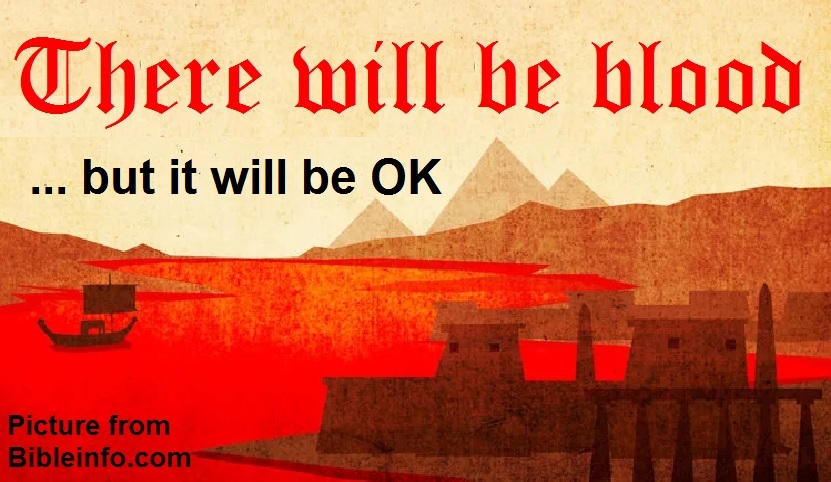
Colin Gale reflects on how the first of the ten plagues of Egypt hints at the truth that God alone can bring great good out of the darkest horror.
Let me start by wishing all fathers a Happy Fathers’ Day! I have been a father for twenty-four years, but today is the first Fathers’ Day on which I am also a father-in-law, as my son was married last summer. Since that wonderful day, along with other members of my family, I have spent the last ten months learning about my daughter-in-law’s deep connections with friends and family going back generations in Bristol.
Likewise, there has been a process, led by me though involving others, of my daughter-in-law being inducted into the history and traditions of our family. Notably, this has included an introduction to being a supporter of the Australian Rules football club that my family have followed since before I was born. We have given her a scarf in club colours to wear; we have painstakingly taught her the words of the club song; and we will continue to tell her the stories of the club’s triumphs and tragedies; its origins in an economically deprived but proudly working class suburb of Melbourne; the astonishing success it savoured especially in the 1920s and the 1950s; the wilderness years it endured between 1958 and 1990; its many closely-fought and heart-breaking grand final losses; the shining victories of the past and the present; and the ever-renewing hope for the future.
Before she was married, none of these things mattered to my daughter-in-law. She did not even know about them. If she had known, it would have been from the position of a neutral observer. But now that she has been grafted by law into our family, she has a stake in that history, as well as in the club’s present fortunes. The club’s victories are her victories, just as they are ours; the wilderness years, the set-backs and defeats are all hers, just as they are ours.
All this, of course, is only about football, and I know that it doesn’t really matter. But I hope we understand that, when we read the book of Exodus, we do so not as neutral observers, but as those with a deep interest in that history, and what it means for our present and our future. Everyone who has put their trust in Christ has been grafted into the story of the people of God. Their triumphs and tragedies, their close shaves and comebacks have all become ours, no matter how long ago they took place, and no matter that at that time we ourselves “were excluded from citizenship in Israel, strangers to the covenants of promise and without hope and without God in the world”. We have a stake in that history because “in Christ Jesus we who were once far away have been brought near through the blood of Christ” (cf. Ephesians 2:12-13).
When we look at Exodus chapter 7, we come to a very serious and sobering part of the history of Israel, and to match this I have chosen a solemn title for the sermon today, a phrase I take no pleasure in adopting but do so in order to do justice to the contents of Exodus chapter 7. The title is ‘There will be blood’. I have borrowed it from the title of a 2007 Hollywood film whose subject was the lawless, cut-throat world of nineteenth-century oil prospecting in the American West. The depressing meaning of the film’s title is that wherever there is oil to be found and dug up, and monetary fortunes to be made and lost, as sure as night follows day, and human nature being what it is, there will, eventually, be violence and blood.
Exodus chapter 7, and the chapters that follow describing the ten plagues of Egypt, make a point that on first sight looks equally stark, a point so stark that these chapters are not often preached on: that wherever there is open defiance of God, there will eventually be blood. Yet on closer examination, it turns out that these sombre chapters reveal a wonderful secret, which is that in the end, this will be the kind of blood that ultimately saves us.
How can we possibly arrive at that or any other positive endpoint, given that the story I am telling starts with the really horrifying assertion that ‘there will be blood’? I suggest we may do so in three stages:
- By asking the question, ‘Is it really so horrific?’
- By giving the answer, ‘Yes, it really is that horrific.’
- By glimpsing how God can alone bring great good out of the worst horror.
OK, so you’ve had the trigger warning now, in Exodus chapter 7 there will be blood, a plague of blood in fact.
The LORD said to Moses, “Tell Aaron, ‘Take your staff and stretch out your hand over the waters of Egypt – over the streams and canals, over the ponds and all the reservoirs’ – and they will turn to blood. Blood will be everywhere in Egypt, even in the wooden buckets and stone jars.” Moses and Aaron did just as the LORD had commanded … and all the water was changed into blood. The fish in the Nile died, and the river smelled so bad that the Egyptians could not drink its water. Blood was everywhere in Egypt.
I think we can all agree that this sounds pretty bad. Put to one side, if you can, the terror of those who, like ITV’s Doc Martin, couldn’t stand the sight of blood. More frightening than the sight of gore is this: if it were literally true that all the water in Egypt had turned to blood – not just in the Nile, but in all the streams and canals, ponds and reservoirs, even the water in buckets and jars – then every last one of the Egyptians would have faced death by dehydration within three days or so, and they would have known that to be the case. It says in verse 23 that ‘all the Egyptians dug along the Nile to get drinking water, because they could not drink the water of the river’, but if literally all the water in Egypt had turned to blood, they would have died of dehydration in three days or so.
So now comes the question: ‘Was it really so horrific? Was it really as bad as described?’ Biblical scholars of the twentieth and twenty-first centuries have suggested that a widespread invasion of toxic algae could have turned the Nile brown or red, killed a lot of its fish, made its waters dangerous to drink, and created an overwhelming impression that red or brownish hues, accompanied by a horrible stench, were everywhere and had gotten into everything. Such an invasion would have been a perfectly plausible, natural event. It would have made it difficult, but not actually impossible, to find safe drinking water. It certainly would have caused fear and dread.
None of this explains away the intervention of God in human history, by the way. Whichever way you look at it, the plague of blood as described in Exodus 7 is a miracle of timing, and is preceded and followed by other miraculous events. Not all the biblical scholars who propose a natural explanation for this plague are trying to demythologize the Bible. Some of them are simply seeking to “discern a pattern of increasing intensification within the whole series” of Egyptian plagues,1 starting with the least serious and progressing through to the most serious and actually life-threatening. The issue is that, within Exodus itself, the first plague seems to be viewed “more as a disgusting nuisance than as a fundamental threat to life. It lasted seven days, causing the Egyptians to dig for water, [and] Pharaoh himself did not take it seriously at all.”2 Verse 23 tells us that he did not take it to heart. Wherever there is open defiance of God, there will be blood, but in the first plague, at least no-one died – apart from the fish, that is. Even so, in answering the question ‘Was it really so horrific?’, we have to say that it was bad enough, and that it was an evil portent of the death that was to come.
We haven’t got a ten week sermon series planned for the ten plagues of Egypt – imagine what a trial it would be if we had! – but next week Claire will be speaking about the tenth plague, the plague on the firstborn. Without wanting to steal too much of her thunder, I will just say that the tenth plague is the terrifying culmination of the threat that is part and parcel of the first plague. Of the tenth plague, it is not possible to say that at least no-one died. This plague justifies the dreadful warning to those who defy God that ‘there will be blood’. It is the blood of the first-born sons of Egypt. By then, it really had becomethat horrific.
In the midst of the horror of the ten plagues, in the light of the lesson that ‘wherever there is defiance of God, there will be blood’, how can we believe it possible for God to bring great good out of the darkest horror? The writer of Exodus did believe that great good could come out of great horror. Otherwise it would not have been written in verse 5 that, when the Egyptians see God’s mighty acts of judgment, they “will know that [he is] the LORD”, or in verse 17 that “by this [Pharaoh] will know that [he is] the LORD”. Back at the start of Exodus chapter 5 Pharaoh says ‘Who is the LORD, that I should obey him and let Israel go? I do not know the LORD and will not let Israel go’ (Exodus 5:2). Coming to know the LORD in the midst of deepest horror doesn’t make the horror go away, but nevertheless it is a great good to come to know the LORD, however it comes about.
Of course, we don’t see this happening in an uncomplicated way in Exodus chapter 7. What we read instead is that, before the plague of blood, God would “harden Pharaoh’s heart” in verse 3, and that “Pharaoh’s heart became hard, and he would not listen” to Moses and Aaron, “just as the LORD had said”, either before the plague in verse 13, or after it in verse 22. Here, in other words, we are up against the mystery of human responses to God making himself known, and the mystery of God’s prior knowledge of the inclinations of the human heart.
The conundrum at the heart of the story of the hardening of Pharaoh’s heart, and the consequent horrific plagues, is the same conundrum at the heart of the story of the passion of Jesus Christ, who was “handed over” to his executioners to be put to death “by God’s set purpose and foreknowledge”, according to the apostle Peter’s sermon at Pentecost (Acts 2:23). They meant it for evil, but God intended it for good to accomplish the saving of many lives: in the rescue of Israel from Egypt in the one case, and in the resurrection of Jesus from the dead in the other. ‘The LORD hardened Pharoah’s heart’ tells us that the Exodus is the story of God working, not Pharaoh.3 ‘Jesus Christ handed over by God’s set purpose’ tells us that the crucifixion is the story of God working, not the Jews or the Romans. And in both cases, the great good that was achieved through the greatest of horrors, was achieved by means of blood.
Even if the plague of blood could be regarded as a nasty inconvenience, the plague on the first-born could not have been written off in this way. The only way Israelite families themselves avoided the tragic consequences of this plague was by coating their doorposts with the blood of a sacrificial lamb, so that the angel of death would pass on by their houses.
I am saying that the message of Exodus chapter 7, in the context of the Bible as a whole, is that God can bring good out of the greatest horror. The truth of this is tested in human experience, precisely when facing the greatest horror. In the midst of such horror, the alternative explanation that God is a bloodthirsty tyrant intent on wreaking plague, misfortune and maximum harm on the unsuspecting and undeserving must be faced. How is it possible to sustain trust in an all-loving and all-powerful God in the light of human pain and suffering? Here too we are up against a mystery, and on the basis of the big picture of the Old and New Testaments we are not able to solve the mystery, but we are able to say two things:
First, God has acted to absorb the horror of human pain, suffering and death within his own person, in the shedding of his own blood. In giving his first-born Son to die upon a cross, God was giving of his own self, in the mystery of the Trinity, to shield us from the worst effects of our own wrongdoing, as well as from all external evils.
Second, God has brought the greatest good out of the worst horror in the resurrection of Christ: life out of death, victory out of defeat, honour out of humiliation, heaven out of hell.
In the death and resurrection of Christ, God acts not with redemptive violence from above us, but with redemptive suffering from alongside us. So the thought which is here in Exodus chapter 7 that ‘wherever there is defiance of God, there will be blood’ need not trigger us, or terrify us. Rather, it reassures us that God is for us to the ‘N’th degree, even to the point of shedding his own blood. The blood of lambs on doorposts rescued the Israelites from plague and slavery, and the blood of Jesus Christ, the Lamb of God, saves us from death and hell. The split blood of murdered Abel called out for retribution on his murderer brother Cain, but the shed blood of Jesus speaks the better word of mercy for sinners who do not know what they are doing (cf Genesis 4:10; Luke 23:34; Hebrews 12:24).
The first plague of Egypt is one of many places in Scripture in which we are reminded that ‘there will be blood’ and Scripture as a whole tells us that this is not a threat of destruction, but a promise of deliverance. We may have faith in the blood of Christ to bring the greatest good out of the worst horror: life out of death, victory out of defeat, honour out of humiliation, heaven out of hell.
The Old Testament tells us that the Israelites memorialised the story of their deliverance from Egypt by an annual Passover feast, and the fathers among them were told that in days to come, when their children asked them about the meaning of the memorial, they were to say ‘[We] do this because of what the LORD did for [us] when [we] came out of Egypt’ (Exodus 13:8, cf. 13:14-15). The New Testament tells us that at the time of the transfiguration, Jesus spoke with Moses and Elijah about his exodus – our English version of the Bible uses the word ‘departure’ but in the original language it is literally the word ‘exodus’ – “which he was about to bring to fulfilment at Jerusalem” (Luke 9:31).
These are the stories that I want to pass on to others, as a father, as a lay preacher, but above all as a Christian, in the same way as they were passed on to me by my parents and other men and women of faith. The story of the first Egyptian plague is undoubtedly a story of blood and horror. So too is the story of the crucifixion of Christ. But these are also stories that tell us who God is: “God is whoever raised Jesus from the dead, having [previously rescued] Israel from Egypt”.4 They are stories of God ultimately bringing the greatest good out of the worst horror. They are stories of liberation and hope for the future. Through the blood of Christ, they are the stories of who we are, and who by the grace of God we may become.
1 B. Childs, The Book of Exodus, page 154.
2 Ibid.
3 G. Forde, The Captivation of the Will, pages 51-52.
4 Robert Jenson, Systematic Theology, vol. 1, chapter 4.
Yard Sale and Open Day

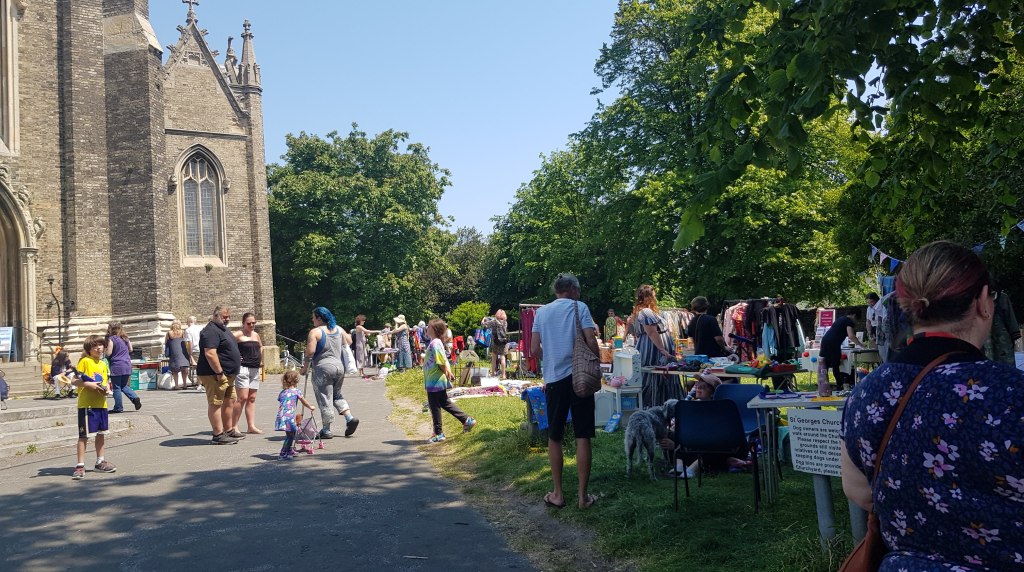
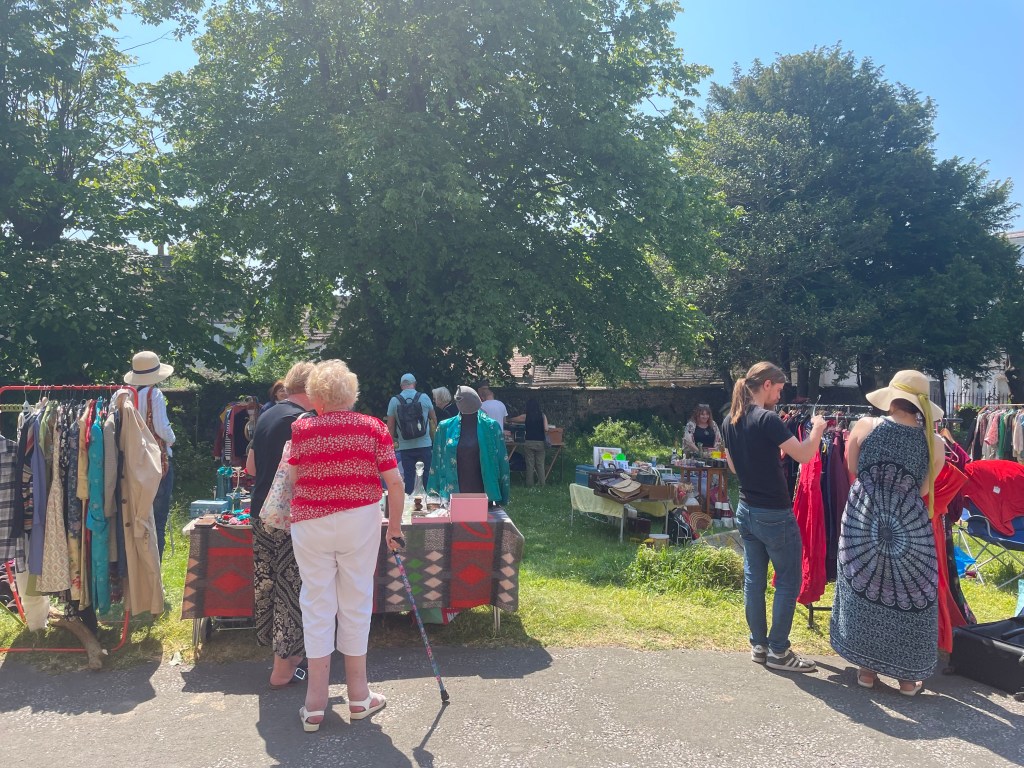
The first of this summers Yard Sale and Open Days went really well and it was a pleasure to welcome over 100 visitors to St George’s. There were tours of the crypt and visitors with a head for heights climbed to the top of our iconic lantern tower. We are looking forward to the next event on Saturday 8th July.
If you are interested in booking a pitch, please contact Jo Mapp on 07724804905 or jippyjap@yahoo.co.uk or via the Facebook event page https://fb.me/e/6JwsxpN22




There will be blood
“In Christ Jesus you who were once far away have been brought near through the blood of Christ”.
(Ephesians 2:13)
Holy Ground (Exodus 3:1-15)
We look at Moses encounter on Holy Ground and explore how through our worship God reveals more about himself, calls us to obedience in our daily lives and assures us that he is always with us.
What has bought you to church this morning?
If we’re honest there are probably a variety of reasons, but one of the reasons why Church meets, why we gather together is because as Christian’s we are called to do that, to gather, to worship God. In worship we praise God for all he’s done and we enter a Holy Space where we encounter God, through prayers, song, God’s word and its teaching. Coming to church, we should be expectant of meeting God in this holy ground.
But are we?
In our bible reading today. Moses encounters God when he’s not even expecting to and look what happened. When we encounter God, amazing things can happen. Things you never expected.
In Moses’ encounter with God, God is calling Moses into leadership.
Challenge of leadership
There is a great challenge in leadership. There are some tasks that sometimes seem too big and hold too much responsibility, really they can only be undertaken if there’s been a true sense of calling, a powerful encounter.
In my own call to leadership, there were definitely times when I thought why me and how on Earth God are you calling me to this?
Leadership holds massive responsibility
Paul has begun his three-month sabbatical, and it’s an exciting thing. A needed thing . A time of rest and refreshment, a time of digging into God, enjoying God’s presence, resetting the compass. Being in leadership can be tough, is a big responsibility. There can be many burdens, there are sacrifices. But In church leadership there are also many many joys and it is all fuelled by a strong sense of God, of being called by God, being given strength from his Holy Spirit and walking in an obedient relationship with him. It is great to continue to pray for Paul that he would have Holy Ground experiences in this time.
But these experiences and callings are not just for leaders.
In Moses’ encounter with God on holy ground, it is about a call to leadership, But this passage isn’t just about being called to leadership there are things in this passage for all of us.
This passage speaks of our God who reveals himself to his people and steps into their normal every day lives, it’s about our God who calls us to obedience to live the lives he wants for us his children and is about our God who also gives us the resources we need to live the lives he wants for us having called us to be children of God.
Moses and God
We began our series on Moses last week and we left the story with him, getting older and being taken back to pharaohs palace, and been given back to pharaohs daughter. He had been saved in order to save Gods people. We then get a story of Moses, being a fully grown adult, and seeing an Egyptian beating up a Hebrew man, one of his own people, Moses sees if anyone is around and seeing no one in his anger he kills this Egyptian man and covers it up. He buries him. He ends up, fleeing into Midian as pharaoh finds out and tries to kill Moses so Moses fleas. He stays in, midian and gets married and continues his life. Meanwhile, the Hebrew people back in Egypt are continuing to be treated harshly and cruelly. And then we get this encounter in ch3 between God and Moses on holy ground.
On Holy Ground
There are three things I want to draw out from Moses encounter. God reveals himself to his people out of compassionate love, he calls Moses and his people to obedience following Gods plan for their rescue and God assures Moses of his ongoing presence with his people.
God reveals himself to his people out of compassionate love.
Moses is going about his everyday business as we see in verse one, he is looking after his father-in-law’s Sheep and he sees this amazing thing a bush on fire, but it’s not burning up. He goes and looks closer, he wants to check it out, to see what’s going on. So he approaches and in verse 4, because he approaches God calls out to him.
God reveals himself to Moses as the God of his ancestors of Abraham of Isaac of Jacob. The reason God reveals himself to Moses and his people is as he tells Moses – he’s seen and heard the cries of his people his people suffering in slavery in Egypt, and that he is going to set them free. Leading them to a land flowing with milk and Honey, an image of abundance.
God sees the need of his people and he reveals himself to them.
Throughout the Bible and history, this continues to be Gods pattern. In the new Testament in Paul’s letter to the Ephesians, he writes: But now in Christ Jesus you who once were far away have been brought near by the blood of Christ. It’s these words that are used in some of our communion liturgy: Father of all, we give you thanks and praise that, when we were still far off, you met us in your Son and brought us home. Dying and living, he declared your love, gave us grace and opened the gate of glory.
These words speak of our need for God that sin has separated us from God, and it’s Jesus that is able to reunite us and so God reveals himself to us through his holy spirit at work in the world, bringing us to relationship with him through Jesus. Every encounter we have with God is because of his love for us he wants to bring us into a close relationship Being more like the people he’s made us to be. Offering forgiveness and freedom.
Moses could have just walked away from his encounter with God. It would’ve been a good story to tell of this burning bush that didn’t burn and an amazing encounter . But it doesn’t end there because when God revealed himself to his people, to Moses, he did so expecting his people to be obedient to him
God calls his people to obedience.
In v 7-9 God is telling Moses his plan, and then he says in v 10 ‘So now, go. I am sending you to Pharaoh to bring my people the Israelites out of Egypt.”’ God is requiring obedience from Moses, he is requiring action.
And what does Moses do? He makes an excuse.
In v11 he says Who am I that I should go to Pharaoh and bring the Israelites out of Egypt?” Then in v13 he appears to be giving another excuse as to why he can’t do what God has asked him to do, it’s like he’s saying I can’t tell them that because they’ll just question in whose authority I can say these things.
He continues his excuses later on in the book as this conversation between him, and God about God’s plan for saving his people goes on into chapter 4. V1 What if they don’t believe me? V10 I’m not very good at speaking.
Moses was reluctant to obey and came up with many excuses. But if we read on through Exodus, we do see that following Moses’ encounter with God on holy ground, following his call to leadership, he obeys.
His obedience to God’s call despite his excuses, led to the rescue of all the Hebrew people from slavery in Egypt, on the journey to the promised land. This land flowing with milk, and Honey showing abundance fullness of life.
I wonder if you have ever made an excuse why you can’t do something – I wonder what has been your best excuse?
I wonder if we sometimes make excuses for why we don’t follow God’s way?
Excuses Why we can’t be patient with that annoying neighbour, why we find ourselves looking in unhealthy places for fulfilment and security and not trusting we can find those things in God.
In Paul’s letter to the church in Philippi he says – Do everything without grumbling or arguing, so that you may become blameless and pure, “children of God without fault in a warped and crooked generation.” Then you will shine among them like stars in the sky as you hold firmly to the word of life.
Obeying Gods call on our lives to live as children of God enables us to be good witnesses to those around us to shine like stars so that others would be drawn to discover and enjoy an obedient relationship with God. That they would be saved from separation from God and be adopted into his family.
When Moses encountered God it led him to obey, despite excuses. As we gather to worship on holy ground and encounter God it encourages us in our obedience to living our lives day to day as children of God. And we can do this because that God is with us.
God is with his people.
The story of Moses’ encounter with God of the burning bush shows that God is with his people. He tells Moses in v12 he will be with him. And then In v 14 we read how God wants to reveal himself to the people through Moses who is to tell the people – I am who I am… I am has sent me to you. ‘The Lord, the God of your fathers—the God of Abraham, the God of Isaac and the God of Jacob—has sent me to you.’
“This is my name forever,
the name you shall call me
from generation to generation.
This phrase I AM is the special name of God that Jewish people do not speak – Yahweh – it can be translated as I am the one who always is. God identifying himself as a personal God. One commentator writes that this phrase I AM is Not conceptual being, being in the abstract, but active being. God actively present with his people before, now and always. God is with his people and will be with his people as they are led out of Egypt, out of their slavery out of their present circumstance.
God says to Moses he will be with him and answer all his excuses providing all he needs to complete his calling.
We have recently celebrated Pentecost, where we remember that God through his holy spirit is at work in our lives, equipping and empowering us, giving us strength to follow God’s way, even when we don’t feel like we have any strength left.
Moses made excuses why it would be difficult to obey and we’ve thought about how we also might make excuses but knowing we are not alone that God is with us can give us the strength to face each new day, to rise to each challenge.
So as we worship God, May we be expectant in encountering God as he reveals himself to us through his word and through his spirit as he calls us to be his children living his way. May we strive to live out that calling in obedience every day, not making excuses and May we know we can do this because God is with us, as God said to Moses I AM Is with you. Our God who is present with us always and is the same yesterday today and forever, no matter what we face he will never leave us and so may that be reason to continue worshipping him.
Holy Ground
“And God said, ‘I will be with you. And this will be a sign to you that it is I who have sent you: When you have bought the people out of Egypt, you will worship God on this mountain.'”
(Exodus 3:12)
Saved Through Water (Exodus 2:1-20)
What is baptism all about? Why the symbolism of water? The New Testament points back to some Old Testament stories to help us understand. In this talk we consider the story of Moses in a basket in the Nile.
Baptism – Water and a new idenity
Today we baptised Mason and Hudson. But you may be wondering, what is baptism all about?
Although, it is a ritual that Christians have been practicing for 1000s of years,
do you really understand what it is all about? What is going on?
Two verses in the New Testament may give some clues.
First, our verse of the week. Jesus tells his disciples:
“Therefore go and make disciples of all nations,
baptising them in the name of the Father and of the Son and of the Holy Spirit,” (Matthew 28:19)
Why do we baptise people as Christians? Because Jesus tells us to! But notice, it is also done ‘in the name of the Father and of the Son and of the Holy Spirit.’ Today is Trinity Sunday, where we remember God is one but three persons. This is perhaps expressed most clearly in the name of God used in baptism: Father, Son and Holy Spirit. One name, but three persons. This is the God of the Bible, the God revealed by Jesus Christ, who is the Son, the God who lives with us still by His Holy Spirit, the God who we speak to as our Father. Baptism in his name, is an outward sign of entering into a living relationship with this God. The name part is important. But why the water?
Well the New Testament gives a few different explanations for the water:
- it is a sign of cleansing, when we become a Christian, God cleanses us from our sins.
- it is a sign of death and re-birth – in that we are covered with water and come out the other side a new person. This links us with Jesus’s death and resurrection.
- it is also linked with some key stories of God saving his people in the Old Testament. In 1 Peter 3:20-21 it says,
“In the ark only a few people, eight in all, were saved through water, and this water symbolises baptism that now saves you also…” (1 Peter 3:20-21)
Noah – Saved through water and a new identity
In fact the story of Noah tells how God took Noah and saved him through the great flood by telling him to build an ark. Noah believed God, built the ark and he and his wife and three sons and their wives went into the ark, along with lots of animals, so that when the flood came on the earth, they were saved when everyone else was drowned.
Then the flood subsided, the water dried up and Noah, his family and all the animals came out the other side – saved from the flood. At that point God entered into a new relationship with Noah, promising never to wipe out the whole earth again in the same way. The rainbow was given as a sign and symbol of that new promise and new relationship between God and his creation.
Noah and his family were saved through water and given a new relationship with God. This is reflected in baptism.
Moses – Saved through water and a new identity
The story, we had read to us earlier from the beginning of Exodus also involves someone being saved through water and coming into a new relationship. In fact we are told at the end of the story, that Moses’s new name means, ‘I drew him out of the water.’
At this time the people of Israel are living in Egypt. They have grown in number and the new Egyptian Pharaoh – that is the king of Egypt has become frightened that they might grow too powerful for the Egyptians and become an enemy within. He thus begins a process of persecution of the Israelites, not unlike the persecution of their descendants by the Nazis in the 1930s and 1940s.
It starts off with basic oppression, forcing the Israelites into harsh labour. But this does not work, they just keep increasing in number.
Then he tells the Jewish midwives to kill the baby boys when they are born. But the midwives fear God more than Pharaoh and refuse to obey. Making the rather silly excuse that Israelite or Hebrew boys are born too quickly so they are never there in time!! Pharaoh the powerful king of Egypt is thwarted by a couple of Israelite women!
So, Pharaoh tells his people to throw all Hebrew boys that are born into the Nile, but to spare the girls. This in itself is ironic, because in this story as with the midwives, it is the women that are the key to resisting Pharaoh’s plans! Three women in particular stand out in Exodus 2. Without them, Moses would have died at Pharaoh’s hands.
His Mother’s Faith
Firstly, there was his mother. For her this baby was a wonderful new creation and just as God says in Genesis 1, in the Creation narrative, ‘it is good’, so this mother like most mothers, looks at her newborn son and sees that “he is good”! This is a fine beautiful baby boy.
So, like most mothers she is desperate to protect him from the wicked rule of Pharaoh that wants him dead along with the other new-born baby boys.
At first she manages to hide him away. But as she grows this becomes more difficult.
So, in a desperate act of faith and hope that somehow God might save her child, she builds an ark. After all if God saved Noah from the flood through the ark, perhaps he can save her son from the Nile by an ark.
So, she obeys Pharaoh and throws her baby Hebrew boy into the Nile, but floating in an ark. Trusting the God that saved Noah through water in an ark, might also save her son, through water in an ark.
His Sister’s Courage
At this point the mother drops out of the story. It is only the babies sister left to watch the baby floating in the reeds of the great river. But she bravely does so. In the end, the sister’s courage in waiting around to somehow look after her baby brother in defiance of Pharaoh, will prove an indispensable part of the story.
His Enemy’s Daughter
Then Pharaoh’s daughter comes to the river. Now remember Pharaoh wants every Hebrew boy dead. Here is his daughter, enjoying all the luxuries of being part of his family and expected to be fully behind his policies coming down to the river just where the baby is floating.
Then she spots the basket and asks for it to be brought to her. She opens the basket and there is a baby!
If we didn’t know how the story works out, this is a moment of sheer jeopardy. Surely, Pharaoh’s daughter will obey her father’s orders and toss this baby – this child of the dangerous Hebrews into the river to drown.
But Pharaoh’s daughter does not act as her father would want. Rather she acts in line with the Hebrew midwives who feared the God of the Hebrews and did what was right.
What did Pharaoh’s daughter do?
- Shows Pity
First of all we are told that she felt sorry for the baby or showed pity. She saw this crying baby and her instinct was to spare it from the terrible massacre perpetrated by her father.
But at first all she says is, “This is one of the Hebrew babies.”
Does this simple phrase show that she is torn between obeying her father and showing pity?
At that moment, in a great act of courage, the sister steps in and makes a suggestion – “Shall I go and fetch one of the Hebrew women to nurse the baby for you?” The sister maybe sensed that Pharaoh’s daughter was moved to show pity, but this was still a great risk – after all, Pharaoh’s daughter could have had her killed for making a suggestion that she defy her father in this way.
But, the daughters courage instead helps bring about Pharaoh’s daughters help. Pity for a crying baby wins out over obedience to a powerful father.
- Acts Generously
But not only does this woman show pity, she also acts generously. When the mother is fetched, she actually pays her to look after the baby! She goes above and beyond what is necessary merely to save, she now acts to positively bless the baby in complete defiance of her father’s aims.
- Adopts
And she goes further, she takes the boy and adopts him and gives him a new name: Moses, which means “I drew him out of water.”
She acts like God, she saves the baby from water, then enters into a new relationship with him.
Notice that Moses is a baby. He does nothing but cry. He owes his life, to his mother’s care and act of faith in God, his sister’s courage and Pharaoh’s daughter’s pity, generosity and adoption. All this is grace, a grace that ultimately comes from God. None of it is down to Moses himself.
Yet, God had plans for Moses. He would ultimately be God’s chosen leader of Israel.
Israel – Saved through water and a new identity
In fact, his birth story echoes what God would do to save Israel.
God went to war with Pharaoh for his oppression of the Israelites. After a series of plagues Pharaoh was forced to let the Israelites leave.
But then he changed his mind and came after them with a great army, so that they were trapped between the army and the sea.
But God once again acted to save the Israelites through water. He parted the sea, so that Israel crossed on dry land, but the Egyptian army, like the Hebrew boy babies from the time of Moses’s birth were drowned in the sea.
God saved them through water, but in order to enter into a new relationship with them, where they would be formed into a new nation, following God’s ways and living in the promised land.
In fact, like Pharaoh’s daughter, who heard baby Moses crying, God heard the cry of his people and had pity on them and rescued them.
Like Pharaoh’s daughter he was generous to them bringing them eventually into a beautiful new land to live in, even though they had done nothing to deserve this.
Like Pharaoh’s daughter God adopted this people to be his own, to bear his name and to live in his ways.
You?
As Christians, we know that baptism, reminds us of all of this.
In his first letter to Corinthians, Paul says:
“They were all baptised into Moses in the cloud and in the sea.” (1 Corinthians 10:2)
He thus deliberately links Christian baptism as a sign of what God does to us, with what God had done for Israel.
Just as Moses as a baby could do nothing to save himself, so we can do nothing to save ourselves.
Rather God, out of pity for our plight because we have lived as though God does not matter and is not important, going our own way and messing up his world, gave us a way out of being condemned for that wrongdoing. He had pity on us and sent Jesus to receive the condemnation on the cross, so that all who put their trust in his salvation may be forgiven, freed from condemnation and saved from judgement and death.
More than that, God acts generously towards us giving us new life, restoring us now and giving us the joy and hope of eternal life.
Finally, he adopts us to be his children and gives us his Spirit, so that we can live with a new and wonderful sense of identity – more than being treated as part of Pharaoh’s family, we are now treated as part of God’s family.
So, have you been saved by God in this way? Have you chosen to put your trust in him and grasp hold of the new life and new identity he offers you? It’s never too late or too soon. Now is the time to take hold of the life that God wants to give you, just as at their baptism we pray he will do for Hudson and Mason.
Yours in Christ,
Paul
Saved through Water
Jesus said, “Therefore go and make disciples of all nations, baptising them in the name of the Father and of the Son and of the Holy Spirit,”
(Matthew 28:19)
Feedback from the Annual Parochial Church Meeting

At our annual meeting on Thursday 25th May, we had an encouraging turn out, and a positive discussion.
Jemima Brown the Regeneration Officer shared all the many initiatives that had begun in her first six months in the role.
We then shared and gave thanks for what was going well:
- A growing profile in the town
- Looking forward to 2027, the 200th anniversary.
- Encouraged by the number of people who visit the church when the door is open.
- Regular services with Eucharist every Sunday
- Beautiful music every week
- Continuing Sunday School
- Fellowship and welcome to new people and visitors
- Opportunity to be friends with St. Luke’s
- The lantern being lit every evening
- New faces in church
- Our two fantastic organists
- The Christmas tree festival
- Now having coffee after the service
- Engagement with the local community
- Claire’s ordination
We elected Mark Ogden to serve for another year as Church Warden and gave thanks for the years that Sue Martin has served as Church Warden. We elected Giny Lowis, Sue Martin, Derek Tench and Janet Reid to the Parochial Church Council. They will join the two Deanery Synod representatives (Jean Mayton and Maureen Claringbold ), the clergy and Church Warden to form the PCC.
We ended the meeting by considering questions you might want the vicar to consider during his Sabbatical as he reflects about St. Luke’s. Suggested questions included:
- Could there be wider use of the building and even the vestry?
- Could the lights on the church tower change colour for special occasions (Like the Eiffel Tower)?
- Could we keep most of the pews, but enlarge “the social area” at the back of church?
- Is there a way of integrating the Sunday School more?
- How can we mix more with St. Luke’s?
- Can we hold other types of service? E.g. Short worship or a healing service?
- Can we find ways to respond to the questions that people in the congregation have in occasional sermon series?
- What can we do for people who have no familiarity with church language and practice?
- How can we be fully inclusive?
- What are we here for?
No YI this week

YI this week is not meeting but we’ll be back at St. Luke’s church hall on 11th June, when anyone in Year 6 to Year 13 would be welcome.
 St. George's Church Ramsgate