“Know therefore that the LORD your God is God; he is the faithful God, keeping his covenant of love to a thousand generations of those who love him and keep his commands.”
Key notices: Service Team Leaders Needed, Our new PCC
Coming Up: Churches Together Prayer Breakfast, Men’s Group Croquet, Relationships Matter Course, Antonia – Mini-Opera, Midsummer Yard Sale and Open Day, Dare to Pray Meeting, Friends fo St. George’s Art Show
Interesting Blogs: Safeguarding advice
Weekly Calendar
Online Forms: Event application, Submit a notice, maintenance report, Safeguarding
Scroll on…
Opening Reflection
One of the most important themes in the Bible is that God is faithful. The key moments in the Old Testament are when God makes his promises to Abraham and David. These are promises that God keeps over many generations and centuries and are ultimately fulfilled in Jesus, who is both the seed of Abraham who brings blessing to the nations and the Son of David who rules for ever.
We need to know that God is faithful, because it shows that he can be trusted. If we cannot be confident in that, then we won’t put our faith in him, and ultimately it is only through faith in God’s promises that we are saved.
It follows that if God is faithful, then we should be faithful. To become like God, to grow in the fruit of the Spirit will include becoming increasingly faithful in our dealings with others. Since God keeps his promises, we will want to keep our promises. Jesus puts it clearly in the Sermon on the Mount, when he says, “Simply let your `Yes’ be `Yes’, and your `No’, `No’; anything beyond this comes from the evil one.” (Matthew 5:37).
So, do people consider you to be faithful? Do you always do what you say and say what you do? Are you careful not to promise what you are not able to deliver? Are you careful to do what you have promised, even when it is going to cost you in some way? Will you stick at your marriage, even when it becomes hard, because you have promised to do so in your wedding vows?
If we as Christians show that we cannot be trusted, then who will believe that our God is faithful? Let’s pray that we are increasingly faithful in all our dealings.
Paul Worledge
Key Notices:
Service Team Leaders Needed
Are you interested in taking on a key role in opening up and setting up for our Sunday Services on a once-a-month basis? We are looking to create a team of 4 or 5 people to carry out this important role. Check out the role description.
New PCC:
The new PCC elected at last week’s APCM:
Church Wardens: Elaine Hartnell and Penny Williams
Deanery Synod Reps: Francina Beard and Mark Ogden
PCC Members: Maureen Claringbold, Sue Martin, Tom Martin, Janet Reid, Malcolm Searchfield, Joyce Thomas
Coming Up:
Churches Together Prayer Breakfast
This Saturday, 6th June, 9am-10am, Newington Free Church.
Men’s Group – Croquet
On Tuesday 23rd June, at 5:30 for 6pm, the men’s group are holding a Croquet Evening at the Croquet Club on the Ramsgate Royal Esplanade (near the boating pool). It is £10 each. Please let Bruce know asap if you would like to come (07708 682464, brucestikes@btinternet.com).
Relationships Matter Course
A seven-week course exploring the good, true and beautiful picture of relationships, sex and sexuality expressed in the Bible. Newington Free church are running this Evangelical Alliance course on Saturday evenings (Saturdays 13, 20, 27 June; 4, 11, 25 July; 1 August), 7-8pm.
Antonia – Mini-Opera
This One-Woman Mini-Opera about Marie Antoinette features Petra, the organist at St. George’s on the harpsichord. Tom Thumb Theatre, Margate, Friday 19th, 7:30pm. Find out more…
Midsummer Yard Sale and Open Day
10am-3pm, Saturday 20th June, St. George’s Church. Encourage people to come along! If you can help with a tower or crypt tour on the day, then please let Paul know asap.
Dare to Pray, Prayer Meeting
Due to clashes on 20th June, the Dare to Pray prayer meeting this month will be on Saturday 27th June, 9:30-10:30am at St. George’s Church
Friends of St. George’s Art Show
This will run from 10th to 19th July, 2-5pm, in St. George’s Church. If you want to enter a painting, drawings, prints or mixed media contact Elaine on e_hartnell@yahoo.com or Janet on 01843 852780.
Interesting Blogs to Share:
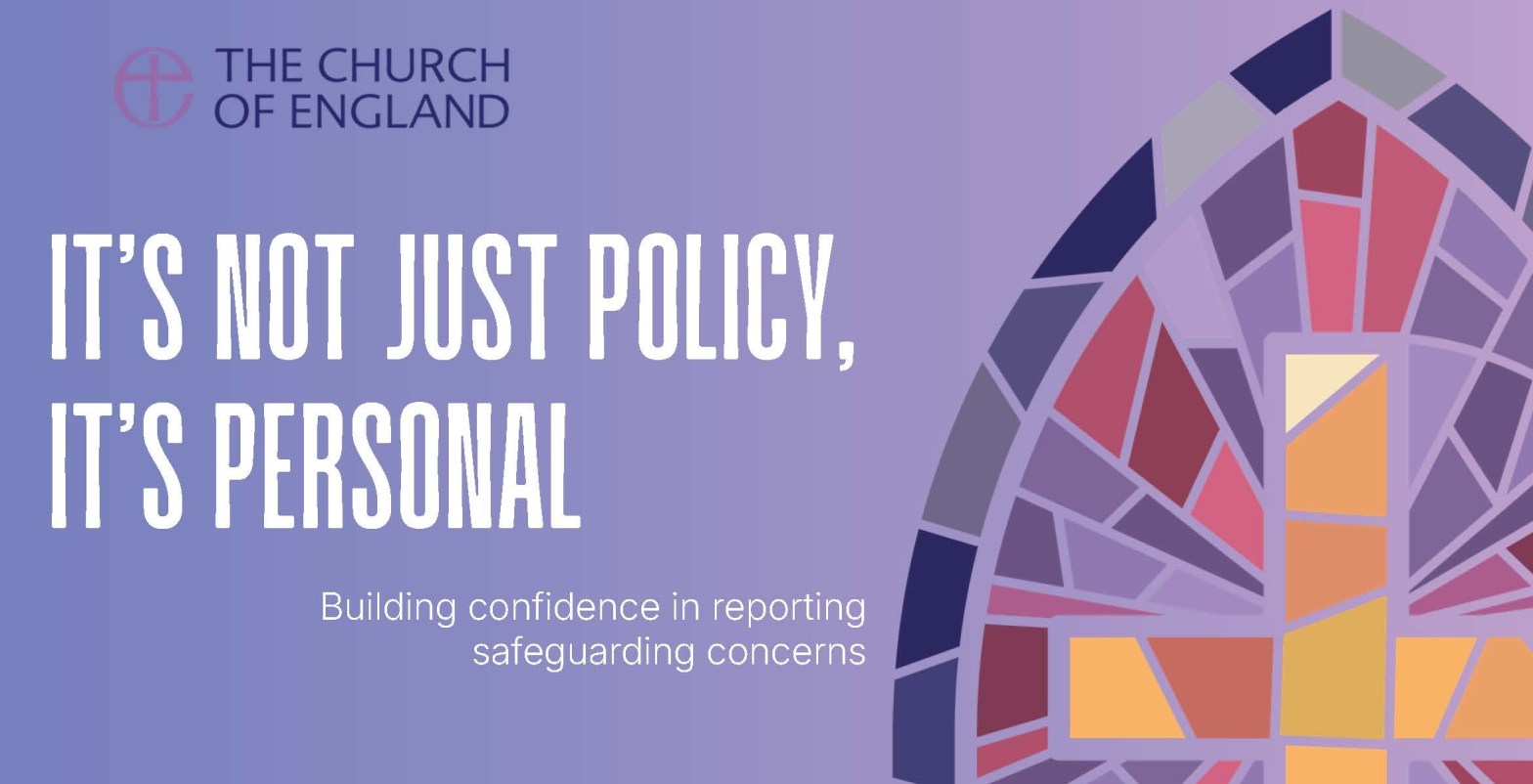
It’s not just policy, it’s personal
The latest guidance from the Church of England on what to do when a safeguarding concern arises. Find out more…
Barriers to Reporting Safeguarding
Reporting a safeguarding concern can feel complicated. This article names some of the most common reasons church officers hesitate, and why the Reporting Safeguarding Concerns and Allegations Code is there to support you through all of them. Read more….
Weekly Calendar
Sunday 7th June – First Sunday after Trinity
Eucharist (St. George’s Church) Matthew 5:31-37 – 9:30am
Will you dare to share the Christian life with others? Life groups are a great way to meet together regularly with a small group of other Christians, for mutual support, to share in reading God’s word and to pray for one another.
Please see Paul if you are interested in joining one. There are now more groups available! They meet at the following times:
Monday evening (two groups)
Tuesday afternoon
Wednesday morning
Wednesday evening
Thursday morning
There is also a youth life group on a Sunday afternoon.
Online Forms:
Under the ‘Contact’ tab on the website, there are now three forms that you can use to help us in managing the church:
Events Application Form. Use this if you are organising a church event that needs a church room booked, advertising or ticketing.
Submit a Notice. Use this if you want to ask us to include a prayer request or other notice in the church notice sheet or email.
If you volunteer in anyway at church the national authorities you should take at least the Basic Module in safeguarding training once every three years. If you hold a role connected with vulnerable adults or children and young people, then you will also need to take the Foundation Module. Once you have completed your training, please forward that certificate to James, our administrator, (office@churchramsgate.org) so that we can keep records of who has done the training.
Reporting a safeguarding concern should be straightforward. And yet, for many Church Officers, something gets in the way. More often it is doubt. A worry about getting it wrong, causing harm, or overstepping. These hesitations are understandable. They are also worth naming, because they are some of the most common reasons concerns go unreported.
What if it feels like interfering? When someone shares a concern with you, it is often because they want help. They are trusting you to do something with what they have shared. A safeguarding concern is never just a private matter, and you are not being asked to take sides or make a judgement. You are being asked to pass the concern on so that someone trained to help can take it from there. Keeping people safe and supported is at the heart of what we are called to do. That is not interference. That is care.
What if someone told you something in confidence, or asked you to keep it a secret? It takes courage for someone to share something difficult, and that matters. But a request for confidentiality cannot come before someone’s safety. Referring is not a betrayal of trust. In many cases, it is the most caring thing you can do.
What if it happened a long time ago? Non-recent concerns are still concerns. Time does not change the obligation to refer, and it does not make what happened any less important to the person who experienced it. If someone shares something that happened in the past, they may have questions about what happens next and what will be shared. Where you can, be honest with them about the process. Your DSO can help you navigate this conversation and make sure the person disclosing knows what to expect.
What if it involves someone senior? This is often the hardest barrier of all. The Reporting Safeguarding Concerns and Allegations Code exists precisely for moments like this. Seniority does not change the process, and you will not be left to handle it on your own.
What if you are not sure it is serious enough? The code does not ask you to investigate or to be certain. It asks you to refer, and to let the right people take it forward. If you are unsure, speak to your DSO. They are there to help you work through it. The Reporting Safeguarding Concerns and Allegations Code is there to guide you. Recognise. Respond. Record. Refer.
16 Then the eleven disciples went to Galilee, to the mountain where Jesus had told them to go. 17 When they saw him, they worshipped him; but some doubted. 18 Then Jesus came to them and said, “All authority in heaven and on earth has been given to me. 19 Therefore go and make disciples of all nations, baptising them in the name of the Father and of the Son and of the Holy Spirit, 20 and teaching them to obey everything I have commanded you. And surely I am with you always, to the very end of the age.”
Key notices: Beth’s return from maternity leave, Annual Parochial Church Meeting
Coming Up: Men’s Group Croquet, Relationships Matter Course
Opportunities to Serve: Service Team leaders needed, Tower and Crypt Tours at St. George’s
Interesting Blogs: When interruption becomes surrender, What makes anything right or wrong
Weekly Calendar
Online Forms: Event application, Submit a notice, maintenance report, access Safeguarding training
Scroll on…
Opening Reflection
The above verse is often seen as Jesus’ mission statement. What are we meant to be trying to achieve as the church? Jesus says, make disciples!
Jesus says that we are to make disciple of all nations. No nationality or indeed type of person is to be excluded from becoming a part of the church of God. All are to be invited into the family of Jesus. I love that our churches contain a great variety of people, including people from other nations, because it reflects our mission to reach out with the good news to all.
We are also to baptise them. Baptism is a sign of a changed life and a changed loyalty. In particular, Jesus teaches us that we should baptise people into the name of the Father, and the Son and the Holy Spirit. This Sunday is Trinity Sunday. We worship a Trinitarian God, a God who is both one, but also three persons. That is the God revealed to us by Jesus, that is the God whom we become identified with through baptism.
Finally, disciples are those who are seeking to learn from and follow a teacher. So Jesus says in the next verse, that we are to teach them to obey everything he has commanded. Matthew’s gospel, perhaps more than the other gospels contains much of Jesus’ teaching about how we are to live. That includes the ethical teaching in the Sermon on the Mount, but there are also many parables about growing the Kingdom of God and instructions on spreading the good news as well. Our mission must be done with love and compassion, but it has to involve words and a call on people to conform their lives to Jesus’ teaching.
The Church’s mission is not primarily about buildings, clergy or worship. They matter, but only in as much as they help to fulfil our calling to make disciples.
Paul Worledge
Key Notices:
Annual Parochial Church Meeting -This Sunday
This Sunday, our service will be a short communion service from 9:30-10:00am followed by the normal refreshments and our Annual Meeting from 10:15am. At the meeting we will be taking questions on the annual report, electing two Church Wardens, two Deanery Synod representatives, six PCC members and talking a bit about the plans going forward with space to ask questions about the plans. You need to be on the electoral roll to vote, but anyone is welcome to join with the meeting.
Beth’s return from Maternity Leave
Beth will be returning to full-time work in her curacy role in September. Between now and then will be a transition period, where she will initially take on a few things, then gradually take on more as we go through the summer. Please pray for her and the family as they manage this period of transition.
Coming Up:
Men’s Group – Croquet
On Tuesday 23rd June, at 5:30 for 6pm, the men’s group are holding a Croquet Evening at the Croquet Club on the Ramsgate Royal Esplanade (near the boating pool). It is £10 each. Please let Bruce know asap if you would like to come (07708 682464, brucestikes@btinternet.com).
Relationships Matter Course
A seven-week course exploring the good, true and beautiful picture of relationships, sex and sexuality expressed in the Bible. Newington Free church are running this Evangelical Alliance course on Saturday evenings (Saturdays 13, 20, 27 June; 4, 11, 25 July; 1 August), 7-8pm.
Opportunities to serve:
Service Team Leaders Needed
We are looking for people to go on a rota to help us run our Sunday services by opening and setting up the church before the service and clearing up after the service. If you can help in this way, then please speak to Paul or Mark.
Tower and Crypt Tours at St. George’s
We are still looking for people to join a team of people who may be willing to help out with the tower and crypt tours on Saturdays in the summer at St. George’s church. This is a great way to show a warm welcome to the public and also raise funds for the church. If you are interested let Paul know.
Interesting Blogs to Share:
AI and the Pornification of Thought
In this insightful and provocative article, Helen Collins compares the use of Large Language Models like Chat GPT with the use of porn and finds parallels between the two. Read more… (5mins)
Every Moment Holy
Listen to this Podcast discussing a new popular resource for Christians called, ‘Every Moment Holy’. It is a book of prayers produced to pray at ordinary moments in life. Find out more by listening… (45 minutes)
Weekly Calendar
Sunday 31st May – Trinity Sunday
Short Holy Communion (St. George’s Church) Matthew 28.16-20 – 9:30am
Community Soup (St. George’s Church) – 12:00-2:00pm
Sunday 7th – First Sunday after Trinity
Eucharist (St. George’s Church) Matthew 5:31-37 – 9:30am
Life Groups
Will you dare to share the Christian life with others? Life groups are a great way to meet together regularly with a small group of other Christians, for mutual support, to share in reading God’s word and to pray for one another.
Please see Paul if you are interested in joining one. There are now more groups available! They meet at the following times:
Monday evening (two groups)
Tuesday afternoon
Wednesday morning
Wednesday evening
Thursday morning
There is also a youth life group on a Sunday afternoon.
Online Forms:
Under the ‘Contact’ tab on the website, there are now three forms that you can use to help us in managing the church:
Events Application Form. Use this if you are organising a church event that needs a church room booked, advertising or ticketing.
Submit a Notice. Use this if you want to ask us to include a prayer request or other notice in the church notice sheet or email.
If you volunteer in anyway at church the national authorities are strongly encouraging you to take at least the Basic Module in safeguarding training once every three years.
If you have not completed the training in the last three years, then the module can be completed online and takes about ninety minutes. You can access the training by following this link. You will need to first register, to access the training. Once the training is completed, you will be sent a certificate. Please forward that certificate to James (office@churchramsgate.org), so that we can keep records of who has done the training.
Finally, let’s keep praying that we can carry out Jesus’ mission.
“Now to each one the manifestation of the Spirit is given for the common good.” (1 Corinthians 12:7)
This Sunday is Pentecost. It is the day we remember God sending his Holy Spirit onto the church. The events of the day itself were spectacular and memorable with the sound of a rushing wind, flames of fire settling on the disciple’s heads, the apostles praising God in different languages that visitors to Jerusalem could understand and, perhaps most amazingly, 3,000 people becoming Christians and being baptised!
True Christian Spirituality (1 Corinthians 12:1-11)
Recently I watched a couple of episodes of a TV programme that follows a group of celebrities of various faiths and none as they embark on a walking pilgrimage and speak to camera about the effect the experience is having on them. Among the group there is only one Anglican, who turns out to be non-practising and who, in the first episode, was surprised to learn that anyone at all believed in the existence of Jesus Christ, having previously considered him to be fictional. In the second episode, he asks his fellow pilgrims the following question: ‘What would you call a hybrid of, kind of, just people of faith, who are spiritual, who aren’t in a particular lane?’ meaning, a particular faith tradition. ‘Why would you need to pick a lane?’ he asked. ‘Why can’t you just appreciate all of it?’
Watching this programme made me wonder: If only there were reliable apostolic teaching to guide this questioner, and all who ask similar questions, about the nature of true Christian spirituality!
And recently I came across an Anglican source of information recommending a wide range of spiritual practices to students, including: going on a pilgrimage; learning about mosses or lichens; spending 15 minutes every day watching slugs or snails in their natural habitat; adopting the habit of talking to strangers in public places; getting a tattoo; attending yoga or breathing-based meditation classes; and so on.
And reading this resource made me wonder: If only there were reliable apostolic teaching to guide students, and all who seek such guidance, about the nature of true Christian spirituality!
The good news is that there is apostolic teaching about the nature of true Christian spirituality, and it is reliable precisely because of Pentecost. The stunning account of the coming of the Holy Spirit is the reading that is most commonly chosen for church services on Pentecost Sunday. Today, however, our reading concerns the stunning effect of the work of the Holy Spirit in the life of the church.
1 Corinthians chapter 12 begins with these words of the apostle Paul: ‘Now about spiritual gifts, brothers, I do not want you to be ignorant’. Except that it doesn’t begin like this, not quite. If it were spiritual gifts the apostle wanted his readers to know about in the first instance, he would have used the Greek word ‘charismata’ to describe them here in his opening line. But he doesn’t. Instead he uses the term ‘pneumatikos’, which when translated from Greek into English means either spiritual people, spiritual things, spiritual matters, or spiritual stuff. Many English translations of the Bible insert the word ‘gifts’ into this sentence, but there is no textual basis for doing so. A much better translation of verse 1 would be ‘Now about spirituality, I do not want you to be ignorant’.
And this is good news, because many of us, inside and outside the church, are in need of reliable apostolic teaching, not first of all about spiritual gifts, of what they consist, as important as that issue is. First and foremost, it is more important for us to know about true Christian spirituality, of what it consists. And this is exactly what we find in 1 Corinthians chapter 12. More precisely, in this chapter we are told at least four things about Christian spirituality – four things we ought to take to heart, if we haven’t already done so, or four things we need constant reminders of, even if we think they’re obvious, in case we ever forget, or are tempted to take them for granted.
And the first thing of four is this: true Christian spirituality is Jesus-centred. It begins and ends with the affirmation that Jesus is Lord. It’s there in 1 Corinthians 12, verse 3. If you come across a spirituality which does not put the lordship of Jesus Christ front and centre, then there is nothing specifically Christian about that spirituality. And our non-practising Anglican celebrity friend from the television is correct in one respect. Other spiritualities are available: spiritualities centred on the human body, on the human spirit, or on human potential; spiritualities based on the natural world, or on any number of assembled deities. The Corinthians knew this, and the apostle Paul writing to them knew this. At one time, Paul writes in verse 2, the Corinthians were pagans, influenced and led astray to mute idols, given over to ecstatic utterances, it may have been. What was the content of those utterances, Paul wanted to know? Did they confess the Lordship of Christ, or did they anathematise him?
This is the point at which we have to choose a lane. By affirming one thing, we inevitably reject its alternatives. If we think of ourselves as spiritual, but do not inhabit any particular faith, we are not in a position to appreciate any of them. Faith is only as good as its object. Indeed, it is nothing without an object. Christians do not put their faith, in faith. They dare not put their trust not in themselves, or the created order, nor in any other thing except the person of Jesus Christ, the Lord of heaven and earth. That is the identifying mark and beating heart of true Christian spirituality.
You would think that there would be agreement on this within the church, and yet there is a version of Christianity that, in the words of the social activist and blogger Jon Kuhrt, “has had its rough edges nicely rounded off, to ensure that it does not cause offence”; that foregrounds “the charity, the inclusion, and the community action” associated with Christian faith, “without reflecting the passion and fire that has driven the motivation to establish most of the significant Christian initiatives”. In his blog, Jon Kuhrt mentions the habitual saying of his father-in-law that “when you speak about Christianity, you’ve got to mention the J-word”, and he tells the story of when he shared this saying with a fellow Christian campaigner, who replied ‘You’re so right, justice is so important!’1
It turns out that all of us need constant reminders of the J-word, which many people use only as an expletive, lest we forget or downplay the centrality of the lordship of Christ to true Christian spirituality. The highest pinnacle of spirituality, as far as the apostle Paul is concerned, the greatest work of the Holy Spirit and the plainest evidence of his work is not an ecstatic spiritual gift. It is when people confess that Jesus Christ is Lord, to the glory of God the Father.
True Christian spirituality is also Spirit-enabled, as we learn from 1 Corinthians chapter 12, verse 3: ‘No-one can say ‘Jesus is Lord’ except by the Holy Spirit.’
When parcels are delivered, they are sent from the warehouse to customers via a delivery fulfilment centre, changing hands several times, and the final, most complex step in the logistical chain is the ‘last mile’ from the local hub to safe arrival in the hands of the intended recipient. The Holy Spirit is he who enables this ‘last mile’ from the Jesus of history to the Christ of faith formed in the hearts of believers.
At times, it seems as though the Spirit is the forgotten third person of the Holy Trinity, and yet his work in us, convicting us of sin and righteousness and judgement, as Jesus himself puts it (cf. John 16:8), this work completes and perfects the saving action of the Trinity towards humankind. ‘The Father sent the Son to be the Saviour of the world’ (1 John 4:14), but without the work of the Spirit creating and sustaining faith in us, it might all have been for nothing. But in point of fact, ‘if anyone acknowledges that Jesus is the Son of God,’ it is because God the Holy Spirit ‘lives in him and he in us’ (1 John 4:15). Thank God that the work of the Holy Trinity is not for nothing!
Whenever Christians have begun to lose sight of the work of the Holy Spirit, they have robbed themselves of the comfort of God’s embrace, and are at risk of being trapped within a paradigm of inadequate effort and uncertain reward in search of God’s favour. I don’t know when the rot started, but it certainly wasn’t in the days of the Protestant Reformation , when Martin Luther explained the phrase ‘I believe in the Holy Spirit’ in the following way:
‘I believe that by my own understanding or strength I cannot believe in Jesus Christ or come to him, but instead the Holy Spirit has called me through the gospel, enlightened me with his gifts, made me holy, and kept me in the true faith, just as he calls, gathers, enlightens, and makes holy the whole Christian church on earth and keeps it with Jesus Christ in the one common, true faith. Daily in this Christian church the Holy Spirit abundantly forgives all sins – mine and those of all believers. On the last day the Holy Spirit will raise me and all the dead and will give to me and all believers in Christ eternal life.’2
I suppose that, if we are being honest, the rot is at risk of starting every day, so conditioned are we to the language of merit and attainment, and so reluctant are we to acknowledge that we do not actually deserve the love poured out on us by God. This means that we require a fresh work of Pentecost to take place within us each new day, to sustain us in trusting and total reliance on his mercy.
True Christian spirituality is also community-minded. It is not the spirituality of self-actualisation, self-fulfilment, or self-absorption. It is very much like the opposite of those things. The apostle Paul evidently thought that this was a message that the Corinthians needed to hear. ‘There are different kinds of gifts, but the same Spirit,’ he writes in chapter 12, from verse 4 onward. ‘There are different kinds of service, but the same Lord. There are different kinds of working, but the same God works all of them in all. Now to each one the manifestation of the Spirit is given for the common good’.
A Bible scholar named Colin Kruse has pointed out what I suppose is obvious to anyone capable of reading between the lines here: “Several passages in 1 Corinthians 12 suggest that there were disintegratingforces at work in the Christian community at Corinth”, he writes. “On the one hand, there were those who weremade to feel inferior because they did not exercise the same spiritual gifts as others and thought they were unworthy to be regarded as members of the church, while on the other hand, there were those who became so inflated through the exercise of gifts given to them that they felt no need of other members of the church”3
Those who felt superior, did so because they were thinking of themselves, rather than others, and taking pride in themselves. Those who felt inferior, did so because they were thinking of themselves, not others, and despairing of themselves. Despair and pride: these are the forces of disintegration that can divide and conquer any congregation. God save us all from such self-absorption here at St Luke’s! God keep us humble of heart and considerate of others here at St Luke’s, in mutual service and genuine love.
Whatever gifts we have, the apostle Paul tells us, put them to work for the common good, and not for the sake of your own self-esteem. The community needs these gifts to function and flourish, to be sure, because we each have something unique to bring to the table, and we should not hesitate to bring it. But our egos ought not be bound up with the exercise and recognition of our gifts. The heart of true Christian spirituality is expressed in the prayer of Richard Alleine, which was taken up by John Wesley: ‘I am no longer my own, but yours. Put me to what you will, rank me with whoever you will. Put me to action, put me to suffering. Let me be employed for you, or laid aside for you, exalted for you or brought low for you. Let me be full, let me be empty. Let me have all things, let me have nothing. And now, O glorious and blessed God – Father, Son, and Holy Spirit – you are mine, and I am yours’.
True Christian spirituality is marked not only by selflessness towards God in prayer, like this prayer of Alleine and Wesley, but also by selflessness towards others in community. It does not entail an interior mystic journey of the soul in the ecstasy of solitude, and the glorious privilege of non-contradiction. Instead, it involves the embodied, real-world experience of everyday life, together with others, and the demands they place upon us.
So true Christian spirituality is Jesus-centred, Spirit-enabled, and community-minded. Last but not least, true Christian spirituality is freely given, rather than being achieved. ‘To one is given through the Spirit the message of wisdom,’ we are told in 1 Corinthians 12, verse 8, ‘to another the message of knowledge by means of the same Spirit, to another gifts of healing by that one Spirit’, and so on and so forth down to speaking in different kinds of tongues, and the interpretation of tongues (1 Corinthians 12:8-10). ‘All these are the work of one and the same Spirit’, writes the apostle Paul in verse 11, ‘and he gives them to each one, just as he determines’. Whatever he does is in his gift, and it is altogether his free gift.
Most gifts are not like this, are they? Every year there is a Christmas dinner and a secret Santa gift exchange at the office in which I work. A month or so before the dinner, my colleagues and I agree on a spending limit and circulate details of items within that threshold we would welcome as gifts. On the evening of the dinner, we exchange cards, unwrap our parcels and usually find within them something that was on our wanted lists. I do something similar to this for Christmas with members of my immediate family, and I would not be surprised to learn that you do too. These kind of arrangements are reciprocal. At their best, they are motivated by appreciation, friendship, and love, rather than obligation. For the most part, I hope, they are well received, though it is worth mentioning that there is a risk-reward calculation involved in the occasional purchase and giving of something that did not appear on any list. Generally speaking, these exchanges conform to a clearly understood pattern, and there is nothing wrong with that. Even so, it may be observed, without criticism, that they are not entirely free practices. They operate within well-established social conventions.
The Holy Spirit, by contrast, is completely free. He gives gifts ‘just as he determines’ to those who have had no opportunity to specify their preferences, and who are in no position to reciprocate. I think that this is incredibly liberating. When it comes to the practice of spirituality, I believe we are prone to being uptight and stressed out. That is why there are TV programmes about people searching for a sense of the sacred, and that is why there are self-help style resources for spirituality involving as often as not an enchantment with nature or a deep dive into one’s own psyche. The apostle Paul’s message of liberation is that we don’t have the responsibility to find or to make sense of ourselves, because God himself, in the person of the Holy Spirit and in his freedom, has loved us, sought us out and found us.
There is absolutely no space for Christians to be smug about any of this. Those in the church are just as prone as anyone else to be anxious and stressed out about spirituality in general, and spiritual gifts in particular. But if the Holy Spirit gives gifts for the common good, and just as he determines, then that lifts true Christian spirituality out of the realm of human achievement and performance anxiety altogether. We may speak in this way as a direct consequence of the saving work of God the Holy Spirit at Pentecost, travelling the ‘final mile’ to reside within our hearts, renew our faith, and inspire our hope. We may pray for this to be the daily reality of our lives, and – because this is his work, not ours – we may be thankful, and live lives of gratitude and pure joy.
Key notices: Are you called to serve on the PCC?, Life in Tudor Ramsgate
Coming Up: This Sunday, Dunkirk Little Ships service, Pentecost Service – Churches Together in Ramsgate, Annual Parochial Church Meeting
Opportunities to Serve: Tower and Crypt Tours at St. George’s
Interesting Blogs: When interruption becomes surrender, What makes anything right or wrong
Weekly Calendar
Online Forms: Event application, Submit a notice, maintenance report, access Safeguarding training
Scroll on…
Opening Reflection
This Sunday is Pentecost. It is the day we remember God sending his Holy Spirit onto the church. The events of the day itself were spectacular and memorable with the sound of a rushing wind, flames of fire settling on the disciple’s heads, the apostles praising God in different languages that visitors to Jerusalem could understand and, perhaps most amazingly, 3,000 people becoming Christians and being baptised!
The work of the Spirit is not ordinarily that spectacular, but it is aways important. It is not limited to those who speak up front in church services or to super-spiritual Christians. As our verse makes clear, it is given to each one of us that are truly Christians. If you have decided to follow Jesus and trust that he has achieved everything necessary to ensure the forgiveness of your sins, your status as a child of God and your place in God’s eternal home, then you have received the Holy Spirit in your life.
The Spirit is there to help us, assure us and comfort us, but it is also there to enable us to be a help for others. Our faith was never meant to be an individualistic faith between just me and God, it was always meant to be a faith to be lived in community. So, we are given ‘manifestations’ or ‘gifts’ of the Spirit to enable us to serve one another for the common good.
Each person’s service will be different, because the Spirit gifts us in all kinds of ways. For some it may enable them to take on official roles in the church, for others it may be just about how they informally encourage and support others around them. For some it may involve speaking God’s words to build people up in the faith, whilst for others it will involve practical acts of service and care. All are essential and all are part of God’s plan to build his church. Let’s all pray for God’s Spirit to work more fully through us and among us.
Paul Worledge
Key Notices:
Are you called to serve on the PCC?
Nomination forms for the roles of PCC member, Church Warden and Deanery Synod representatives are now available at the back of church, along with role descriptions. At our Annual Meeting next Sunday after a shortened 9:30am service we will have our annual meeting. At this meeting we will be seeking to elect two Church Wardens, two Deanery Synod representatives and six PCC members. Please let Paul or Sue have nomination forms as soon as possible and by Sunday 31st May at the latest.
Last Saturday we were treated to a fantastic talk by Margaret Bolton on what it was like to live in Ramsgate in Tudor times. Margaret was dressed in Tudor attire and her talk included illustrations examples of what English would have sounded like in Tudor times and singing! There were 32 in the audience, and we raised £191.82 for the Church Restoration Fund. A big thank you to Margaret and to all those who helped host and provided the refreshments.
Coming Up:
This Sunday 24th May
St. George’s is hosting another parade service to celebrate the evacuation of the Allied forces from Dunkirk in May 1940. The service will take place at 11am. However, there will be a small short communion service in the chancel to celebrate Pentecost from 9:30-10:00am.
Pentecost Service – Churches Together in Ramsgate
Join other Christians from around Ramsgate for our next joint service on Sunday 24th May, 6pm at the Royal Harbour Academy, Upper Site, off the New Haine Road. There will be praise, prayer and Bible teaching, along with activities for all ages.
If you want a lift from St. Luke’s then let Paul know and we can give lifts from St. Luke’s from 5:30pm.
Opportunities to serve:
Tower and Crypt Tours at St. George’s
We are still looking for people to join a team of people who may be willing to help out with the tower and crypt tours on Saturdays in the summer at St. George’s church. This is a great way to show a warm welcome to the public and also raise funds for the church. If you are interested let Paul know.
Interesting Blogs to Share:
When interruption becomes surrender
In this reflective article, a nurse considers that come from the pressure of her intense job. Read more… (5 mins)
What makes anything right or wrong?
In this ten-minute video, Glen Scrivener, a Christian apologist debates with Stephen Woodford an Atheist about how we decide what is right or wrong. Watch the video
Community Soup (St. George’s Church) – 12:00-2:00pm
Sunday 31st – Trinity Sunday
Short Holy Communion (St. George’s Church) Matthew 28.16-20 – 9:30am
APCM (St. George’s Church) – 10:15-11:15am
Life Groups
Will you dare to share the Christian life with others? Life groups are a great way to meet together regularly with a small group of other Christians, for mutual support, to share in reading God’s word and to pray for one another.
Please see Paul if you are interested in joining one. There are now more groups available! They meet at the following times:
Monday evening (two groups)
Tuesday afternoon
Wednesday morning
Wednesday evening
Thursday morning
There is also a youth life group on a Sunday afternoon.
Online Forms:
Under the ‘Contact’ tab on the website, there are now three forms that you can use to help us in managing the church:
Events Application Form. Use this if you are organising a church event that needs a church room booked, advertising or ticketing.
Submit a Notice. Use this if you want to ask us to include a prayer request or other notice in the church notice sheet or email.
If you volunteer in anyway at church the national authorities are strongly encouraging you to take at least the Basic Module in safeguarding training once every three years.
If you have not completed the training in the last three years, then the module can be completed online and takes about ninety minutes. You can access the training by following this link. You will need to first register, to access the training. Once the training is completed, you will be sent a certificate. Please forward that certificate to James (office@churchramsgate.org), so that we can keep records of who has done the training.
Finally, let’s keep praying for greater works of the Spirit in our lives.
“But you will receive power when the Holy Spirit comes on you; and you will be my witnesses in Jerusalem, and in all Judea and Samaria, and to the ends of the earth.” (Acts 1:8)
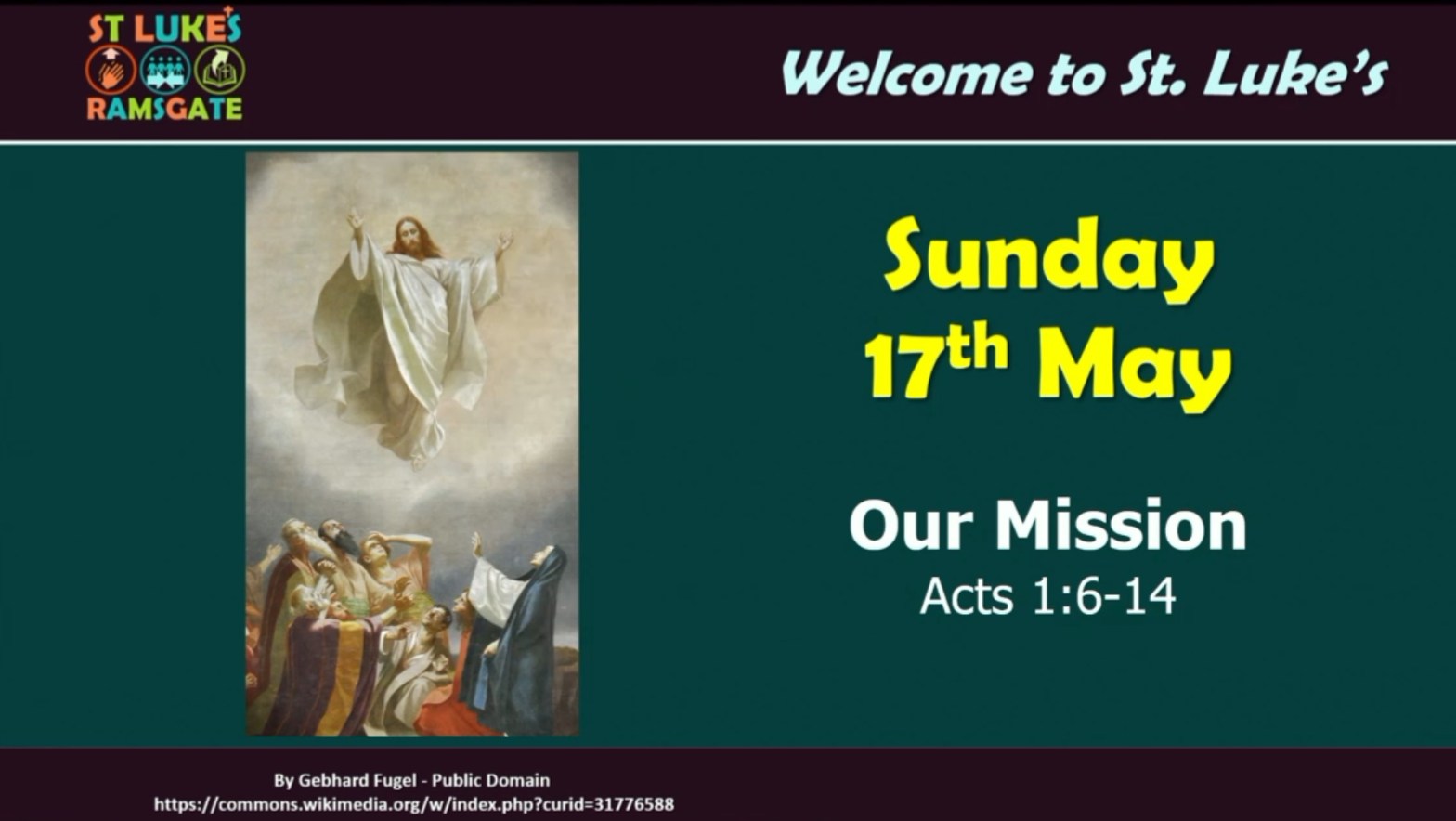
This Thursday was Ascension Day. It is the day when we remember that Jesus, after proving that he had bodily resurrected from the dead, went to the Father in heaven to take his place at God’s right hand to rule in power. So, we remember the power and authority of Jesus not just over the Kingdom of Israel, but the whole world.
“Where is Jesus now?” is a question I am sometimes asked. People kind of know that Jesus died and rose again, but they are not sure what happened next. If he rose from the dead, then where is he now?
The answer is that he has ascended. That is what we remember on Ascension Day, which was last Thursday and it is what our passage from Acts tells us about. The resurrected Jesus left earth to return to heaven and take up his place at God’s right hand.
That is good news for us now for many reasons. Three are quickly worth pointing out:
Firstly, he is securing our place in God’s Home. Jesus says in John’s gospel:
“In my Father’s house are many rooms; if it were not so, I would have told you. I am going there to prepare a place for you.” (John 14:2)
Secondly, he is interceding for us
“Who is he that condemns? Christ Jesus, who died–more than that, who was raised to life–is at the right hand of God and is also interceding for us.” (Rom. 8:34)
Jesus died the sacrificial death for us. He is in heaven to present that sacrifice to God and so secure our forgiveness and status as God’s children as well as the help we need day by day in life. He is our man in heaven!
Thirdly, he is ruling for us
“And God placed all things under his feet and appointed him to be head over everything for the church,” (Ephesians 1:22)
Jesus at God’s right hand has the ultimate authority and power. But he uses that power for the sake of his church.
What is Jesus doing among us now?
I regularly write an article for the St. George’s magazine the Lantern, and as Ascension Day falls in May this year, I wrote about what it means for Jesus to be ascended.
Mark Ogden read the article, which is always encouraging, but came back with a gentle question:
“What is Jesus / the Spirit of Jesus doing now on earth and among us?”
It’s a good question and in a sense is one that the book of Acts provides the beginning of an answer to. Indeed, at the start of the book, Luke writes,
“In my former book, Theophilus, I wrote about all that Jesus began to do and to teach” (Acts 1:1)
The implication is that what Jesus had done in his life, death and resurrection was only the beginning, the start of something amazing. This second book, is going to talk about what Jesus continues to do on earth in and among his followers.
Indeed, in these opening verses, that seems to be the transition. The disciples first of all ask Jesus the question:
“Lord, are you at this time going to restore the kingdom to Israel?” (Acts 1:6)
This question has a few assumptions to it:
First, they think that Jesus’ Kingdom of God project is limited to Israel.
Second, they assume that Jesus’ work is complete, now he can simply restore things to the way they should be.
Third, they seem to assume that they have no role to play in bringing about that restoration.
But, Jesus’ response is first of all to deal with the question directly, by saying they can’t know God’s timings. The full restoration will come when Jesus returns, which the angels later re-assure them will happen, but they and we cannot know when that will be. So, we live between Christ’s first and last coming, the time when in one sense the Kingdom of God is already in place, because Jesus is on his throne in heaven, but in another sense we still await the full restoration, because we live in a world still full of sin, evil and death.
Jesus also challenges their assumptions. In verse 8, he says two times, this is what you are going to do, they now have a role to play in advancing the Kingdom of God. This, however, is also Jesus’ continuing work, they will do it in the power of the Holy Spirit, that Jesus will send from heaven. Finally, this work is not limited to Israel, it is to go beyond Israel to the ends of the Earth!
Stop Staring, Start Sharing…
Perhaps linked to this challenge is what happens, when Jesus does ascend into heaven. He disappears before their eyes as he rises up from them and is obscured by a cloud. So, they are left staring.
We too can be so amazed by Jesus and what he has achieved and who he is, that we are left simply staring at his glory in wonder and awe. We can be so caught up in studying Jesus and finding out about him – which is all necessary and good – that we forget that God has a job for us to do.
Like the disciples, perhaps we too need to heed the words of the angels: “Why do you stand looking into the sky?” It’s a kind of comical question and its implication is stop staring and start sharing. Stop meditating on who Jesus is and start doing what Jesus wants!
So, how are we to stop sharing and start sharing? Can I suggest three points that I think arise out of the passage?
Share in Power of the Spirit – vs. 8a
In verse 8, Jesus is clear that they will receive power from on high when the Holy Spirit comes on them. We can often feel powerless as Christians. Powerless, because we seem to be such a small group in the face of a world that seems not to care about Christ, powerless because we feel the pressures of trying to just keep the church on the road, powerless because we are so aware of the limitations of our own talents and abilities.
But this was all true for the first disciples. Luke tells us that the core community of Jesus followers in Jerusalem was just 120 people. Few if any were wealthy, few if any were carefully trained, few if any had any real influence in the world. Yet, in time, from that small seed, the mighty Roman Empire was converted from paganism to Christianity and the good news of Jesus spread around the world. How was that possible? The power of the Holy Spirit.
So, the same is true for us. It is very easy to focus on our limitations and to give up on doing anything for Christ. It is easier to sit back and stare at Christian YouTube videos or just come to church and enjoy the service. But, God wants to share his power with us by the Holy Spirit, to enable us to play our part in growing his Kingdom.
The parts we play as individuals will of course all be different. And one of the things it is always good to do at the time of Annual Meetings is to celebrate the many different ways people help serve in our churches, whether it is by being elected to the PCC or teaching in Sunday School, leading a life group, serving tea and coffee, or just coming and encouraging one another, and inviting others to come to church, all these are important ways of serving, which we need the power of the Holy Spirit to do.
So, let’s be people that stop staring and start sharing.
Share in Proclamation to the World – vs. 8b
The second point, is that Jesus says their role is to be witnesses first in Jerusalem, then in Samarian and then to the ends of the earth. This gives us an outline of the structure of the book of Acts. The first few chapters are about the church growing in Jerusalem as more and more people believe the proclamation of the apostles about Jesus’ death and resurrection. Then the message spreads to Samaria, initially through Philip, then it starts spreading all over the place, with the books focus being on the work of Paul in spreading the word, eventually to Rome itself.
However, other traditions tells us that Thomas one of the Twelve, actually travelled as far as Southern India and shared the good news of Jesus there!
Our role may not be to travel far, but we are called to help proclaim the good news about Jesus as far and wide as we can. Within this congregation there is a wide network of contacts. People you can invite to services, others God may give opportunities to talk to about your own faith and why it matters to you, others who may be open to finding out more. Let’s not beat ourselves up by our failure to proclaim the word, but let’s pray that God may open our eyes to see the opportunities that we might otherwise miss.
Although, much of our vision and planning can be taken up with discussions with what to do about our buildings, our ultimate aim, and the ultimate purpose for our buildings, must always be to provide opportunities for more people to come and discover the good news about Jesus. That is why our buildings were built in the first place. That is why our key aims are not just around developing and selling buildings, but about growing new worshipping communities, so we can reach more people with the gospel and developing our youth work, so that the next generation can hear the good news as well.
Will you stop staring and start sharing in proclaiming the good news about Jesus?
Share in Prayer together – vs. 14
So, that is what Jesus says he wants them to do. But what do they do first while they wait for the Spirit to come? They pray together.
Jesus had modelled prayer to them. Jesus did not rush into ministry, he spent forty days in the wilderness, no doubt to pray. Before choosing the Twelve, he prayed. When things were going well, he prayed that he might stay focussed on the correct mission.
So, as the disciples are faced with this enormous task, their first instinct is to pray.
But, notice they pray together. And by together, I mean groups that had been apart in the past came together to pray. Verse 14 tells us that Jesus’ disciples prayed alongside Jesus’ brothers. We do not hear much about Jesus’ brothers, but during his ministry, they were often critical of how Jesus was going about things and they were certainly a distinct and separate group to Jesus’ disciples.
Yet, from 1 Corinthians 15, we know that the resurrected Jesus also appeared to Jesus’ brother James, and from later in Acts, we know that James became the leader of the church in Jerusalem and his voice played a key role in some of the important decisions made by the early church.
What had been two distinct groups of people loyal to Jesus in different ways, were now working together. In particular, they were sharing in prayer together.
As we look for St. Luke’s and St. George’s to work more closely together in our Dare to Share vision, we are aware that we are two distinct groups, with different ways of approaching the worship of Jesus. Yet, we are all loyal to the same Christ and we are together called to be God’s light in Ramsgate. So, let’s express that by praying together.
One of the best blessings of the last year has been the development of the Dare to Pray prayer meeting which happens on the third Saturday of every month at St. George’s. We met yesterday. The number of people there varies between half a dozen and fifteen, but there is always a mixture of people from St. Luke’s and St. George’s and the prayers have I believe really helped us as we move forward together as churches. We also share together what we think God maybe saying to us.
So, why not make praying together, especially with other Christians locally a key part of your commitment to the life of the church. Join us next month. Or why not come and join with an even wider group of Christians from around Ramsgate at the Churches Together Pentecost Service at the Royal Harbour Upper Site next Sunday evening?
Will you stop staring and start sharing in prayer with Christians from different groups?
Stop Staring, start sharing
So, will you stop seeing Christianity as an interesting thing to stare at and start sharing in Christ’s continuing work today. Will you dare to share in the power of the Holy Spirit, in the proclamation of the gospel and in praying together with others?