“But you will receive power when the Holy Spirit comes on you;and you will be my witnesses in Jerusalem, and in all Judea and Samaria, and to the ends of the earth.”
Key notices: Dare to Pray, Collection for Christian Aid, Are you called to serve on the PCC?, Tower and Crypt Tours
Coming Up: Life in Tudor Ramsgate, Men’s Group – Mini-Golf, Dunkirk Little Ships, Pentecost Service – Churches Together in Ramsgate, Annual Parochial Church Meeting
Wider Church: The Latest from ACTS
Interesting Blogs: What motivates us?, Hunger and Thirst for Righteousness
Prayer Requests
Weekly Calendar
Online Forms: Event application, Submit a notice, maintenance report, access Safeguarding training
Scroll on…
Opening Reflection
“But you will receive power when the Holy Spirit comes on you;and you will be my witnesses in Jerusalem, and in all Judea and Samaria, and to the ends of the earth.” (Acts 1:8)
This Thursday was Ascension Day. It is the day when we remember that Jesus, after proving that he had bodily resurrected from the dead, went to the Father in heaven to take his place at God’s right hand to rule in power. So, we remember the power and authority of Jesus not just over the Kingdom of Israel, but the whole world.
His return to one place, his throne in heaven, meant that his power could operate in every place. From there he could send out the Holy Spirit on all Christians, so that His power would be operative through them, wherever they might be. Now his body is the church, spread throughout the globe, living and proclaiming the good news of Jesus’ death and resurrection and inviting people to receive forgiveness of sins, a relationship with God and the hope of eternal life.
We can do that, even though people may challenge our right to invite people from different cultures to become Christians, because Jesus as the one sitting at the right hand of God, is ruler over all cultures and ethnicities. As he says, at the end of Matthew’s gospel, “All authority in heaven and on earth has been given to me. Therefore, go and make disciples of all nations…” (Matthew 28:18-19a)
Finally, because Jesus is in heaven and ruling in power, we can have greater confidence to pray. This was the initial response of the disciples immediately after Jesus’ ascension as they awaited the coming of the Holy Spirit. It should be our first instinct too. Why not use this time to recommit to prayer in your life and with others.
Paul Worledge
Key Notices:
Dare to Pray, prayer meeting
Join us Saturday, 9:30am to 10:30am at St. George’s Church for our monthly dare to pray prayer meeting. This week the focus will be specifically on praying for our Annual Meetings and all those serving on our PCCs.
Collection for Christian Aid
Many of you will be aware that the past week has been Christian Aid week and will already be donating through their envelope scheme. However, since Christian Aid is one of the three charities we have agreed to support as a church, we will also make the loose collection at this Sunday’s service to go towards Christian Aid. So, any money you put in the collection or the card machine by the door this Sunday will be donated to Christian Aid.
Are you called to serve on the PCC?
Are you interested in helping our church flourish? Do you want us to be more effective at daring to share the gospel with the outside world and life with one another? Do you long to see a church that is growing rather than struggling? Do you want to help steer our church through the big changes in the coming years? None of this can happen, unless we dare to share the organisational load of running a church. We need people to join our Parochial Church Council, who are effectively the trustees of St. George’s, to work with the vicar in overseeing the work of the church. If you are interested, then please speak to Paul or another PCC member. Elections take place at the annual meeting on 31st May, and nominations need to be made by then.
Tower and Crypt Tours at St. George’s
We are still looking for people to join a team of people who may be willing to help out with the tower and crypt tours on Saturdays in the summer at St. George’s church. This is a great way to show a warm welcome to the public and also raise funds for the church. If you are interested let Paul know.
Coming Up:
Life in Tudor Ramsgate – THIS SATURDAY
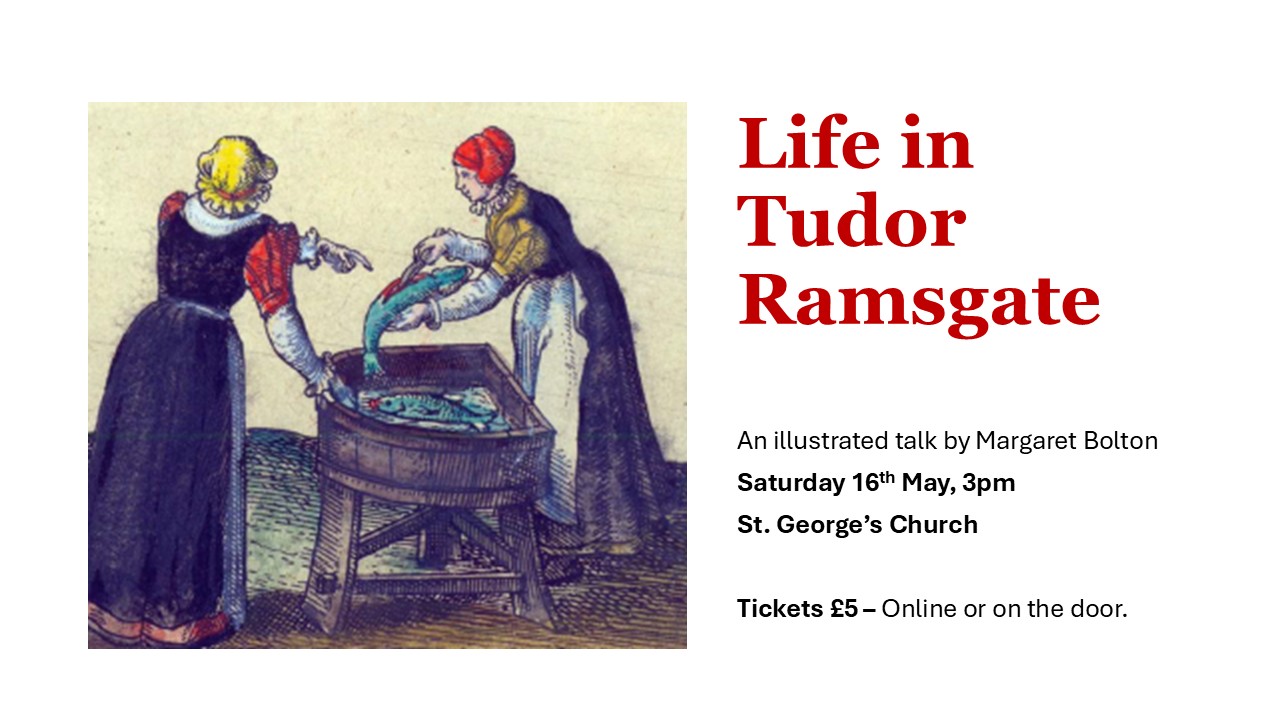
On Saturday 16th May, 3pm, Margaret Bolton will be giving a talk about Tudor Ramsgate. It will include insights into school life, the work of a housewife, the jobs people did, visits by important people and the experiences of family life. Tickets will be £5 with all proceeds going to the St. George’s Restoration fund. Tickets available online, via the St. George’s website or on the door.
Men’s Group – Mini-Golf
Wednesday 20th May, 6pm at Strokes in Margate. Trophy night for him with the lowest score! Early start, lifts to the course, snacks available. £7.50. Contact Bruce Stokes 07708 682464, bruce.stokes@btinternet.com.
Dunkirk Little Ships – Sunday 24th May
Next Sunday, St. George’s is hosting another parade service to celebrate the evacuation of the Allied forces from Dunkirk in May 1940. The service will take place at 11am. However, there will be a small short communion service in the chancel to celebrate Pentecost from 9:30-10:00am.
Pentecost Services – Churches Together in Ramsgate
Join other Christians from around Ramsgate for our next joint service on Sunday 24th May, 6pm at the Royal Harbour Academy, Upper Site, off the New Haine Road. There will be praise, prayer and Bible teaching, along with activities for all ages.
Annual Parochial Church Meeting (APCM)
The Annual meeting is on Sunday 31st May after church. There will be elections for two Churchwardens, two Deanery Synod reps and six PCC members. Please consider standing or encouraging others to stand.
Wider Church:
The latest from ACTS
Check out the latest newsletter from ACTS by clicking here….
Interesting Blogs to Share:
What motivates us, recognition by others or God?
This brief article summarising a video reminds us that many of the key people in the Bible go unnamed. Yet, they are not insignificant in God’s plan or work. Read more…
Hunger and thirst for righteousness
In this brief article, the writer reflects on their experience of deep thirst when travelling in the Middle East and what this famous beatitude of Jesus really means. Read on…
Dunkirk Little Ships Service (St. George’s Church) – 11:00am-12:00pm
CTiR Pentecost Service (Royal Harbour Academy) – 6:00pm
Life Groups
Will you dare to share the Christian life with others? Life groups are a great way to meet together regularly with a small group of other Christians, for mutual support, to share in reading God’s word and to pray for one another.
Please see Paul if you are interested in joining one. There are now more groups available! They meet at the following times:
Monday evening (two groups)
Tuesday afternoon
Wednesday morning
Wednesday evening
Thursday morning
There is also a youth life group on a Sunday afternoon.
Online Forms:
Under the ‘Contact’ tab on the website, there are now three forms that you can use to help us in managing the church:
Events Application Form. Use this if you are organising a church event that needs a church room booked, advertising or ticketing.
Submit a Notice. Use this if you want to ask us to include a prayer request or other notice in the church notice sheet or email.
If you volunteer in anyway at church the national authorities are strongly encouraging you to take at least the Basic Module in safeguarding training once every three years.
If you have not completed the training in the last three years, then the module can be completed online and takes about ninety minutes. You can access the training by following this link. You will need to first register, to access the training. Once the training is completed, you will be sent a certificate. Please forward that certificate to James (office@churchramsgate.org), so that we can keep records of who has done the training.
“Do not be overcome by evil, but overcome evil with good.” (Romans 12:21)
The Christian message is that evil has been overcome by good. On the cross, Jesus defeated Satan and bore the the sin of the world whilst remaining perfectly obedient to God. Even though, he was treated unjustly and abused in the lead up to his brutal crucifixion, he did not retaliate, but bore it all to bring about our salvation. Jesus overcame evil with good.
At the end of our service, we are going to give Amelia a lighted candle. When we do so, we will talk about how as Christians, God has called us out of darkness to be a people of light. It is beautiful imagery, but what does it mean?
Well, Jesus who is himself, the light of the world tells his followers, “You are the light of the world.” But what does that mean. He goes on to say,
“In the same way, let your light shine before people, that they may see your good deeds and praise your Father in heaven.” (Matthew 5:16)
Living as people of light means being good, it means learning to please God in the way that we live.
Fruit of the Spirit
At St. Luke’s we are doing a series on the fruit of the Spirit. We are looking at the characteristics, that as Christians we should be naturally developing to imitate God’s character in our day to day lives. This week, the characteristic we are considering is ‘goodness.’ For Christians, those who seek to follow Jesus, because we believe God is good, we too are to be good in the way we live.
But that is not a view that fits easily with the outlook of many. In today’s world, we have an increasing tendency to see ourselves as victims of our circumstances, to focus and dwell on the ill-treatment we so often receive from others, and the problems we face as a result. From this perspective, the problem is not my lack of goodness, but the forces of evil in the world, whether it be sexism, racism, or the abuse of those in power.
Such an attitude can mean we struggle to believe that there is a good God. When all we focus on is the oppression and evil in the world around us, then we are likely to say, “How can there be a good God, when the world is full of so much suffering and evil?”
There is all the difference in the world, between seeing yourself as a child of a good God and the victim of a corrupt society. The first viewpoint can lead to a life full of goodness and faith, the second is more likely to lead to despair.
We cannot deny the wickedness and evil in the world, but as Christians we believe that they are not fundamental or permanent, what is ultimately fundamental and permanent is the good God of Jesus Christ.
As it says in Romans:
“And we know that in all things God works for the good of those who love him, who have been called according to his purpose.” (Romans 8:28)
This truth is played out powerfully in the story of Joseph.
Joseph’s Goodness
Many of you will know the story of Joseph, it is one of the best-known stories in the Bible and it has even been turned into a musical: Joseph and his Technicolour Dreamcoat.
Joseph has every reason to see himself as a victim. Although he had been his dad’s favourite child, symbolised by the fact that his dad had given him a beautiful coat to wear, his brothers out of jealousy had kidnapped him taken away his coat, sold him as a slave covered the coat in goat’s blood and told their father that he had probably been killed by a wild animal.
Joseph is then taken to Egypt and sold as a slave into the house of Potiphar an official to Pharaoh, the king of Egypt. So, he finds himself, an oppressed slave and a despised foreigner. Yet, the Bible asserts that God was with him.
Joseph’s Good Work
Joseph could have sunk into despair and self-pity. He could have given up in the face of terrible circumstances. But he doesn’t. Instead, he does good. In particular, he does good work for his master Potiphar. So much so, that everything he does is so successful, that Potiphar notices and keeps promoting him, until in the end he trusts him to run his whole household.
Joseph, who lived hundreds of years before Jesus, nonetheless shows us what
it means to:
“… let your light shine before men, that they may see your good deeds and praise your Father in heaven.” (Matthew 5:16)
He is also living out the promise made to his great-grandfather Abraham,
“I will bless those who bless you, and whoever curses you I will curse; and all peoples on earth will be blessed through you.” (Genesis 12:3)
By doing good work for his master who is an Egyptian, Joseph enables God’s blessing to flow through him to the Egyptians.
God’s calling to us as Christians in our workplaces is to be those who do good work, who bring blessing to the companies or organisations we work for, whether those companies or organisations are kind to us or not.
Joseph resists Evil
But goodness is not just doing good work, it is also resisting doing what is evil.
Joseph was a naturally very good-looking young man. But good looks can be a curse, they can bring unwanted attention. In this case his master, Potiphar’s wife, took a shine to Joseph. She asked him to sleep with her. In fact, she kept asking him to sleep with her!
But Joseph resists the temptation. He tells her that he can’t do it, because it would betray the trust that has been given to him by his master, it would disrespect their marriage, and it would be a sin against God. Indeed, Joseph describes what she is proposing as wicked or evil and refuses to even be with her.
Joseph, demonstrates goodness, by not just resisting doing something he knows is wrong, but by being very clear why it is wrong and seeking to avoid the temptation altogether by avoiding being with her.
Joseph does not make light of sin. He does not downplay why it is wrong or flirt with the possibility but draws out the full seriousness of sin and flees from it.
In this way, he mimics Jesus who famously, resisted the temptations of the Devil. Indeed, the New Testament says that Jesus was completely without sin. He was totally good.
Goodness does not flirt with wickedness it is repulsed by evil.
Joseph is a great example of what it means to live a good life.
Potiphar’s Wife
But then comes the twist. Potiphar’s wife destroys the good Joseph. Although Joseph is a victim of her wickedness, she is the one who plays the victim.
Joseph’s brothers had betrayed him and taken his coat. Now in an echo of that moment of injustice, Potiphar’s wife, in a desperate attempt to seduce him forcefully removes some of his clothing, but Joseph flees from her.
Then she twists the story. She calls her servants in and plays the victim. Here she is the victim of an attempted rape by this foreigner that her husband has brought into the house. She builds sympathy for her fate, by appealing to her servants’ racist tendencies, as well as the natural loathing of their boss.
When she tells her husband her version of events, he is naturally furious and Joseph ends up in jail. In playing the victim, Potiphar’s wife is creating a victim in Joseph.
Was God good to Joseph?
But this raises the problem that we started with. Is God really a good God? Was he good to Joseph?
At the start of the story, the stress is that God was with Joseph. Although he had been sold as a slave by his brothers, God had helped Joseph to be successful in his new situation. But that all comes to nothing. Joseph ends up in jail.
Crucially, this is not the end of the story. The jail he is thrown into is the one where Pharoh’s prisoners were kept. Joseph will end up correctly interpreting the dreams of Pharaoh’s cupbearer, who will be restored to Pharaoh. When Pharaoh, then has trouble interpreting the dream, the cupbearer recommends Joseph and so Joseph ends up not just running Potiphar’s household, but the whole of Egypt. He does so to help Egypt and other nations survive a terrible drought. Even his brothers end up saved from starvation, because of Joseph’s leadership and are reconciled with him.
At the point of being thrown into jail, Joseph may well have doubted that God was good. But by the end of his life, he could look back and say to his brothers,
“You intended to harm me, but God intended it for good to accomplish what is now being done, the saving of many lives.” (Genesis 50:20)
Jesus died for our good
Even this mirrors what would later happen to Jesus. He was put to death on the cross by wicked men, who brought all kinds of false charges against him. But although Jesus was the victim of a great injustice, God had always planned that his death would be for the greater good.
He died in our place, he took the punishment for our failure to be good, for the times we have not done good work and for the times when we have not resisted temptation to do evil.
But his aim is not just to rescue us from punishment for evil, it is also there to help us become people who do good, who bring a blessing to the world around us, and ultimately bring glory to God. He died that we might be brought out of darkness to be a people of light.
As Jesus says,
“In the same way, let your light shine before men, that they may see your good deeds and praise your Father in heaven.” (Matthew 5:16)
So, will you join the people of light? Will you trust that God is a good God, that Jesus died so that your failure to be good can be forgiven, and will you seek God’s help to live good lives from now on?
Key notices: Joining the PCC? Helping on Sundays, Silent Parade
Coming Up: Ascension Day Service, Life in Tudor Ramsgate, Men’s Group – Mini-Golf, Pentecost Service – Churches Together in Ramsgate, Annual Parochial Church Meeting
Interesting Blogs: Thy Kingdom Come resources, Staying Hidden in a World that overshares
Weekly Calendar
Online Forms: Event application, Submit a notice, maintenance report, access Safeguarding training
Scroll on…
Opening Reflection
The Christian message is that evil has been overcome by good. On the cross, Jesus defeated Satan and bore the the sin of the world whilst remaining perfectly obedient to God. Even though, he was treated unjustly and abused in the lead up to his brutal crucifixion, he did not retaliate, but bore it all to bring about our salvation. Jesus overcame evil with good.
Goodness is one of the characteristics that make up the fruit of the Spirit. As Christians we are growing increasingly in the likeness of God, and so, since God is good, we should also becoming increasingly good. Indeed, in Ephesisans 2:10, Paul tells us that “we are created in Christ Jesus to do good works.” Whilst Jesus himself says, “let your light shine before others, that they may see your good deeds and glorify your Father in heaven.” (Matthew 5:16). Our good works grow out of our relationship with God, but they also point others to the God to whom we belong.
Joseph, had every reason to be bad. He had been sold into slavery by his brothers and forced to serve as a slave in a foreign household in Egypt. All his hopes and dreams were torn away from him. Yet, Joseph responded by doing good. He served his new master as best he could and soon won his trust and respect. When his master’s wife tried to seduce him, he did the right thing and refused to sleep with her. After she falsely accused him of trying to rape her, life took another turn for the worse and he was thrown into jail. Yet he continued to live a good life and in a dramatic twist ended up becoming Prime Minister of Egypt and leading a plan that would save many, including his brothers from starvation.
At the end of his life, he summed up the story for his brothers: “You intended to harm me, but God intended it for good to accomplish what is now being done, the saving of many lives.” (Genesis 50:20)
Paul Worledge
Key Notices:
Joining the PCC?
Are you interested in helping our church flourish? Do you want us to be more effective at daring to share the gospel with the outside world and life with one another? Do you long to see a church that is growing rather than struggling? Do you want to help steer our church through the big changes in the coming years? None of this can happen, unless we dare to share the organisational load of running a church. We need people to join our Parochial Church Council, who are effectively the trustees of St. George’s, to work with the vicar in overseeing the work of the church. If you are interested, then please speak to Paul or another PCC member. Elections take place at the annual meeting on 31st May, and nominations need to be made by then.
Helping on Sundays
Making everyone feel welcome on Sundays and ensuring things run smoothly is an important task – as well as a privilege. Ahead of the Annual Meeting on 31 May, let’s renew and expand the list of : those who set out books and greet worshippers; those who read aloud, those who lead intercessions; those who open up and set up the church. Simple written guidance is available for each of these, and you’d be part of a team. Please consider being one of them and speak to Paul Worledge or Mark Ogden if interested.
Mark and Amanda will be AWAY on Sunday 17 May. Extra opportunities to join in with your help!
Silent Parade
The Town Council is inviting people to take part in a unique and moving community event taking place at Ramsgate Royal Harbour on 23rd and/or 24th May, 8:30-9:30pm. The Silent Return, We Are Shadows procession is a respectful, non-verbal act of remembrance marking the return of soldiers to Ramsgate during Operation Dynamo in 1940. Participants will take part as “Shadows”, forming part of a silent procession that reflects the experiences of those who arrived here after Dunkirk.
No acting experience is required, only a willingness to take part in a calm, respectful and reflective activity. Young people aged 13–16 must be accompanied and supervised by a parent or responsible adult at all times during the event. Participants will be asked to wear dark or black clothing and remain silent throughout the procession.
Join us for a special service on Thursday 14th May at 11:30am in St. Luke’s, to celebrate the ascension of Jesus to his throne in heaven.
Life in Tudor Ramsgate – Next Saturday
On Saturday 16th May, 3pm, Margaret Bolton will be giving a talk about Tudor Ramsgate. It will include insights into school life, the work of a housewife, the jobs people did, visits by important people and the experiences of family life. Tickets will be £5 with all proceeds going to the St. George’s Restoration fund. Tickets available online, via the St. George’s website or on the door.
Men’s Group – Mini-Golf
Wednesday 20th May, 6pm at Strokes in Margate. Trophy night for him with the lowest score! Early start, lifts to the course, snacks available. £7.50. Contact Bruce Stokes 07708 682464, bruce.stokes@btinternet.com.
Pentecost Services – Churches Together in Ramsgate
Join other Christians from around Ramsgate for our next joint service on Sunday 24th May, 6pm at the Royal Harbour Academy, Upper Site, off the New Haine Road. There will be praise, prayer and Bible teaching, along with activities for all ages.
Annual Parochial Church Meeting (APCM)
The Annual meeting is on Sunday 31st May after church. There will be elections for two Churchwardens, two Deanery Synod reps and six PCC members. Please consider standing or encouraging others to stand.
Interesting Blogs to Share:
The Quiet Revival One Year On
As you may be aware the original Quiet Revival report published a year ago, has recently been discredited, with the YouGov research being shown to be faulty. However, Bible Society have now published a new report, which collates a lot of evidence to show that there is a change in the Spiritual climate in our country and especially among younger people, where there is a greater openness than before to the Christian faith. Read the report… (Long Read)
Gospel Hospitality
Keeping with the theme of kindness, this post talks about using hospitality to build relationships which may enable the sharing of the good news. 6 minute read
Will you dare to share the Christian life with others? Life groups are a great way to meet together regularly with a small group of other Christians, for mutual support, to share in reading God’s word and to pray for one another.
Please see Paul if you are interested in joining one. There are now more groups available! They meet at the following times:
Monday evening (two groups)
Tuesday afternoon
Wednesday morning
Wednesday evening
Thursday morning
There is also a youth life group on a Sunday afternoon.
Online Forms:
Under the ‘Contact’ tab on the website, there are now three forms that you can use to help us in managing the church:
Events Application Form. Use this if you are organising a church event that needs a church room booked, advertising or ticketing.
Submit a Notice. Use this if you want to ask us to include a prayer request or other notice in the church notice sheet or email.
If you volunteer in anyway at church the national authorities are strongly encouraging you to take at least the Basic Module in safeguarding training once every three years.
If you have not completed the training in the last three years, then the module can be completed online and takes about ninety minutes. You can access the training by following this link. You will need to first register, to access the training. Once the training is completed, you will be sent a certificate. Please forward that certificate to James (office@churchramsgate.org), so that we can keep records of who has done the training.
“Therefore, as God’s chosen people, holy and dearly loved, clothe yourselves with compassion, kindness, humility, gentleness and patience.” (Colossians 3:12)
This week in our Fruits of the Spirit series we are considering kindness. Kindness is about helping and caring for others in a generous way. Kindness does make a difference to the world. Blaise Pascal said, “Kind words do not cost much. Yet they accomplish much.” Kindness works in our most intimate relationships, but also with strangers. Showing kindness to your spouse is one of the best ways to improve your marriage, whilst a kind welcome to a stranger opens the possibility of a lasting and fruitful friendship. Let’s pray for more kindness.
Coming Up: Life in Tudor Ramsgate, Annual Parochial Church Meeting, Men’s Group – Mini-Golf, Pentecost Service – Churches Together in Ramsgate
Wider Church: Thanet Prayer Diary
Interesting Blogs: The Quiet Revival – One Year on, Gospel Hospitality
Prayer Requests
Weekly Calendar
Online Forms: Event application, Submit a notice, maintenance report, access Safeguarding training
Scroll on…
Opening Reflection
We are looking at the fruit of the Spirit, the set of qualities that we should expect to be growing in as Christians as our character is formed to be more like the character of God. This week we are considering kindness. Kindness is about helping and caring for others in a generous way.
Princess Diana, who herself was known for showing kindness, was reported as saying, “Carry out a random act of kindness, with no expectation of reward, safe in the knowledge that one day someone might do the same for you.” There is truth in this. Kindness often begets kindness, whereas unkindness spawns more unkindness. As Christians, however, we are not motivated to show kindness in the hope that it will rebound on us, but because God, our Father has already shown kindness to us.
God’s kindness to us is closely linked to his grace (Ephesians 2:6-7) and to his work through Jesus to bring about our salvation (Titus 3:3-7). It is no surprise then, that it forms one of the key qualities that makes up the fruit of the Spirit (Galatians 5:22-23a) and should be expected from God’s chosen people (Colossians 3:12). Indeed, Christian love is often expressed through acts of kindness (1 Corinthians 13:4).
Kindness does also make a difference to the world. Blaise Pascal said, “Kind words do not cost much. Yet they accomplish much.” Kindness works in our most intimate relationships, but also with strangers. Showing kindness to your spouse is one of the best ways to improve your marriage, whilst a kind welcome to a stranger opens the possibility of a lasting and fruitful friendship. Let’s pray for more kindness.
Paul Worledge
Key Notices:
Electoral Roll: Please fill in a form if you aren’t yet on it!
The electoral roll is a list of church members who have the right to vote at our annual meeting. Last year we had to create a new roll, and many people would have joined the electoral roll then. If you did not join last year or have started coming more recently, then you can now join the new roll, if you are 16 or over, have been baptised and have either been attending for six months or live in the parish. Please pick up a form at the back of church and return to Mark or fill in the online form. Forms must be completed by THIS SUNDAY. The Annual meeting is on Sunday 31st May after church.
Helping on Sundays
Making everyone feel welcome on Sundays and ensuring things run smoothly is an important task – as well as a privilege. Ahead of the Annual Meeting on 31 May, let’s renew and expand the list of : those who set out books and greet worshippers; those who read aloud, those who lead intercessions; those who open up and set up the church. Simple written guidance is available for each of these, and you’d be part of a team. Please consider being one of them and speak to Paul Worledge or Mark Ogden if interested.
Mark and Amanda will be AWAY on Sunday 3 May and Sunday 17 May. Extra opportunities to join in with your help!
Coming Up:
Life in Tudor Ramsgate
On Saturday 16th May, 3pm, Margaret Bolton will be giving a talk about Tudor Ramsgate. It will include insights into school life, the work of a housewife, the jobs people did, visits by important people and the experiences of family life. Tickets will be £5 with all proceeds going to the St. George’s Restoration fund. Tickets available online, via the St. George’s website or on the door.
Men’s Group – Mini-Golf
Wednesday 20th May, 6pm at Strokes in Margate. Trophy night for him with the lowest score! Early start, lifts to the course, snacks available. £7.50. Contact Bruce Stokes 07708 682464, bruce.stokes@btinternet.com.
Pentecost Services – Churches Together in Ramsgate
Join other Christians from around Ramsgate for our next joint service on Sunday 24th May, 6pm at the Royal Harbour Academy, Upper Site, off the New Haine Road. There will be praise, prayer and Bible teaching, along with activities for all ages.
Annual Parochial Church Meeting (APCM)
The Annual meeting is on Sunday 31st May after church. There will be elections for two Churchwardens, two Deanery Synod reps and six PCC members. Please consider standing or encouraging others to stand.
Wider Church
Thanet Prayer Diary
You can find the latest Thanet Prayer Diary for May and June at the back of church ordownload here.
Interesting Blogs to Share:
The Quiet Revival One Year On
As you may be aware the original Quiet Revival report published a year ago, has recently been discredited, with the YouGov research being shown to be faulty. However, Bible Society have now published a new report, which collates a lot of evidence to show that there is a change in the Spiritual climate in our country and especially among younger people, where there is a greater openness than before to the Christian faith. Read the report… (Long Read)
Gospel Hospitality
Keeping with the theme of kindness, this post talks about using hospitality to build relationships which may enable the sharing of the good news. 6 minute read
Will you dare to share the Christian life with others? Life groups are a great way to meet together regularly with a small group of other Christians, for mutual support, to share in reading God’s word and to pray for one another.
Please see Paul if you are interested in joining one. There are now more groups available! They meet at the following times:
Monday evening (two groups)
Tuesday afternoon
Wednesday morning
Wednesday evening
Thursday morning
There is also a youth life group on a Sunday afternoon.
Online Forms:
Under the ‘Contact’ tab on the website, there are now three forms that you can use to help us in managing the church:
Events Application Form. Use this if you are organising a church event that needs a church room booked, advertising or ticketing.
Submit a Notice. Use this if you want to ask us to include a prayer request or other notice in the church notice sheet or email.
If you volunteer in anyway at church the national authorities are strongly encouraging you to take at least the Basic Module in safeguarding training once every three years.
If you have not completed the training in the last three years, then the module can be completed online and takes about ninety minutes. You can access the training by following this link. You will need to first register, to access the training. Once the training is completed, you will be sent a certificate. Please forward that certificate to James (office@churchramsgate.org), so that we can keep records of who has done the training.
Finally, let’s show real kindness as we go about our day to day life.
“Be completely humble and gentle; be patient, bearing with one another in love.” (Ephesians 4:2)
This week we are returning to our 10 part series on the Fruit of the Spirit. We started by looking at the list of characteristics as a whole as Paul gives it in Galatians 5, then we looked in turn at the first three of the nine traits that make up the fruit of the Spirit, the godly character that the Spirit works to form in us. Those first three were: love, joy and peace. Over the next few weeks we will be considering the next three in the list, starting this week with patience.
Key notices: Electoral roll, Help on Sundays, Life Groups, 150th Newsletter, Thanks
Coming Up: Life in Tudor Ramsgate, Annual Parochial Church Meeting
Interesting Blogs: Third Places; Faith, hope and autism
Weekly Calendar
Online Forms: Event application, Submit a notice, maintenance report, access Safeguarding training
Scroll on…
Opening Reflection
“Be completely humble and gentle; be patient,
bearing with one another in love.” (Ephesians 4:2)
This week we are returning to our 10 part series on the Fruit of the Spirit. We started by looking at the list of characteristics as a whole as Paul gives it in Galatians 5, then we looked in turn at the first three of the nine traits that make up the fruit of the Spirit, the godly character that the Spirit works to form in us. Those first three were: love, joy and peace. Over the next few weeks we will be considering the next three in the list, starting this week with patience.
When I look at the fruit of the Spirit with a small group, I often ask people which of the characteristic they feel is their weakest. The most common answer is patience. Perhaps that is not surprising. We live in a world where we can order almost anything more or less instantly on our phone or even through our smart speaker. In the past you would find things out by going to the library and trawling through books. Now you just ask google. We live in an instant world, where we don’t expect to wait for long and so we are not trained in patience.
In addition our world has become one of constant distraction, which means our attention span has shrunk. In the early nineteenth century, people would sit and listen to speeches that lasted for hours. Today, people watch 30 second videos on TikTok. We are losing the capacity for sustained engagement, let alone endurance in the face of hard times.
All of this matters, because real engagement with others, with God, even with ourselves takes time. Our lack of patience is leading to a deficit of relationship. We need to spend time in personal prayer and Bible study and in attending church if we are to grow in our relationship with Jesus. We need patience with the people in our lives, by being slow to anger and sticking with them, when it can be difficult and hard. We need patience, so let’s pray that God will grow it in our lives through the work of His Spirit.
Paul Worledge
Key Notices:
Electoral Roll: Please fill in a form if you aren’t yet on it!
The electoral roll is a list of church members who have the right to vote at our annual meeting. Last year we had to create a new roll, and many people would have joined the electoral roll then. If you did not join last year or have started coming more recently, then you can now join the new roll, if you are 16 or over, have been baptised and have either been attending for six months or live in the parish. Please pick up a form at the back of church and return to Mark or fill in the online form. Forms must be completed by 3rd May. The Annual meeting is on Sunday 31st May after church.
Helping on Sundays
Making everyone feel welcome on Sundays and ensuring things run smoothly is an important task – as well as a privilege. Ahead of the Annual Meeting on 31 May, let’s renew and expand the list of : those who set out books and greet worshippers; those who read aloud, those who lead intercessions; those who open up and set up the church. Simple written guidance is available for each of these, and you’d be part of a team. Please consider being one of them and speak to Paul Worledge or Mark Ogden if interested.
Mark and Amanda will be AWAY on Sunday 3 May and Sunday 17 May. Extra opportunities to join in with your help!
Life Groups
Will you dare to share the Christian life with others? Life groups are a great way to meet together regularly with a small group of other Christians, for mutual support, to share in reading God’s word and to pray for one another.
Please see Paul if you are interested in joining one. There are now more groups available! They meet at the following times:
Monday evening (two groups)
Tuesday afternoon
Wednesday morning
Wednesday evening
Thursday morning
There is also a youth life group on a Sunday afternoon.
Thanks from Mark Ogden
I wanted to express thanks to the many from St Luke’s worshipping community who turned up and turned out on Sunday 19th for what was a huge day in the calendar. I’m sure others would want to express the same sentiments. It was a good, colourful and interesting event and opportunity for collective witness.
Coming Up:
Life in Tudor Ramsgate
On Saturday 16th May, 3pm, Margaret Bolton will be giving a talk about Tudor Ramsgate. It will include insights into school life, the work of a housewife, the jobs people did, visits by important people and the experiences of family life. Tickets will be £5 with all proceeds going to the St. George’s Restoration fund. Tickets available online, via the St. George’s website or on the door.
Annual Parochial Church Meeting (APCM)
The Annual meeting is on Sunday 31st May after church. There will be elections for two Churchwardens, two Deanery Synod reps and six PCC members. Please consider standing or encouraging others to stand.
Interesting Blogs to Share:
Third Places
By third places, we mean places which are neither the home nor the work place, but a different kind of place where people gather for conversation, commonality and conviviality. In our society they are in decline as we become increasingly individualised, isolated and polarised. Can the church become a more effective third place? Read more… (10 mins)
Faith, hope and autism
This is a review of a book on autism and the church. Do we understand how autistic people experience church? What gifts can they bring to the wider community? Read more… (5 mins)
If you volunteer in anyway at church the national authorities are strongly encouraging you to take at least the Basic Module in safeguarding training once every three years.
If you have not completed the training in the last three years, then the module can be completed online and takes about ninety minutes. You can access the training by following this link. You will need to first register, to access the training. Once the training is completed, you will be sent a certificate. Please forward that certificate to James (office@churchramsgate.org), so that we can keep records of who has done the training.
This Sunday: A Joint Service at St. George’s Church at 11am, no Livestream! Find out more about all that is happening on Sunday…
Key notices: Electoral roll, Help on Sundays, Life Groups, Can you help with a tour?
Coming Up: Romp through the Old Testament, Men’s Goup Snack and Watch, Life in Tudor Ramsgate
Interesting Blogs: Two blogs on the Bible and its use today…
Weekly Calendar
Online Forms: Event application, Submit a notice, maintenance report, access Safeguarding training
Scroll on…
Opening Reflection
The story of George and the Dragon is a great story. George comes across a village, where the people are having to offer a human each day to the dragon to placate him. He offers to help and despite the princess pleading with him to save himself from the dragon, he goes into battle, kills the dragon and rescues the princess and village.
Although the story is fantasy, it presents George as a great example of service. He does not ignore the problem or the village’s suffering, but offers to help, to do what he can to aid the village. But, it is also a great act of courage, because he risks his life to fight a dragon that no-one else dares to stand up to. In the story, George survives the dragon, but the real St. George was killed as part of the persecution of the Christians by the Roman Emperor Diocletian in 303AD.
George was not the first Christian martyr. Many died for their faith and still do. The first Christian martyr was Stephen, who died at the hands of a Jewish mob upset at his teaching about Jesus.
Stephen had been selected as one of seven to be a Deacon in the church. This was a new role created to serve the poor by ensuring that the distribution of food to the widows was done effectively and fairly. So, Stephen was initially selected to serve, but he soon showed great courage. He also became a great preacher and powerful advocate for the Christian faith in Jerusalem in the early days of the church. No-one it seemed, could argue against him, so in frustration they hauled him before the Jewish leadership on trumped up charges. Stephen’s response was to give a courageous speech, which so upset the listeners that they took him outside and stoned him.
The real Saint George was an example of great courage. Stephen was an example of both service and courage.
Paul Worledge
This Sunday
The Service starts at 11am!
There is lots happening at St. George’s. Lots of fun and a great opportunity for us as a church to connect with the wider town community and show our desire to serve the town.
11am Joint All Age Service at St. George’s Church
12pm Mumming Play of St. George and the Dragon outside church, 12pm
12:30pm St. George’s Day parade setting off.
1:20pm A lunch and Pride in Place presentation in the Church.
Pride in Place funding is an exciting opportunity for Ramsgate to develop and flourish with a £20 million fund to help improve our town.
Key Notices:
Electoral Roll: Please fill in a form if you aren’t yet on it!
The electoral roll is a list of church members who have the right to vote at our annual meeting. Last year we had to create a new roll, and many people would have joined the electoral roll then. If you did not join last year or have started coming more recently, then you can now join the new roll, if you are 16 or over, have been baptised and have either been attending for six months or live in the parish. Please pick up a form at the back of church and return to Mark or fill in the online form. Forms must be completed by 3rd May. The Annual meeting is on Sunday 31st May after church.
Helping on Sundays
Making everyone feel welcome on Sundays and ensuring things run smoothly is an important task – as well as a privilege. Ahead of the Annual Meeting on 31 May, let’s renew and expand the list of : those who set out books and greet worshippers; those who read aloud, those who lead intercessions; those who open up and set up the church. Simple written guidance is available for each of these, and you’d be part of a team. Please consider being one of them and speak to Paul Worledge or Mark Ogden if interested.
Life Groups
Will you dare to share the Christian life with others? Life groups are a great way to meet together regularly with a small group of other Christians, for mutual support, to share in reading God’s word and to pray for one another.
Please see Paul if you are interested in joining one. There are now more groups available! They meet at the following times:
Monday evening (two groups)
Tuesday afternoon
Wednesday morning
Wednesday evening
Thursday morning
There is also a youth life group on a Sunday afternoon.
Can you help run a tour?
We are hoping to offer tours of St. George’s tower and crypt on Saturdays through the tower. This not only allows locals and tourists to experience the wonders of the building but also raises money for the church. If you are interested in being part of a team to run these tours, then please contact Jemima (07971782477 or regenerationofficer@stgeorgechurchramsgate.uk).
Coming Up:
Romp through the Old Testament
An interactive day of exploration, new insights and fun with Rev. Dr. Sue Woan. Free! (donations welcome) Bring your own lunch – drinks provided. Saturday 18th April, 9.30am – 3.00pm. Newington Free Church, St. John’s Avenue, Ramsgate. To book a place contact Robin Plant: robin.plant@protonmail.com.
Men’s Group Snack and Watch
Hot soup and snacks, and a chance to watch the acclaimed film on dementia, The Father. £5. For more information contact Bruce Stokes, 07708 682464, bruce.stokes@btinternet.com .
Life in Tudor Ramsgate
On Saturday 16th May, 3pm, Margaret Bolton will be giving a talk about Tudor Ramsgate. It will include insights into school life, the work of a housewife, the jobs people did, visits by important people and the experiences of family life. Tickets will be £5 with all proceeds going to the St. George’s Restoration fund.
Interesting Blogs to Share:
The most overlooked evangelistic tool?
Phil set to reading the Bible alone. Within just a few weeks, he understood how Jesus’ death and resurrection offered him the forgiveness and hope he was seeking. Many people are requesting Bibles… Read more (5 mins)
Troubling Jesus – how non-Christian young people make sense of Scripture
What they shared was sometimes deeply uncomfortable, unsettling interpretations we may be overly familiar with and offering fresh perspectives on God and Jesus. Read more (10 mins)
Weekly Calendar
Sunday 19th April – Third Sunday of Easter
Joint Service (St. George’s Church) Acts 7:54-60 – 11:00am
If you volunteer in anyway at church the national authorities are strongly encouraging you to take at least the Basic Module in safeguarding training once every three years.
If you have not completed the training in the last three years, then the module can be completed online and takes about ninety minutes. You can access the training by following this link. You will need to first register, to access the training. Once the training is completed, you will be sent a certificate. Please forward that certificate to James (office@churchramsgate.org), so that we can keep records of who has done the training.
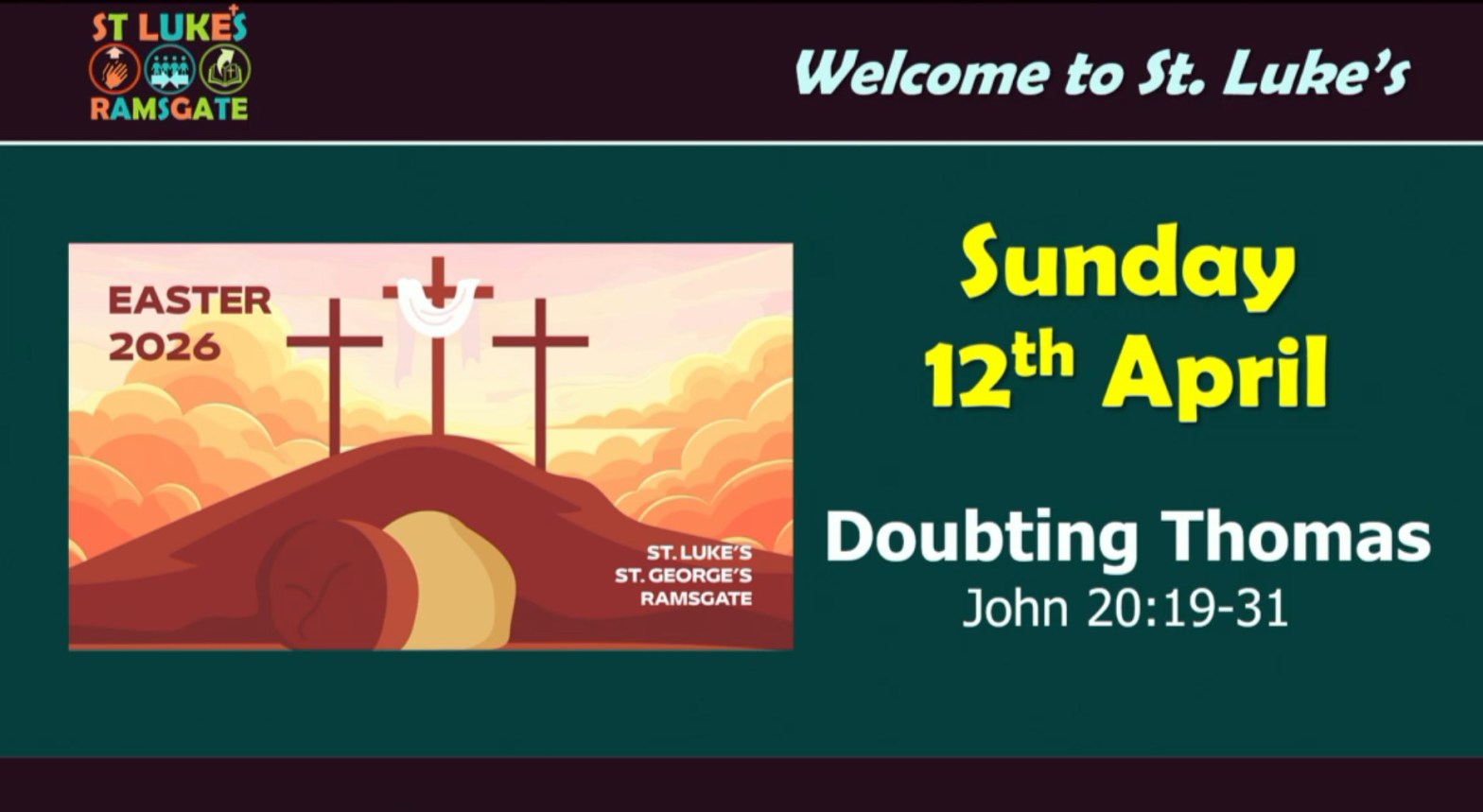
19 On the evening of that first day of the week, when the disciples were together, with the doors locked for fear of the Jewish leaders, Jesus came and stood among them and said, “Peace be with you!” 20 After he said this, he showed them his hands and side. The disciples were overjoyed when they saw the Lord.
21 Again Jesus said, “Peace be with you! As the Father has sent me, I am sending you.” 22 And with that he breathed on them and said, “Receive the Holy Spirit. 23 If you forgive anyone’s sins, their sins are forgiven; if you do not forgive them, they are not forgiven.”
24 Now Thomas (also known as Didymus), one of the Twelve, was not with the disciples when Jesus came. 25 So the other disciples told him, “We have seen the Lord!”
But he said to them, “Unless I see the nail marks in his hands and put my finger where the nails were, and put my hand into his side, I will not believe.”
26 A week later his disciples were in the house again, and Thomas was with them. Though the doors were locked, Jesus came and stood among them and said, “Peace be with you!” 27 Then he said to Thomas, “Put your finger here; see my hands. Reach out your hand and put it into my side. Stop doubting and believe.”
28 Thomas said to him, “My Lord and my God!”
29 Then Jesus told him, “Because you have seen me, you have believed; blessed are those who have not seen and yet have believed.”
30 Jesus performed many other signs in the presence of his disciples, which are not recorded in this book. 31 But these are written that you may believe that Jesus is the Messiah, the Son of God, and that by believing you may have life in his name.