Join us on 15th March for a special All Age service to celebrate Mothering Sunday, 10am at St. George’s Church.
There will be a short Holy Communion service beforehand in the chancel area of the church starting at 9:30am.
Find out what is happening at Ramsgate's Town Centre Church.

Join us on 15th March for a special All Age service to celebrate Mothering Sunday, 10am at St. George’s Church.
There will be a short Holy Communion service beforehand in the chancel area of the church starting at 9:30am.
“Rejoice in the Lord always, I will say it again: Rejoice!” (Philippians 4:4)
How can you tell someone is a Christian? Jesus says, “by their fruit you will recognise them” (Matthew 7:16) and a key characteristic of the fruit of the Spirit is joy. So shouldn’t joy be a key sign that someone might be a Christian? At last Saturday’s confirmation service, there was a palpable sense of joy, especially among the candidates as they publicly declared their faith in Jesus. Joy often is a mark of Christians.
How do we cultivate this joy? By focussing on our reason for joy. By gathering together to praise God and celebrate what he has done for us in Jesus.
Fruit of the Spirit, Joy (Psalm 100)
“A joyful church is a growing church!” (Bishop Philip North)
Last Saturday, we had a wonderfully joyful service as we celebrated 29 candidates from across Thanet making public declarations about their faith, and over 190 people in St. Luke’s for the occasion. The bishop led it in a rightfully joyful way, but the true joy was to see the evidence of God at work in individual lives and indeed to see the joy on the candidates faces. This is what we long to see more of in our church life.
Last week, we saw, that as Christians filled with God’s Spirit, we are called to walk in step with the Spirit and so to see the growth of the fruit of the Spirit in our lives, a character that reflects the character of God.
Over the coming months, we are going to look in turn at the nine characteristics of the fruit of the Spirit. The second one in the list is joy. In other words, if the Spirit is truly at work in our lives, then we should expect to see people full of joy in our churches. Indeed, for our churches to be joyful churches.
Last summer, Andrew McMillan, Mark Ogden and I went to a conference in London about planting and growing churches. you might expect it to have been a very evangelical affair, but one of the keynote speakers was Bishop Philip North, a well-known Anglo-Catholic. His talk was all about the importance of joy in our churches. He saw joy as key to effective mission and growth. He even claimed, “A joyful church is a growing church!”
Surely, this is right isn’t it? There is something attractive and compelling about true joy, that draws people in. Just like sunshine after weeks of rain, a joyful community in the midst of miserable world, lifts your spirits and makes you want more.
How do we find joy?
So how do we find joy as Christians and as a church?
Moments of joy:
There are of course moments of joy that all people whether Christian or not share in.
Weddings
When I was on holiday, someone asked me, as a vicar what was the most enjoyable part of my job. I said, leading groups with people exploring the Christian faith. She said, that she wanted me to say, taking weddings! Certainly, taking weddings are a joyful part of my role, because it is a privilege to be enable such a joyful occasion. And many will say that their wedding day was the happiest day of their lives. It even says so in the Bible of Solomon:
“… the day of his wedding, the day his heart rejoiced.” (Song of Songs 3:11b)
Childbirth
Another candidate for the happiest day in people’s lives is the birth of their child or children. Bringing a new life into the world, is certainly an amazing moment. Describing the occasion, Jesus says:
“A woman giving birth to a child has pain because her time has come; but when her baby is born she forgets the anguish because of her joy that a child is born into the world.” (John 16:21)
Success
Perhaps a third moment of joy, is when we experience some kind of success. I was pretty happy last Monday night, when the chess team that I captain managed to win their match 4-0! A great success.
But of course, there are bigger more important moments of success. For much of history, harvest time is a time of joy, because the success of your crops, was not just a reward for the hard work you had put in, but food security for the coming year. Similarly, success in war, especially when an oppressor is defeated is a reason for great rejoicing. The celebrations at the end of World War II were remembered by many as a moment of great joy.
These ideas are encapsulated in a famous verse from Isaiah:
“The people walking in darkness have seen a great light; on those living in the land of the shadow of death a light has dawned. You have enlarged the nation and increased their joy; they rejoice before you as people rejoice at the harvest, as men rejoice when dividing the plunder.” (Isaiah 9:3)
All of these things bring great moments of joy that are common to all human experience and life. But life is more than these moments. It includes moments of great sadness and struggle.
The writer of Ecclesiastes reminds us that there is:
“a time to weep and a time to laugh, a time to mourn and a time to dance,” (Ecclesiastes 3:4)
Permanent Joy:
Yet Paul commands in Philippians:
“Rejoice in the Lord always. I will say it again: Rejoice!” (Philippians 4:4)
For Christians, there will be times when we are rightly sad and mourning. The outbreak of war in the Middle East is a reason to be sad and mourn. For many of you, there will be personal circumstances and reasons, that give you reason to weep and mourn.
How then can Paul tell us, ‘Rejoice in the Lord always!’?
I don’t think Paul is saying we should always smile and pretend to be happy no matter what is happening in our lives. Such joy is just a mask. It’s not the real thing. No, Paul is calling on us to hold on at a deep level to the joy that we have in and because of Christ. A joy that no matter how bad the circumstances of life become can never be taken away. It is a joy that comes through the deep connection with God that Jesus brings. This is not a joy rooted in the circumstances of life, but the permanent truths about Jesus and the eternal salvation he brings.
A key passage on joy comes from Jesus’ teaching to his disciples in John’s gospel. He is teaching in a moment of gloom, because he has told his disciples that he is leaving them. The next day he will be crucified.
Nonetheless, Jesus talks to them about how they can find joy:
“As the Father has loved me, so have I loved you. Now remain in my love. If you obey my commands, you will remain in my love, just as I have obeyed my Father’s commands and remain in his love. I have told you this so that my joy may be in you and that your joy may be complete. My command is this: Love each other as I have loved you.” (John 15:9-12)
Notice, how Jesus roots joy in love. Knowing that we are loved by God and obeying his commands and especially his command to love others. When we are fully embedded in this network of love, then not only is our joy complete, but Jesus finds joy in us!
If this is the case, then the barriers to joy are obvious. We lose our joy when we become disconnected from God and others. When love fails, joy fails.
Barriers to Joy:
In some ways it is odd to be talking about joy in Lent. After all isn’t Lent a time or mournful self-reflection. Yes, it is, but the point of the mournful self-reflection is to reach a deeper joy with God.
In talking to his disciples about his coming death and resurrection he says to them:
“I tell you the truth, you will weep and mourn while the world rejoices. You will grieve, but your grief will turn to joy.” (John 16:20)
Without Good Friday, there would be no Easter Sunday. The cross deals with our sin, the resurrection guarantees our hope as forgiven people. In the same way, Lent is a time to deal more seriously with our sin in order to embrace more fully the joy of the resurrection life we have in Jesus.
And sin is our greatest barrier to joy, because sin disconnects us from God and others. If our joy in Christ has been blocked, then we need with God’s help to deal with the blockage, so that joy may flow again.
Disconnected from God – Psalm 51
David knew this very clearly. Psalm 51 was his great confession, that he wrote following his sin of committing adultery with another man’s wife and then having him killed to cover it up. It is one of the key Psalms that has been focussed on in Lent.
In the Psalm, David begs for God’s forgiveness. In doing so he longs for what he has lost because of his sin – his joy in God.
“Let me hear joy and gladness; let the bones you have crushed rejoice.” (Psalm 51:8)
“Restore to me the joy of your salvation and grant me a willing spirit, to sustain me.” (Psalm 51:12)
If you have lost the joy of your salvation, then maybe it is because you need to confess your sin once more to God. Why not use Psalm 51 as a model prayer to help you!
Disconnected from Others – Psalm 133
A second reason for loss of joy is to become disconnected from others. In Psalm 133, the joy of unity and good relationships is celebrated:
“How good and pleasant it is when brothers live together in unity!” (Psalm 133:1)
If we have lost our joy, it may be because we have fallen out with others and particularly other fellow Christians. If so, we need to do something about it.
After all, Jesus says:
“Therefore, if you are offering your gift at the altar and there remember that your brother has something against you, leave your gift there in front of the altar. First go and be reconciled to your brother; then come and offer your gift.” (Matthew 5:23-24)
Lack of Corporate Thanksgiving – Psalm 100
The third blockage may be more to do with laziness, than with broken relationships. Have we stopped making meeting with others to praise and worship God a priority in our life? In other words are we failing to attend church as regularly as we could?
Psalm 100, is known as the Jubilate, because the first word in the Latin version, is translated, “Shout for joy!” It is also the only Psalm to have the title, “a Psalm for thanksgiving.”
But it, is not so much a Psalm for thanksgiving, as a Psalm that calls on us to come together to give thanks to God.
It includes 7 commands:
The first three and last three are in effect all a call to join with others in praise to God. Whilst the middle one is an invitation to know why we should praise and give thanks to God, because he made us and he is our good shepherd. The last verse also underlines how God is good, loving and faithful.
There is every reason to thank God, so let’s come together and do so together! Let’s be a joyful church, not because the momentary circumstances of life are good, but because our God is always good and his love for us endures forever!
When we do, then we are being truly radical in today’s secular, individualised and moaning society. We will be a truly joyful church and I believe we will see more people want to join us in God’s network of love, and perhaps we will have many more moments of celebration like last Saturday.
Be ready for a joyful church (depending on time)
But, if we want that, then we need to be proactive. One way to do that is to prepare for coming to church, rather than just turning up.
With my children going to university in recent years, I have learnt about the idea of pre-drinks. Students often have cheap shop drinks at home, before going out to clubs in order to help them be tipsy enough to have fun when they arrive at the club. Shouldn’t we, as Christians consider a similar idea for church. I don’t mean having a quick tipple of Sherry on a Sunday morning before church but preparing ourselves that we might enjoy ourselves (and encourage others) when we come to church.
How can we do that? Well, think about the barriers we mentioned.
Perhaps if we did this kind of preparation more fully, then our services would be truly joyful occasions, the highlights of our week and a draw for all who come and visit us.
“Rejoice in the Lord always, I will say it again: Rejoice!”
(Philippians 4:4)
Scroll on…
How can you tell someone is a Christian? Jesus says, “by their fruit you will recognise them” (Matthew 7:16) and a key characteristic of the fruit of the Spirit is joy. So shouldn’t joy be a key sign that someone might be a Christian? At last Saturday’s confirmation service, there was a palpable sense of joy, especially among the candidates as they publicly declared their faith in Jesus. Joy often is a mark of Christians.
But how can we maintain our joy? Is Paul’s command to, “Rejoice always!” realistic? Clearly to rejoice always cannot mean always acting with a happy or cheerful demeanour. Elsewehere, Paul tells us to “weep with those who weep” (Romans 12:15) just as Jesus wept at the grave of Lazarus (John 11:35). In a similar way the Psalms are full of expressions of pain and suffering.
Yet, the Psalms frequently move on from acknowledging the struggles of life to focus once more on God and rejoice in the salvation he brings. This is how we are to rejoice, not by denying our pain, but seeing that God is above and beyond our pain and will bring us through. That is why Paul’s command is not simply to rejoice, but to ‘Rejoice in the Lord!’ We may not have much to be happy about in our lives, but we can always rejoice in who God is and what he has done for us and will do for us.
So, as Christians we can find joy that goes beyond the circumstances of our present experience. It is this joy rooted in our relationship with God, that enables us to stand out from the world in a way that is deeply attractive and contagious.
How do we cultivate this joy? By focussing on our reason for joy. By gathering together to praise God and celebrate what he has done for us in Jesus.
Paul Worledge
St. Luke’s will be hosting the Churches Together Prayer Breakfast at St. Luke’s Hall on Saturday 7th March, 9am to 10am. Everyone is welcome to attend.
Next Sunday, we will be celebrating Mothering Sunday. There will be a short said communion service in the chancel area from 9:30am followed by an all age service to celebrate Mothering Sunday from 10am, during which daffodils will be distributed to the women in the church. Do join us for one or both of these services.
The next event is a Games night at St Lukes, Church Hall on Thursday 12th March. Please let Bruce know if you are going.
St. Luke’s will be hosting 80 Year 6 pupils from St. Lawrence College and Newlands School on the morning of Tuesday 24th March for this interactive workshop run by ACTS.If you can volunteer to help host and run the workshop (setting up from 9am and tidying up until about mid-day), then please let Paul know.
The service, led by the Bishop of Dover, will bring together individuals and church groups from across our county highlighting the rich and varied communities which we serve. This will be the main opportunity for the whole Diocese to formally welcome and show our support for our new Diocesan Bishop. Saturday 28th March, 5:30-6:30pm. Canterbury Cathedral. Click here to book a free ticket.
An interactive day of exploration, new insights and fun with Rev. Dr. Sue Woan. Free! (donations welcome) Bring your own lunch – drinks provided. Saturday 18th April, 9.30am – 3.00pm. Newington Free Church, St. John’s Avenue, Ramsgate. To book a place contact Robin Plant:
This 3-minute video from Tearfund, suggests ways that we can pray for the situation in the Middle East. Watch…
Steve Dew-Jones who works for a human rights organisation documenting Christian persecution in Iran gives a personal perspective on the US attacks. Read more (4 minutes, note this was written last Saturday)
Eucharist (St. George’s Church) Psalm 100 – 9:30am
Sunday School (St George’s, 10:30am)
Confirmation Follow Up (St Luke’s Vicarage) – 5:00-6:30pm
Prayer Meeting (St. Luke’s Church) – 9:30-10:00am
Confirmation Follow Up (St Luke’s Vicarage) – 7:30-9:00pm
Prayer Meeting (St. George’s Church) – 9:30-10:00am
Community Meal (St. George’s Hall) – 5:30-7:00pm
Community Soup (St. George’s Church) – 12:00-2:00pm
Prayer Meeting (St. Luke’s Church) – 9:30-10:00am
Confirmation Follow Up (St Luke’s Vicarage) – 11:30am-1:00pm
Men’s Group Games Evening (St Luke’s Hall) – 7:00-9:00pm
Prayer Meeting (St. George’s Church) – 9:30-10:00am
Community Soup (St. George’s Church) – 12:00-2:00pm
Mothering Sunday (St. George’s Church) 1 John 4:7-12
Said Communion Service, 9:30am
All Age Service, 10am
Confirmation Follow Up (St Luke’s Vicarage) – 5:00-6:30pm
Will you dare to share the Christian life with others? Life groups are a great way to meet together regularly with a small group of other Christians, for mutual support, to share in reading God’s word and to pray for one another.
Please see Paul if you are interested in joining one. There are groups at the following times:
Under the ‘Contact’ tab on the website, there are now three forms that you can use to help us in managing the church:
If you volunteer in anyway at church the national authorities are strongly encouraging you to take at least the Basic Module in safeguarding training once every three years.
If you have not completed the training in the last three years, then the module can be completed online and takes about ninety minutes. You can access the training by following this link. You will need to first register, to access the training. Once the training is completed, you will be sent a certificate. Please forward that certificate to James (office@churchramsgate.org), so that we can keep records of who has done the training.
Finally, let’s rejoice in the Lord always!
Yours in Christ
Paul Worledge
(Priest in Charge, St. George’s Ramsgate)
“Since we live by the Spirit, let us keep in step with the Spirit.” (Galatians 5:25)
Last week, we looked at the two humanities on offer. The one rooted in Adam’s disobedience to God in the Garden of Eden and the other rooted in Christ’s obedience to God in the Garden of Gethsemane as he expressed his willingness to die on the cross as a sacrifice for our sins. We now have the option of continuing to live simply in the old way as a descendant of Adam and his disobedience, or by faith in Christ as those reconciled to God and assured of his forgiveness.
Join us this Sunday as we introduce our new series on the Fruit of the Spirit.
Two Humanities in our Lives
Last week we were looking at Romans 5, and how two key moments in history defined two possible ways of being human:
Adam’s disobedience in the Garden of Eden
and
Jesus’ obedience expressed in the Garden of Gethsemane, that led to his willing sacrifice on the cross.
We all inherit Adam’s disobedient humanity, through our natural birth, but we can become part of Jesus’ true humanity through being born again by faith in him.
In Galatians 5, Paul uses two different terms to talk about how these two humanities are expressed in our lives as Christians today.
‘The Flesh’ stands for what we are by natural birth. It is the disobedient attitude that we inherit from Adam, our natural tendency to say, ‘No!’ to God’s will and live for our own self-interest.
‘The Spirit’ stands for what we are by new birth, because when we put our faith in Jesus, we received the Holy Spirit in our lives. This is expressed powerfully in the Confirmation service, when the Bishop prays for each of the candidates that they will receive the Holy Spirit.
Paul is clear that these two humanities are ultimately incompatible:
“For the sinful nature desires what is contrary to the Spirit, and the Spirit what is contrary to the sinful nature. They are in conflict with each other, so that you do not do what you want.” (Galatians 5:17)
As Christians we have this constant struggle, between the flesh or the humanity we inherit from Adam and the Spirit that we receive when we put our faith in the new humanity of Christ. It is an inner war, which we all experience, but the encouragement is to lean into the Spirit and reject the flesh.
This all may sound a bit abstract, but Paul makes it concrete with two lists, ‘the works of the flesh’ and ‘the fruit of the Spirit’.
The Works of the Flesh
Not a complete list
Let’s start with the works of the flesh. The first thing to say, that this is not a complete list of all possible vices, that arise out of the flesh. In a similar list, a Jewish philosopher called, Philo, who wrote a little before the New Testament had 140 examples. This is just an example list, a taster.
Neither is Paul saying that everyone who lives according to the flesh does all of these ‘works’. Most of us can probably see that we have been caught up in a few of these works or attitudes in the past, not everyone will have been guilty of all.
Remarkably Contemporary
Secondly, this list is remarkably contemporary, with perhaps the exception of ‘idolatry’ which is usually not expressed in the same way as it was in the first century Graeco-Roman culture. Otherwise, these are all actions and attitudes that are common today. Indeed, when I’ve talked about this passage when doing baptism preparation, it is a passage that people find quite easy to relate to!
There are 15 different actions and attitudes listed, and although it is not easy to put them into groups, the following four groups is a reasonable way to categorise them.
The first three are all to do with sexual sins.
It is notable, that a lot of our modern culture appeals to our sexual appetites, with sexualised images used to sell us things or distract us on social media and pornography awash on the internet.
The second two are to do with replacing the true God with counterfeits. In Paul’s day this meant worshipping idols, that was going to temples with statues of made-up divinities to worship. In our day, God is replaced most frequently with an advertising industry that sells us a vision of life being satisfied by material possessions and exciting experiences rather than a deep relationship with God.
The Greek word for witchchraft or sorcery is pharmakeia, which is where we get our word, ‘Pharmacy’ from. The sorcery of Paul’s day was often accompanied with drug taking to try and simulate a spiritual experience. Once again, today, many people replace God with drugs.
Perhaps, sex and drugs is what you would expect from a Christian list of vices. But the majority of the list is taken up with attitudes and actions that are about concern for self and damaging to the rest of the community.
Again, these feel incredibly contemporary. Social media tends to appeal to some of these attitudes, perhaps particularly hatred and factions, where people are fed only the thoughts and ideas of people like them and the more outrageous and hateful posts tend to gain the most interest. The result is people increasingly aligning with one group against another, which they hate. So, community is increasingly divided and angry.
It can be seen from the context, that Paul is concerned to discourage behaviours that tend to destroy the sense of community in the church:
“If you keep on biting and devouring each other, watch out or you will be destroyed by each other.” (Galatians 5:15)
“Let us not become conceited, provoking and envying each other.” (Galatians 5:26)
Our vision to ‘dare to share’ is a challenge to work towards cohesion within and across our church communities. Not to fall into the ways of the flesh, that will created hatred and factions within and between church communities, but to work towards mutual understanding and concern for each other.
The final two in the list are to do with excessive drinking or wild partying. It is making oneself out of control through drink. A great contrast to the self-control that is one of the characteristics of the fruit of the Spirit.
Works of the Law
The phrase, ‘works of the flesh’, echoes a phrase Paul has used earlier in the letter of Galatians: “works of the Law”. This is deliberate.
Paul links self-centred immoral behaviour, with a religion that focuses on human achievement and self-identification through following legal or religious regulations. Such behaviour leads not to true righteousness, but a kind of self-righteousness that can express itself in hatred, discord, factions and selfish ambition.
In contrast, Paul says, that as Christians we are not about following the Law in that way.
In particular, he says:
“But if you are led by the Spirit, you are not under law.” (Galatians 5:18)
There is a fleshly way of following the law, that leads to self-righteousness, and there is being led by the Spirit, which produces the kind of character, which naturally lives according to the Law. Paul calls this character, ‘the fruit of the Spirit.’
The Fruit of the Spirit
So, why does Paul use the term “fruit” rather than saying the works of the Spirit?
Holistic Character Formation
Primarily, because this is about a holistic character formation, rather than specific actions or attitudes. Notice the word, ‘fruit’ here is singular. These are characteristics that describe one fruit not lots of different types of fruit.
So, for example, we might describe a banana as yellow, bendy, with a tough skin and soft innards. A banana needs all of those qualities to make it a banana. If it is yellow and bendy, with a tough skin, but without soft innards, it is not a banana.
In the same way this list of nine qualities or virtues, are all necessary for the character being described to be truly the fruit of the Spirit.
Most non-Christians will have some of these qualities, but when the Spirit gets to work in us, we will develop all of these qualities in increasing measure.
Gradual, Inevitable Growth
But it does not happen overnight. We may become Christians overnight and therefore enter immediately into a new relationship with God, knowing we are completely forgiven and filled with his Spirit. We become part of the new humanity Christ brought in.
But just as it is often hard to tell when looking at a tree what kind of tree it is, it becomes obvious as time goes by, because the fruit will gradually and inevitably grow and so you can tell whether it is an apple tree or a plum tree or an oak or a sycamore.
Love Centred, Other Focussed
Finally, it is worth noticing that ‘love’ comes first in the list. It has priority, and compared with other lists of virtues in the world of Paul’s day, ‘love’ is distinctively seen in Christian lists.
Why is it so important? Because love, the concern for others as much as for ourselves is the true fulfilment of the Law. When we follow the Law for religious achievement or identity, as some were encouraging Paul’s original readers to do or we use Christianity as a badge for our own ideologies or political outlooks, then we are not showing love, we are ultimately being selfish and denying the heart of the law. When, however, we live by the Spirit, and the quality of love grows in our lives, we truly fulfil the Law:
“The entire law is summed up in a single command: “Love your neighbour as yourself.”” (Galatians 5:14)
I am not going to look at the rest of the list in detail now. This is actually an introduction to a sermon series. Over nine sermons, spread out over the next few months, we are going to look at each of these qualities that describe the Fruit of the Spirit, so that we can truly grow this fruit more and more in our lives and community.
How to Live
But, how can we grow the fruit in our lives. Verses 24 and 25 help us. Remember Paul, has said that within us as Christians is a battle between the flesh and the Spirit, between our old humanity inherited from Adam, and our new humanity that we have through faith in Christ.
So, how do we interact with this battle?
See the Flesh as Crucified
Firstly, we need to see our flesh as crucified:
“Those who belong to Christ Jesus have crucified the sinful nature with its passions and desires.” (Galatians 5:24)
Notice, that ‘crucified’ is in the past tense, it has already happened. When we accept that Jesus died for our sins on the cross, we are putting our own fleshly life which we inherit from Adam on the cross.
Crucifixion in the ancient world was not just designed to inflict a torturous death, it was designed to humiliate the victim, to destroy their dignity in the sight of all those watching. In Jesus’ crucifixion, we see Jesus dying for the sins that arise out of our fleshly desires. In this way we see the true horror of what our flesh results in. The cross of Jesus humiliates and shames the sinful nature. We are meant to think, if that is what the flesh does, to our saviour, then how can I follow the desires of my flesh any more.
So, the first step towards the fruit of the Spirit, is to see the true horror of the flesh within us. So, that we may naturally reject it more and more, when it seeks to influence the way we live.
Walk in step with the Spirit
The second thing we are to do is to keep in step with the Spirit:
“Since we live by the Spirit, let us keep in step with the Spirit.” (Galatians 5:25)
On Strictly come dancing, celebrities who are most amateur dancers are paired with professional dancers. To start with they can’t dance well at all, but as they practice with the professionals, they learn to follow the steps of the professional, and gradually they look increasingly impressive as dancers in their own right.
The Holy Spirit is God and shares the qualities of God. The more we seek to live in the way the Spirit lives, the more we will grow in the fruit of the Spirit, imitating the virtuous qualities of God and Jesus themselves.
There will be some steps that come more naturally to some than others. One person may already be naturally gentle, but not very self-disciplined, by walking in step with the Spirit, their self-discipline will continue, another may be joyous, but not patient, by walking in step with the Spirit they will become more patient.
So, as we set out on this journey of exploring the Fruit of the Spirit together, let’s pray for God’s help to see our flesh as crucified in Christ and our lives increasingly walking in step with the Holy Spirit.
This is not Cultural Christianity, this is transformational Christianity.
“Since we live by the Spirit, let us keep in step with the Spirit.”
(Galatians 5:25)
Scroll on…
Last week, we looked at the two humanities on offer. The one rooted in Adam’s disobedience to God in the Garden of Eden and the other rooted in Christ’s obedience to God in the Garden of Gethsemane as he expressed his willingness to die on the cross as a sacrifice for our sins. We now have the option of continuing to live simply in the old way as a descendant of Adam and his disobedience, or by faith in Christ as those reconciled to God and assured of his forgiveness.
As Christians, we inhabit both of these humanities. In Galatians Paul talks about our ‘flesh’ or ‘sinful nature’ as the drives and attitudes that we inherit from Adam’s disobedience. It can lead us into all kinds of different sins. As Christians, however, we have received the Holy Spirit, which helps us to live in obedience to God. In particular, the fruit of the Spirit in our lives is to develop characteristics or virtues which are deeply attractive: love, joy, peace, patience, kindness, goodness, faithfulness, gentleness and self-control.
Over the coming few months, we will be looking in more depth at each of these virtues and how we can grow in them with the help of God. Wouldn’t it be wonderful if people’s experience of the church was of a community whose members are marked by such qualities? Indeed, one of the things that drew me to become a Christian as a child was observing people in the church exhibiting such beautiful qualities.
These virtues do not develop automatically. Paul talks of a conflict in our lives between the flesh and the Spirit within us. If we are to truly live out the new humanity of Christ, then we need to learn to resist the flesh and its urges and walk in step with the Spirit.
Paul Worledge
St. Luke’s and St. George’s will be hosting the Churches Together Prayer Breakfast at St. Luke’s Hall on Saturday 7th March, 9am to 10am. Everyone is welcome to attend. If you can offer to help with the catering, then please see Paul this Sunday.
Our book corner has now moved to the warmer less draughty side of the church. Do go and have a look at the colourful selection of new books in the front-facing display case chosen by Lucy. Many of these books are about the lives of missionaries. The older bookcase contains Bibles, Handbooks, and books explaining different books or parts of the Bible. There is plenty of choice for everyone. You are welcome to borrow the books, but when you return them, it would be great if you could write a brief review to encourage others to read them. Some cards for your comments will be available soon. We welcome donations of other Christian books which are still in good condition and do not have handwritten notes in them.
Copies of the March and April prayers are available at the back of church or download here.
Sat. 28th Feb., 5pm, St. Luke’s Church
Please come and support candidates from St. Luke’s, St. George’s and other local churches being confirmed and baptised at the end of February. There will be around nine candidates from St. Luke’s and four from St. George’s. Bishop Rose will be taking the service.
The next event is a Games night at St Lukes, Church Hall on Thursday 12th March. Please let Bruce know if you are going.
St. Luke’s will be hosting 80 Year 6 pupils from St. Lawrence College and Newlands School on the morning of Tuesday 24th March for this interactive workshop run by ACTS.If you can volunteer to help host and run the workshop (setting up from 9am and tidying up until about mid-day), then please let Paul know.
The service, led by the Bishop of Dover, will bring together individuals and church groups from across our county highlighting the rich and varied communities which we serve. This will be the main opportunity for the whole Diocese to formally welcome and show our support for our new Diocesan Bishop. Saturday 28th March, 5:30-6:30pm. Canterbury Cathedral. Click here to book a free ticket.
An interactive day of exploration, new insights and fun with Rev. Dr. Sue Woan. Free! (donations welcome) Bring your own lunch – drinks provided. Saturday 18th April, 9.30am – 3.00pm. Newington Free Church, St. John’s Avenue, Ramsgate. To book a place contact Robin Plant:
This week marked the fourth anniversary since Russia’s invasion of Ukraine. In this article read a report about the work of CMS partners in the country. It includes some prayer requests. Read more…
In this article, Mark Meynell, explores the implication of the four years of war in Ukraine for International Law. Read more…
Eucharist (St. George’s Church) Galatians 5:13-26 – 9:30am
Prayer Meeting (St. Luke’s Church) – 9:30-10:00am
Prayer Meeting (St. George’s Church) – 9:30-10:00am
Community Meal (St. George’s Hall) – 5:30-7:00pm
Community Soup (St. George’s Church) – 12:00-2:00pm
Prayer Meeting (St. Luke’s Church) – 9:30-10:00am
Confirmation Course (St Luke’s Vicarage) – 11:30am-1:00pm
CTiR Prayer Breakfast (St. Luke’s Hall) – 9:00-10:00am
Community Soup (St. George’s Church) – 12:00-2:00pm
Eucharist (St. George’s Church) Psalm 100 – 9:30am
Sunday School (St George’s, 10:30am)
Confirmation Course (St Luke’s Vicarage) – 5:00-6:30pm
Will you dare to share the Christian life with others? Life groups are a great way to meet together regularly with a small group of other Christians, for mutual support, to share in reading God’s word and to pray for one another.
Please see Paul if you are interested in joining one. There are groups at the following times:
Under the ‘Contact’ tab on the website, there are now three forms that you can use to help us in managing the church:
If you volunteer in anyway at church the national authorities are strongly encouraging you to take at least the Basic Module in safeguarding training once every three years.
If you have not completed the training in the last three years, then the module can be completed online and takes about ninety minutes. You can access the training by following this link. You will need to first register, to access the training. Once the training is completed, you will be sent a certificate. Please forward that certificate to James (office@churchramsgate.org), so that we can keep records of who has done the training.
Finally, let’s keep developing the fruit of the Spirit in our lives,
Yours in Christ
Paul Worledge
(Priest in Charge, St. George’s Ramsgate)

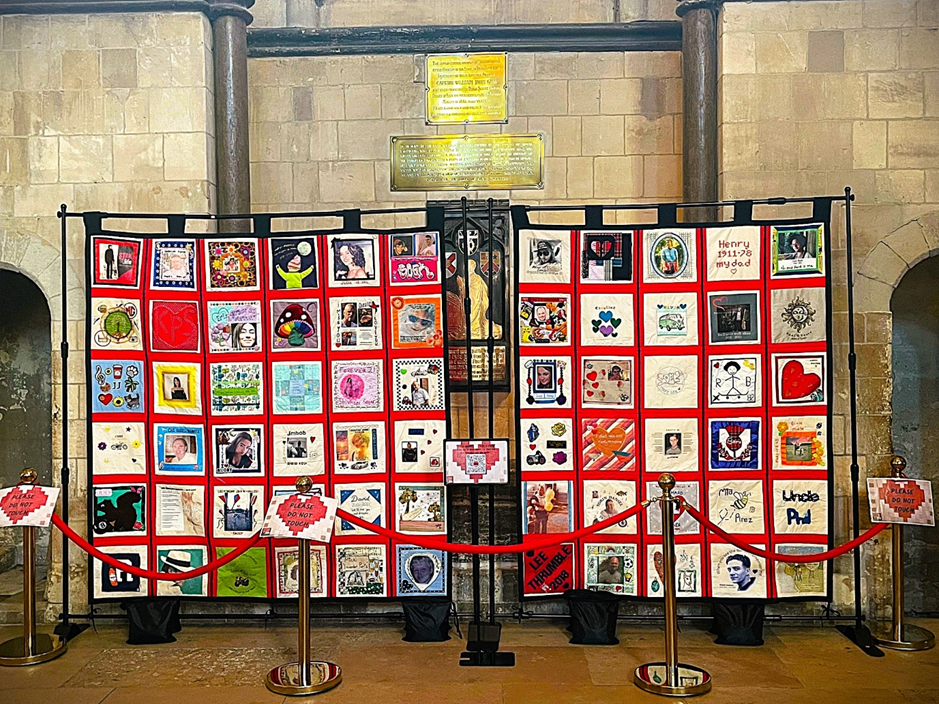
Kent’s “Speak Their Name” Memorial Quilt: 66 squares. 66 lives. A promise to remember, and a call to change.
The quilt will be visiting St George’s from 18th March to 1st April, with a Connection Event on Saturday 21st March, when there will be a chance to learn more about the quilt and the stories behind it, and to take part in a Q&A session from 2pm to 4pm.
Within Kent and Medway almost 200 deaths by suicide are reported a year and we know this is likely to be under reported by Coroners verdicts, but there are moments when grief refuses to stay quiet. The Kent Speak Their Name Suicide Memorial Quilt is one of them: a powerful, hand-crafted memorial made up of 66 individual squares, each created by families and friends bereaved by suicide , each square a life, a story, a face, a name that will not be erased.
The quilt was led in Kent by Tristan and Emma Kluibenschadl, founders of STAK.life (Stefan’s Acts of Kindness), after losing their beloved son Stefan, who died by suicide at just 15. Stefan, they say, had reported relentless bullying at his Saturday job for being autistic, and they describe a wider failure of understanding and appropriate support around him — in education, mental health, and the systems meant to protect children who are struggling.
This is not “just” a quilt. It is a public refusal to let people become statistics.
A quilt stitched from love, and from the shards of the unthinkable
The Kent quilt grew from a moment in September 2024, when Tristan and Emma attended the unveiling of another Speak Their Name memorial quilt in Portsmouth. Seeing Stefan’s name and photograph among the squares was “heart-wrenching, yet profoundly moving,” and it sparked a decision: Kent needed its own space to hold grief, memory, and community — out loud, together.
In January 2025, with community donations, volunteers, and workshop packs sent across the county, the Kent project began. Twelve workshops were held across Kent, offering bereaved families a safe place to create, talk, cry, laugh, and be understood by people who didn’t need grief explained to them.
Each square is different , stitched, painted, embroidered, layered with photos, symbols, favourite colours, in-jokes, and messages that still sound like the person who is gone. Together, the squares form a tapestry that says plainly: they mattered, they still matter, and we will keep speaking their names.
“For just as through the disobedience of the one man, the many were made sinners, so also through the obedience of the one man the many will be made righteous.” (Romans 5:19)
Adam famously disobeyed God’s one rule not to eat from the tree of the knowledge of good and evil. We are all descendants of Adam, and like our ultimate father we all continue to disobey God. The Bible calls that sin.
Yet, God sent Jesus as a second Adam, a new humanity. In contrast to Adam, Jesus obeyed. Now, we have a choice of which humanity we want to belong to. The disobedient one founded by Adam or the obedient one launched by Christ, through whom we can be made righteous in God’s sight.
Adam and Christ
Artificial Intelligence – The Image of Man
Artificial Intelligence is here. In many ways it seems increasingly human like. It can relate to us almost like another human, write essays, songs, music, create art and even movies. It seems increasingly human like. Does its coming mean that this is going to be one of the most pivotal or epochal moments for humanity? Will it change or even replace humanity?
Artificial Intelligence is made to mimic humans. It is trained on masses of human output, so that it can produce similar output itself. As such AI offers a kind of copy or image of humanity.
But what happens, if you take an image of the image. If you take a photo of a photo, then the second photo is not as close a representation as the first. Keep doing it and the image becomes degraded.
Some scientists did a similar thing with AI. Rather than using human output, they trained an AI on AI output. If AI is a copy of humanity, then this AI was a copy of the copy. Then they trained another AI on the output of the copy of the copy. The more they did this, the more the AI produced total gobbledygook. The further the copy goes from the original the more degraded it becomes. AI needs humanity, to be able to imitate humanity. It can’t ultimately replace humanity.
Image of God
Right at the beginning of the Bible, it says that humans were made in the image of God. In some way, we mirror what God is like, without being fully God ourselves.
If that is what it is to be human, then we remain more fully human the more connected with God we are. The more distant from God we become, the more degraded becomes the image of God in us and the less human we become.
Two Epochal Moments for Humanity
What has all this to do with Romans 5? In Romans, Paul is presenting the good news about Jesus Christ as truly good news for the whole of humanity. And in this section of Romans he is comparing two different versions of this humanity. Each is rooted in an epochal moment in history, a moment where humanity was changed for ever on a more fundamental level than Artificial Intelligence will ever do, because these two events effected our connection with God and so our ability to truly live in the image of God.
So, what were these two crucial moments?
Adam’s Trespass or Disobedience: Humanity Degraded
The first, was Adam’s choice to disobey God. In Genesis, Adam is presented as the first man, with Eve as the first woman alongside him. They were the ones created in God’s image. The Bible sees all of us as ultimately descended from Adam and so in some way we inherit Adam’s likeness in ourselves. We too are in God’s image, like them. But we also inherit the big choice that they made.
You may find it hard to accept that we are all descended from one man. But, in 2004, some mathematicians put together a mathematical model to answer the question as to who was the most recent common ancestor of all people alive today. The results suggested that this person lived no earlier than 1400BC and possibly as recently as AD55. Now, our most recent common ancestor, is not our only common ancestor, there would have been lots of people living 1,000s of years ago, that are ancestors of everyone living today. It’s not a big step to believe that one of these was the Adam, that the Bible talks about.
So, what was the big choice that Adam made? In Genesis we are told, that Adam was put in the Garden of Eden and given access to the fruit of all the trees including the tree of life. There was just one rule. He was not allowed to eat from the tree of the knowledge of good and evil. This probably represents the choice to decide for ourselves what is right and wrong, rather than to defer to what God says. Adam, having this one rule, however, at the prompting of the devil decided to disobey the commandment and eat the fruit.
The result was to distance himself from the God, that he was made to be in the image of. It lead to the ultimate degradation of humanity, from which the rest of the sins of the world flow.
As Adam’s descendants we too share in the same attitude of disobedience to God, thinking we can decide for ourselves what is right and wrong rather than defer to God. So, we true degrade the image of God in us, that we were created to be. We lose the ultimate meaning of our humanity. We become sinners and as a result of our sin, we die spiritually and physically. In our sin we come under God’s judgement, his condemnation.
This is what Paul is saying again and again in Romans 5. Just look at the start of verse 19:
“For just as through the disobedience of the one man the many were made sinners…” (Romans 5:19)
For Paul, the moment Adam chose to disobey God, was the moment humanity lost its calling to be made in the image of God, it was plunged into a world full of sin, condemnation and death. Separated from their maker, humanity was deeply degraded.
Christ’s Gift and Obedience: Humanity Renewed
In contrast to Adam’s disobedience, Paul presents Christ’s obedience. What is he referring to? Jesus’ death on the cross. The cross was many things, even in the verses earlier in chapter 5, Paul has talked about how through the cross, we are justified and reconciled with God, more than that the cross was the greatest demonstration of God’s love to us.
But, the cross was also an act of obedience. Jesus, was in a way a new Adam, a reset for humanity. Jesus as the eternal Son of God came in the flesh, to share in our humanity, but also to offer a reset to our humanity, to be the human who truly was in the image of God.
This challenge reached its climax in the Garden of Gethsemane, where Jesus who knew that the cross was coming the very next day, knelt down to pray, longing that he might somehow avoid the pain and suffering it would entail. But in the end he prayed to God, “Not my will, but yours be done.” Whereas Adam chose to reject God’s will in disobedience, Jesus despite the enormous personal cost chose to embrace God’s will in obedience.
But, Paul, says in so doing, he opened up a new possibility for humanity. He offered a way back to God, a chance to embrace our original calling to live in the image of God. A chance to be justified by God rather than condemned. A return to life, true life and eternal life.
Jesus’ death, then was the other epochal moment in human history. It created a new humanity, free from the results of Adam’s original choice.
As it says in verse 19:
“For just as by the one man’s disobedience the many were made sinners, so by the one man’s obedience the many will be made righteous.”
Our Choice:
So, we now have a choice. Do we want the degraded humanity of Adam or the renewed humanity of Christ?
In Romans 5, Paul lays out the results of being part of these two humanities:
Adam’s by Descent: Condemnation and Death
As people descended from death, we all inherit the degraded humanity of Adam. We are all sinners. And this has consequences: condemnation and death.
As it says in verse 12:
“Therefore, just as sin entered the world through one man, and death through sin, and in this way death came to all men, because all sinned–” (Romans 5:12)
And in verse 18:
“Consequently, just as the result of one trespass was condemnation for all men,” (Romans 5:18a)
The condemnation spoken of here is the just judgement of God on our sin.
In the news this week, Andrew Mountbatten-Windsor was arrested on suspicion of misconduct in public office. Suspicion is not the same as condemnation, but the police will try and see if there is a case for him to answer and if there is, then he will be taken to court where the case will be put, and if he is found guilty he will be condemned and there will be a punishment.
Andrew, had a position of great privilege and responsibility. He was meant to use it to represent the UK and advance its prospects, not for his own benefit and to satisfy his own lusts. However, he is under suspicion of doing just that and there is rightly an outcry against him and a demand that if guilty he face judgement and is stripped of his place in the line of succession and barred from a home in the royal grounds in Windsor.
As human beings, we are made in the image of God. As such we are given an office to represent God, but we have ignored God, and used our position simply to satisfy our own desires and lusts. This is our sin, and on the day of trial, God will condemn us and judge us for our behaviour. We will be cut off from him totally and barred from a place in his eternal home. This is the ultimate death.
We can choose to continue living in this way without God. But the good news is that in Christ, God has offered us a way back to true humanity.
Christ’s by Faith: Justification and Life
At the beginning of chapter 5, Paul says,
“Therefore, since we have been justified through faith, we have peace with God through our Lord Jesus Christ,” (Romans 5:1)
We are born as descendants of Adam, but if we put our faith in Jesus, we can become part of his renewed humanity. Adam’s disobedience was profound and had profound consequences, but the gift of Jesus’ obedience is more powerful than that of Adam’s disobedience:
“But the gift is not like the trespass. For if the many died by the trespass of the one man, how much more did God’s grace and the gift that came by the grace of the one man, Jesus Christ, overflow to the many!” (Romans 5:15)
So, what do we gain as part of Christ’s new humanity:
“Consequently, just as the result of one trespass was condemnation for all men, so also the result of one act of righteousness was justification that brings life for all men.” (Romans 5:18)
We receive justification. That is when it comes to God sitting in judgement on us, because we have chosen to belong to Christ, God sees not our sin, but Jesus’ sacrifice on behalf of our sin. And so we are justified, we are no longer under condemnation for our sin.
As a result we are reconciled with God, and we can enjoy the true life that he created us to have. A life that means we are welcomed into his eternal home, but more than that a life that means we are part of his family now, and can approach him as our Father. This is what it means to have peace with God.
As such we can come close to God and be made increasingly into the image of God, that we were originally created to be. We can live our true calling, we can discover our true humanity.
Conclusion:
Paul’s writings in Romans may feel a long way from talk about AI and our modern world. But, the rise of AI forces us to think once more about what it means to be truly human. Indeed, if we are going to make the most of AI and avoid its dangers, then we need to understand our humanity more deeply than ever.
The Bible tells us that Jesus is the only way to really regain our true humanity that was lost by Adam. Now more than ever is the time to come and put out faith in him and discover the life that only he can offer.
“We did not follow cleverly invented stories when we told you about the power and coming of our Lord Jesus Christ, but we were eyewitnesses of his majesty.” (2 Peter 1:16)
Join us this Sunday as all ages join together for our focus on Jesus’ Transfiguration. Come and glimpse the glory of Jesus.
The Transfiguration
Aberdeen sees sun
Longest period in Aberdeen without sun for over 70 years. 21 terrible days with no sun. Then on Thursday the sun shone!
What had happened to the sun? It had not gone away it had been hidden by the clouds. Its glory was obscured by the gloom of the weather.
When we took off from Morocco to fly home from our holiday it was cloudy and rainy. But the plane takes you up beyond the clouds and you discover that the sun is still shining. Its glory remains.
Why is God’s glory hidden?
Some people ask, why does God not reveal his true glory? Wouldn’t we then believe in him. Why is God so hidden?
When Jesus walked the earth, similarly, people demanded to be shown proof that he truly was God’s special person. Despite Jesus’ amazing teaching and his incredible miracles, they were still not convinced, they still wanted more evidence. After all, despite the amazing things Jesus did he still looked like an ordinary human being.
And partly to prove their point, they had Jesus crucified. If Jesus could be killed like a criminal, then surely that was proof that he could not be anyone special. To these people the true glory of God was hidden.
So, why does God hide himself from us? Why didn’t Jesus show his full glory to everyone?
Is it because God does not exist? Or was Jesus really not God’s Son?
The events described in Matthew’s gospel today, show that that is not the case. Jesus did reveal his full glory. Like the clouds clearing to reveal the sun, the earthly nature of Jesus momentarily allowed his full glory to shine through.
What the Disciples Experienced
Jesus chose three of his closest disciple, Peter, James and John, to go up to the top of a High Mountain with him. Normally if you climb a mountain, the awe-inspiring moment is the spectacular views that you see. But Jesus did not take them up the mountain for the scenery. He took them so that they could have a true taste of Jesus in his true glory.
Matthew tells the story, by emphasising that this is what was experienced by the three disciples. Most of what happens is described as something happening to them. What they saw, what they experienced, what they heard. All of it was completely outside normal human experience. All of it pointed to the true nature of Jesus.
Jesus Transfigured
The first thing they saw was Jesus transfigured before them. Matthew says his face shone like the sun and his clothes, became as white as light. He was a heavenly being, a Divine being. In other places, angels are described in similar ways. So at the end of Matthew’s gospel, the angel who comes and rolls back the stone from the tomb Jesus is buried in is described:
“His appearance was like lightning, and his clothes were white as snow.” (Matthew 28:3)
In the Old Testament, God himself is described in similar terms:
“He wraps himself in light as with a garment; ” (Ps.104:2a)
All this showed that Jesus was not just a human like you and me, his true nature was in this moment shining through, for Peter, James and John to see.
Moses and Elijah
The second thing they see is Moses and Elijah talking with Jesus. This in itself is amazing, because both Moses and Elijah had been dead for hundreds of years. But why these two?
The appearance of Moses and Elijah with Jesus, shows that Jesus is at least as important as both of them. But whereas they went up a mountain to meet with God, now Jesus goes up a mountain to be met by them. Jesus takes on the role of God.
Peter, James and John have not been brought up the mountain to meet with God, like Moses and Elijah, but to see the true glory of Jesus.
Cloud
Thirdly, a cloud comes down and covers them. Matthew says it was a bright cloud. In the Old Testament, God coming down was often shown by a cloud coming. When Moses brought Israel to Mount Sinai, a cloud came down on the mountain. When Moses went up on the mountain to meet with God and to receive the Ten Commandments on tablets of stone, the cloud came down and covered the mountain. This represents the very presence of God on the mountain with them.
For Peter, James and John, this was not just a vision, but an all embracing experience. It was terrifying.
Voice from the cloud
Finally, they hear God addressing them directly from the cloud. What he says to them about Jesus is utterly amazing:
“This is my Son, whom I love, with him I am well pleased, listen to him.”
When Moses met with God on the mountain, God gave him the Ten Commandments. When Elijah went up the mountain to meet with God, God gave him instructions of what to do next. When Peter, James and John were taken up the mountain they were not given a law or instructions of what to do next, but a person to listen to and follow. Just after Jesus had told them things that they found hard to hear, that the plan was for him to die, that following him would mean denying yourself, things that might make them want to give up on following Jesus, Jesus was given the highest endorsement possible.
What was good about the disciples being there?
So, why did Jesus take the disciples up the mountain for this experience? While they are in the midst of their experience, Peter says, “It is good for us to be here!”
But why was it good for them to be there?
To be Confident about Jesus
When Peter said it was good for them to be there, he went on to suggest it was because they could do things for Jesus, Moses and Elijah. He could build a shelter for each of them.
But Jesus did not bring them there to serve Him, but to discover his true nature. They were meant to be spectators in the moment not contributors to the moment. There would be plenty of time for them to serve Jesus, but this was a moment for them to experience him.
And it was transforming. It gave these three the confidence they needed to lead the church after Jesus’ death and resurrection. Sadly, James was executed not long after Jesus’ resurrection, but Peter and John went on to write parts of the Bible. Peter wrote:
“We did not follow cleverly invented stories when we told you about the power and coming of our Lord Jesus Christ, but we were eye-witnesses of his majesty. For he received honour and glory from God the Father when the voice came to him from the Majestic Glory, saying, “This is my Son, whom I love; with him I am well pleased.” We ourselves heard this voice that came from heaven when we were with him on the sacred mountain.” (2 Peter 1:16-18)
And John wrote at the start of his gospel,
“The Word became flesh and made his dwelling among us. We have seen his glory, the glory of the One and Only, who came from the Father, full of grace and truth.” (John 1:14)
If we come at our Christian lives eager simply to serve, rather than to truly seek God and know his glory, then we will not be transformed. We will soon give up.
Don’t get so caught up in a desire to serve, that you miss out on experiencing the true glory of Jesus.
To Listen to Jesus
In the preceding section, Peter in particular had struggled to accept, Jesus saying that he was going to be rejected and die. At times, we too will find Jesus teaching, or the teaching of the Bible hard to accept. But when we come to understand that Jesus is God’s beloved Son, with whom he is well pleased, then we know that the most important thing in life is to listen to him.
At the end of Matthew’s gospel, the risen and ascended Jesus tells his disciples to go and make disciples of all nations and to teach them to obey everything he has commanded them. Obey Jesus only makes sense when we know who he is.
To be Comforted by Jesus
The Transfiguration is told in Matthew, Mark and Luke’s gospel. Each telling contains all the main elements, but there are differences. The thing that Matthew tells us that the other gospels don’t is how the disciples responded initially – they were terrified!
Wouldn’t you be? Being on a mountain when the clouds come down, is scary in itself. If the cloud is also bright in a strange way, that would be more scary. But if God spoke to you straight out of the mountain, that would be terrifying. That’s what happened to Peter, James and John.
But as soon as it is over, Jesus comes to them and touches them and says, “Get up, do not be afraid.”
Yes, they had learnt about Jesus’ true nature and his glory, that was an amazing experience, but they needed to know Jesus’ humanity and that they could relate to him as before. They were learning, that God is comforting and caring, despite being mighty and awesome. Jesus holds both those things together.
Why was Jesus’ glory hidden?
Peter, James and John experienced the true glory of Jesus. But why was it hidden to others. Why didn’t Jesus bring the other twelve? Why didn’t he reveal his glory even more widely, so that more believed? Why does he tell Peter, James and John not to talk about this until after he has died and risen from the dead?
The one thing we can say, is that this is not a sign of God’s weakness, but part of his plan. God is not incapable of revealing his glory. He chooses to remain hidden.
But why?
Firstly, the terror of Peter, James and John, also reminds us of the terror of the Israelites when God appeared to them at Mount Sinai. They said to Moses,
“”When the people saw the thunder and lightning and heard the trumpet and saw the mountain in smoke, they trembled with fear. They stayed at a distance and said to Moses, “Speak to us yourself and we will listen. But do not have God speak to us or we will die.” (Exodus 20:18-19)
One reason God remains hidden is that we simply cannot cope with seeing his full glory. It is too terrifying and scary. We need to hear from God, through those who are at our level. So, God sent messengers through the prophets. He sent his Son not as a glorious angel, but as a normal human being. He had the message about Jesus spread not with words written in the sky, but through the people of the church and the words written by inspired humans in the Bible. God’s glory remains hidden so that we can cope with his message.
Secondly, though, God’s hiddenness is a judgement for a world that seeks to live without him. Jesus revealed himself, most fully to those who sought to follow him most closely. Those who rejected him or demanded that he show them signs, did not see his glory, or his more amazing miracles or even his resurrection. As Blaise Pascal said,
“He hides himself from those who test him,
and he reveals himself to those who seek him.”
If you approach God, with an attitude of testing him, expecting him to meet the tests you set for his existence, or the standards you set for morality, then he will remain hidden to you.
If you want to experience God’s glory, then you need to seek him. You need to accept that God knows better than you. That you need his help, he doesn’t need your approval. That your only hope is to trust his message of forgiveness through the cross and that the only way to live is by following his ways. The more you seek God, then the more God will give you moments of experiencing his glory and the more we come to know God’s glory, the more we will be transformed and equipped to change our world, as the first disciples did.
God to Abraham: “I will bless those who bless you, and whoever curses you I will curse; and all peoples on earth will be blessed through you.” (Genesis 12:3)
Like Israel in the wilderness we may find life tough at times, perhaps because we keep failing to live in God’s ways. Yet, we can know that God’s ultimate aim will always be to bless us and bring us into his ultimate promise of life, just as he brought Israel into the Promised Land.
This Sunday we finish our series on Israel travelling in the wilderness.
Numbers 22:21-41 New International Version
Balaam’s Donkey
21 Balaam got up in the morning, saddled his donkey and went with the Moabite officials. 22 But God was very angry when he went, and the angel of the Lord stood in the road to oppose him. Balaam was riding on his donkey, and his two servants were with him. 23 When the donkey saw the angel of the Lord standing in the road with a drawn sword in his hand, it turned off the road into a field. Balaam beat it to get it back on the road.
24 Then the angel of the Lord stood in a narrow path through the vineyards, with walls on both sides. 25 When the donkey saw the angel of the Lord, it pressed close to the wall, crushing Balaam’s foot against it. So he beat the donkey again.
26 Then the angel of the Lord moved on ahead and stood in a narrow place where there was no room to turn, either to the right or to the left. 27 When the donkey saw the angel of the Lord, it lay down under Balaam, and he was angry and beat it with his staff. 28 Then the Lord opened the donkey’s mouth, and it said to Balaam, “What have I done to you to make you beat me these three times?”
29 Balaam answered the donkey, “You have made a fool of me! If only I had a sword in my hand, I would kill you right now.”
30 The donkey said to Balaam, “Am I not your own donkey, which you have always ridden, to this day? Have I been in the habit of doing this to you?”
“No,” he said.
31 Then the Lord opened Balaam’s eyes, and he saw the angel of the Lord standing in the road with his sword drawn. So he bowed low and fell facedown.
32 The angel of the Lord asked him, “Why have you beaten your donkey these three times? I have come here to oppose you because your path is a reckless one before me.[a] 33 The donkey saw me and turned away from me these three times. If it had not turned away, I would certainly have killed you by now, but I would have spared it.”
34 Balaam said to the angel of the Lord, “I have sinned. I did not realize you were standing in the road to oppose me. Now if you are displeased, I will go back.”
35 The angel of the Lord said to Balaam, “Go with the men, but speak only what I tell you.” So Balaam went with Balak’s officials.
36 When Balak heard that Balaam was coming, he went out to meet him at the Moabite town on the Arnon border, at the edge of his territory. 37 Balak said to Balaam, “Did I not send you an urgent summons? Why didn’t you come to me? Am I really not able to reward you?”
38 “Well, I have come to you now,” Balaam replied. “But I can’t say whatever I please. I must speak only what God puts in my mouth.”
39 Then Balaam went with Balak to Kiriath Huzoth. 40 Balak sacrificed cattle and sheep, and gave some to Balaam and the officials who were with him. 41 The next morning Balak took Balaam up to Bamoth Baal, and from there he could see the outskirts of the Israelite camp.
“For just as through the disobedience of the one man, the many were made sinners, so also through the obedience of the one man the many will be made righteous.”
(Romans 5:19)
Scroll on…
This week we began Lent. For many Lent is reduced to the time when you give something up, whether it be chocolate, alcohol, coffee or something else, but traditionally it is meant to be much more than that.
The aim of Lent is to reflect on our lifestyles and ask ourselves whether we are truly living the way God called us to live. It is a time to focus afresh on God, to acknowledge our sin, give thanks for his grace and mercy and seek to live in obedience. Giving something up or taking on new spiritual habits may help with that, but they are not the ultimate aim of Lent.
Lent is inspied by the forty days Jesus spent fasting in the wilderness. During that time, Jesus was preparing for his ministry and was tempted by the devil. The big question for Jesus was whether he would take the hard route and obey God or the easy route and give in to temptation. It was a preparation for a ministry of obedience, which climaxed in his ultimate act of obedience: dying on the cross to bring us forgiveness of sins.
All this is in contrast with Adam, who famously disobeyed God’s one rule not to eat from the tree of the knowledge of good and evil. We are all descendants of Adam, and like our ultimate father we all continue to disobey God. The Bible calls that sin.
Yet, God sent Jesus as a second Adam, a new humanity. In contrast to Adam, Jesus obeyed. Now, we have a choice of which humanity we want to belong to. The disobedient one founded by Adam or the obedient one launched by Christ, through whom we can be made righteous in God’s sight.
Paul Worledge
There will be four candidates from St. George’s being confirmed at St. Luke’s on Saturday 28th at 5pm. For after the service refreshments we want to provide hot drinks and cake. If you can make a cake for the service, then please sign the list at the back of church.
At our PCC, we agreed to support the three following charities:
If you are interested in being a representative for any of these, then please see Paul.
Sunday 22nd February, 6:30pm, St. James’ Church, Westgate, CT9 5JU
Sat. 28th Feb., 5pm, St. Luke’s Church
Please come and support candidates from St. Luke’s, St. George’s and other local churches being confirmed and baptised at the end of February. There will be around nine candidates from St. Luke’s and four from St. George’s. Bishop Rose will be taking the service.
There is going to be a training and resource making session for all the Easter Cracked events across Thanet on Wednesday 25th February, 12pm at St. Peter’s Baptist Church, run by Active Christianity in Thanet Schools.
The next event is a Games night at St Lukes, 12th March.
A short video (90seconds) helping parents to consider how to work with their child to understand how they are feeling and why. Find out more…
With the growth in AI and its use, questions are raised about what it means to be human and how not to lose our humainty in the face of being replaced by AI. Read more…
Eucharist (St. George’s Church) Romans 5:12-19 – 9:30am
Confirmation Course (St Luke’s Vicarage) – 5:00-6:30pm
Churches Together Prayers (St James’ Church, Westgate) 6:30pm
Prayer Meeting (St. Luke’s Church) – 9:30-10:00am
Prayer Meeting (St. George’s Church) – 9:30-10:00am
Community Meal (St. George’s Hall) – 5:30-7:00pm
Ash Wednesday Service (St. George’s Church) – 11:00am-noon
Community Soup (St. George’s Church) – 12:00-2:00pm
Joint PCC Meeting (St Luke’s Hall) – 7.30pm
Prayer Meeting (St. Luke’s Church) – 9:30-10:00am
Confirmation Course (St Luke’s Vicarage) – 11:30am-1:00pm
Prayer Meeting (St. George’s Church) – 9:30-10:00am
Community Soup (St. George’s Church) – 12:00-2:00pm
Confirmation Service (St Luke’s Church) – 5pm
Eucharist (St. George’s Church) Galatians 5:13-26 – 9:30am
Will you dare to share the Christian life with others? Life groups are a great way to meet together regularly with a small group of other Christians, for mutual support, to share in reading God’s word and to pray for one another.
Please see Paul if you are interested in joining one. There are groups at the following times:
Under the ‘Contact’ tab on the website, there are now three forms that you can use to help us in managing the church:
If you volunteer in anyway at church the national authorities are strongly encouraging you to take at least the Basic Module in safeguarding training once every three years.
If you have not completed the training in the last three years, then the module can be completed online and takes about ninety minutes. You can access the training by following this link. You will need to first register, to access the training. Once the training is completed, you will be sent a certificate. Please forward that certificate to James (office@churchramsgate.org), so that we can keep records of who has done the training.
Finally, let’s align ourselves with the new humanity of Jesus.
Yours in Christ
Paul Worledge
(Priest in Charge, St. George’s Ramsgate)
Have a WordPress.com account? Log in now.

