Sorry it’s late this week… but please do read our weekly email. In particular, there is a lot happening in the next couple of weeks in the lead up and preparation for Christmas, so do see if you can help!
There are many things in life we need to resist, gossiping, malicious speaking, violence, losing our temper, taking people for granted, being hard hearted, the list could go on and on.
In our third Daniel sermon, we look at how three Jewish men, exiled in Babylon, dared to resist idolatry. Taken from their homes as youths, with their God honouring names changed to fit the Babylonian idols, Shadrach, Meshach, and Abednego had earned high-ranking positions of leadership within an alien city.
When they refused to worship to a golden statue, the King of Babylon was overtaken by a furious fit of rage, demanding that if they do not bow, they would be thrown into a fiery furnace. Yet, they knew the greatness of God. Rather than rationalising their worship of an idol to themselves, they remained faithful to the commandment.
The three act with respect and graciousness, not overcome with emotion, but overflowing with loyalty, peace and faithfulness to God. In stark contrast, the King had very little control over himself. His fit of rage led him to violence and so they were thrown into the blazing furnace, but God rescued them.
There will be many times that we will have to resist temptation, but just like Shadrach, Meshach and Abednego, let’s resist the temptation to think God is less than he is, let’s resist the temptation to rationalise why we can turn from him. Let’s close the door on opportunities to deny our faith and walk forward faithfully towards our God, whatever the outcome, however hopeless or hopeful the circumstances may look.
Beth Keenan
Sunday 1st December
This will be a joint all age service at St. Luke’s at 11am. There won’t be a service at St. George’s this Sunday, please join us at St. Luke’s.
Christmas Publicity
We would love to deliver as many leaflets as we can around St. Luke’s, St. George’s and Christ Church parishes. Please pick a road, indicate it on the map, take a bundle of fliers and deliver to the road asap.
Vision 2030
If you weren’t able to come on Monday night and missed the livestream, you can still watch it here. You can find the Vision 2030 document here. We are asking people to give us feedback on the vision using this simple and short online form by the end of the year. Then we will review the Vision and agree how to move forward at our PCC meetings in January.
Christmas Tree Festival
If you would like to enter a tree into the Christmas Tree Festival, then please collect a form from Janet Reid or off the church website and return it to her by Tuesday 26th November.
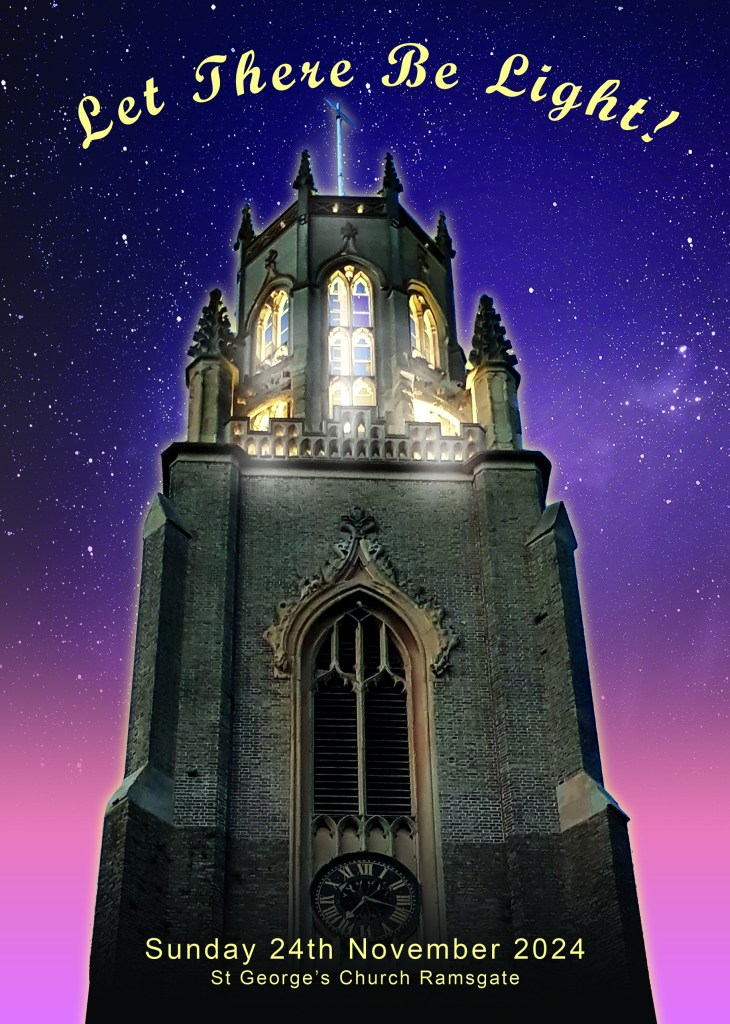
Let There be Light, This Sunday 24th November from 5pm
Next Sunday evening after the town light switch on, there will be a special event in St. George’s with light shows, refreshments and music (this year with more mainstream music). Please pick up a leaflet and come with friends. If anyone can lend us a ‘slow cooker’ or similar to heat mulled wine, then please let us know this weekend.
Christmas United Prayer Meeting, 1st December
Join together with Christians from all over Thanet as we come together for prayer in the lead up to Christmas. Sunday 1st December, 6:30pm-7:30pm, St. Philip’s Church, Northdown.
Coastal Choir Concert, 6th December
Please come and support this evening of carols and Christmas music at St. Luke’s church 7:30pm on Friday 6th December. Tickets £7 all proceeds to Cheerful Sparrows Chairty. If anyone would be willing to help with refreshments and/or welcoming please see Brenda Clarke who will coordinate a team.
Links to Share:
With MPs due to debate the Assisted Dying Bill this week, here are a couple of articles about the subject.
Warnings about Assisted Dying Bill
MPs won’t have sufficient time to scrutinise assisted suicide legislation before it’s debated in the Commons, CARE has warned. Read Statement.
Why am I so terrified of Euthanasia?
Ian Stackhouse reflects on why he is so concerned about the idea of Euthanasia becoming legal. Read more…
Finally, let’s pray that we are able to dare resist pressures towards idolatry in our society.
Yours in Christ
Paul Worledge
(Priest in Charge, St. George’s Ramsgate)
Weekly Calendar
Sunday 24th November – Christ the King
Eucharist (St George’s, 9:30am) – Reading: Daniel 3:13-30
Let There Be Light! (St George’s Church) – from 5pm
Monday 25th
Prayer Meeting (St. Luke’s Church) – 9:30-10:00am
Craft Group (St. George’s Hall, Soup Kitchen) – 2:00-3:30pm
What’s On – a page which lets you know what is happening this week and gives information about upcoming events.
Notices – You can read the latest notices on this page.
Sermons – Read a transcript of a recent sermon or watch the YouTube version recorded at St. Luke’s. There are now videos for all the sermons over the summer.
Safeguarding Training
If you volunteer in anyway at church the national authorities are strongly encouraging you to take at least the Basic Module in safeguarding training once every three years.
If you have not completed the training in the last three years, then the module can be completed online and takes about ninety minutes. You can access the training by following this link. You will need to first register, to access the training. Once the training is completed, you will be sent a certificate. Please forward that certificate to James (office@stlukesramsgate.org), so that we can keep records of who has done the training.
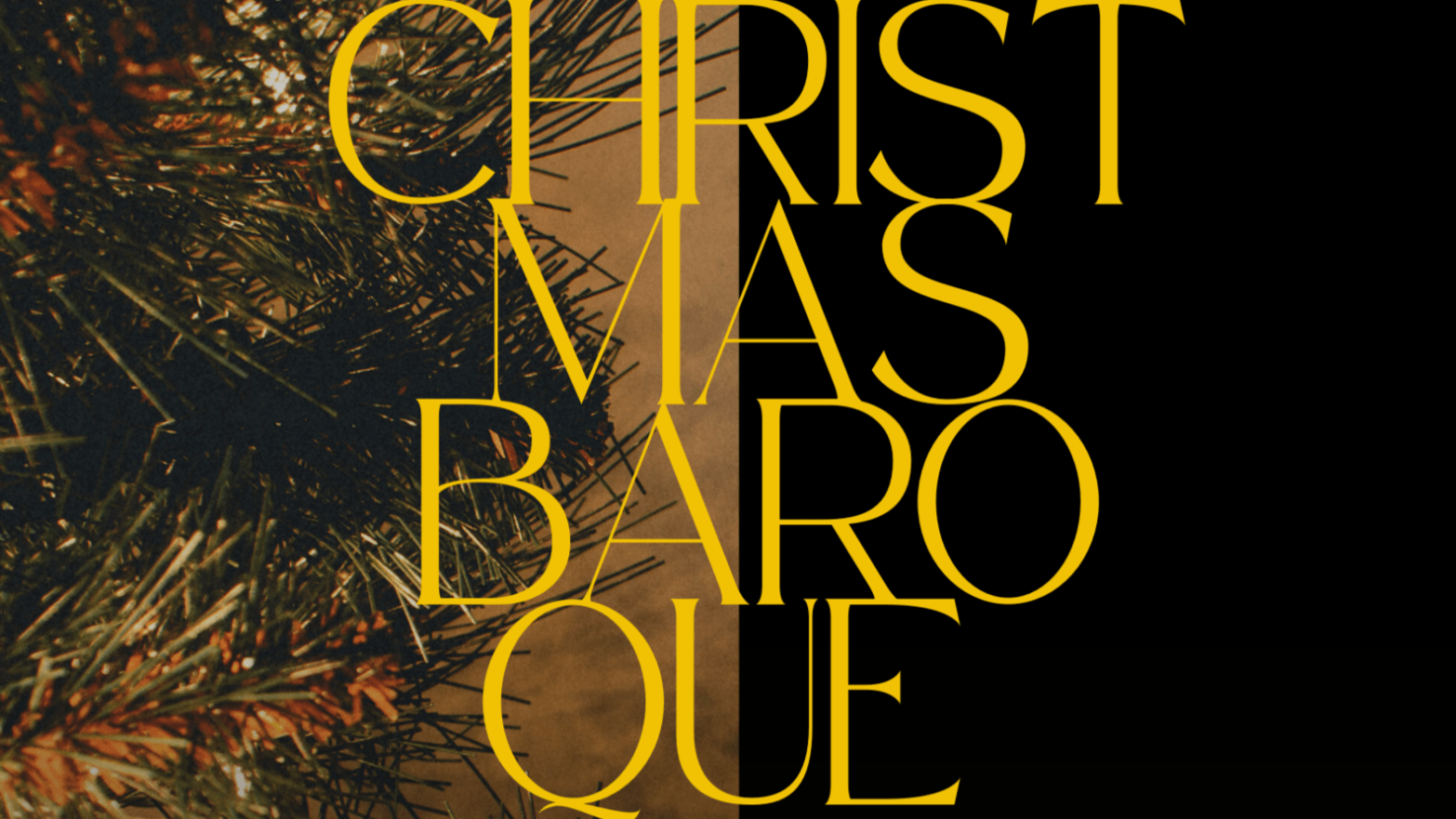
Monday 16th December, 7:30pm. Doors open at 7:00pm.
In the setting of the beautiful St. George’s church as it hosts its annual Christmas Tree festival, join us for this wonderful concert of Baroque music, featuring the Baroque Collective: Hannah Morley, Joel Raymond, Tom Shelley and Petra Hajduchova.
Tickets are £13 in advance (before 12th December) or £15 after this date or on the door. Under 16s are free.
“God reveals deep and hidden things; he knows what lies in darkness, and light dwells with him.” (Daniel 2:22)
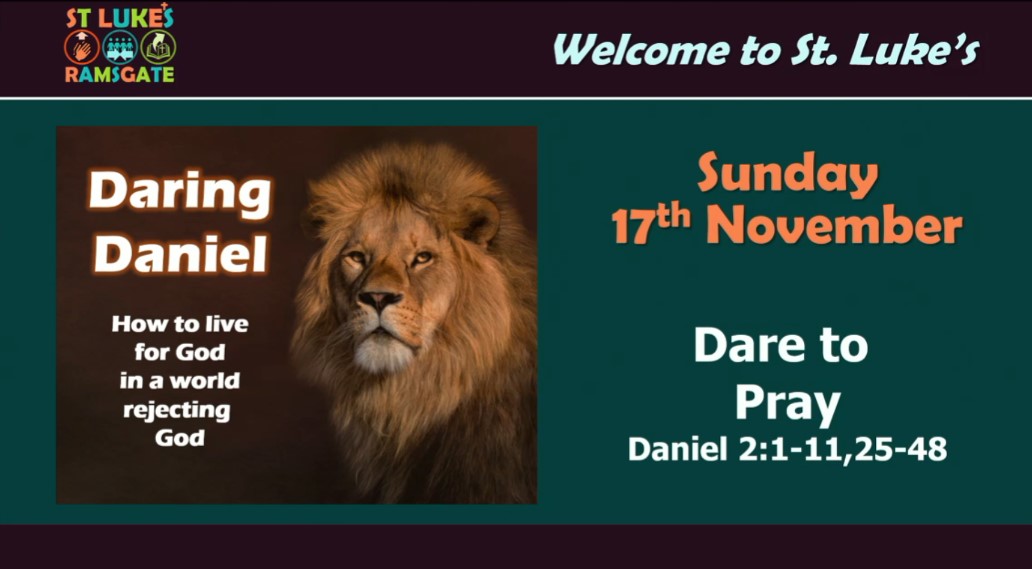
This Sunday, we return to our series on Daniel. Faced with an impossible seeming challenge from the boss, Daniel turns to prayer. As a result, Daniel brings some powerful and challenging truths to the king.
Today is Safeguarding Sunday, which is poignant considering the Archbishop has had to resign, because of a failure to deal adequately with a Safeguarding issue.
But, why do institutions or organisations fail to tackle abusers. Part of the problem is that it takes courage to call out, challenge or uncover such wicked behaviour when it comes to light. Victims need to dare to share the abuse they have suffered, leaders in an organisation need to be willing to accept that sometimes well respected people within an organisation might be an abuser, and they have to be willing to share that truth beyond the organisation, risking reputational damage for themselves and the organisation itself.
In short stopping abuse, needs people to act in ways that can be deeply uncomfortable. Yet, not to act can allow abusers to go unpunished and more people to suffer abuse. Which tragically is what happened with John Smyth.
Our reading today from Daniel, is not about tackling abuse, but it does involve people being willing to challenge conventional thinking and to speak the truth, even though to do so is risky.
It’s a long story, but involves two key characters, Nebuchadnezzar who was king of the Babylonian empire, the biggest empire ever seen in the Near East up until that point and Daniel, a Jewish exile recruited to be trained up in the Babylonian empires civil service.
Let’s start by considering Nebuchadnezzar, someone who dares to push beyond conventional thinking, albeit in a very bullying and aggressive way!
Nebuchadnezzar: Dares to Push beyond Conventional Thinking
Under Nebuchadnezzar’s father, the Babylonians had destroyed the Assyrian Empire and before he was king Nebuchadnezzar, himself had led an army, which had wiped out the Egyptian Army under Necho II in the Battle of Carchemish. With the empire now established, Nebuchadnezzar’s dad had died and he had taken over ruling this large and powerful empire.
Nebuchadnezzar, was already then used to turning the world upside down, as well as enforcing his rule through violent means. We see both those aspects in this story.
He has had a disturbing dream and he wants to know its meaning. The normal way of doing things was to tell the dream to his advisers, then they would give an interpretation. But how could Nebuchadnezzar be sure, their interpretation was the real meaning of the dream and not just an attempt to interpret it along with conventional thinking? Nebuchadnezzar comes up with a bold request. He wants them to tell him what the dream was, before telling him the meaning. Only then could he be confident that they had real insight beyond human thinking.
The magicians and advisers respond by saying, this is impossible! How can they know his dream? No other king has ever made such a request. Basically, they say this is an impossible and ridiculous suggestion. So, Nebuchadnezzar becomes angry and threatens violence. “Tell me or you all die!” is the gist of what he is saying.
Now, admittedly, this is not the kind of boss you would want to work for. And Nebuchadnezzar’s threats of violence are not to be commended – he is clearly not concerned about safeguarding his staff! His style of rule is closer to Stalin than the Archbishop of Canterbury!
Yet, there is something to be commended about his bold request. He wants to get beyond the platitudes of conventional thinking, he wants to push to the deeper meaning behind his dream. He is questioning the attitudes of his day. He wants to really know the truth.
Do we dare to push beyond conventional thinking?
Perhaps you too are someone fed up with the conventional wisdom of today. Perhaps like Nebuchadnezzar, God has brought you to long for a deeper meaning or understanding of life. Perhaps you are beginning to question the kind of ideas you have always believed in.
Increasingly, people in our society are questioning some of the commonly held assumptions. Louise Perry, for example has written a book called, The Case Against the Sexual Revolution, questioning many of the now conventional beliefs about sexual liberation, because she has come to see that on the whole sexual liberation has been bad for most women, but most benefits predatory men.
Others are beginning to question the idea that science can fully explain life and shows us that God is not needed. They are seeing that science cannot answer all our questions, it does not help us find agreement on some of the big cultural questions of the day. It cannot connect us with the deeper meanings of life and the world. Perhaps we need guidance from God after all.
Still others are questioning whether the technological revolutions around smart phones are leading us and particularly our children to become increasingly anxious and depressed, that rather than connecting people they are leaving people increasingly isolated and alone and distracting us from exploring deeper meanings in life.
Will you be a Nebuchadnezzar and dare to push beyond conventional thinking and ways to seek a deeper truth?
Daniel: Dares to Seek God’s Help
The magicians and advisers see no way to be able to meet Nebuchadnezzar’s demand to tell him his dream, so the command goes out that all of them be killed. This is where Daniel comes in. Although they are at the lowest rung of the civil service, he and his friends also face death. But Daniel response in a different way to the magicians and other advisers. He dares to pray, to seek God’s help.
This contrast between Daniel and his friends and the magicians and advisers, is fundamental to the story and rooted in a contrasting belief in God.
In verse 11, the Magicians and advisers say: ‘No one can reveal it to the king except the gods. The gods do not live among humans’ (vs. 11)
They believe in the spiritual, but not in a spiritual that reveals things to human beings, not in gods who listen and speak.
Daniel on the other hand, believes in the God revealed by Moses and the prophets. He believes in a God who does listen and speak. So rather than responding with despair, he dares to seek God’s help, he dares to pray.
“He urged them to plead for mercy from the God of heaven, concerning this mystery.” (vs. 18)
And the amazing thing is God answered his prayer, and that night revealed Nebuchadnezzar’s dream and its meaning to him. Daniel prayed, God revealed and the other magicians and advisers were saved.
Do we dare to seek God’s help?
This is a challenge for us as Christians today. Like the magicians and advisers, it is easy to despair, to see the impossible, to give up and resign ourselves to collapse. We can forget that our God is the God who speaks and listens. He is not a distant unknowable God, but one we can engage with, cry out to. He is, ‘our Father.’
Over this year of discernment, we have been asking God to speak to us. To show us the plans for the future. Like Daniel, who asked his friends to pray, we’ve done this together and we think that God has now revealed the outlines of a way forward. A vision not of despair, but I hope of growth.
But, we need to keep on praying. Indeed, prayer must be front and centre of our attempts to implement the vision if we really are to grow the church. We need to dare to seek God’s help.
But of course, daring to seek God’s help, may involve us becoming part of the solution. The truth is it is easier or more comfortable to sit back and despair, than pray for God to intervene and risk becoming part of God’s solution. That is what happened to Daniel, he was the one that having now been given Nebuchadnezzar’s dream had to tell the king what it was and its interpretation. He needed to dare to speak truth to power.
Interlude: The Dream and its interpretation
So, what was the dream and what was its interpretation?
In the dream was a statue, with four layers. The head was gold, the chest and arms silver, the belly and thighs bronze and the legs and feet of iron and clay. In the dream a rock comes and strikes the feet of iron and clay and the statue is destroyed and all its parts lost without trace, whilst the rock becomes a huge mountain and fills the earth.
The interpretation is that each stands for a great kingdom, beginning with the kingdom of gold, which is Nebuchadnezzar’s kingdom. But none of the Kingdom’s last, each one is replaced by the other, until finally a different kind of kingdom, represented by the rock and mountain, which is God’s kingdom. This kingdom will endure forever.
For Nebuchadnezzar, the dream and interpretation is both encouraging, but also deeply challenging. His kingdom is golden, but it won’t last, it is not ultimate. God has something better in mind.
Daniel: Dares to Speak Truth to Power
Now how would you feel about telling Nebuchadnezzar that his kingdom, great though it is, is not going to last? This is the guy, who was quite quick to order his whole civil service to be killed. Wouldn’t you want to tell him what you think he wants to hear?
Again here is a contrast between the magicians and other advisers and Daniel. Back in verse 4, they say to Nebuchadnezzar, “O King live forever!” They tell him what they think he wants to hear, that his kingdom is going to be the one that lasts. That his conquests mark the end of history. They want to give him the attractive conventional wisdom of the day.
But Daniel is willing to tell him the deeper truth that comes from God: ‘After you, another kingdom will arise…’ (vs. 38) Your kingdom is not the ultimate kingdom. Actually, there will be three other great kingdoms after you, but none of them will be the ultimate kingdom. Only God’s kingdom is eternal.
Fortunately, for Daniel, Nebuchadnezzar is delighted to be told this deeper truth and to know that because Daniel told him the dream as well as its meaning he could trust it was true and Daniel’s God is the true God:
“Surely, your God is the God of gods and the Lord of kings and a revealer of mysteries…” (vs. 46)
Had Nebuchadnezzar been converted? He had certainly taken a big step in the right direction, but as we will see next week, he still had some way to go!!
Do we dare to speak God’s truth?
As for us, will we like Daniel dare to speak God’s truth. Are we prepared to tell people the deep things God reveals, when it may well not be what they want to hear?
Daniel told Nebuchadnezzar, that his cherished empire, magnificent as it was, his life’s work would ultimately be like rubbish blown away by the wind. That only God’s kingdom is eternal.
Are we willing to challenge people, that the things they work for and value most in life, great and good as those things may be, will one day all come to nothing? That they need to seek first God’s kingdom and his righteousness?
To trust in what Christ has done for them and not in what they have achieved for themselves?
Will we dare to speak or share God’s truth?
Nebuchadnezzar dared to push beyond conventional thinking to God’s truth, Daniel dared to pray that he might be used by God as a solution to the crisis and he dared to speak challenging truths to power. Will we dare to step out of the conventional and seek first God’s kingdom and his righteousness?
Join us for a fun event at St. Luke’s Hall, 7:30-9:30pm tonight (Saturday 16th November). Come as a team or as individuals and join up with others to form a team on the night. Simple snacks and refreshments are provided, but you may also want to bring your own.
There will also be an opportunity to hear about the work of Tearfund and make a donation to them. Gift Aid envelopes will be available.
This week, some reflections on the Archbishop’s resignation both at the start and in the shared links later on. Also, news about the upcoming service, Saturday’s Quiz evening and a number of key upcoming events. There is also a link to the livestream about our proposed vision, associated document and a link to share your feedback on that. Finally, don’t forget the prayers and calendar at the end of the email.
This week came the shocking and sad news that Justin Welby, the Archbishop of Canterbury has quit. He resigned after criticism of his handling of abuse allegations against John Smyth, a lay leader of the Iwerne camp movement. In short, he did not ensure the allegations were pressed home, so that John Smyth was brought to justice sooner and further abuse prevented.
John Smyth’s abuse was first revealed to the leaders of the Iwerne camps in the early 1980s. Although, they recognised that what he was doing was both abhorrent and criminal, they made the terrible decision not to report it to the police. They allowed concern for reputation to override concern for justice and the protection of future abusees.
There is of course a need to handle any allegations of abuse in appropriate ways. Just because someone is accused, does not mean they are guilty. False accusation is a serious crime in its own right and we do not want to be guilty of spreading false rumours about individuals. Nevertheless, every allegation needs to be taken seriously and reported to safeguarding officers, so that it can be investigated sensitively, abusers stopped, and justice done.
We need to recognise, that our instinct is to cover up our own sin and to protect the reputation of our institution or movement. It will never be easy to accept that a predator has been allowed to infiltrate and abuse in our midst. Yet, unless we are prepared to allow such truths to surface and acknowledge that accusations against those we respect may be true, our safeguarding will fail.
God’s forgiveness is not a cover up of sin. Jesus paid the price for our sins, so we would not have to, but he did so with a public display of the full horror of human sin. We too need to allow the sin in our midst to be made public.
This Saturday: The Big Quiz Night, 7:30-9:30pm, St. Luke’s Hall
Tearfund’s The Big Quiz Night is back on Saturday 16th November, 7:30-9:30pm at St. Luke’s Hall. The money this quiz raises will support Tearfund’s Transforming Communities programme, helping local churches around the world lead their communities out of extreme poverty and into a sustainable future. Invite your friends, family and neighbours for some poverty-beating, community-building fun! Please come ready to make donations on the night. Snacks and drinks will be provided, but please feel free to bring your own too!
Vision 2030
If you weren’t able to come on Monday night and missed the livestream, you can still watch it here. You can find the Vision 2030 document here. We are asking people to give us feedback on the vision using this simple and short online form by the end of the year. Then we will review the Vision and agree how to move forward at our PCC meetings in January.
Christmas Tree Festival
If you would like to enter a tree into the Christmas Tree Festival, then please collect a form from Janet Reid or off the church website and return it to her by Tuesday 26th November.
Men’s Group – Chocolate Night
7:30pm Tuesday 19th November, Salvation Army, £5
Carl Whitewood will be welcoming us to the Salvation Army church in High Street to talk about chocolate. Before training as a Salvation Army officer, Carl spent nearly 30 years in the food industry; baking craft bread, processing fruits, making some of the UK’s best ice cream and assuring the quality of your favourite chocolate bars in 20 manufacturing plants across Europe. He continues to make his own ice cream and chocolate and to teach and talk about the art and science of these wonderful foods. During the chocolate demonstration you will learn about the history of chocolate, how chocolate came from its origins in South America into Europe and the many changes that led to the chocolate that we enjoy eating today. There will be lots of opportunities to taste and enjoy Theobroma cacao – The food of the gods. Please let Bruce know if you are going.
Basic Safeguarding Training, 23rd November
If you are involved as a volunteer at St. Luke’s, then you are encouraged to do the Basic Safeguarding training. This can be done online (and if you are working with children or vulnerable adults, you will need to do the online version, so that you can access the next level), but there is also an opportunity on Saturday 23rd November, 10:30-13:00 at St. Mark’s Ramsgate to attend a face-to-face training session led by Kevin Spain. You can access the online training by following this link.
Let There be Light, Sunday 24th November from 5pm
Next Sunday evening after the town light switch on, there will be a special event in St. George’s with light shows, refreshments and music (this year with more mainstream music). Please pick up a leaflet and come with friends. If anyone can lend us a ‘slow cooker’ or similar to heat mulled wine, then please let us know this weekend.
Christmas United Prayer Meeting, 1st December
Join together with Christians from all over Thanet as we come together for prayer in the lead up to Christmas. Sunday 1st December, 6:30pm-7:30pm, St. Philip’s Church, Northdown.
Christmas Unwrapped at St. Luke’s, 3rd December
In partnership with ACTS, we will be hosting Year 6 pupils from at least two schools on this date for a 90-minute session exploring the true meaning of Christmas. If you can help on the day with biscuit decorating, then please see Paul, asap.
Coastal Choir Concert, 6th December
Please come and support this evening of carols and Christmas music at St. Luke’s church 7:30pm on Friday 6th December. Tickets £7 all proceeds to Cheerful Sparrows Chairty. If anyone would be willing to help with refreshments and/or welcoming please see Brenda Clarke who will coordinate a team.
Links to Share:
Justin Welby Resignation – Diocesan Statement and Safeguarding links
This is the official Diocesan Statement about Justin Welby’s resignation. This includes links for those who made need support in the light of the Safeguarding comments being made. Read Statement.
Justin Welby Resignation – Reflections from an Evangelical
What should we learn from the Justin Welby resignation and the cover up of John Smyth’s abuse? In this video, Glen Scrivener speaking from a Conservative Evangelical perspective calls on us to focus on the actual reason Justin Welby resigned and to learn the lessons on safeguarding. His comments at the end of the video challenge particularly evangelicals on some of the attitudes that might lead to a cover up. Warning, this does include some graphic description of John Smyth’s abuse. Watch 30 mins.
Finally, let’s pray that we are willing to uncover sin and bring justice and safety.
Yours in Christ
Paul Worledge
(Priest in Charge, St. George’s Ramsgate)
Weekly Calendar
Sunday 17th November – Second Sunday before Advent
Eucharist (St George’s, 9:30am) – Reading: Daniel 2:1-11,25-48
Monday 18th
Prayer Meeting (St. Luke’s Church) – 9:30-10:00am
Craft Group (St. George’s Hall, Soup Kitchen) – 2:00-3:30pm
What’s On – a page which lets you know what is happening this week and gives information about upcoming events.
Notices – You can read the latest notices on this page.
Sermons – Read a transcript of a recent sermon or watch the YouTube version recorded at St. Luke’s. There are now videos for all the sermons over the summer.
Safeguarding Training
If you volunteer in anyway at church the national authorities are strongly encouraging you to take at least the Basic Module in safeguarding training once every three years.
If you have not completed the training in the last three years, then the module can be completed online and takes about ninety minutes. You can access the training by following this link. You will need to first register, to access the training. Once the training is completed, you will be sent a certificate. Please forward that certificate to James (office@stlukesramsgate.org), so that we can keep records of who has done the training.
“[The LORD] will judge between many peoples and will settle disputes for strong nations far and wide. They will beat their swords into ploughshares and their spears into pruning hooks. Nation will not take up sword against nation, nor will they train for war anymore.” (Micah 4:3)
When you look at the reality of humanity and history, it is hard to see how people can ever achieve lasting peace. There is no hope. Yet Micah portrays a hope rooted in the God of the Bible. It is only by his actions that wars will one day cease, that peace will come.
War memorials come in many guises. At last year’s Remembrance Sunday service, I showed you a picture of the war memorial statue at Southend on Sea. This year I have a different war memorial to highlight, which was part of a post-war community-building project as well as being a war memorial.
It is an artwork titled ‘The Tree of Life’, which is part of the collections of the British Museum.1 It is sculpted entirely from decommissioned weapons which were given in return for bicycles, sewing machines and farm equipment following the end of the civil war in Mozambique in the 1990s. It was part of an art project titled ‘Swords into Ploughshares’. The Wikipedia entry for this phrase explains that the concept is of military weapons or technologies being converted for peaceful civilian applications. It’s not simply about the decommissioning of military technology, it’s about its re-purposing for peaceful ends. But who needs Wikipedia when we have this morning’s readings from the Old Testament?
I want to consider different aspects of these readings under three headings: firstly, ‘Swords into Ploughshares’; secondly, ‘Ploughshares into Swords’; and thirdly, ‘Swords into Ploughshares, forever’.
Swords into Ploughshares
Micah chapter 4 verses 2 and 3 read: “The law will go out from Zion, the word of the LORD from Jerusalem. He will judge between many peoples, and shall settle disputes for strong nations far and wide. They will beat their swords into ploughshares, and their spears into pruning hooks. Nation will not take up sword against nation, nor will they train for war any more.”
So the vision is of people beating their spears into pruning hooks, as well as their swords into ploughshares – all the technology of human destruction being transformed into tools for agricultural labour and flourishing.
And tied up with agricultural flourishing, there will be human flourishing: “Everyone will sit under their own vines and under their own fig trees, and no one will make them afraid.” (Micah 4:4). This is a vision of the kind of peace, that existed prior to the division of the kingdom of Israel, returning to the land. In 1 Kings chapter 4 verse 25, it says that “during Solomon’s lifetime Judah and Israel, from Dan [to the north, near the border with Lebanon] to Beersheba [to the south, not far from Gaza], Judah and Israel lived in safety, each man under his own vine and fig tree”. It is a strange and uncomfortable thing to be speaking of this 3000 year old vision in 2024, at a time when peace seems so far from these and other places.
And the vision includes a phrase which inspired the lyrics of African-American spiritual hymn ‘Down By the Riverside’.
‘Gunna lay down my burden, down by the riverside,
‘I ain’t gunna study war no more,
‘gunna lay down my sword and shield,
‘gunna shake hands with every man’,
and so on.
These words in turn helped to inspire the civil rights movement, and the Vietnam War protests, in the United States of America. More broadly, this vision of Micah, many of the elements of which were shared by the prophet Isaiah, inspired the formation of the United Nations in the late 1940s, following the unprecedented loss of life associated with the Second World War. The words of the prophet, and a statue of a man beating a sword into a ploughshare, appear outside the UN headquarters in New York.2
This is a beautiful and an inspiring vision of the last days, when “the mountain of the Lord’s temple will be established as chief among the mountains. “It will be raised above the hills, and peoples will stream to it”, say the prophets Micah (4:1) and Isaiah (2:2). “Many nations will come and say, ‘Come, let us go up to the mountain of the Lord, to the house of the God of Jacob. He will teach us his ways, so that we may walk in his paths’.
But these particular words of the prophets were not written on the UN walls. With these words left out, all we are left with is a noble “human social program”.3 And a human social program, however noble it may be, leaves open the possibility, in fact the ever-present “demonic threat, of a return to war”4 following a period of peace. This is the reason for our second heading this morning …
Ploughshares into Swords
We know about this from history and from experience. Many conflicts are raging today, and they seem to be getting worse, not better. A few months ago, there were news reports of a three-day ceasefire in one of the war zones, to enable children to receive their vaccinations, their inoculation rounds, in safety. After that, the bombing started up again, threatening the lives of those very same children. Even on the radio news this morning, the first item was about which members of the Royal Family were going to attend the Remembrance Sunday service at the Cenotaph, and the second item was about how many people had died overnight in war zones.
As well as knowing about this senseless, deadly cycle from history and experience, we know about it from the Scriptures, because alongside the reading from the prophet Micah this morning, I suppose you will remember the reading we heard from the prophet Joel, and his sobering vision of a return to war.
In Micah everyone lived under their own vine and fig tree in safety, but in Joel the sickle is swung, and the grapes are trampled, and these are the grapes of the wrath of God against the nations, “so great is their wickedness”, declares the LORD in Joel chapter 3, verse 13.
And prior to that, the tools of peaceful and productive agriculture are converted into weapons of war. “Proclaim this among the nations”, says the prophet in verse 9. “Prepare for war! Rouse the warriors! Let all the fighting men draw near and attack. Beat your ploughshares, into swords, and your pruning hooks, into spears. Bring down you warriors, O LORD!” Here the “working ingredients” of the visions of Micah and Isaiah – “judgement, nations, sword against nation, vine and fig tree” are taken up by Joel in a “dramatic”, and intentional, “reversal”. Here the “nations gather for war”, “undo the hoped-for disarmament”, and “bring on themselves the judgement that” in other circumstances might “have led to [a] just settlement”.5
When we consider Micah and Joel side by side, we see that the Bible teaches what history and experience teach: that we are trapped in a depressing cycle of war giving way to peace, giving way to war once again. War, like wrongdoing, is not yet banished from the earth. The Protestant Reformer, John Calvin, once commented that “we might indeed do without the sword, [if we] were angels in this world” – but as we are not, “the use of the sword will therefore continue, to the end of the world”.6 The First World War, after which Remembrance Sunday was first instituted, was supposed to be ‘the war to end all wars’. How hollow that aspiration rings today! The United Nations was formed after the horrors of the Second World War, and it made ‘Swords into Ploughshares’ its watchword. Yet in the eighty years since, we have witnessed the continuation of ploughshares being beaten into swords. With one eye on the news, do any of us really know what the future will hold?
Although this cycle of war, and peace, and war again, is inevitable in Scripture, in history, and in experience, we must never rest content with it. Remembrance Sunday is not simply an annual opportunity to reassure ourselves that the country we live in has only ever fought in just wars, and on the right side. There is something about war which should always shock and horrify us.
The concept of a just war is an interesting one. Today it is widely assumed that any war which has a just cause can be considered to be just. But that is not the case. There are many criteria that have been developed over the centuries to determine what a just war is and looks like. A just cause is certainly one of them, but a war that meets this one criterion and no others does not meet the threshold for being called a just war.
A just war:
has a just cause,
is waged by a legitimate authority,
is waged as a last resort,
with the intention of obtaining peace,
without being motivated by hatred or revenge,
with a probable chance of success,
uses only means that are required for success; that do not do more harm than the harm they prevent; that do not harm the innocent; and that respect the provisions of international law.7
Fighting a just war, as distinct from a war simply in which the cause is just, is not an easy thing to do. That is why a former Archbishop of Canterbury, when asked at the start of a radio interview a couple of decades ago whether a certain war this country was fighting at the time was just or unjust, hesitated for thirty seconds – which seemed like an eternity on the radio – before attempting to give any sort of answer. While wrongdoing remains in the world, so too the threat of war will remain. “If we were angels in this world”, we might well do without the sword, but we are not, and “the use of the sword will therefore continue to the end of the world”. We human beings have a talent for turning over a new leaf, then tearing right through it. We have an aptitude for receiving the moral compass handed down by our forebears, and then breaking it. Our noble human “swords into ploughshares” projects co-exist with, or after a while they lead us back to, the nasty human reality of “ploughshares into swords”.
As I have said, we must never rest content with this state of affairs. We must long to see swords beaten into ploughshares again. We might wonder whether there is any basis for hoping, that the cycle will one day end, and the ploughshares will never turned into weapons again. Well, the Scriptures do give us a basis for hope, under a final heading
Swords into Ploughshares, forever
Joel’s vision of ‘Ploughshares into Swords’ looks ahead to a time when ‘the day of the LORD is near’, according to chapter 3, verse 14. It is a penultimate picture of the second-last reality. By contrast, Micah’s vision of ‘Swords into Ploughshares’ is of the last days themselves. It is a picture of the final reality, when mercy triumphs over judgment (cf. James 2:13). With one eye on the Bible, we really do know what the future will ultimately hold, whatever may take place in the meantime.
Without this firmly-based hope for the future, Remembrance Sunday might be a dark and mournful day. Hot on the heels of Remembrance Sunday needs to follow a glorious ‘Anticipation Sunday’ so that our hope in God may be sustained. And every year, that is exactly what happens, because the first Sunday in Advent, just a couple of weeks away now, always draws our attention to the return of Christ to establish his eternal kingdom and make all things new on the earth.
Of course, “we do not yet see everything subject to him” (Hebrews 2:8), and in the meantime it can be easy to lose anticipation, and fall into doubt and despair. “We do not yet see everything subject to him. But we see Jesus”, the writer of the letter to the Hebrews encourages us, “now crowned with glory and honour because he suffered death, so that by the grace of God he might taste death for everyone” (2:9).
Buried in this phrase there is a clue, which neither Joel nor Micah possessed, a clue to the reality of the transformation of swords into ploughshares forever. We do not yet see that permanent transformation. But there is one thing that the world has already seen. The cruellest and most degrading instrument of violence and death, that has ever been devised in the history of the world, has been forever transformed into a universally recognised symbol of faith and hope and love.
Crucifixion wasn’t just designed to punish and kill, it was designed to shame, humiliate, break, and destroy. It took the atoning work of Christ and the resurrection power of God to permanently convert the cross from a damnable weapon into a tree of life, beneath which we can stand secure and hopeful.
“In what way shall I praise you?’ asked Archbishop Anselm of Canterbury in a meditation he wrote over 900 years ago, which was actually addressed to the Holy Cross, “how shall I exalt you? … By you, sinful humanity is justified, the condemned are saved, the servants of sin and hell are set free, the dead are raised to life. By you the blessed city in heaven is restored and made perfect.”8
“On each side of the river” in the city of God stands “the tree of life”, as we read in the book of Revelation, “and the leaves of the tree are for the healing of the nations” (Revelation 22:2). The cross of Christ, once a torture rack, has become for us the tree of life. This is how we know that the sword will be permanently transformed into the ploughshare. Clinging to this tree, we will live forever, our sins forgiven, and our lives restored to a state of original blessing, thanks be to God.
Without ever forgetting Remembrance Sunday, when we look back in sombre quiet and seriousness at all that has taken place, and in grateful memory of those who have lost their lives in war – without forgetting these things, today we will also glory in the cross, which was once an object of terror, but is now a sign of hope forever. And we will lean into Anticipation Sunday, and look forward to what is to come, when war will be no more, and God will be all in all. Amen.
“[The LORD] will judge between many peoples and will settle disputes for strong nations far and wide. They will beat their swords into ploughshares and their spears into pruning hooks. Nation will not take up sword against nation, nor will they train for war anymore.”
It’s Remembrance Sunday this week, so please remember there is no service at 9:30am, but a special civic service at 11am after the Parade through town (setting off at 10:40am), last post and laying of wreaths at the memorial in front of the church.
John Lennon wrote the famous song, Imagine.It is a beautiful song, which invokes a sense of hope for a better future.
Indeed, one of the lines echo the verse above: “Imagine all the people, living life in peace.” That is certainly the vision of Micah when he says that one day the nations will “beat their swords into ploughshares and their spears into pruning hooks.” If Rachel Reeves could scrap Defence spending, then she would have £57.1 billion to spend on the NHS and Education without having to raise taxes!
How might this happen? This is where Lennon’s vision breaks down. He imagines a world without any nations or possessions, nothing to die for and no need for greed or hunger. But how would such a world work? How can we create one, ‘brotherhood of man’ without oppression and bloodshed? Certainly, no-one has come any closer to achieving that since John Lennon wrote the lyrics and wars and conflicts continue along with hunger and greed.
When you look at the reality of humanity and history, it is hard to see how people can ever achieve lasting peace. There is no hope. Yet, in contradiction to Lennon’s vision of a world without religion, Micah portrays a hope rooted in the God of the Bible. It is only by his actions that wars will one day cease, that peace will come.
As Christians, we have that great hope, but we are also called to live it now. After all, it was Jesus, the Prince of Peace who said, “Blessed are the peacemakers.”
Paul Worledge
What have we discerned? – This Monday
As we come to the end of the Year of Discernment we want to share, Vision 2030, the plan we think God has for our churches over the coming five years. We will be making a presentation on Monday 11th November at 7:30pm at St. Luke’s church, members from both churches are encouraged to come and hear the plans. There will be opportunities for feedback in the meeting and in the weeks afterwards. If you cannot make it on the night you can watch via this livestream.
Next Saturday: The Big Quiz Night
Tearfund’s The Big Quiz Night is back on Saturday 16th November, 7:30-9:30pm at St. Luke’s Hall. The money this quiz raises will support Tearfund’s Transforming Communities programme, helping local churches around the world lead their communities out of extreme poverty and into a sustainable future. Invite your friends, family and neighbours for some poverty-beating, community-building fun! Please come ready to make donations on the night. Snacks and drinks will be provided.
Men’s Group – Chocolate Night
7:30pm Tuesday 19th November, Salvation Army, £5
Carl Whitewood will be welcoming us to the Salvation Army church in High Street to talk about chocolate. Before training as a Salvation Army officer, Carl spent nearly 30 years in the food industry; baking craft bread, processing fruits, making some of the UK’s best ice cream and assuring the quality of your favourite chocolate bars in 20 manufacturing plants across Europe. He continues to make his own ice cream and chocolate and to teach and talk about the art and science of these wonderful foods. During the chocolate demonstration you will learn about the history of chocolate, how chocolate came from its origins in South America into Europe and the many changes that led to the chocolate that we enjoy eating today. There will be lots of opportunities to taste and enjoy Theobroma cacao – The food of the gods. Please let Bruce know if you are going.
Christmas United Prayer Meeting
Join together with Christians from all over Thanet as we come together for prayer in the lead up to Christmas. Sunday 1st December, 6:30pm-7:30pm, St. Philip’s Church, Northdown.
Basic Safeguarding Training
If you are involved as a volunteer at St. Luke’s, then you are encouraged to do the Basic Safeguarding training. This can be done online (and if you are working with children or vulnerable adults, you will need to do the online version, so that you can access the next level), but there is also an opportunity on Saturday 23rd November, 10:30-13:00 at St. Mark’s Ramsgate to attend a face-to-face training session led by Kevin Spain. You can access the online training by following this link.
Let there be Light!
On Sunday 24th November, there will be the ‘Let there be light!’ event at St. George’s after the town’s Christmas Light switch on, starting at about 5pm.
Thanet Prayer Diary – November and December
You can download the Thanet Prayer Diary for November and December here.Alternatively pick one up from the back of church.
ACTS Prayer and Thanksgiving Event – 18th November
Join us for an evening of prayer, thanksgiving and updates about the work of ACTS (Active Christianity in Thanet Schools). As well as a time to meet our new workers, Abi and Charlotte, over a cuppa and a slice of cake!
Monday 18th November, St Philips Church, Palm Bay, CT9 3JJ, 7:00pm
Links to Share:
Looking out for exploitation at the local car wash
Sadly, modern slavery exists in most local communities. Read this article to see how you might help to tackle it. Read more…
Now Halloween is over, a question: Should Christians watch horror?
This video is a discussion about whether it is appropriate for Christians to watch horror programmes or films. Do they “keep God on the agenda” or do they just leave us disturbed? Watch the video (40 mins.)
Finally, let’s pray that we can be peacemakers.
Yours in Christ
(Priest in Charge, St. George’s Ramsgate)
Weekly Calendar
Sunday 10th – Remembrance Sunday
Eucharist (St George’s, 9:30am) – Reading: Micah 4:1-4; Joel 3:9-17
Sunday School (St George’s, 10:30am)
Monday 11th
Prayer Meeting (St. Luke’s Church) – 9:30-10:00am
Craft Group (St. George’s Hall, Soup Kitchen) – 2:00-3:30pm
What have we discerned? (St. Luke’s Church) – 7:30-9:00pm
What’s On – a page which lets you know what is happening this week and gives information about upcoming events.
Notices – You can read the latest notices on this page.
Sermons – Read a transcript of a recent sermon or watch the YouTube version recorded at St. Luke’s. There are now videos for all the sermons over the summer.
Safeguarding Training
If you volunteer in anyway at church the national authorities are strongly encouraging you to take at least the Basic Module in safeguarding training once every three years.
If you have not completed the training in the last three years, then the module can be completed online and takes about ninety minutes. You can access the training by following this link. You will need to first register, to access the training. Once the training is completed, you will be sent a certificate. Please forward that certificate to James (office@stlukesramsgate.org), so that we can keep records of who has done the training.
The inaugural Ramsgate Lumiere opens with the Ramsgate Town Christmas Light switch on, Sunday 24th November. After the switch on, follow Samba Ya Wantsum, Ramsgate’s very own Samba Band and their magical lantern procession up the High Street to St George’s. Let There Be Light is a free event, open to all, with music, lightshows and refreshments.
Gadzukes Ukulele band, Thanet Festival Choir and Soul Choir will all be performing on the night and the church will be illuminated by Lumen Studios video projections and lighting by James Brown AV.
Refreshments including soup, hot drinks and mince pies will be provided for a festive celebration which marks both the beginning of the Christmas period and the end of the 2nd year of Project 200.
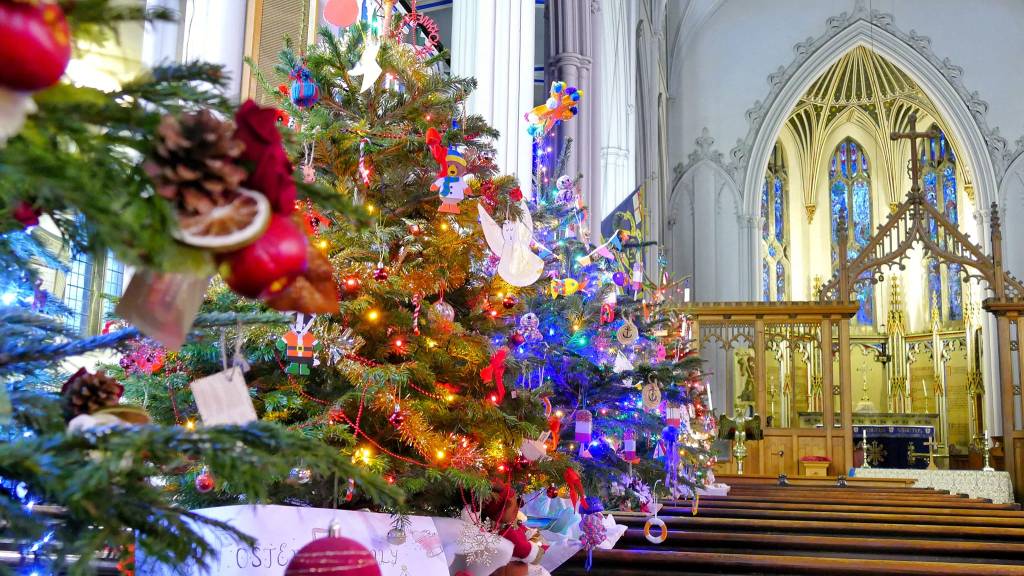
We invite friends, families, schools and organisations, Church Hall users, businesses in the town and those who are in sympathy with the restoration of this beautiful church to exhibit a small decorated tree in the SIXTEENTH CHRISTMAS TREE FESTIVAL and make it the best ever.
photo by Frank Leepard 2021
We feel that a real tree of 3 to 4 feet in height would be suitable. We are able to supply stands and if you would like us to order a tree for us, please indicate on the enclosed form and include a cheque for £25. In previous years, visitors have commented on the lovely sent as well as the magical sight which greeted them as they entered the church.
Suggestions for decoration include Christmas Carol or song, a colour theme or something specifically connected with the exhibitor. We have an electrical supply to plug lights into. For businesses this is an inexpensive way to advertise and also to support the church.
Setting up will take place on Wednesday 11th December and Thursday 12th December between 2-5pm and the Festival will be open to visitors from 13th to 22ndDecember.
Trees remain the property of the exhibitor but most people are happy to leave them in the church throughout the Christmas period. If you want to remove a tree would you tell us so that we can arrange a time.
There will be a small prize for the favourite tree chosen by visitors. Rules for exhibiting in the festival:
Print and return the form below with payment for a tree by Tuesday 26th November to Janet Reid – address details on form.
Ensure you are able to decorate your tree between 2-5pm on either Wednesday 11th or Thursday 12th December.
Decorations will need to be removed by the end of 5th January. The church will be open on that day from 2-5pm to enable that. Please note that any decorations not collected by 5pm on 5th January will be disposed of.
Participants may either take their tree home (by the end of 5th January) or leave it in situ to be disposed of by the church in an environmental way.
Any damage or loss to the trees or decorations during the event is at the participant’s own risk with no liability to the church.
If anyone would like to offer to help sit in the church as a welcomer during the festival please contact Janet Reid and she would be delighted to add you to the rota!






 St. George's Church Ramsgate