
“Forgive us our debts, as we have also forgiven our debtors. And lead us not from temptation, but deliver us from the evil one.”
(Matthew 6:12)
Parenthood – Love and Sacrifice (1 Samuel 1:20-end)
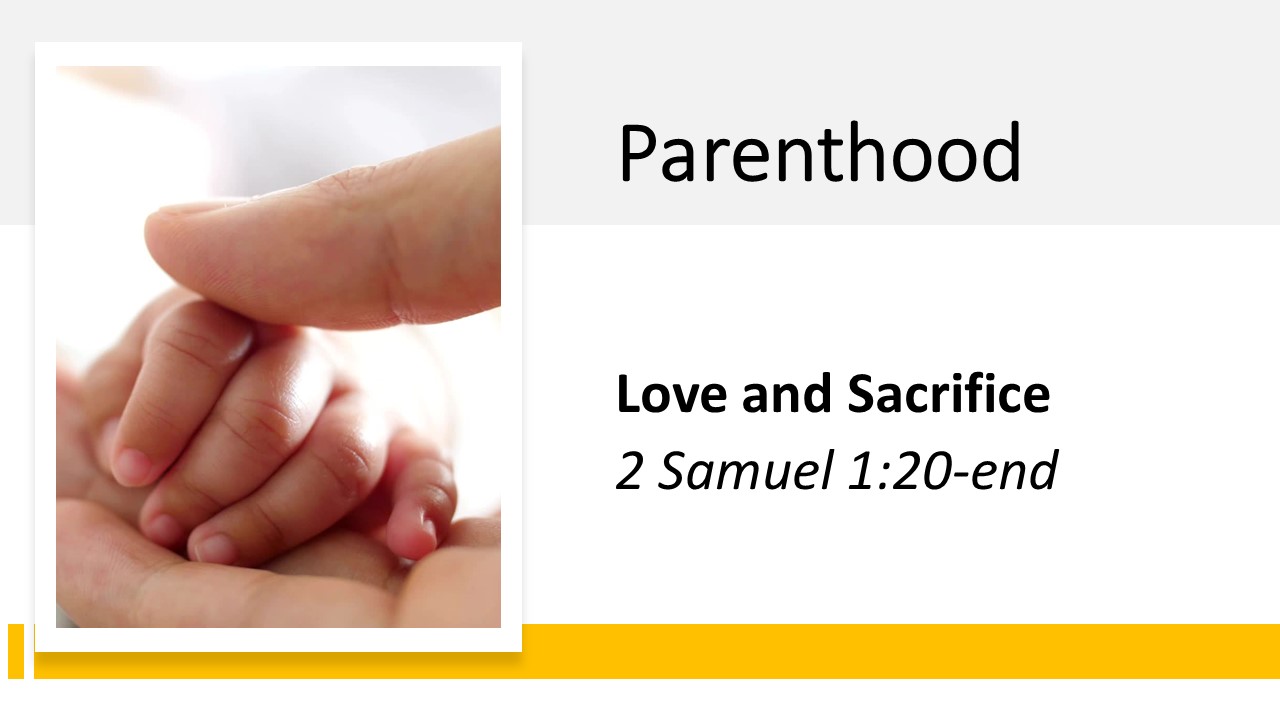
Being a mother takes sacrifice. Hannah was desperate to become a mother, so why when God gave her a son did she give him back to God?
Have you ever wanted something really badly?
Have you ever wanted something so badly that it’s all you can think about, you desire it, dream about it, talk about it share your need for it.
When I was younger I really desperately wanted a Mr Frosty. I don’t know if you have ever come across Mr Frosty. it was basically a big hunk of plastic that you put ice cubes in its hat and turned a handle, added some fruity flavourings and it basically made a crushed ice slushy.I badly wanted a Mr Frosty I think from about probably the age of 4/5 it went on my Christmas list and for a number of years I think it went on there every Christmas. I can’t remember now if one of my cousins had one or not, but I just thought this was the most fantastic thing and I really wanted it. So I kept asking. I can’t remember if I did eventually stop asking or I realised that my life was carrying on without one and that was okay, when on my 18th birthday I opened up a present and what did I get I got a Mr Frosty because mum said it’s something I’ve always wanted and so she finally bought me a Mr Frosty. I love that gift I love the thought that mum knew me so well she knew that that’s what I’d wanted when I was younger it might be a trivial thing to want but it was something I wanted and I eventually did get it
Is there something desperately that you really want?
Hannah’s desire for a child
In the Bible there is a story of a lady called Hannah. Hannah didn’t have children and she really wanted to. She was really sad about it and her husband was concerned for her – Hannah, why are you weeping? Why don’t you eat? Why are you downhearted? Don’t I mean more to you than ten sons?”
But Hannah knew what she wanted. Hannah and her husband and the whole family had Gone to the temple to offer their yearly sacrifices and Hannah had got up in her longing and desire and had gone into the temple of the Lord and she made a vow to God saying Lord Almighty if he will only look on your servants misery and remember me and not forget your servant and give her a son then I will give him to the Lord for all the days of his life and no razor will ever be used on his head” and she kept crying and crying to the Lord just full of of desire for what she wanted and felt she needed. As she was praying Eli one of the priests the high priest, saw her lips moving and thought she was drunk and he said how long are you going to stay drunk and she’s like I’m not my lord I’m a woman who is deeply troubled I’ve not been drinking I was pouring out my soul to the Lord I’ve been praying here out of my great anguish and grief.
and Eli says to her go in peace may the God of Israel grant you what are you have asked of him. in due course Hannah did actually become pregnant and she gave birth to a son and named him Samuel and Samuel sounds similar to the Hebrew word heard by God and so she calls him Samuel because she says I asked the Lord for him.
We’re going to look a little bit more about Hannah and Samuel and what we see of parenthood love and sacrifice so we’re gonna continue her story by reading from 1 Samuel chapter 1 starting at verse 21through to 28.
Parenthood – love and sacrifice
The title I gave todays talk was parenthood – love and sacrifice, but maybe a better title might actually be parenthood – loving sacrifice.
Raising a child can and does require loving sacrifice. Great parents do give up things in order for their children to grow and develop well.
To help us think about that a little bit I have a little quiz
How much sleep do you parents give up? These options are for the number of nights before the child reached one year of age. is it 25 nights, 78 nights, 133 nights or 265 nights. The answer is 133 nights.
How much does it cost to raise a child? Is it £2000 £20,000 £200,000 £2 million? According to him and ask her on the times it’s just over £200,000 to raise a child from birth to the age of 18
According to the official office of national statistics how much of a parents time each day is spent on childcare and housework? Is it 60 minutes, 158 minutes, 252 minutes, 381 minutes? the answer is 252 minutes.
Final question what proportion of parents pay towards the cost of their children’s house? is it 1/5 of parents, half of all parents, 2/3 of all parents or 4/5 of all parents. According to the website I was looking at apparently 2/3 of parents contribute in some way towards their child’s property.
Parenthood involves loving sacrifice of your own needs for the sake of your child.
When I was younger I thought the story of Hannah giving Samuel up in service to God was a strange story. She was desperate for a son, but she gave him back to God. Why would she sacrifice that?
It’s true parents sacrifice many things for the love of their children, to provide for their needs but why was Hannah’s sacrifice to only raise him until he was three and then give her child to God’s service? I think I found this strange because I didn’t fully understand the motivation behind Hannah’s sacrifice.
I’ve come up with three reasons why Hannah gave Samuel back to God. Number one she was able to sacrifice raising her son at home because she had faith in a loving God. Her heartfelt prayer came from a place, yes of desperation, but to a God who she believed would listen to her and care for her.
Secondly I think she sacrificed raising her son because of her gratitude to God for answering her prayers. She recognised that the gift of her son was just that a special gift and that God had provided her what she had most wanted. Which was why she was able to offer him back to God.
When we take up the offering we normally say Lord, all things come from you and of your own do we give you. This is gratitude and that’s what I think enabled Hannah to give her son back to God.
Thirdly she was able to entrust Samuel into Gods service because she was faithful to her father God. She had made a vow and she followed through. She could have said her prayer, received her son and then done nothing about the promise she had made to God. And yet she was faithful. Obedient in return.
The story of Hannah really struck a chord for my mum. My mum and dad were married for seven years before I was born and mum told me once that she never felt she could say the same prayer as Hannah because she couldn’t give me up. My mum desperately wanted to be a mum but she never felt she could give me up like Hannah did. We were having this conversation once and I said but mum that’s exactly what you’ve done. You brought me up to know and love God and sent me off into the world to serve him.
By Hannah’s sacrifice Samuel was going to be brought up in Gods house. She was ensuring him a future of walking closely with God
Remember our verse at the beginning? Come my children listen to me I will teach you the fear of the Lord’
That’s what my mum did for me and what Hannah did for Samuel.
We are not all parents here this morning but I believe On this Mothering Sunday that we can all learn from Hannah’s example?
I think there are at least three things:
Gratitude – have an attitude of gratitude. Know that we are Gods children that we are his. That is the place that we’re starting from. Show gratitude to our parents, carers and those that through loving sacrifice give of their time and resources to help us.
Importance of teaching and nurturing faith in our children – And that all of us can play a part in the nurturing of faith in our children but also for each other.
God’s faithfulness and plan
Hannah’s story shows us that we love a God who is faithful to his people, has a plan and provides for their need Samuel became a great prophet in Gods plan for providing for his people when they desired a king.
We can all learn from the story of Hannah, to be grateful to our loving heavenly parent, to look out for where we can help our children and young Christian’s to grow in faith and to be assured of Gods faithfulness and plan for all his people.
Youth provision this week

This week at YI, our group for the young people of St. George’s and St. Luke’s, we will continue using Rebecca McLaughlin’s book and explore whether science has disproved Christianity.

Supper this is week is fried chicken wraps with salad.
Then at 6:30 our doors remain open for anyone who wants to come and there will be a variety of games and activities available.

We’d be delighted to welcome any young people from Year 6 to 13.
Have a good rest of the week.
Parenthood – love and sacrifice
“Come, my children and listen to me; I will teach you the fear of the Lord.”
(Psalm 34:11)
Our Daily Bread (Matthew 6:25-34)

Prayer is about expressing our goals to God and trusting in his care. How does the expression: ‘Give us today, our daily bread’ help to shape the goals we pray for and breed a deeper trust in God, that releases us from anxiety?
Prayer – the antidote to worry
Are you a worrier or a prayer?
In a survey carried out before the Pandemic, anxiety was effecting 30% of women between 18-24 in 2018, a figure that was only 8.2% in 2008. The increase is not limited to just this age group, but has grown massively amongst men and women under 55.
Why is this? Lots of reasons are suggested, the financial crash of 2008, followed by greater insecurity, stagnating wage rises and austerity are possibly part of the problem. The introduction of social media on mobile phones is undoubtedly part of it too, as well as wider concerns like Brexit and Climate change.
I am sure all of these are major factors in the increase in anxiety, but perhaps there is another one. Maybe part of the reason for the growth in anxiety is the decline in prayer. If church attendance is a guide, then between 1980 and 2015, church attendance had fallen from 11.8% of the population to 5% of the population.
Could our society be becoming more anxious as we become less prayerful, less connected with God?
The Bible claims that prayer is the antidote to worry:
“Do not be anxious about anything, but in everything, by prayer and petition, with thanksgiving, present your requests to God.” (Philippians 4:6)
“Cast all your anxiety on him, because he cares for you.” (1 Peter 5:7)
We are looking at the Lord’s Prayer, and this week we are focussed on the line: “Give us today our daily bread.” It is the part of the prayer that deals with our basic needs in life.
In Matthew’s gospel, the Lord’s prayer appears as part of Jesus’s teaching in the Sermon on the Mount. Soon after teaching us this way of praying, he goes on to deal with people’s natural concerns about their basic needs. In other words having taught us to pray for our basic needs, he teaches us not to worry about them.
In fact this is the key passage in the whole New Testament on worry. The Greek word for worry appears 6 times in this passage and 3 times in the parallel passage in Luke. That’s 9 out of 27 times it appears in the whole New Testament. Jesus is saying the same thing over and over again: ‘Do not worry!’
But, he doesn’t just tell us to stop worrying, he also gives us reasons to stop worrying. He wants us to see that worry comes about through a wrong vision for life’s goals and a lack of trust in God’s care.
This is where prayer comes in. Prayer is an expression of our goals to God, as we tell God we want and it is an expression of our trust in God, as we seek his help and support. When we in pray to God our goals, become increasingly aligned with God’s goals and our trust grows in his provision. So we stop worrying about what does not matter and we trust God for what does matter.
The simple line, ‘Give us today, our daily bread,’ expresses all this brilliantly, when it comes to our material possessions.
Prayer – an expression of goals
First of all then, let’s look at this prayer as an expression of goals that are in tune with God’s goals.
- Wealth a false goal
Jesus begins his teaching on not worrying, with the words, “Therefore, I tell you do not worry…”
This, ‘therefore’ refers to the paragraph before, where Jesus warns against chasing after riches.
He says in verse 19: “Do not store up treasures on earth…”
and warns in verse 24: “You cannot serve both God and money.”
Later on Jesus will warn in the Parable of the sower, that faith fails to come to fruition in some, because of wealth and worry:
“The one who received the seed that fell among the thorns is the man who hears the word, but the worries of this life and the deceitfulness of wealth choke it, making it unfruitful.” (Matthew 13:22)
Jesus is clear that running after riches and wealth is not something that should be a goal for us as Christians. So, Jesus does not teach us to pray, dear God help me win the lottery… or help my business to be as successful as Amazon… or help my house value to go up a lot. No, he teaches us to pray, ‘Give us today our daily bread.’
In fact this line in the Lord’s prayer draws on the book of Proverbs and in particular some wisdom at the end of the book, where it says:
“Keep falsehood and lies far from me; give me neither poverty nor riches, but give me only my daily bread.
Otherwise, I may have too much and disown you and say,
`Who is the LORD?’ Or I may become poor and steal, and so dishonour the name of my God.” (Proverbs 30:8-9)
Notice, that here ‘daily bread’ is explicitly a prayer to not be poor or rich!
Why? Because both may destroy the more important goal of honouring God. Having too much wealth, can mean we learn to rely on our wealth rather than on God. He becomes gradually less important in our lives and we can end up disowning him.
Conversely, being too poor may push you into desperate measures, so that you end up stealing and so dishonouring God.
Praying for what we need and nothing more, is avoiding the false goal of wealth, but staying true to the main goal, to honour God. It is a brilliant expression of what our goals should be with regards our basic needs.
- Social Justice
But notice that the prayer is for ‘our daily bread’ and not ‘my daily bread.’ This is not just a prayer concerned with my own selfish needs and desires, but it has a societal dimension. Our goal should not just be that I receive what I need, but that everyone around us does as well.
Luther picker up on this point and saw it as a prayer for social justice in society to ensure everyone received what they needed.
In fact he warned those who exploited the poor through injustice, so that they might not have enough to survive on: “Let them beware of … the intercession of the church, and let them take care that this petition of the Lord’s Prayer does not turn against them!”
Perhaps our prayers and goals are often too individualistic and self-centred. The God of the Bible is consistently concerned for the material needs of the poor in society, we should be praying for and seeking to meet those needs to.
- God’s Kingdom is the key goal
Finally, on this question of goals, we need to see that this prayer for our material needs: “Give us today our daily bread…” is not the only petition or even the most important petition in the Lord’s prayer.
In verse 25, Jesus goes on to say:
- “…Is not life more important than food, and the body more important than clothes?” (Matthew 6:25b)
In fact he says that, a life that is focussed solely on material concerns is a denial of the God of the Bible:
“So do not worry, saying,`What shall we eat?’ or`What shall we drink?’ or`What shall we wear?’ For the pagans run after all these things, and your heavenly Father knows that you need them.” (Matthew 6:31-32)
Rather, life is about a much higher goal:
“But seek first his kingdom and his righteousness, and all these things will be given to you as well.” (Matthew 6:33)
That is why the Lord’s Prayer, although it asks for material needs, begins with an emphasis on these more fundamental goals, that are to do with God:
“Hallowed be your name,
Yours Kingdom come,
Your will be done.”
We should pray for our material needs, having enough food to eat and clothes to wear is a valid goal in life. But as Christians it cannot be the only or sole goal. Indeed, if it is we will be racked with anxiety about having enough, especially if storing up riches has become our aim.
But we are not called to serve money, but God. We are not called to a life of anxiety, but the pursuit of God’s kingdom and his righteousness in our lives.
When we consider our prayer lives, we need to ask ourselves, do our prayers reflect these goals. Are they mainly about our material needs, or the material needs of others, or are they equally or even more concerned for God’s Kingdom and our righteousness – for the transformation of our lives into the likeness of Christ and the salvation of our friends and neighbours.
Jesus says when these things become our goals and priorities, ‘all these things will be given to you as well.’ In other words, God will provide for your basic needs. That’s where prayer as an expression of trust comes in.
- Prayer – an expression of trust
‘Give us today our daily bread’ is a recognition that we depend on God for our basic needs. It shows that we trusting both that he cares for us and that we can leave the future in his hands.
Trust in God’s care for our needs
In teaching us not to worry, Jesus is keen to show us that God will look after us. He argues from God’s care for nature, to the fact that because we are more valuable, God will definitely care for us:
“Look at the birds of the air; they do not sow or reap or store away in barns, and yet your heavenly Father feeds them. Are you not much more valuable than they?” (Matthew 6:26)
“If that is how God clothes the grass of the field, which is here today and tomorrow is thrown into the fire, will he not much more clothe you, O you of little faith?” (Matthew 6:30)
Now none of this is saying, that we just need to pray and trust God. We still need to work. We still need to earn our money, buy the food and cook it! As Luther said, “God doesn’t put the seed in the birds beaks!” However,
the point Jesus is making is that we do not need to be anxious that when we do those things, we won’t have enough. God will ensure that we will.
So what do you do, if you are struggling to pay your way in the present cost of living crisis? The simple answer is not to worry, but to seek help. Seek help in prayer, first of all, God will provide. But, also you may need to seek help to make sure you are receiving all the financial support available to you or in budgeting your money more effectively, or in knowing where food may be available that is free or affordable.
And if you are not struggling, then remember that where all you have comes from. We may feel comfortable and secure, but actually we are utterly dependent on the daily bread God provides. Let’s learn to live with a sense of gratitude and dependence that keeps us rooted in him, rather than in our relative prosperity forgetting him altogether.
Trust in God for our future
Prayer is an expression of trust in God for his provision, but there is also a sense in which it leaves the future in God’s hands. This is key to dealing with anxiety, because anxiety is: the splitting of the soul between the now (where the heavenly Father meets us) and an imagined dreaded future of need.
The Lord’s Prayer is only a prayer to give us today our daily bread. It is not concerned about our future needs, because that is to feed our anxiety and not trust that God will be there tomorrow for us.
As Jesus says at the end of our reading:
“Therefore do not worry about tomorrow, for tomorrow will worry about itself. Each day has enough trouble of its own.” (Matthew 6:34)
This is not just an afterthought, it is actually one of the earliest lessons God wanted to teach his people.
When Israel had been rescued from being slaves in Egypt they found themselves wandering in the wilderness. How were they going to feed themselves, with no access to farming?
God’s answer was to provide them with Manna. Each morning they would go out and collect these flakes that appeared on the wilderness floor, which they were then able to eat.
The Manna appeared each day, but the constant worry must have been: will it appear tomorrow? Since it might not, surely the best thing to do was to store some for future days. But that worry was to not trust God’s promise that he would provide each day.
So, Moses said them:
“Then Moses said to them, “No-one is to keep any of it until morning.” However, some of them paid no attention to Moses; they kept part of it until morning, but it was full of maggots and began to smell. So Moses was angry with them.” (Exodus 16:19-20)
God used the Manna to teach them a lesson. They could rely on God to meet their daily needs. They did not need to worry about the future.
That is why Jesus teaches us to pray, “Give us today, our daily bread.” It is a trust that God will provide for today and that we do not need to worry about tomorrow, because that will be a new day when God will provide!
So, stop worrying about the future and pray for your needs for today!!
Worrier or a Prayer
If anxiety is an issue for you, then you need to learn to pray.
Pray as an expression of God’s goals, not for wealth that will lead you away from him, but for what you need. Not just for your own needs, but for justice and provision for everyone’s needs. And seeking not material needs as the main priority, but God’s Kingdom and his righteousness.
And pray as an expression of trust in God. We are dependent on him, but he cares and values us deeply. And pray not worrying about the future, but for the needs of today – trusting that God can handle the future for us when that day comes!
St. George’s in the News!
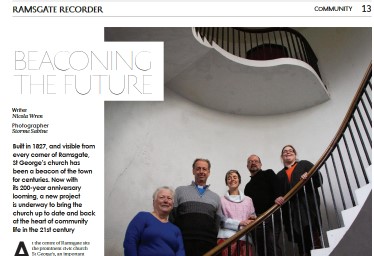
St. George’s has recently appeared in two local news articles.
The Regeneration Project was a feature in the latest edition of the Ramsgate Recorder. Check out the article…
It was also mentioned in a piece on the Isle of Thanet News. Read more here…
Harpsichord Concert

St. Luke’s Ramsgate, Sunday 12th march, 4pm
Join us for this free pop-up concert with Petra Hajduchova, the senior organist from St. George’s. Harpsichord – From Baroque to Rock! An exciting programme from Bohemian and European Baroque to contemporary music – which include pieces by Dussek and Scarlatti, or Stephen Montague and surprising electronic effects! The concert lasts about an hour.
Rescheduled – How can you believe the Bible is true?
Rescheduled from last week, YI this Sunday evening, our group for the young people of St. George’s and St. Luke’s, will look at the question ‘How can you believe the Bible is true?’

Supper this week is pizza, salad and chips.
Then at 6:30 our doors remain open for anyone who this week fancies sharpening their table tennis skills.

We’d be delighted to welcome any young people from Year 6 to 13.
Have a good rest of the week.
Daily Bread…
“Do not be anxious about anything, but in everything, by prayer and petition, with thanksgiving, present your requests to God.”
(Philippians 4:6)
YI tonight
Unfortunately tonight’s YI has been cancelled.
We’ll be back next week

