Once a term YI lead an evening service for all ages and this Sunday (29th) is that day.
In a world that can feel so divided, YI are helping us explore what Jesus says about love overcoming things that divide us. And so the title of the service is ‘Love conquers all’. There will be worship, prayers, drama, bible readings and quizzes to help us think about this topic.
As we look at the first coming of the good news about Jesus into Europe recorded in the book of Acts, Colin Gale shows us four grand openings created by God.
The sermon preached at St. Luke’s on the same day as St. George’s.
For the last month or more here at St Luke’s, we’ve been reading the story of how the good news of Jesus gospel spread outward, first from Jerusalem to Judea, then secondly to Samaria, third to Jewish communities in the Roman province of Asia, fourth to the Gentile community in the Roman province of Asia, fifthly to Europe, and then sixthly to Rome. And in a sense all this is just the start, because if you’ve ever read through to the end of the book of Acts, you will know that there is no proper ending to it. The very last verses of the book talk about the apostle Paul living in Rome, opening his home to everyone, proclaiming the kingdom of God and teaching everyone who would listen about the Lord Jesus Christ. This is a way of indicating that the church of Christ, inspired by the Holy Spirit, will never stop until it really does make it to the ends of the earth.
Each of these six missionary moves was a major psychological hurdle for the early church. Without these moves, Christianity would have remained a Jewish sect. Humanly speaking and in the absence of the Holy Spirit, most likely it would have petered out within a generation. All of us who are not Jews would have remained without God and without hope in the world.
Acts chapter 16 marks the fifth of these outward moves, the move into Europe for the first time. In speaking about verses 6 to 15 of that chapter, the second of the two passages we heard read out this morning, I want to draw your attention to what I am calling grand openings – not one but four grand openings – which can take place as readily today as they did two thousand years ago. But before I do that, I want to take a backwards glance to the first passage that was read, Acts chapter 13 verses 1 to 12.
In this reading, you may remember, the sorcerer Elymas or Bar-Jesus is clearly cast in the role of the bad guy, and it looks as though the apostle Paul has called down a curse on him to strike him blind. What was at stake was the chance the Cypriot pro-consul had of hearing and responding to the word of God. The sorcerer was intent on stopping that happening. Even so, what the apostle Paul says and does seems pretty harsh, at least it seems harsh until we read that the sorcerer’s blindness was to be ‘for a time’. Elymas is struck blind, not permanently but for a time, so that he had to grope around for someone to lead him.
This is pretty much exactly what happened to the apostle Paul at the time of his conversion, as described back in Acts chapter 9, which you may remember the vicar speaking about earlier this month. Paul’s own temporary blindness was part and parcel of the momentous change that God brought about in his life. After his blindness came a grand opening, the opening of his eyes. So too the mist and darkness that overcame Elymas was an acted-out parable, designed to highlight his true spiritual state. There is hope for the sorcerer in the fact that Paul says his blindness will only be ‘for a time’. Maybe there would be a grand opening of his eyes too, so that he, like the apostle Paul and like the Cypriot proconsul, could believe the good news of Jesus, and turn and be forgiven. We never find out from the book of Acts how the story of Elymas ends. Indeed none of us knows how our own story will end; but we do know that, by the grace of God, it is possible for our eyes can be opened to the truth of the gospel of Jesus Christ.
So there is one kind of grand opening running through the book of Acts before we even reach chapter 16, which is the opening of people’s eyes, literally and metaphorically, for them to see their need, and to see the grace of Jesus Christ as the answer to that need. That is how the good news spread from Jerusalem and Judea through Samaria to Rome and beyond. And this is a grand opening that continues to happen for people today as they reflect on their own lives, learn from the Bible and connect with the church: their eyes are opened to the truth about themselves and about the love of God in Jesus Christ.
Then in verses 6 to 15 of Acts chapter 16 we read about four more grand openings that happened then, and have never stopped happening since.
The first grand opening is this: the LORD opened a way. Back in chapter 13, you may remember, Paul and Barnabas were sent on their way to Cyprus, we are told, by the Holy Spirit. Here in chapter 16, we see the flip side of having one way opened, which is to have other ways blocked off. Paul and his companions were prevented by the Holy Spirit from preaching the word in the province of Asia, we read in verse 6. So then they tried to enter Bithynia, but according to verse 7 “the Spirit of Jesus would not allow them to”. We have no way of knowing whether this guidance came in the form of some kind of prophetic utterance, from a dream or vision, or else through a juxtaposition of circumstances. We can’t be even be sure whether or not they were even conscious, at that point, of being led; perhaps it was with the benefit of hindsight that they concluded that they had been led.
The dream of the man from Macedonia asking for help, as described in verse 9, certainly confirms them in their conviction of being led, but there is no suggestion that messages from dreams were routinely sought after, or anticipated, by them. If it was important for us to know precisely how Paul and his companions received guidance, in order for us to imitate their practice, we can be sure that Luke would have included these details in his narrative. The main thing Luke wanted to impress upon his readers was not how they were guided, or whether they were conscious of being guided, but simply the fact that they were guided, the fact that the Lord opened a way.
This is the first grand opening in this passage, and what it means for us is that we may be reassured that God will guide us. Thankfully we don’t have to stress about the ways or means by which God will guide us. He will do so whether or not we are conscious of it at the time, and regardless even of whether we can even recognise it with the benefit of hindsight. It will not always be the way we would have chosen, but the Lord will open a way for all his children.
We don’t need to worry about failing to discern or accidentally missing out on the will of God. The centre of God’s will is this: to love him with all our heart, mind, soul and strength, and to love our neighbours as ourselves. “Whatever you do”, wrote the apostle Paul to the Colossians, “whatever you do, whether in word or deed, do it in the name”, by which he means according to the character, “of Jesus Christ, giving thanks to the Father through him”. (3:17). The law of love is the revealed will of God for the transformation of our lives, and it is the work of our lifetimes to be conformed to it. Beyond this, God has a providential will by which he governs the universe and everything in it, which we cannot always discern, let alone frustrate. We may rest assured that he will open a way for us to do, or to endure, whatever he wants us to do or endure, and that he will open a way for us to go, or to stay, wherever he wants us to go or stay.
The second grand opening in Acts chapter 16 is that the Lord opened Lydia’s heart to the message of the gospel. Verse 14 tells us that Lydia was one of several respectable, well-to-do and devout Jewish women who gathered to pray outside the city of Philippi near the river. Jewish law required a minimum of ten men for the establishment of a synagogue. No number of women, however god-fearing, could make up this quorum of ten, and in the absence of a synagogue inside the city, an informal meeting-place was found outside. Lydia, however respectable, well to do and god-fearing she was, still needed her heart to be opened to the message brought by the apostle Paul that Jesus was the Lord and Messiah, and it was the Lord himself who opened her heart.
This grand opening is reminiscent of and synonymous with the opening of the eyes of the apostle Paul himself to the truth of the gospel back in chapter 9. John Calvin, the Protestant Reformer, says that “by the word ‘heart’, Scripture sometimes means the mind, as when Moses says [in Deuteronomy chapter 29 verse 4] ‘until now the Lord has not given you a heart to understand’. So also in this verse Luke means not only that Lydia was moved by the inspiration of the Holy Spirit to embrace the gospel with a feeling of the heart, but that her mind was illuminated to understand”.[1]
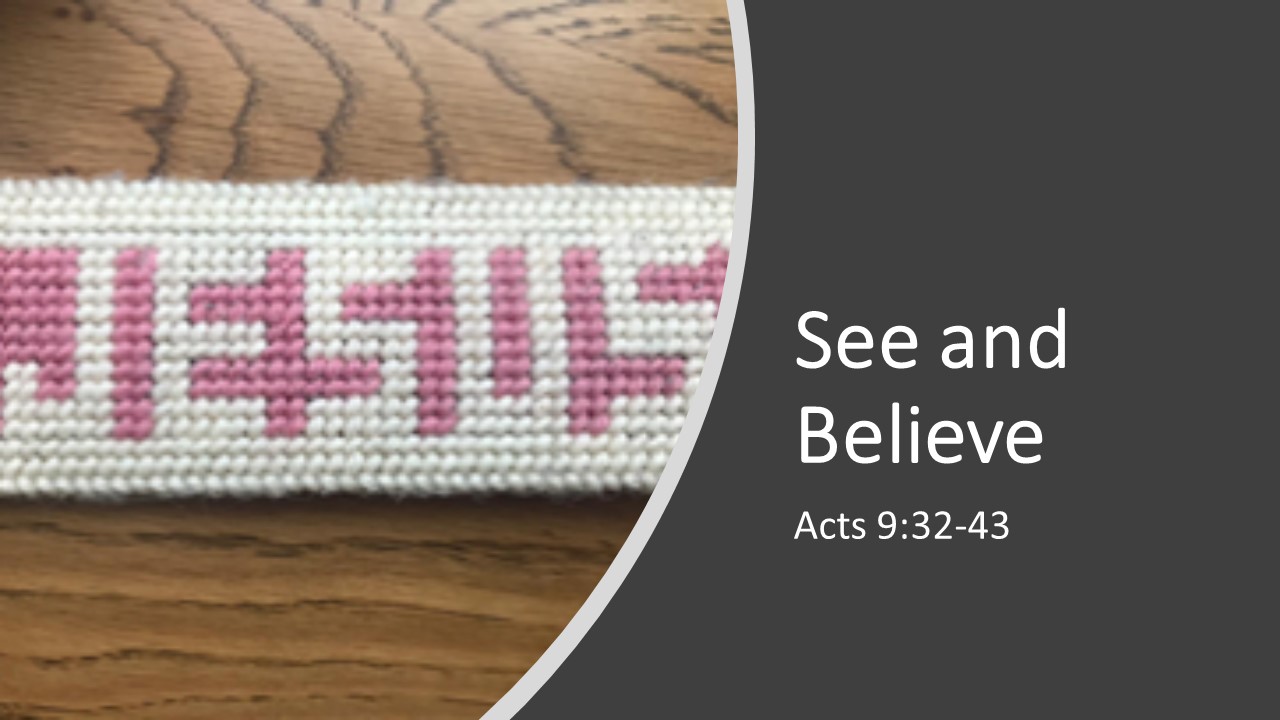
It is like the moment that took place in church a couple of weeks ago, when Claire displayed a picture on the screen of indecipherable pink shapes with a white background, but then explained that once you saw the pink as the background, you then see the white shapes clearly forming the word ‘Jesus’. It was a little light-bulb moment, a moment when the penny dropped. Once we saw the word ‘Jesus’, it was impossible for us to un-see it afterwards. This is what it is like for us when the Lord opens our eyes, our hearts and our minds to a new way of seeing, feeling and thinking – the way of the Christian gospel as set out in the Bible and lived out by our fellow believers. It is a definitive change which affects our entire lives from that point on, and from which there is no going back. This grand opening is the principal work of the Holy Spirit in our lives, whether or not we think to acknowledge it as such. Our hearts may have been already opened to this message. We may be seeking a means of obtaining or sustaining this single-minded clarity. In any event, here in church we are in the right place for our hearts and minds to be opened, re-formed and conformed to Christ. One thing is for sure: it’s not within our power to open and change our hearts, it is a work of God to do that.
The third grand opening in this chapter is easy to miss if you’re not looking out for it, but it’s between the lines of the first half of verse 15. The Lord having opened her heart to Paul’s message, Lydia opened her household to the gospel. This is implied in the fact that the members of her household were baptised along with her. Having received the message with gladness, Lydia took it home and shared it with her nearest and dearest, the people she lived with every day. We are not given any of the details about how she did this. There might have been infant children among the number who were baptised on this occasion, for all we know. There’s nothing in the chapter that prohibits that as a possibility, and there’s the Old Testament precedent of Abraham having the infant male children of his household circumcised at the same time he was, as a sign and seal of belonging to God’s family. Lydia might have thrown a baptism or christening party, but if she did the baptism wouldn’t have been for the sake of the party; the party would have been for the sake of the baptism.
Or, on the other hand, the gospel might have been accepted by those of older years within Lydia’s household with whom she shared it. Either way, the fact that Lydia brought her household along with her in accepting baptism is proof that Jesus Christ was the subject of conversation in Lydia’s home, and that in having these conversations, Lydia was demonstrating love for the people she lived alongside every day.
They say that charity starts at home, and so it does whenever we speak and act at home in such a way as to promote Christian faith, hope and love. The people who live with us probably know us most intimately. They tend to know what makes us tick, and if we try to put on an act, they can usually spot it a mile off. Have our hearts been opened by the Lord to the gospel, and do we love the people we live with, or if we can’t say we love them, do we even like them, if only a little bit? If so, we must find appropriate and genuine ways of opening up our households to the gospel. The previous two grand openings I spoke about are the work of the Lord, but this one is one for us.
The last grand opening in Acts chapter 16 is also to be found in verse 15. Having been baptised, Lydia opens her house to Paul and his companions. Luke, the author of the book of Acts, writes that “she invited us to her home”. By the way, the use of the word ‘us’ there is a little clue that Luke had joined the apostle’s entourage by this time. When discussing the comings and goings of Paul, Silas and Timothy at the start of chapter 16, Luke talks about where they went and didn’t go, but from verse 10 onwards he uses ‘we’ and ‘us’, indicating that he was an eyewitness, along with Silas and Timothy, of the events he proceeds to describe. “‘If you consider me a believer in the Lord’, [Lydia] said, ‘come and stay at my house’. And she persuaded us.”
This would have been a grand opening indeed, because it is fair to presume that Lydia, a dealer in purple cloth from the city of Thyatira, was wealthy, and that her house was large. The manufacture of and trade in purple cloth was a thing in the ancient world; it was centred in Thyatira and commentaries on the book of Acts pick up on historical evidence outside the Bible for a guild of purple cloth merchants in Philippi.
We learn from verse 15 that Lydia becoming a Christian changed the way she related to her family – she opened her home to the gospel – and changed the way she related to the bricks and mortar she owned – she opened her house for fellow believers, to come and stay with her and eat with her.
Lydia’s motive in inviting Paul, Silas, Timothy and Luke to come to her house does not seem to have been to establish the kind of network of social obligation that was part and parcel of Roman society. Paul, Silas, Timothy and Luke were living itinerant lives at the time, and it would have been obvious to Lydia that they were in no position to reciprocate her offer. Nor did Lydia invite them to stay because they were old friends from similar social backgrounds who got on well together. It is clear that she had only just met them. The basis for the invitation is there in her words: “If you consider me a believer in the Lord, come and stay at my house”. She invited them because they were fellow believers. And – this too is important – they accepted her invitation, simply because they were fellow believers. It was not a matter of obligation, or social affinity. They were building a new society which cut across economic and cultural barriers, gender barriers as well, and which was centred on their common faith in Jesus. Part and parcel of doing that was opening, and being welcomed into, each other’s homes, sharing food and drink, showing and receiving hospitality, not simply to be sociable but to grow and to strengthen the church of Christ. Lydia does here in chapter 16, Paul did it at the open-ended conclusion to the book of Acts, and Christians have been doing it ever since.
This too is a grand opening for us to emulate. Think of all that God has done for us, and at what a cost. He has opened up a way for us, and he has opened our hearts to a new life, and he will continue to do so. Is it such a hard thing to open our homes to the gospel, and to our fellow believers in Christ? “Let no debt remain outstanding”, writes Paul in Romans chapter 13, “except the debt of love”.
Actually it can come hard. Not all of us have the gift of hospitality, or of remembering names. Many of us consider ourselves to be shy or private people. If we are at a church that we have been part of for many years, I know it requires a conscious decision on our part to talk to people other than those we have known for years. If we are at a church that is new to us, I know it can be really tough to reach out and begin to form the links that are needed in order to say to one another: Shall we arrange to meet? For some of us there is the practical problem that we do not have the skills to boil an egg, or perhaps we do not have the kind of bricks and mortar that would easily accommodate guests. So we need to think creatively about different ways to apply the ‘debt of love’ principle.
If we are doing the inviting, let’s consider not inviting our friends, our relatives, or our rich neighbours, since if we do, they may invite us back, and we will be repaid. Instead let’s consider inviting those who are not in our circle, who are new to the church, or who are in no position to return the invitation, knowing that, if we do this, as Jesus says in Luke chapter 14, we will be blessed.
If we receive an invitation, let’s accept it whenever we can, not on the basis of similarity of status, circles of friendship, or how many years we have been part of the church, and without any embarrassment, because we share the same faith in Christ.
If our homes can’t accommodate guests, let’s meet for a walk. If we don’t cook, let’s meet for coffee. If we can’t afford lunch, let’s meet to not have lunch, or let’s share lunch at church today, whether or not we have brought food ourselves today or whether or not we are particularly interested in the business of the annual meeting. I dare say that there will be enough to go round. Let us find time in our diaries to connect with one or other of the St Luke’s, St George’s or Christ Church growth communities outside of Sunday morning.
By his Holy Spirit, the Lord has opened a way for us, and he has opened our eyes, our hearts and our minds to believe his message. Let us therefore open our homes to him and to one another, so that together we can grow to know one another better and become more like the church God wants us to be.
Thank you to all those who suggested charities for us to support as a church. We now have a questionnaire for people to fill in to choose which of the suggestions we will actually support. The form contains information about each charity and asks you to tell us your top 3 preferences under each of local, national and international charities. Please collect a form from the back of church and return it to Sue Martin by 31st May.
Peter was in trouble! He had spent time at someone’s house that was not a Jew. For the Jewish Christians in Jerusalem this was scandalous! So, when Peter returns to Jerusalem he explains what had happened and how God was calling them to a radical new way of thinking about the world.
Why all the fuss about who you eat with?
Partygate and more recently Beergate have dominated our news over the last few months.
When you describe the stories out of context you might wonder what all the fuss is about?
People are outraged that Boris Johnson had a birthday cake with a number of guests in his house on his birthday.
Keir Starmer had a beer and curry with some colleagues whilst preparing for a local election.
In normal circumstances neither event would pass without comment, they would just be seen as normal events in the run of life. Yet, when we know the whole story, the big picture or context we can understand what all the fuss is about. These events happened during a Pandemic when there were laws in place to stop people mixing together outside their household. Both events arguably were law-makers breaking the law at a time when many others were making huge sacrifices to keep those same laws. Given that context the events take on a far greater significance, although the details of whether laws were actually broken is of course still under debate – especially in the case of Keir Starmer.
Chapter 11 of Acts tells us that Peter has returned to Jerusalem after spending a long time travelling further afield telling people the good news about Jesus, who had risen from the dead and was offering salvation to all who believed. However, for the Christians in Jerusalem who were all Jews, Peter’s ministry had become controversial, because he had started preaching that same message to those who were not Jews and in particular had stayed in their houses and probably eaten with them.
So in verse 3, Peter is accused of ‘going into the house of uncircumcised men (that is non-Jewish men) and eating with them.’ For us that seems like they are making a fuss about nothing, but we need to understand the cultural context and the background they were coming from.
The Wrong Division: Unclean, Clean and Saved
In particular we need to see how the very first Christians would have viewed the world.
The Old Division: Clean and Unclean
They would have divided the world into two groups, Jew and Gentile or clean and unclean. To be a part of the people of God you needed to be ceremonially clean according to the Law of God, that is you would have been circumcised – if you were a man – and would have taken seriously the Jewish rules and regulations on remaining clean and unclean. In particular the rules about which animals could be eaten and which animals could not be eaten, the animals labelled clean in the Old Testament Law, such as cows, sheep and goats and those labelled unclean such as pigs and shell fish.
Such rules were God given religious identity markers – ways of showing who the true people of God were. Yet it meant that in practice Jew would refuse to eat with non-Jews for fear of becoming unclean.
The New Division: Saved and Unsaved
Yet, for the Christian Jews, another division had now happened, one brought about by the person of Jesus. This was a division between those who were saved and those who were not saved.
With Jesus’s death and subsequent resurrection, they had realised, as Peter makes clear in Acts 2, that Jesus was both Lord and Messiah. He was God’s chosen king, the Son of God.
This was also confirmed by the sending of the Holy Spirit at Pentecost on Jesus’s followers, a kind of Divine confirmation that the first Jewish followers of Jesus, were the true people of God, because they had accepted Jesus to be God’s Messiah and Lord.
Indeed, Peter in his first sermon quotes from Joel and Old Testament prophet that describes the coming of the Holy Spirit on all God’s people. The end of the quote says:
“And everyone who calls on the name of the Lord will be saved.” (Joel 2:32; Acts 2:31).
Peter and the earliest Christians realised that Jesus was the Lord and those who called on him, his disciples or followers were the ones who were truly saved. They were the ones who believed in Jesus, the ones who had repented and found forgiveness of sins and the gift of eternal life.
Yet, not all Jews had accepted that – after all many of the Jewish leaders had been behind Jesus’s crucifixion, so were unlikely to accept that they had God’s Messiah killed. Thus increasingly it was clear that from a Christian point of view the Jews were split between those who believed in Jesus and were saved and those who rejected him and were not saved.
Salvation for Jews only
Yet, to start with at least, when they said, ‘everyone who calls on the name of the Lord will be saved,’ they thought the ‘everyone’ referred to ‘everyone who was clean,’ that is every Jew. Jesus after all was the Jewish Messiah, a Jew himself, and all Twelve apostles were Jews themselves. Surely, you could only be saved by the Jewish Messiah if you were already a Jew.
So, the very first Christians saw the world as a three-way division, the Gentiles or unclean, the Jews or clean who didn’t believe and were not saved and the Jews who did believe and were saved. The coming of Jesus had certainly changed their view of the world and how it was divided up, but they still believed in the distinction between clean and unclean, between Jew and Gentile, that the Old Testament religious markers of the Old Testament people of God: circumcision and the food laws, were still relevant.
Yet, Peter had broken those rules. He had eaten with Cornelius a non-Jew. For the Jews in Jerusalem, this felt a bit like Party-gate. So when he arrived in Jerusalem, Peter had to explain himself.
Interpreting the Event: Another Pentecost
Peter’s re-telling of the story, which you can read at far greater length in chapter 10 of Acts is useful, because it doesn’t just repeat the facts, it helps us see how Peter was interpreting the events to help persuade his fellow Jewish Christians that he was right to eat with Cornelius.
Whilst chapter 10 tells us what God did and what Peter did, Peter’s explanation in chapter 11, is Peter explaining to those who believed Gentiles were unclean, how he had come to change his mind with God’s guidance.
The Problem: Ritual Cleanness
Firstly, Peter does not begin in the same place as Acts 10. In Acts 10, Luke begins with the angel coming to Cornelius, but Peter begins with the vision God showed him. This is where God deals with the key issue for Peter.
In the vision, a blanket full of unclean animals is lowered down and Peter is commanded to kill and to eat. Peter as a Jew keen to follow the Jewish ritual rules on cleanness refuses, but God responds: “Do not call anything unclean that God has declared clean.”
God seems to be declaring that the old laws around ritual uncleanness were no longer relevant. God had a new way of declaring things clean.
Just as the laws that restricted our freedom because of the Pandemic were appropriate and in place for a time, they have now come to an end. We are now in a new era, where the threat of the disease is not strong enough to justify restricting people’s freedom to meet and congregate. So the law have been dropped.
In the same way, what God had shown Peter in Acts 10, was that the old Jewish laws around clean and unclean were no longer relevant now that Jesus had come. This was a new era, a new covenant or testament was in place. Now, the Law of the Spirit had superseded the Law of Moses, now Gentiles could be a part of the people of God, without first becoming a Jew. Peter eating with Cornelius was not breaking God’s laws, because those laws were no longer relevant.
The Proof: Combined Witnesses
But how could they be sure about that?
Because God provided three separate witnesses to show that Peter should be with Cornelius. This is really important. The Bible says that in order for something to be proved you need two or more witnesses.
The first witness was the vision Peter had, which is confirmed by the almost immediate arrival of messengers from Cornelius summoning him to his house in Caesarea. A summons that is further confirmed by the Holy Spirit’s guidance to Peter.
Then when he arrives at Cornelius’s house, he hears that Cornelius has also received a vision of an angel who knew where Peter was and told him to summon him. Two separate visions, that both encouraged the same encounter at the same time. This seemed to be a double witness to the fact that God was bringing them together.
Then arguably there is a third witness. As Peter begins to explain the good news about Jesus to Cornelius and his household all of who were Gentiles, the Holy Spirit comes down on them and they start speaking in tongues, in a way very similar to the way it had happened to Peter and the Jewish followers at Pentecost.
Each event by themselves could be argued to be made up by one person or a strange happening, but the combination of events gives a cast-iron guarantee that this was from God. Peter and the Jewish Christians with him at the time were at least persuaded that the old laws around clean and unclean were no longer relevant.
The Point:
And the point was this for Peter. Before he had ascended to heaven, Jesus had said in Acts 1:5:
“For John baptised with water,
but in a few days you will be baptised with the Holy Spirit.”” (Acts 1:5)
The mark of those who belonged to Jesus was that they were given the Holy Spirit. In his Pentecost sermon, Peter had realised that this pouring out of the Spirit on God’s people was a fulfilment of Joel’s prophecy, the prophecy that ended with the statement:
“And everyone who calls on the name of the Lord will be saved.” (Joel 2:32; Acts 2:31).
If God was repeating Pentecost with Cornelius a non-Jew, then the implication was that the ‘everyone’ was not just restricted to Jews, it was literally everyone, Jew and Gentile.
The old way of looking at the world was no longer relevant. The old Jewish religious markers of the people of God: circumcision and food laws were no longer relevant now Christ had come and fulfilled the Law. Now it was those who called on the name of Jesus and so received the Spirit who were the true people of God.
Peter was not wrong to eat with Cornelius, the old rules were no longer relevant. Partygate was explained.
A Radical Welcome:
Yet, this was not just about defending Peter’s actions, this was about confirming a radical new perspective that goes to the heart of what Christianity is all about.
The radical welcome of Cornelius draws out the full implications of what Jesus had achieved through his death and resurrection and the sending of the Spirit.
Radical Salvation
First of all it underlines the radical nature of salvation through Jesus. Cornelius was told by the angel that Peter would bring him a message through which he would be saved and it was as Peter was preaching that the Holy Spirit was poured out on Cornelius and his household, in a way that fulfilled the Joel prophecy and so showed they were saved.
In other words, you did not have to be clean – in terms of the Old Testament Jewish regulations in order to be saved or receive the Holy Spirit. You were saved merely by hearing the message about Jesus and responding to it with repentance and faith.
Yes, that change of heart will show itself in terms of changed moral behaviour. The moral laws of the Old Testament were still relevant. After further debate on this issue in Acts 15, the church agrees that Christians do not need to be circumcised, but they do call them to steer clear of idolatry and sexual immorality two areas where Biblical morals and the morals of the ancient world differed most markedly.
Yet, salvation comes instantly with faith in Christ and commitment to live his way, the good works flow from salvation, they do not achieve it. This is radical salvation.
Let’s be careful not to suggest or require that anything beyond faith in Christ and repentance is needed for salvation.
Radical Church
Secondly, this shows us that the church is a radical new community where the only identity that matters is to belong to Christ. All other identities become irrelevant to membership of the church. Paul expounded this in Galatians by saying,
“There is neither Jew nor Greek, slave nor free, male nor female, for you are all one in Christ Jesus.” (Galatians 3:28)
There will be people within the church who are radically different to you. If you have really grasped the difference Christ makes, this is something that should be celebrated as showing the incredible unity we have in Christ.
Radical Invitation
Thirdly, this reminds us that the invitation to come and follow Jesus is a radical invitation, because no-one should be left out of that invitation. It is easy to think that only people like us can become Christians or to imagine that whole groups of people should not really ever be invited to become Christians.
Yes, different groups may require different approaches, but no-one is outside of Christ’s invitation to salvation.
Ironically, in the light of our passage, today in an attempt to avoid anti-semitism, telling Jews about Jesus is often frowned upon. Yet, Jews are just as much invited to turn to Jesus as anyone else.
Conclusion:
Peter concludes his talk by saying, “… who was I to stand in God’s way.” If we make salvation about more than faith and repentance or fail to welcome or invite people that are different to us into the church, then the reality is we are standing in God’s way.
Maureen Claringbold and Judith Finch continue on the PCC as Deanery Synod representatives. Paul Worledge and Claire Coleman are also on the PCC as the clergy licensed to the parish.
We also discussed how we are doing and how we could be better at Growing Disciples and Building Community, both within the church and reaching out to the town around us.
Finally, we thanked Jenny Smith for her 25 years service as Church Warden (and around 60 years service on the PCC!) and present her with some flowers and tokens in gratitude. Then we all had a wonderful lunch in the hall.
There will be a celebration service for the Queen’s Platinum Jubilee on 5th June at 11amin St. George’s church. This will be a joint service between St. Luke’s and St. George’s and be for all ages.
After the service, at around 12pm, we will have a balloon release, with prayers of thanks for the queen outside the front of the church. Then there will be a treasure hunt, barbecue and cake in the church grounds from 12-2pm.
Any offers of help with preparing for any aspect of the event are welcome. In particular, we are looking for people to offer to make cakes and anyone who can lend us a BBQ (especially if it is gas powered) and / or offer to cook on a BBQ. Please let Paul know asap.
We long that people would see Jesus and come to believe in him. How does that happen? Acts shows us disciples who are constantly pointing people to Jesus. In this talk Claire Coleman shows how two disciples, Peter and Dorcas, point others to Jesus.
Version of the Sermon preached at St. Luke’s on the same day as St. George’s
I’m renowned in my family for not seeing what is right in front of me. There was a particular instance in recent years where I was visiting my Aunt, Uncle and Cousin and we were in their back garden having tea. Folkestone has over the years had many air shows and it’s not uncommon to see red arrows flying over the town. As we were eating I heard the planes, but I could not see them – my family have no idea how I missed them flying over and to be honest I’m not sure either – I couldn’t see them. I believed they had been there but hadn’t managed to see it for myself. Another time when I was trekking in New Zealand there was an open grazing pasture with a forest tree line at the back of it. Everyone I was with was exclaiming how beautiful the deer were. Like these were the best deer you could ever hope to see. I couldn’t see a single deer in this big expanse of green. I felt like I was missing out, I even thought they might be messing me around and that there wasn’t really any deer in the field at all. It took me saying to my friend that I couldn’t see the deer and for them to patiently point out the tree line with about twenty beautiful deer in front of it for me to see, believe and know for myself that the deer were really there. I needed help to see. My friend, having seen the deer himself, was able to point out the deer to me.
I don’t know what you make of this picture here on the screen – what do you see? Do you see pink shapes on a white background or do you see something else? This was made for me years and years ago from some ladies in the church where I grew up. If you ignore the pink shapes and focus on the white, then the pink becomes the background with a white border around it and the word Jesus inside it. Sometimes we need help seeing Jesus, sometimes we need to help others to see Jesus for themselves.
These might be slightly silly stories to share. But in our passage from Acts today we see two miraculous events that are seen by people and because of what they see many come to believe in Jesus.
5 mins
As we look at the passage we’ll explore what it is that is being seen, how that leads to belief in Jesus, the Son of God, saviour of the world and What part we can play in helping others to see Jesus more clearly.
The book of Acts starts with the disciples in ch 1 v4 being told by Jesus after his resurrection to wait in Jerusalem for the gift of the Holy Spirit and then in v8 that they will receive power when the Holy Spirit comes upon them and they will be Jesus’ witnesses in Jerusalem, and in all Judea and Samaria and to the ends of the earth.’ And the book goes on to tell how the disciples did just that. They tell what they have seen Jesus do. Peter starts off as the main one preaching and witnessing to what Jesus has done by his words, he and John healed the lame man in Jesus’ name, they are arrested, on a number of occasions in fact but that doesn’t stop Peter witnessing to his fellow Jews about Jesus.
Which is why we find him in ch 9 v32 travelling about the country, going here and there visiting with the brother and sisters wherever he went (in the NIV the Lord’s people). Peter can’t help but share the good news of Jesus with others. In this travelling about the country we have these two stories where Peter is involved in the healing of Aeneas from paralysis and Tabitha from death.
These miracles parallel some of Jesus’ own miracles. We can read of when Jesus healed a paralytic man who was lowered through the roof by his friends in Luke 5 and when Jairus daughter was raised from death in Luke 8. Peter is doing nothing that hasn’t been seen before . However when Jesus performed these miracles they were signs of God’s coming kingdom and of Jesus being the son of God, the promised king who had power over sin, illness and death.
When Peter is involved in these miracles – Luke communicates clearly to us that it is Jesus Christ who healed Aeneas. It is not Peter in his own abilities. Peter says that in v35 ‘Aeneas, Jesus Christ heals you; get up and make your bed (get up and roll up your mat). Peter is clearly saying this isn’t because of me, this is because of Jesus. Peter is relying on and trusting in Jesus’ power. When he is invited over to Joppa with Tabitha Peter dismisses everyone from the room and turns to prayer – he’s on his knees praying and only after prayer does He tell her to get up. She opens her eyes sits up and he helps her to her feet, taking her to the other believers and showing her to be alive. This became known and many believed.
The detail of him being on his knees to pray is really interesting to me and again shows that Peter was doing all he could to let others see Jesus through him. It was not Peter’s power but Jesus’. kneeling is a sign of submission of realising it’s not in our own strength, of recognising who is really in charge and who has the power, namely Jesus. No one could see him doing this he’d sent them out but I think Peters reliance on Jesus through prayer must have shone through him. His attitude could be seen and pointed to Jesus.
How do we show our reliance on Jesus? What habits do we cultivate behind closed doors that shows an attitude of surrender to God. Is this something we need to develop . Time with God in prayer.
In Peters actions of healing of knowing it is Jesus working through him, he is being a faithful witness to Jesus. He’s pointing those who witness these miracles and who hear about them, to the truth about Jesus. That it is Jesus who truly has the power over all things. The miraculous has a way of witnessing to Jesus’ power it can bring people to see the power of Jesus and to believe.
But It is not only through the miraculous that people come to believe in Jesus in these passages.
The miraculous healing of Aeneas started with Peter being obedient to God’s call to go and make disciples – he was travelling about meeting with other believers to encourage them in their faith (I’m sure he would have been encouraged in his own faith too). And it was from this obedience to talking about Jesus that he met Aeneas and the miraculous occurred. Peter knew that Making disciples involved teaching and sharing with others to obey all that Jesus commanded. That was his starting point.
There is something we can learn here of the importance of meeting with each other, visiting each other , encouraging each other in our faith. Sharing how we’ve seen Jesus at work in our lives. Is there something this week we can give thanks to Jesus for? Do we think about sharing that with others? Part of our journey as brothers and sisters involves not only supporting each other in the tough times but encouraging each other with the good stories of God being at work in our lives. Do we take enough time to do that with each other, to tell each other about the goodness of our God.
That is one of the good things about annual church meetings – not only with the opportunity of a shared lunch – but we get an opportunity to look at all the good things God has been doing in the life of our church in the past year and get to look towards good things to come.
These passages have shown that people see and believe through the miraculous, through faithful obedience as a disciple in sharing about Jesus and In the story of Tabitha we see another aspect of living life as a disciple. Witnessing through every day life and the care of others.
This story of Tabitha is full of more detail than the healing of Aeneas. We’re given Tabithas name in both Arimean and Greek both of which mean gazelle and we’re told specifically that she’s a disciple. The word used actually specifically means female disciple. To some of our modern ears having it pointed out that she was a female disciple might sit uncomfortably female dr, female clergy. I don’t feel that way I am a female member of clergy and Luke’s intention was not to be on the negative side of a gender equality debate, he wanted to encourage it. by using this phrase Luke actually wants to show the importance of women in the church. Tabitha was a follower in her own right. Not because of any men in her household but because she knew Jesus personally and it affected her life.
How do we know that? Well as we read on we see that she cared practically for others – she was doing good and helping the poor. V36. The widows show Peter the clothing that Tabitha had provided for them v39. That she’d made for them.
Her love of God and the practical ways she lived out her faith led others to have faith in her God of miracles – when she died they washed her body but instead of anointing her body for burial they laid it in the upper room and sent for Peter. It is almost like they are anticipating the miraculous. The everyday faith of Tabitha made way for the miraculous and for many to see Jesus at work and believe.
How different might it have been if she wasn’t living out her faith. Good works don’t earn Gods love for us but it is a response to Gods love and a huge witness to those around us.
The way we take care for each other as brothers and sisters as well as the wider community is a massive witness – showing others Jesus.
Examples of seeing this in action…
How are we witnessing to Jesus. How are we letting others see him in our lives through what we say, through our attitudes and in what we do?
These miracles and the lives of both Peter and Tabitha all helped others see Jesus and believe in him. Let us too live our lives pointing others to Jesus and knowing his love more and more for ourselves.
Lord God open our eyes to see you more clearly. To see you at work in our world. Help us to see where we can join in. We pray that we would grow in our love for you and your world and we would follow you more closely in everything that we do. Help us in our love and care for others to witness to your love and truth.
It is now around one month until the Platinum Jubilee celebrations. We are planning a joint service at St. George’s that day followed by a Big Lunch in the church grounds. We would love to make this a really special occasion and there is potential for funding to help us do that.
If you would like to join a team planning for the event, then please come to St. Luke’s vicarage on Thursday 12th May, 7:30pm for a planning meeting.
Our Youth Initiative (a group for school aged children, year 6 upwards who meet Sunday evenings in term time) did a fantastic job of leading their service on Easter Sunday evening. It was a service open to all ages and was a great time of praise and reflection on how much we are loved by God and the importance of remembering Jesus sacrifice on the cross and his resurrection.
The plan is to have a Youth Initiative led service every term. The next two dates for your diaries will be Sunday 29th May and Sunday 17th July. The services start at 6pm and aim to last 45 minutes followed by refreshments afterwards.




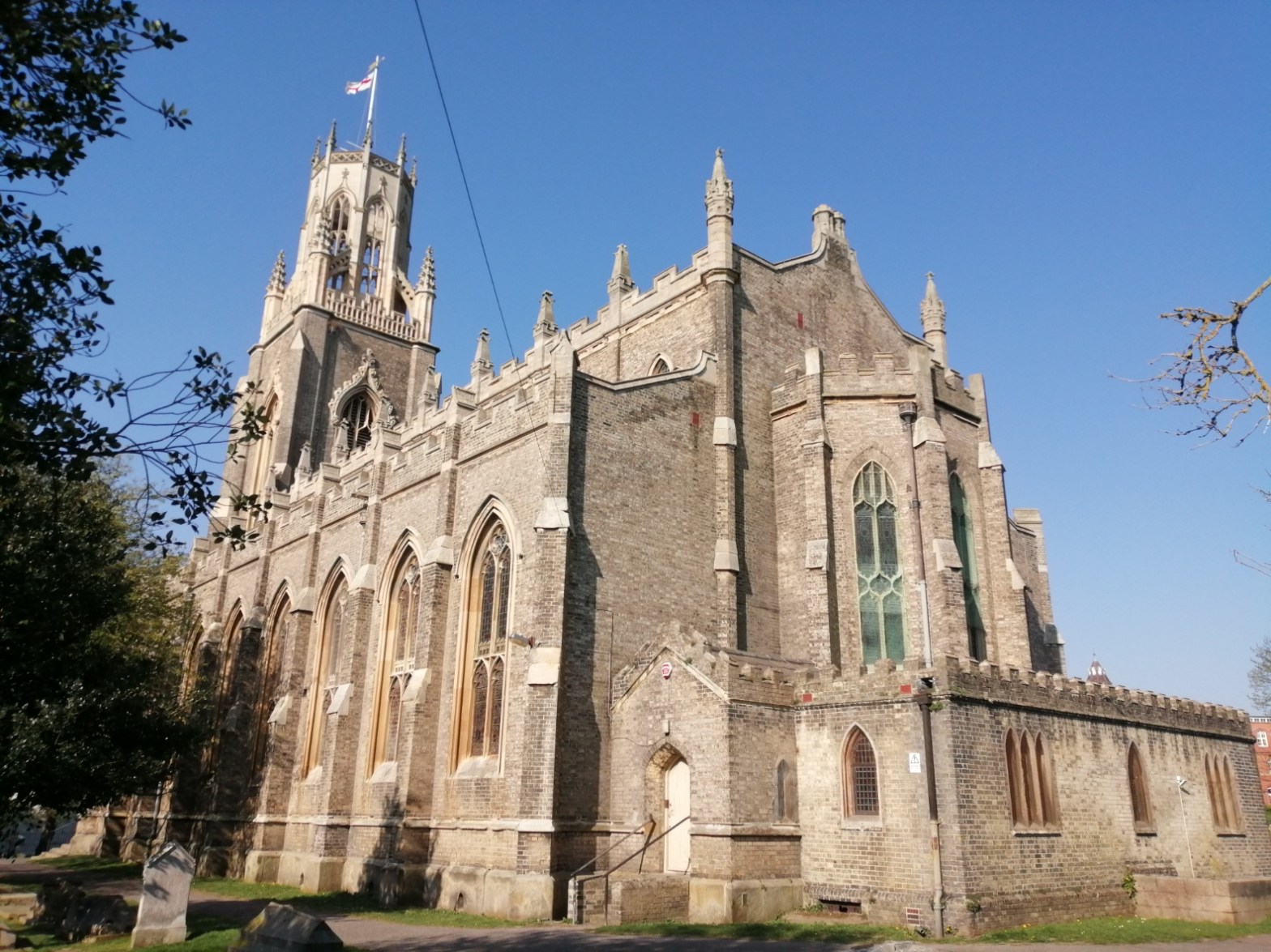

 St. George's Church Ramsgate