SOLO EXHIBITION: JEMIMA SARA ‘SEE WHAT LOVETHE FATHER HAS GIVEN US’
Saturday 2nd, Sunday 3rd, Friday 8th, Saturday 9th and Sunday 10th March 2024 12 noon til 5pm St George’s Church, Church Hill, Ramsgate, CT11 8RA
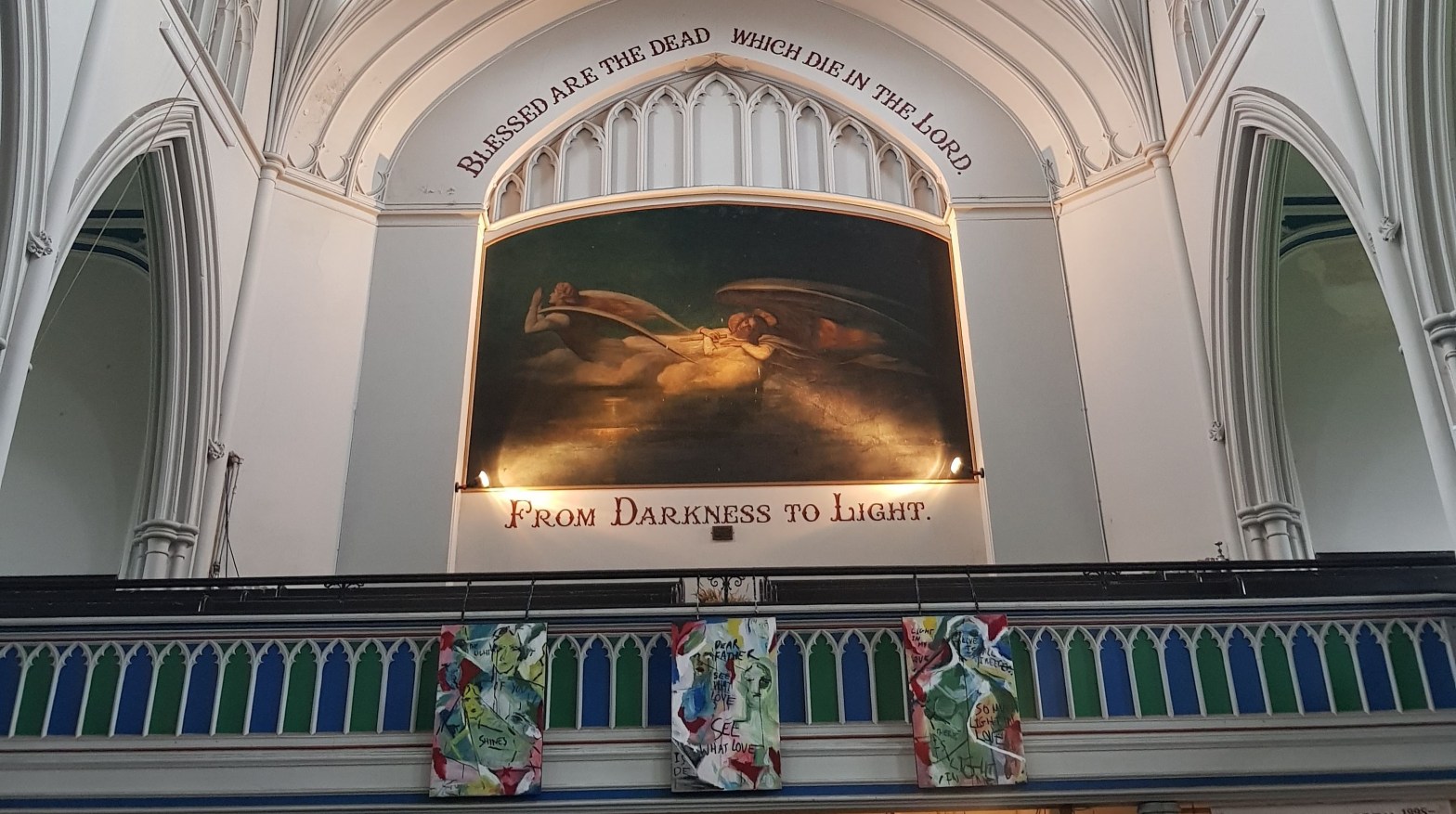
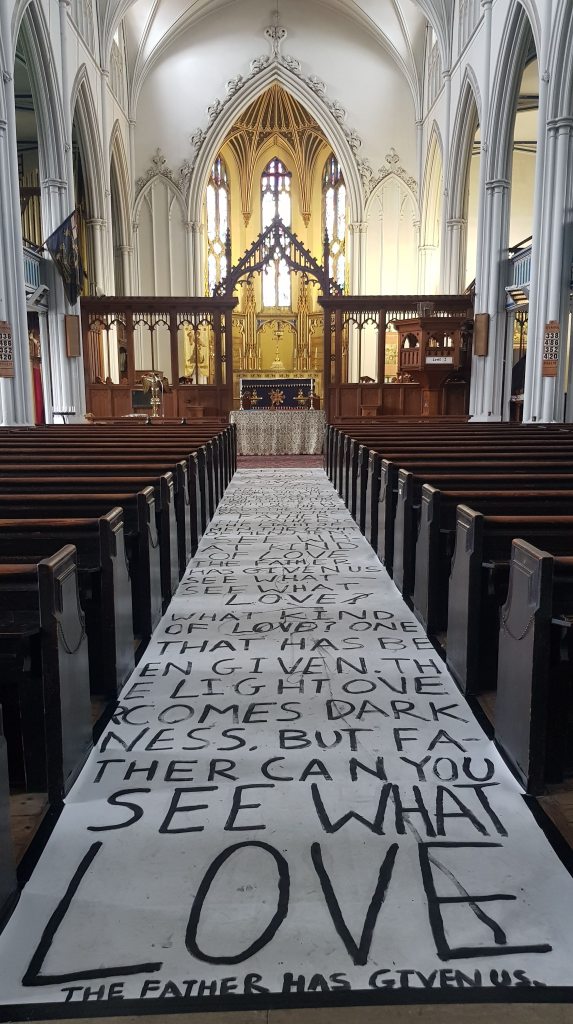
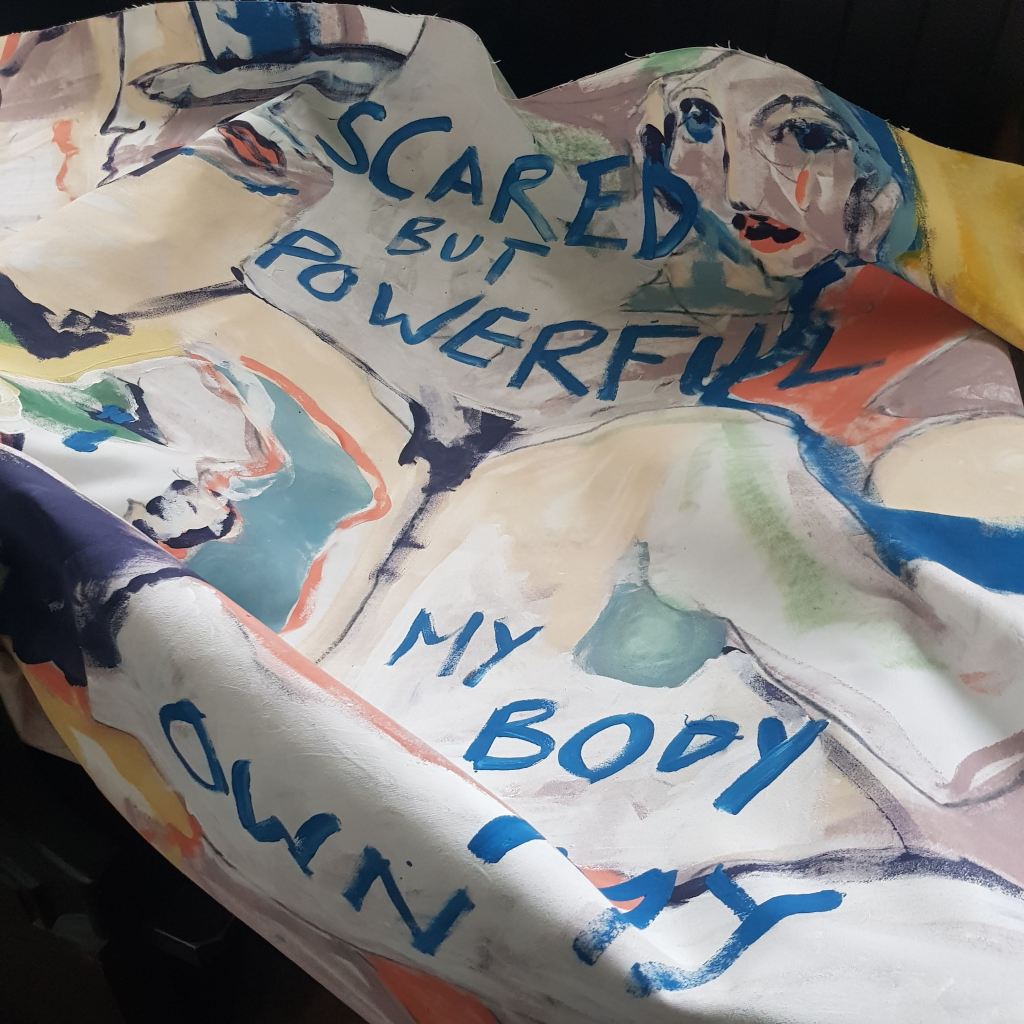
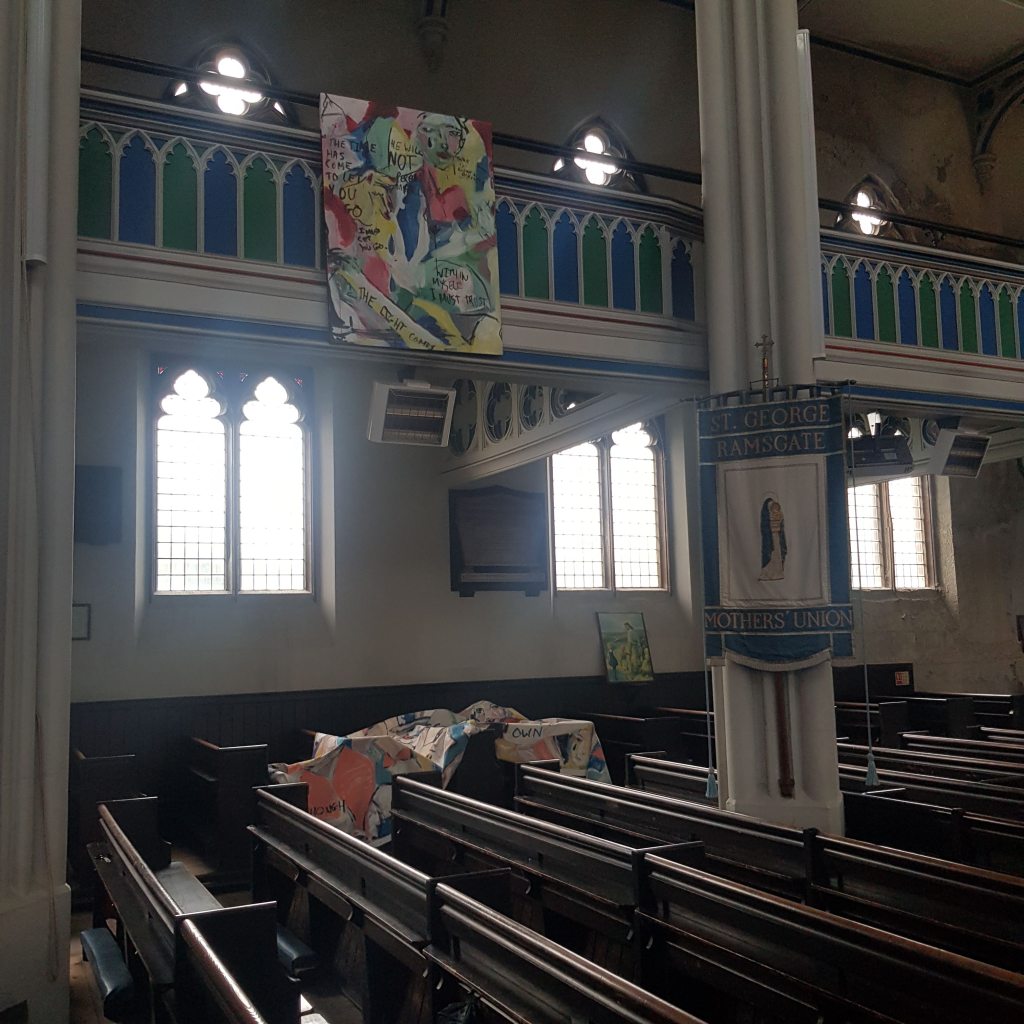
JEMIMA SARA is a multidisciplinary artist merging the fluidity of everyday life experiences and diaristic texts with both figurative and abstract imagery via paintings, installations, and performances. St George’s is pleased to be hosting her installation in the church for 2 weekends at the start of March.
ARTIST JEMIMA SARA says of her work:
“SEE WHAT LOVE is a personal show rooted in my own homage to spirituality, identity andhealing. Within this show I wish to explore memories, beliefs and fabricated or distorted recollections of events.This show is my personal reflection within the spiritual setting of St George’s Church.With this being my own exploration – I aim to touch on the historical contributions of radical women and women artists who have long been neglected or rejected completely, particularly in their exploration of spirituality.It’s about womanhood, sadness, grief, distorted recollections, spirals, everyday life and exploring freedom of expression all within the structures of a church”.https://www.instagram.com/jemimasara/
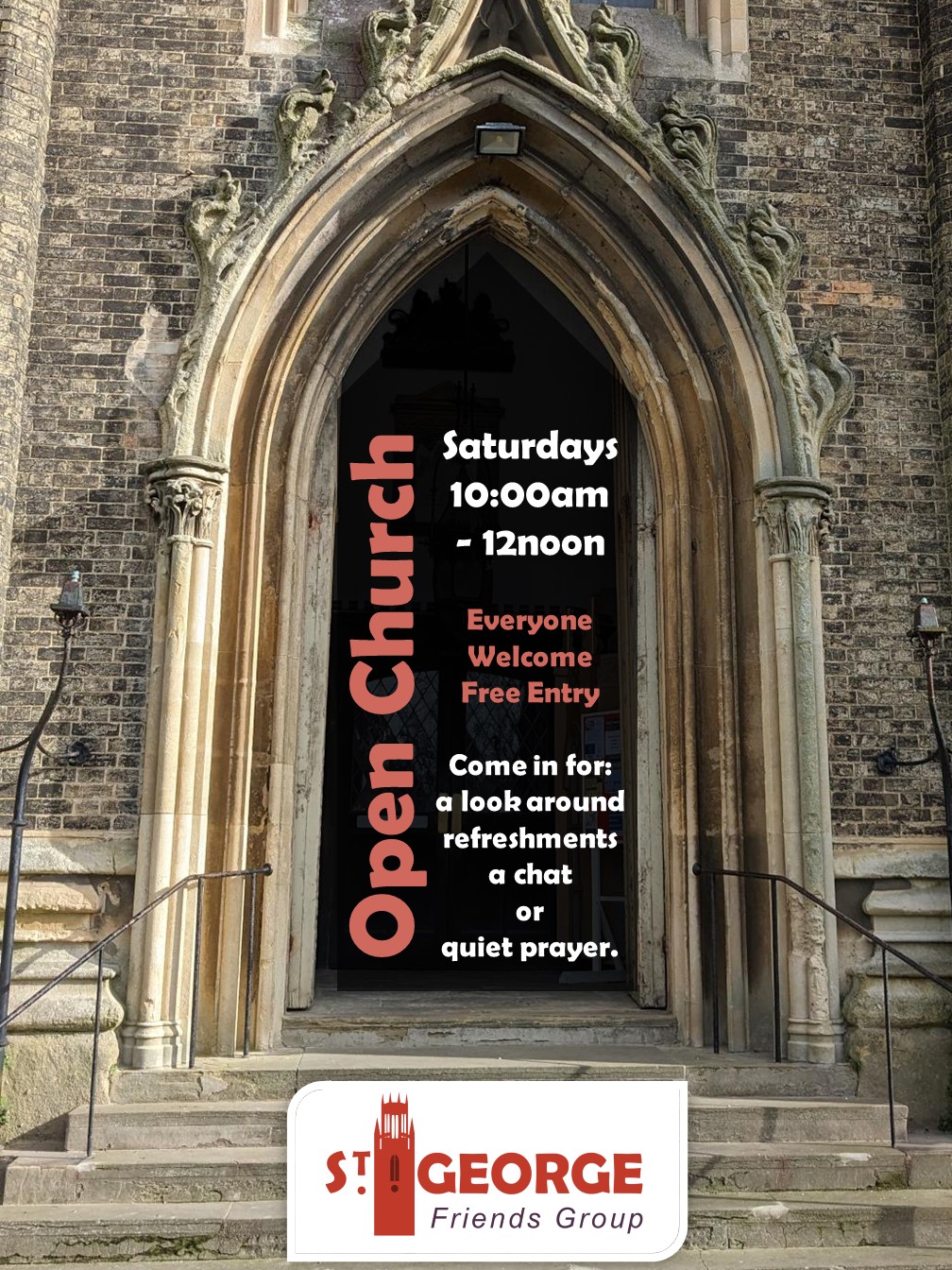
From Saturday March 2nd, the Friends of St. George’s will be opening St. George’s church up from 10am-12noon every Saturday. Come in for a look around, refreshments, a chat or for quiet prayer. Everyone is welcome and entry is free.
“Though I am free and belong to no one, I have made myself a slave to everyone to win as many as possible.” (1 Corinthians 9:19)
Paul is concerned to win. But he is not after the prestige of winning for himself. His concern is to win people for Christ. That is to share the good news or gospel of God’s salvation through Jesus, so that they might believe and so be forgiven for their sins, be reconciled to God and receive the gift of eternal life. When this happens, there is a sense of success for Paul and rejoicing in heaven, but the greatest reward goes to the one who has been won for Christ.
I was never much good at sport, often coming last in races on school sport’s day and only being picked for sports teams when they were really desperate! I was never going to win a sporting prize at school.
But, I did discover I was pretty good at chess. I even won a prize as best West Sussex under 14 in one competition. But even with chess, I was never going to win any really fantastic prizes. When I was a Sixth Former, I was asked to play for Sussex under 18s twice. Both times I lost – once to a twelve year old! Then when I went to university, I had a friend who played for the Greek chess team. He could quite easily wipe the board with me!!
I was good at chess – but not that good! To do really well at chess or any sport, you need both abundant talent and dedicated training. It turned out I had some talent, and a little bit of training – but not enough of either to become a really top notch player!
In the NIV version at the end of the reading, Paul talks about ‘not being disqualified for the prize.’ A little earlier he talked about the prize that sportspeople of his day went for – a crown.
In Greece in the first century, there were four great sporting events that people from all over Greece travelled to. The most famous was the Olympic Games at Olympia, but the second most famous one was the Isthmus Games, which were held in a stadium only six miles from Corinth. The first readers of Paul’s letter, would have been very familiar with athletes racing against each other and other competitive sports taking place, with the athletes aiming to become top notch, to win first prize. And what they won in those days was not a gold medal like today, but a crown made up from pine leaves covered in plaster.
It was a great symbol of accomplishment and honour. But of course, it was not a crown that lasted. The leaves would soon have withered and after a few years the crown would have crumbled.
Paul, however, says that as Christians our aim is not to win that kind of crown – one that soon falls apart. Our aim is a crown that will last forever.
What is the prize we are seeking to win? (9:27)
One of the groups who looked at the passage this week were not sure what this referred to and asked, “What is the prize we are seeking to win?” What is the everlasting crown that Paul is referring to? It’s a good question.
It may be the salvation won for us by Christ, that we will receive on the last day. Paul certainly talks about the crown in that way in other places.
Yet, Paul’s concern in chapter 9, is to win people for Christ. When he does that, they receive the crown of righteousness and become part of God’s eternal kingdom, but they also become in a sense his crown, the symbol that shows he has preached the good news of Jesus faithfully. Paul sometimes describes the churches he has founded in this way. For example in 1 Thessalonians:
“For what is our hope, our joy, or the crown in which we will glory in the presence of our Lord Jesus when he comes? Is it not you?” (1 Thessalonians 2:19)
This is an eternal crown, because those who owe their faith in part to Paul’s preaching will be eternally grateful as they share a place with him in eternity!
Paul’s passion then is to gain this crown. To see men and women come to believe in Christ, to receive his righteousness and his gift of eternal life. That is what he aimed for in his life and that passion is powerfully expressed in our reading today.
Questions…
But that leads to another question from one of our groups:
Is Paul’s strategy just for those called to be evangelists or all believers?
This is another good question and to help understand the question and its answer we need to remind ourselves how chapter 9 fits into Paul’s overall argument.
In chapters 8 to 10 of Corinthians, Paul is calling on the Christians to be willing to forego their rights, in order to build up and preserve the faith of other Christians in love.
In chapter 9, he uses himself as an example of this, explaining how he has foregone his freedoms and rights in order to preach the gospel about Jesus faithfully and so win people for Christ.
Some of what Paul says about himself, will just be relevant to his own situation and role, but the more general thrust of what he is saying is relevant to us all. We too need to be willing to sacrifice our rights out of love for others and particularly in seeking to win people for Christ.
One thing Paul does towards this goal is ‘to become all things to all people’ in order to save some. That leads to another good question from one of the groups:
How do we maintain Christian integrity, whilst also seeking to ‘be all things to all people’?
First of all we need to be clear that Paul is not saying that we simply imitate people’s behaviours in every way. It would not be right for example to take up drug dealing just to get alongside drug dealers!
Rather when Paul talks here about, ‘being all things to all people,’ he is saying he is willing to forego his right to live in a way that suits his background culture or comfort zone, in order to connect with people from different backgrounds. I am going to call that behaviour Holy Solidarity and that is what he emphasises in 9:19-23.
But to do that is certainly not to let go of our integrity as Christians. In fact in 9:1-18, Paul says he refuses to go along with certain expectations for the sake of the gospel, even when he would benefit from doing so and has every right to do so. I am going to call this Holy Resistance.
It is in attending to both Holy Solidarity and Holy Resistance that we can ‘be all things to all people’ and maintain Christian integrity.
So, let’s look at those two issues and what they meant for Paul and what they might mean for us.
Holy Resistance
First of all, Holy Resistance.
In verse 18, Paul says:
“What then is my reward? Just this: that in preaching the gospel I may offer it free of charge, and so not make full use of my rights as a preacher of the gospel.”
In the first half of the chapter, Paul has used a number of arguments to make clear that those who preach the gospel, the good news about Jesus, deserve to be paid a reasonable wage for doing so. As an apostle he had the right to be paid by the Corinthians whom he had spent eighteen months teaching about Jesus and God’s salvation.
However, he had chosen to forego that right and refused to be paid by the Corinthians. Why did he do that? He says so that it could be offered free of charge. Earlier on in verse 12, he said because to do so would be to hinder the gospel of Christ.
Not that Paul did not want the Corinthians to be generous with their money. At the end of the letter he mentions a collection he is making for the poor in Jerusalem.
Probably Paul was concerned about the way patronage worked in Roman cities at that time. People would offer generous donations or gifts, but they would expect loyalty, even compliance in return.
So, Paul did not want to receive financial support from the wealthy in Corinth, because he might then become in some way obliged to them and so be drawn into one faction against another or privileging the wealthy over the poor. He as a gospel preacher would be seen to be bought and belong to one particular person or group, rather than free to show concern for the whole people of God.
So, although he had the right to receive money from the Corinthians for his work, he forewent that right as an act of holy resistance against the potential manipulative control of the wealthy.
As Christians today, we also will need at times to act in holy resistance. To refuse to meet people’s expectations or to join in with what people want in order to maintain the integrity of the gospel and our witness.
In particular, although, we struggle financially as churches, we also need to be careful that in accepting money or donations, we are not pushed into relationships or behaviours that undermine our gospel witness.
That is why, we encourage all giving to be done anonymously. If I and other key leaders don’t know who is giving large amounts of money to the church, then we cannot be unduly influenced by them.
Yes, let’s pray for more money to fund what we need, but let’s also be concerned to protect the integrity of the gospel. We are at times called to Holy Resistance, even when it is costly.
Holy Solidarity
At the same time as resisting pressure to do what some expect from him, Paul also says, in verse 19 – “Though I am free and belong to no one, I have made myself a slave to everyone, to win as many as possible.”
Then in verse 22: “I have become all things to all people so that by all means I might save some.”
What Paul is talking about here is ‘Holy Solidarity.’ Just as Christ gave up the glory of heaven and became one of us, so we give up our rights and freedoms to come alongside those different to us.
Holy Solidarity means being willing to adapt ourselves to the culture and ways of others in order to connect with them and share the good news with them, even though it might mean taking on customs or ways that take us out of our comfort zones or what we are used to.
So, how might we go out of our comfort zones in order to help win others for Christ?
Some of the groups had some initial suggestions:
One way may simply be on a Sunday after church, instead of rushing away or talking only to the same people as normal, to seek out and befriend those who may be new to the church, so that they can be encouraged in their exploration of faith.
Another group suggested outside services as a way of going to where people are. This year we are going to encourage St. Luke’s and St. George’s to be more involved in the Churches Together Good Friday witness in the town centre.
Another suggestion was to connect to people locally by showing love by meeting their needs. We are already doing that in a number of areas with a number of different groups: Gather that we heard about earlier, Cafe4All, the St. George’s community meal, Play and Praise, the potential After-School club. All these initiatives involve people giving up their own freedoms in order to help connect with people in holy solidarity, in the hope both to show them real love, but also to share the good news of Jesus with them.
Finally, there were suggestions about how we might need to adapt our services in ways we may not like – no-one likes change, but might better enable and encourage new people to come and hear the good news about Jesus.
All of these are ways of showing holy solidarity with the world around, in order to help connect with them and so share the good news of Jesus.
In the Year of Discernment we need to consider how we might improve on these present ways of connecting and also whether God is calling us in new directions to.
Not Running Aimlessly
In the last few verses Paul compares his ministry with that of an athlete. Paul pushes himself hard, in order to win the crown just as an athlete does. He says he does not run aimlessly.
In response to this, one group asked the question:
What does ‘running aimlessly’ (1 Cor. 9:26) look like in a believer’s life?
It is to take our eyes off the prize, which is to win people for Christ. Those who come to faith partly as a result of our efforts are our eternal crown.
When we live the Christian life, but do not have our eyes on this prize, when we make no efforts or sacrifices to win people for Christ, whether playing our part in supporting the wider church witness or in our personal witness, then we are running aimlessly, we are not seeking the prize.
Let’s imitate Paul, as he imitates Christ, by being willing to forego our rights, make sacrifices, show holy resistance and holy solidarity, that together as churches in Ramsgate we might win the eternal crown of people in eternity with Christ because of our efforts.
Everyone likes to win. This week I went to chess club twice. On the Tuesday, I won my game easily and the other members were complaining, “It’s not fair – he’s got God on his side!” But God has a sense of humour and on the Wednesday, I blundered and lost against someone I’ve never lost to before. My wife’s response to the news was, “Good for humility.”
As with any competition or sport, to become a winner involves both talent and hard work. Top athletes spend hours training each day and top chess players, have to work at studying the game almost full time. Winning is costly. You have to forego freedoms in order to train hard and win.
Paul is concerned to win. But he is not after the prestige associated with winning a competition or the glory of being a top sportsman. His concern is to win people for Christ. That is to share the good news or gospel of God’s salvation through Jesus, so that they might believe and so be forgiven for their sins, be reconciled to God and receive the gift of eternal life. When this happens, there is a sense of success for Paul and rejoicing in heaven, but the greatest reward goes to the one who has been won for Christ.
This week as we look at Paul’s description of his strategy for winning people for Christ in 1 Corinthians 9, as part of our Year of Discernment, we will be considering some questions and suggestions from this week’s study groups:
Is Paul’s strategy just for those called to be evangelists or all believers?
How do we maintain Christian integrity, whilst also seeking to ‘be all things to all people’? (1 Cor. 9:22)
What does ‘running aimlessly’ (1 Cor. 9:26) look like in a believer’s life?
What is the prize we are seeking to win? (1 Cor. 9:27)
Paul Worledge
St. George’s Website
What’s On – a page which lets you know what is happening this week and gives information about upcoming events.
Notices – You can read the latest notices on this page.
Sermons – Read a transcript of a recent sermon or watch the YouTube version recorded at St. Luke’s. There are now videos for all the sermons over the summer.
This Lent our Study Groups will be looking at the passage for the sermon on the upcoming Sunday, reflecting together on it through prayerful discussion, then feeding back their reflections to the preacher and into the overall discernment process. If you are not already part of a Study Group and would like to be, then please let Paul know.
Planned Giving Update
Last year St. George’s received over £21,000 from people’s regular giving, donations, collections and the tax we can reclaim when Gift Aid forms are signed. We are very grateful for the many who give generously to help keep our church running smoothly. However, although that sounds like a lot of money, and we also received significant money from rentals and other sources, we actually spent around £10,000 more last year that we received. So please pray that we can increase our giving levels, so as to ensure the ongoing viability of St. George’s as a Christian congregation.
It is of course not too late to start giving on a regular basis to St. George’s. Either take a Planned Giving envelope from the desk at the back of church or sign up using the Parish Giving Scheme.
The Event – Local Churches Joint Youth Meeting
The Event is taking place this Sunday 25th February from 6-8pm @ Queen’s Road Baptist Church, Broadstairs, CT10 1NU.
It is a chance for young people from Year 7 upwards from churches around Thanet to experience true community together, through group activities and encountering God. If you are introduced in attending, please contact Claire (see below).
World Day of Prayer
This year it is on 1st March, 10:30am at St. Laurence Church, Ramsgate. If you would like to take part, then email: drdebbie08@gmail.com.
Snapshot: Youth Survey by the Diocese
This survey has been created by the Canterbury Diocese Youth Council to hear the voices of young people. If you are aged 11 to 24 (not just those involved in churches) we would love for you to complete it. The form is anonymous and we will be collecting the responses to pass on to Bishop Rose.
Snapshots has been designed to create a platform for hearing the voice of young people across our diocese. The Youth Council aim to put out three Snapshot questionnaires a year.
This first one is about church/sharing faith.
Closing date: the end of February.
Safeguarding Training
If you volunteer in anyway at church the national authorities are strongly encouraging you to take at least the Basic Module in safeguarding training once every three years.
If you have not completed the training in the last three years, then the module can be completed online and takes about ninety minutes. You can access the training by following this link. You will need to first register, to access the training. Once the training is completed, you will be sent a certificate. Please forward that certificate to James (office@stlukesramsgate.org), so that we can keep records of who has done the training.
Online Forms
Under the ‘Contact’ tab on the website, there are now three forms that you can use to help us in managing the church:
Events Application Form. Use this if you are organising a church event that needs a church room booked, advertising or ticketing.
Submit a Notice. Use this if you want to ask us to include a prayer request or other notice in the church notice sheet or email.
How do the Christian and the Hindu religions view money differently?
In this article Rahil Patel, who used to be a Hindu monk, but is now a Christian, explains the different attitudes to money and wealth in Hinduism and Christianity. Read More…
God saves by helping us through suffering
Sometimes we are called to suffer for our faith. But how can we keep going, when under great pressure to give up? In this article read about an Anglican Bishop caught up in the Japanese capture of Singapore, who was literally beaten for his faith. Read more.
Finally, let’s keep praying that we might win people for Christ.
SEE WHAT LOVE: Tickets are on sale all week for our upcoming concert with exhibition performing on Saturday 24th February 2024! @starlingsworld @keziah_ziah and @socialsingingchoirwith an exhibition from @jemimasara at St George’s Church in Ramsgate. The doors open at 7pm and the show starts at 7.30pm. Tickets are available here – https://www.universe.com/events/see-what-love-tickets-GDC485 The event will be raising funds for The Power of Women Festival 2024. By attending SEE WHAT LOVE, you’ll not only experience an unforgettable concert but contribute to empowering women in Thanet
“Knowledge puffs up, but love builds up.” (1 Corinthians 8:1)
Paul shows that love is the eternal value that builds up Christ’s church. When we grasp this, then knowledge can be used for building up others rather than justifying our own freedoms and pride.
As Christians we claim to follow a creator God, a God who brings order out of chaos. We are called to construction not destruction. We are called to build something special – not buildings, although they have their place, but people of faith and a community of faith.
Today we are back looking at the letter of Paul to the Corinthians written in the 50s AD. It is a letter that is a plea for people to stop behaving in ways that are destructive to the Christian community and to start working to build it up.
That is what Paul saw himself doing. He says, earlier in the letter, in 1 Corinthians 3:9-11:
“For we are God’s fellow-workers; you are God’s field, God’s building. By the grace God has given me, I laid a foundation as an expert builder, and someone else is building on it. But each one should be careful how he builds. For no-one can lay any foundation other than the one already laid, which is Jesus Christ.” (1 Corinthians 3:9-11)
Jesus Christ is the foundation. Out of love for us, he forego his rights as the Son of God and died a sacrificial death on the cross, in order to offer us forgiveness, a new start and eternal life. It is through faith in his work, that we find salvation and a place as one of his people, a place in his church.
His life, death and resurrection, laid the foundation for the church, a church which by His Spirit and through his people he has continued to build over Millenia and around the world.
This is a church, which as it has preached and lived out the values of Christ it has helped to construct a better world, yet also looks forward to being a part of God’s ultimate construction of a new heaven and new earth, where finally all the decay and destruction of our present world will be no more.
The Year of Discernment and 1 Corinthians 8-14
We Christians here in Ramsgate, just like the Christians in Corinth in the 50s AD are a small part of the bigger church. But we are still called to be a part of that great construction project in this place.
St. Luke’s and St. George’s are making 2024 a year of discernment, when we want to seek God’s guidance and direction for the years ahead, for how we may go about building up his church in this place.
So, over Lent, we are going to be looking together at these central chapters in 1 Corinthians, chapters 8-14, to help us as we reflect on God’s call.
What holds these chapters together is the Christian attitude of love – a love that builds up. It builds up both individual Christians and also the community of Christians, the church. But it Christian love, by its nature, is sacrificial. In particular, these chapters emphasise that love leads us to forego our rights for the sake of protecting and building up the church and others.
But these chapters also contain the flipside, warnings that when we insist on our rights and ignore the needs of others, we cause untold damage to the church and its members.
This theme is worked out across a number of different issues. Some seem obscure to us and are specific to the time and place of 50s AD Corinth, but nonetheless as we look at what Paul has to say about them, we understand more clearly this key theme of love that foregoes one’s rights to build up the church.
So:
Chapters 8, 10 look at meat sacrificed to idols. For us that feels like an obscure issue, but the principles Paul articulates are important for us to grasp today and we’ll see how it introduces this theme of love foregoing rights.
In chapter 9, Paul describes his own behaviour and attitudes in foregoing his rights for the sake of building up the church
In chapter 11, he criticises those who use their spiritual gifts without concern for authority structures and those who partake in communion services without concern for the poorer among them. We are to act out of love for others, not out of a desire to make the most of our freedoms for our benefits.
Chapter 12 focuses on spiritual gifts, but with an encouragement to use Spiritual gifts for building up others and valuing the part everyone has to play.
Then in chapter 13, the climax of this whole section is a description of love as the eternal value.
Finally, Paul concludes this whole section in chapter 14, by insisting that people willingly submit to order at their meetings out of a concern for the building up of others.
As we go through these chapters in Lent, we are going to try something a bit different. The study groups are going to look at the passage that will be preached on in the week before it is preached. They will reflect on it with some fairly open ended questions and in the light of their studies reflect on what God might be saying to us as churches as we seek to discern where God is leading us. Those thoughts will be fed back to the preacher, who will then use and refer to some of them in the following week’s sermon, whilst all the comments will feed into the ongoing discernment process.
That’s the plan and in choosing the sections of these chapters we are going to look at, I’ve tried to avoid the more obscure ones! However, this week, before we start that process, I want to quickly tackle the issue of food sacrificed to idols, that perhaps feels most obscure for us today.
Food Sacrificed to Idols
As we read letters like 1 Corinthians one of our difficulties is that we are listening to one side of a conversation. At the start of chapter 7, Paul says, ‘Now about the matters you wrote about…’ In other words part of the point of this letter is to respond to a letter from the Corinthians, which had clearly raised a number of issues.
Perhaps the question Paul is responding to here is:
“Was it OK to eat food that was sacrificed to idols?”
Paul’s answer is far from simple. In fact if you read chapters 8 and 10, he gives three contradictory answers:
“No, if…” in 8:13
“No way!!” in 10:14-21
“Yes.” in 10:25-27
Why three different answers? Probably because of three different settings.
In this passage Paul talks of two groups, ‘the weak’ and ‘the strong’. ‘The strong’ saw themselves as having superior knowledge to the weak. They were probably wealthier and better educated and maybe grasped and understood the Christian teaching more fully.
But also, as the wealthy they were probably – at least before becoming Christians – used to eating meat regularly.
There were three settings where they would have done this:
One setting was as part of idol worship. This is probably the setting Paul is referring to in 10:14-21. Paul says, this is definitely not on, as you cannot be involved in worshipping idols as well as worshipping Christ.
The idols may not be real gods, but people treat them as ‘Lords’ nonetheless. If you treat them as a real god, then you are not allowing Christ to be the one true Lord in your life. As Jesus said, when speaking about money as an idol, ‘You cannot serve both God and Money.” So, when it came to eating meat as part of idol worship, Paul says, ‘No way!’ ‘Flee idolatry!’
In contrast at the end of chapter 10, Paul is talking about eating meat at home, when it had been bought in the market place. Here the meat may or may not have been sacrificed to an idol before being sold. But as Paul accepts, what you eat does not matter to God. Food is not contaminated by being sacrificed to an idol. So, you are free to eat it in your own home, without worrying whether it has come through the temple.
However, the context of chapter 8, is a different setting again. Here it is about eating meat in an idol temple. This seems not to be as part of actual idol worship, but it was common for dinner parties and civic events to happen in temple buildings, using the meat that had been part of idol worship.
So was this situation alright? Paul does not lay down a set of rules and regulations, he is more concerned to explain key principles and values that arise from the good news about Jesus, that we are to live by.
Knowledge puffs up and justifies rights
In the first verse, Paul says, ‘Knowledge puffs up.’
The strong felt that they were free to continue eating meat, even though most meat was sacrificed to idols in temples, because as Paul accepts they knew that idols are nothing. There is only one God. This knowledge, they felt left them free to eat whatever they wanted.
Certainly, when we come to have knowledge about God, we do discover freedom from superstitions, fears and guilt that may otherwise enslave us. We no longer need to work for some kind of salvation, by following rules or regulations, because God has done everything in Christ to win our salvation. That is wonderful knowledge to have and it is liberating.
Paul agrees with the strong. Idols are nothing. What you eat does not matter. As Christians we are free to eat meat, without worrying about it being tainted by idol worship.
BUT for Paul this is not the whole picture. If our knowledge just leads to us asserting our rights and freedoms without concern about its effects on others, then we become puffed up and arrogant. In fact, Paul concludes at the end of chapter 8, that such an attitude is ultimately destructive.
Why? Because although the strong may be confident, there is nothing wrong with eating meat sacrificed to idols in an idol temple and in their own minds can distinguish the eating of meat from idol worship, the weak, those who don’t fully grasp this knowledge, but are nevertheless Christian brothers and sisters, may be led by the example of the strong – especially if they see them eating in the temple precincts, to eat idol meat, without being able to distinguish the eating of such meat from actual idol worship. As such they are in their own minds led into idol worship, their conscience is damaged, their faith is destroyed.
Paul is saying to the strong, your knowledge may set you free, but how can you use your freedom in a way that will lead to the destruction of a brother or sister in Christ?
Love builds up and foregoes rights
So, Paul says, we have rights as Christians, but there are times that we need to forego those rights.
In verse 13, he says, that if eating meat causes a brother or sister to fall into sin. He will never eat meat again. Out of love for his brothers and sisters in Christ, he is willing to forego his rights, to avoid their destruction.
Paul, then goes on to give other examples in chapter 9 of how he foregoes his rights or freedoms in order to build up the church, the community of Christians and to avoid tearing it down. But that’s for next week!
Paul uses himself as an example, but he ultimately brings us back to Christ. In 11:1 at the end of the discussion about meat sacrificed to idols, he says, “Follow my example, as I follow the example of Christ.”
If our faith is founded on the ultimate act of love, which involved Jesus giving up His rights as the Son of God to die on the cross, for our salvation and to build God’s people, the church, then should we not forego our rights and freedoms for the sake of the protection of the faith of others and the building up of Christ’s church.
Are you about construction or freedom?
So, are you about building something eternal or about your own personal freedom?
Are you concerned with the growth in faith of those around you and careful to avoid anything that might make them fall?
What rights or freedoms do you need to give up, to help protect and build up the faith of others around you?
Jesus says, if you hold to his teaching, “then you will know the truth, and the truth will set you free.” (John 8:32). In other letters Paul prays that his readers “may know the hope to which [God] has called [them] … and his incomparably great power for us who believe” (Ephesians 1:18-19) and that their love will “abound more and more in knowledge and depth of insight.” (Philippians 1:9)
Our faith involves knowledge of the great truths about God, truths that transform the way we live. For Christians knowledge is a good thing, the gospel, the good news about Jesus shares knowledge about God’s saving work through Jesus Christ (cf. 1 Corinthians 15:1-8). Knowledge is good.
Yet in his letter to the Corinthians, Paul contrasts knowledge with love: “Knowledge puffs up, but love builds up.” Like many good things, when knowledge becomes valued as an end rather than a means it becomes destructive. There were some in the Corinthian church who felt they had superior knowledge and so looked down on others and felt free to act without concern about its impact on others.
Paul challenges this attitude and the problems it was causing in his letter, especially in chapters 8 to 14 of 1 Corinthians. At one level these chapters are obscure, because they are dealing with issues that were particular to the church in Corinth in the 50s AD. Yet, the fundamental values that Paul expresses in dealing with the difficulties are powerfully relevant for the church through all ages.
As we seek to discern where God is calling us as churches in the coming years, it is good to reflect on these chapters and in particular how Paul shows that love is the eternal value that builds up Christ’s church. When we grasp this, then knowledge can be used for building up others rather than justifying our own freedoms and pride.
Paul Worledge
St. George’s Website
What’s On – a page which lets you know what is happening this week and gives information about upcoming events.
Notices – You can read the latest notices on this page.
Sermons – Read a transcript of a recent sermon or watch the YouTube version recorded at St. Luke’s. There are now videos for all the sermons over the summer.
This Lent our Study Groups are going to try something new as a way of engaging with St. Luke’s and St. George’s year of discernment. They will be looking at the passage for the sermon on the upcoming Sunday, reflecting together on it through prayerful discussion, then feeding back their reflections to the preacher and into the overall discernment process. If you are not already part of a Study Group and would like to be, then please let Paul know.
A big thank you to all who ran, helped out and attended the Pancake Party. It was good to see people of all ages joining together in all the fun activities!
Love is all you need
– Community Meal Fundraising Concert
We now think the total raised by the concert the other Friday is over £2,000, which is a fantastic result. This will go a long way to enabling the Community Meal to continue to provide good food and social connection to the many who attend. The meal is also looking for new cooks with Level 2 training or above who can be on a rota once or twice a month to provide a meal for around fifty people.
Depression and Anxiety Self-Help Group – Wed. 6-7:30pm
The group meets this Wed in the Perry Room in St Luke’s Church Hall (follow the signs). Our theme will be Dealing with triggers from childhood. All welcome. More details from David (07881 582800, davidw.hawthorn1@sky.com) or Pauline (p.emptage@sky.com).
Snapshot: Youth Survey by the Diocese
This survey has been created by the Canterbury Diocese Youth Council to hear the voices of young people. If you are aged 11 to 24 (not just those involved in churches) we would love for you to complete it. The form is anonymous and we will be collecting the responses to pass on to Bishop Rose.
Snapshots has been designed to create a platform for hearing the voice of young people across our diocese. The Youth Council aim to put out three Snapshot questionnaires a year.
This first one is about church/sharing faith.
Closing date: the end of February.
World Day of Prayer
This year it is on 1st March, 10:30am at St. Laurence Church, Ramsgate. If you would like to take part, then email: drdebbie08@gmail.com.
Safeguarding Training
If you volunteer in anyway at church the national authorities are strongly encouraging you to take at least the Basic Module in safeguarding training once every three years.
If you have not completed the training in the last three years, then the module can be completed online and takes about ninety minutes. You can access the training by following this link. You will need to first register, to access the training. Once the training is completed, you will be sent a certificate. Please forward that certificate to James (office@stlukesramsgate.org), so that we can keep records of who has done the training.
Online Forms
Under the ‘Contact’ tab on the website, there are now three forms that you can use to help us in managing the church:
Events Application Form. Use this if you are organising a church event that needs a church room booked, advertising or ticketing.
Submit a Notice. Use this if you want to ask us to include a prayer request or other notice in the church notice sheet or email.
It may be Lent, but in this article, Barnabas Aspray, explains simply and powerfully, why the Son of God became a human being: in order to die. As we prepare for Good Friday and Easter, then why not read this fresh reflection on what Christians understand is wrong with the world and what God’s rescue plan for us is. Read more…
View from the edge: A Sudanese Refugee
Church Mission Society’s, newly launched video will take you to a displaced persons’ camp in northern Uganda, where you will meet a South Sudanese refugee called Hellen and our local partner Sam Malish. You’ll be inspired by their story of finding and sharing peace amid the horrors of violent conflict.
Finally, let’s grow in knowledge so we can love others and build one another up.
“Then a cloud appeared and covered them, and a voice came from the cloud. ‘This is my Son whom I love, ‘Listen to him!'” (Mark 9:7)
Who do you listen to? The modern super-connected world hurls a tidal wave of different voices at us day after day, bombarding us with a multitude of news, opinions and stories. How do we choose what to listen to when we are faced with such an enormous selection?
When you first meet someone there is a lot you don’t know about them.
You can quickly see what they look like, but it takes time to really find out what kind of person they are, what they like, whether they are shy or outward going, kind or nasty, what kinds of music they enjoy and so…
We gradually get to know them,
but often there is still a lot about a person that we never really know.
There is a lot about people that remains invisible.
Peter, James and John had been following Jesus for a couple of years.
They were getting to know him and beginning to realise,
that he was quite unlike anyone else. A really special person.
He spoke and taught with an amazing authority,
he did amazing miracles.
They had even seen him calm storms and raise the dead to life.
They were coming to realise that Jesus was God’s special person,
God’s anointed one, the promised coming king.
They were beginning to see Jesus for who he really was,
but then something happened that revealed even more amazing about Jesus.
There is no record of any other event like it in all the Old Testament or ancient writings. We call it the Transfiguration, and in this moment, they saw something about who Jesus was that they had never seen before.
The transfiguration made the invisible visible.
Jesus took Peter, James and John, his three closest disciples up a mountain.
When this strange event happened.
On this board is an invisible diagram. To help us understand the Transfiguration, we are going to make the invisible visible.
Unveil three aspects of the story by painting over wax covering:
Paint over the Jesus transfigured section.
The word ‘transfigured’ means changed or transformed.
Peter, James and John who had only ever seen Jesus as a man like them, suddenly saw his clothes become dazzling white – whiter than any white they had ever seen before. This was the kind of dazzling white that in the Bible is always associated with God. In the New Testament it is used to describe angels and in one of Daniel’s visions it is used to describe the ancient of days or God.
Imagine you were there: How would you feel if you suddenly saw someone’s clothes start glowing bright white?
Paint over Moses and Elijah
Then we are told that Moses and Elijah appeared talking with him.
Moses and Elijah were two great men of God from the Old Testament, who had spoken God’s words in powerful ways. In particular they had both gone up to a mountain top to meet with God and listen to his words. Now, here they were on a mountain top, talking not with God, but with Jesus!
Imagine you were there: How would you feel if you suddenly saw some heroes from the past talking with your friend?
Peter was not sure what to do with this great vision. He offered to build shelters for Jesus, Elijah and Moses, perhaps hoping to keep the vision going or at least to have some control of what was going on. But this experience was only temporary and completely beyond his understanding or comprehension.
Paint over the cloud…
The only response Peter receives is the appearance of a cloud and a voice from the cloud. This is the voice of God and his message is simple:
“This is my Son! Listen to him!!”
God calls Jesus his Son. Jesus is no ordinary man, he is the most important person who has ever lived – the Son of God.
Imagine you were there: How would you feel if you heard a voice from the cloud. Would you believe what it said.
For Peter, James and John this was an amazingly awesome moment. They had seen the invisible truth of Jesus’ divinity or God-nature revealed, they had glimpsed in that moment his true glory.
It was a life changing experience, one they would never forget, but Jesus told them not to tell anyone. They still had more to discover about Jesus, to truly understand who he was, they needed to wait until after his death and resurrection.
But why did Jesus give these three a glimpse of his glory at this moment.
We’ll think about that after the next children’s song.
I’m gonna jump up and down…
————————————————————————————————–
So, why did Jesus give this glimpse of glory at this time?
The two people that appear with Jesus give us a clue.
Listen to Him!
Note links with Moses – Card with Moses on and ear on the other side.
The transfiguration event is like when Moses went up Mount Sinai to meet with God. He took Joshua up the mountain with him, as Jesus took Peter, James and John up a mountain. God appeared in a cloud and spoke.
With Moses, God gave the Law for Moses to teach the people for them to follow and obey.
Turn Moses card around.
Now God does not give the Law, he says, ‘Listen to Jesus.’ Why? because He is God’s Son. The Transfiguration, shows that Jesus is God’s most special person, his anointed spokesperson. Even Moses spoke of a prophet who would come after him and be greater than him.
So will we listen to Jesus? Will we treat his words as more important, more valuable, more trustworthy, more authoritative than anyone else’s?
Will we listen to Jesus, when his teaching goes against what most people around us think? If we have glimpsed his glory in the transfiguration, then surely we should.
Will we listen to Jesus, even when it means living or acting in a way that we do not want to, or when it challenges what we already think? If we have glimpsed his glory in the transfiguration, then surely we should.
Will we allow his words to transform our thinking and our lifestyles, because we have seen the invisible truth of who he really is?
Follow Him, come what may!
Note links with Elijah – Card with Elijah on and shield on the other side.
The transfiguration also features Elijah, who also went up a mountain to meet with God. Elijah went to God on the mountain, because he was feeling fed up, like he was the only one that really cared about following God, and because the queen at the time wanted him killed, because she did not like what he was saying.
On the mountain, Elijah experienced and earthquake, strong winds and a fire, but he knew that awesome, though those things were God was not in any of them. Then he heard God’s small voice, which told him he was wrong. There were lots of other people still following God and he told him to go and call one of them to be trained up to replace him. So, Elijah went and called Elisha.
Elijah’s mountain top experience acted as a kind of shield against his fears, his struggles and his despair. It encouraged him to keep going despite the problems. Turn Elijah around to make shield.
Not long before Jesus took Peter, James and John up the mountain he had told them that he was going to be killed. This must have been very worrying for them and they were going to have to stick with Jesus even though Jesus was going to die on the cross.
For them having a glimpse of the glory of Jesus was to encourage them to follow Jesus, come what may!
It can be hard being a follower of Jesus. Sometimes we may be teased or bullied because of it. But when we have glimpsed the glory of Jesus, when we know who he truly is, then that acts as a kind of shield that helps us to keep going.
So, how do you connect with the glory of God?
Perhaps it is through focussing on him and prayer and praise, with others or by yourself. Maybe it is by spending time alone with God. I hope that joining us in church on Sunday can in some small way draw us to connect with the glory of God.
Whatever it is, it is something we need to want and desire. We have chosen a verse for the year. As we seek to discern God’s way forward, we first of all need a desire to connect with God, to come into his presence, to glimpse his glory. Why? Because it makes us ready to listen to him and to persevere despite the discouragements we face.
Let me finish by reading the verse of the year and leave you to pray quietly in response.
“One thing I ask of the LORD, this is what I seek: that I may dwell in the house of the LORD all the days of my life, to gaze upon the beauty of the LORD and to seek him in his temple.” (Psalm 27:4)
Who do you listen to? The modern super-connected world hurls a tidal wave of different voices at us day after day, bombarding us with a multitude of news, opinions and stories. How do we choose what to listen to when we are faced with such an enormous selection?
An easy way is to go along with the opinions that are most common, allowing our thinking, behaviours and actions to be shaped by the attitudes of the largest crowd. After all it is hard to swim against the tide.
But is the crowd always the best voice to listen to? Pilate listened to the crowd and had Jesus crucified.
Another simple option is to select those voices that agree with what you already think. We can do that by choosing to buy a particular newspaper or we are pushed into it by social media algorithms that feed us with the opinions that best match ours. This is appealing because it gives us the impression we are always right. Everyone loves to feel that they are right. But we can’t all be right all the time.
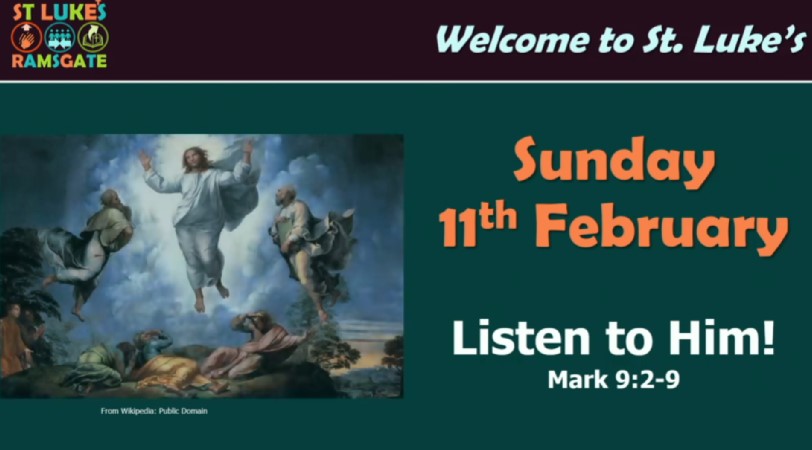
Who then should we choose to listen to? Jesus, took Peter, James and John up a mountain, where he was transfigured before them. Somehow mysteriously, but visibly, Jesus’ true glory was revealed on top of the mountain. They had a glimpse of his true nature. This was no ordinary man, but God with us.
What did all this mean? Why did Jesus do this at this moment? As they were wondering about this, God’s voice gave an answer: ‘Listen to him!’ The revelation of Jesus’s unique and special nature showed them that Jesus’ words were more special, more important, more lifegiving than anyone else’s. When we are bombarded by so many voices, let’s choose to listen to Jesus above all.
Paul Worledge
St. George’s Website
What’s On – a page which lets you know what is happening this week and gives information about upcoming events.
Notices – You can read the latest notices on this page.
Sermons – Read a transcript of a recent sermon or watch the YouTube version recorded at St. Luke’s. There are now videos for all the sermons over the summer.
Weekly Calendar
Sunday 11th February
Eucharist (St George’s, 9:30am) – Reading: Mark 9:2-9
Monday 12th
Daily Prayer (St. Luke’s Church) – 9:30-10:00am
Craft Group (St. George’s Hall, Soup Kitchen) – 2:00-3:30pm
Pancaked, fun and games on Tuesday 13th February, 4:00-6:00pm, St. Luke’s Church, organised by the St. Luke’s and St. George’s social committee. Please sign up on the list at the back of church. Bring your own frying pan!
Ash Wednesday Reflections – This Wednesday
To mark the beginning of Lent we will be having an Ash Wednesday service on Wednesday 14th February 12 noon at St George’s church. An opportunity to reflect on being dead to sin and forgiveness we receive due to the cross of Jesus.
New Curate
Last Sunday we announced that we will be welcoming a new curate to St. Luke’s and St. George’s at the end of June. Her name is Beth Keenan. Read more…
Snapshot: Youth Survey by the Diocese
This survey has been created by the Canterbury Diocese Youth Council to hear the voices of young people. If you are aged 11 to 24 (not just those involved in churches) we would love for you to complete it. The form is anonymous and we will be collecting the responses to pass on to Bishop Rose.
Snapshots has been designed to create a platform for hearing the voice of young people across our diocese. The Youth Council aim to put out three Snapshot questionnaires a year.
This first one is about church/sharing faith.
Closing date: the end of February.
Love is all you need
– Community Meal Fundraising Concert
A big thank you to all who helped to make this event such a great success, especially Jemima, St. George’s Regeneration officer. It was a wonderful concert with the Coastal Choir and Viking Ukes entertaining us beautifully. We had over 130 people who attended and raised over £1,000 for the work of the community meal.
World Day of Prayer
This year it is on 1st March, 10:30am at St. Laurence Church, Ramsgate. If you would like to take part, then email: drdebbie08@gmail.com.
We are looking for a cook
Are you able to cook a two-course meal for around fifty people? We are looking for volunteers to join a rota of cooks for the community meal on Tuesday evenings at St. George’s.
Safeguarding Training
If you volunteer in anyway at church the national authorities are strongly encouraging you to take at least the Basic Module in safeguarding training once every three years.
If you have not completed the training in the last three years, then the module can be completed online and takes about ninety minutes. You can access the training by following this link. You will need to first register, to access the training. Once the training is completed, you will be sent a certificate. Please forward that certificate to James (office@stlukesramsgate.org), so that we can keep records of who has done the training.
Online Forms
Under the ‘Contact’ tab on the website, there are now three forms that you can use to help us in managing the church:
Events Application Form. Use this if you are organising a church event that needs a church room booked, advertising or ticketing.
Submit a Notice. Use this if you want to ask us to include a prayer request or other notice in the church notice sheet or email.
What do smaller churches get wrong when they look at bigger churches?
In 2024, we are looking to have a year of discernment, where we consider what God may be calling us to as churches over the coming years. This article may help us develop the right attitudes when we think about this. Read more…
How are adults coming to faith in the UK?
Many of the questions submitted for our questions for the Year of Discernment asked about how we can better share the good news with the people around us. Phil Knox is an evangelist, speaker and missiologist at the Evangelical Alliance. He recently tweeted a thread about how are adults coming to faith in the UK at the moment. Here are the big themes and some suggestions for churches to explore… Read more…(It’s a short and encouraging read!)
We are delighted to announce that Beth Keenan will be joining us here in Ramsgate as a curate at the end of June.
Beth writes:
“‘Hello there! My name is Beth Keenan, and I am thrilled to be joining Rev. Paul at St Luke’s and St George’s. My husband Tom, our toddler Toby, and I are excited to be moving back to Thanet, where two of the three of us were born! We have loved living in Cambridge for the past four years, getting involved with wild churches and schools’ missions and making close friendships with other young families, but we are all very happy that we will be living by the sea again!
For the next five years, I will be taking on the role of Pioneer Curate. This means that my responsibility will be to pioneer (start) new things. So, during my first year, I will learn a lot about St Luke’s and St Georges, and then as new pioneer initiatives hopefully start and begin to grow (with lots of prayer!), they will become the focus of my time. My favourite example of a pioneer is Disney’s Moana, feel free to ask me why when you meet me! I can’t wait to join you all and will keep you in my prayers in the coming months!”









 St. George's Church Ramsgate