Christmas is a time of great celebration and at church it is all free! We would love to invite you to join us at one of our Christmas services. There are three churches and several events to choose from.
In all of them we celebrate the birth of Jesus Christ. He came from the riches of heaven yet was born into poverty. Why did he come? To invite us to become part of God’s family and enjoy his riches.
Please see below for details of our services across the three churches in Central Ramsgate: Sailors’ Church, St. George’s and St. Luke’s.
Friday 16th, 6:30-7:30pm
Service of Remembrance (St. Luke’s, Hollicondane Road)
A chance to come and remember and give thanks for the lives of loved ones who, who we will be missing this Christmas.
Sunday 18th, 11:00am-12:00pm
Family Carol Service (St. Luke’s, Hollicondane Road)
A carol service for all ages.
Wednesday 21st, 7:00-8:00pm
Carol Service (St. George’s, Church Hill, off High Street)
Join us in the beautiful setting of the town centre church, for carols, creating a crib scene and the tree of remembrance.
Friday 23rd, 3:00-4:00pm
Carol Service (Sailors’ Church, Harbour)
Join us for Christmas at the beautiful Royal Harbour’s church.
Christmas Eve, 4:00-5:00pm
Crib Service (St. Luke’s, Hollicondane Road)
An interactive retelling of the Christmas story for young children.
Christmas Eve, 6:30-7:30pm
Traditional Carol Service (St. Luke’s, Hollicondane Road)
9 lessons and carols by candle-light, not suitable for young children.
Christmas Eve, 11:30pm-12:30am
Midnight Service (St. George’s, Church Hill, off High Street)
Welcome in Christmas Day itself with this special Holy Communion.
Christmas Day, 11:00am-12:00pm
All Age Service and Communion (St. Luke’s, Hollicondane Road)
An informal Christmas Day celebration for all ages.
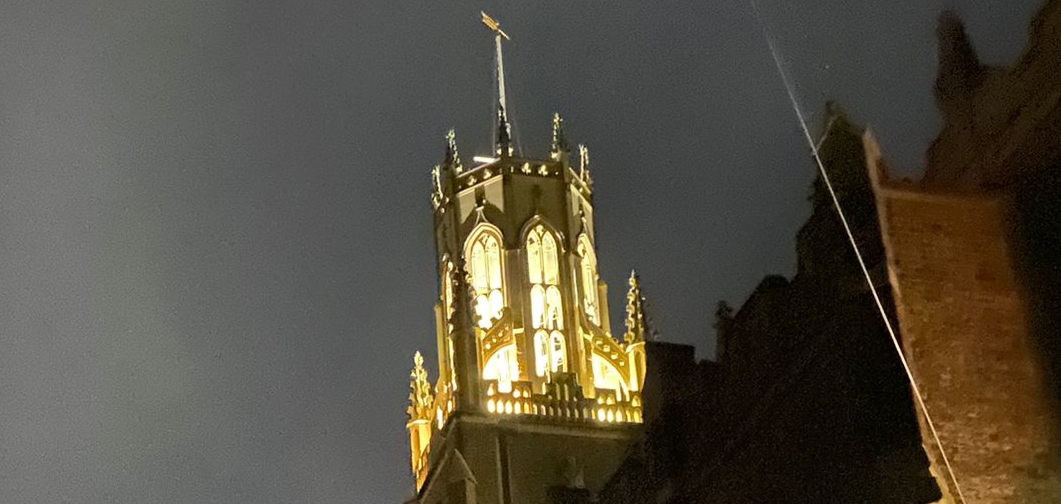
Join us from 4:30pm, at St. George’s Church for refreshments and to celebrate the lighting of the lantern at the same time as Ramsgate town’s Christmas lights.
This Friday it is Black Friday. The special sales day, which is meant to kick off the Christmas shopping bonanza. We are bombarded with adverts encouraging us to make the most of the bargains and often see people queuing and fighting for the best deals.
We are offered deals on all the latest and best stuff:
iPhone 14,
55in TV screen,
Play Station 5
Samsung Smartwatch
Swanky Coffee Machine
All of this adds up to encouraging us to focus on gathering an abundance of possessions.
But will all this stuff really make you happier? Will your life truly be better as a result?
Jesus’s words act like a pin to the ballooning consumerism of Black Friday. He says, “… life does not consist in an abundance of possessions.”
Arguing over Money
This comment comes in response to a request from someone in the crowd:
“Teacher tell my brother to divided the inheritance with me.”
Probably his father has died and now there is an argument between his brother and him about sharing out the inheritance. Such arguments and manoeuvrings to gain more money are just as common today as they were then. An inheritance is likely to be the biggest amount of money people will gain in one go, so if having lots of money is what matters to them, it is at this stage that their greed will show itself and often erupt into bitter and destructive family disputes. I wouldn’t be surprised if most of you here were aware of such disputes.
Jesus refuses to be caught up in someone else’s argument. Rather than joining the argument over the money from the inheritance, he turns it into an argument about people’s attitude to money in order to warn both the crowd then and ultimately us now.
Jesus may not care about this man’s inheritance, but he does care about his soul and ours. So, he issues a very strong warning:
“Watch out! Be on your guard against all kinds of greed;…”
(Luke 12:15)
Again and again in the New Testament and the Bible, greed is listed as one of the most serious of sins. Do we watch out for it? Do we guard our souls against it? Or are we so contaminated by the consumerism of our society that we allow our souls to be deeply infected with a desire to accumulate an abundance of possessions and to grab hold of as much money as possible, no matter what the cost to our relationships or our souls?
Fool’s Gold
To ram home the warning, Jesus tells a parable. It is perhaps one of the most simple parables. There is just one rich man and God. Yet it packs a powerful punch.
The rich man is a farmer and he is already rich. But then he has a bumper crop. He is going to be even richer! His only problem is that he now has so much that he doesn’t know what to do with it all. Then he comes up with a solution. He’ll build bigger barns, so that he can live comfortably and luxuriously off the proceeds for the rest of his life, eating, drinking and being merry.
Then God responds and says, “You fool!”
This rich man’s whole attitude is utterly foolish and wrong.
But why? What is wrong with his attitude. I think we can point to three aspects:
Solitary
First of all, his attitude is very solitary. The short story, puts over a real sense of isolation for this man. It is mainly about the man deliberating with himself and talking to himself. It is all about ‘I’:
What will I do?
I have no place to store my crops.
This is what I’ll do.
I will tear down my barns and build bigger ones.
I will store my surplus grain.
I’ll say to myself.
The only time he says, ‘You’ is when he is talking to himself!
This is totally and utterly self-centred. No other person gets a look in. It hasn’t even occurred to him he could use his extra wealth to help others or give to the poor.
This in itself is a challenge to the man who approached Jesus. His concern was for his own gain from the inheritance, fighting for his own selfish ends. No doubt the battle was ruining his relationship with his brother.
When greed grips our hearts, then we quickly become self-obsessed and selfish. We have a solitary attitude that can damage our relationships and stop us caring for those in need around us.
Paul warns in 1 Timothy 6:9:
“People who want to get rich fall into temptation and a trap and into many foolish and harmful desires that plunge men into ruin and destruction.” (1 Timothy 6:9)
Perhaps part of the reason for loneliness and relationship breakdown in our society today is the strong encouragement to run after bigger and better possessions that creates quite a selfish attitude.
Even in the church how selfish are we with our wealth?
John Wesley famously said,
“Earn all you can,
Save all you can,
Give all you can.”
Do you give all you can or just enough to salve our conscience?
Are we more concerned to use our wealth for the good of others or so that we can eat drink and be merry for many years to come?
Ultimately, such a self-centred attitude to money, makes us fools in God’s sight!
Temporary
The second reason the rich man of the story is a fool is that his attitude is too focussed on the temporary. He plans to store up wealth for this life, but fails to take into account death. God says to him:
“You fool! This very night your life will be demanded from you. Then who will get what you have prepared for yourself?” (Luke 12:20)
From the perspective of eternity, gathering more stuff for yourself is pointless. When you die, you leave it all behind. As God says to the rich man: ‘Then who will get it?’ Not you is the point.
To ignore our death as relevant to our life is all too common and all too easy in our world of relatively good health and long life expectancy. Yet, it is ultimately foolish.
In Psalm 39, the Psalmist says:
“Show me, O LORD, my life’s end and the number of my days; let me know how fleeting is my life. ” (Psalm 39:4)
Those who know that their life is drawing to an end, suddenly discover that the things they value and their attitudes change.
As Christians we know that one of the greatest gifts we have from God is eternal life. We can have a confidence about death, which means that we should not fear thinking about it or contemplating how little is our time on earth.
When we do that surely, we must move from gathering things that are only temporary and working for what is eternal. Looking forward to the day when Jesus acknowledges us before the angels and God.
Idolatry
The third reason the rich man in the story is a fool is that his greed is actually a form of idolatry. His possessions have taken the place of God in his life.
Jesus goes on to say in verse 21:
“This is how it will be with whoever stores up things for themselves but is not rich towards God.” (Luke 12:21)
In all his deliberations the man did not once think about God. Jesus tells the story in the context of a Jewish culture for whom talk about God and the idea of God was very much a focus. Yet, this man in the story shows no concern for God, when he thinks about what to do with his new found wealth.
Indeed, the man that had come seeking Jesus’s help. Seemed to see Jesus, the God-man not as someone to listen to and serve, but someone who could be enlisted to serve his own selfish ends.
In both cases, concern for God’s will or kingdom was not a reality in their deliberations about money.
As Christians it is even easier for us to ignore God when it comes to thinking about our money, because unlike Jesus’s time God is hardly ever spoken about outside of churches.
In fact there is a sense that money has become the replacement god. In Colossians it says:
“Put to death, therefore, whatever belongs to your earthly nature: sexual immorality, impurity, lust, evil desires and greed, which is idolatry.” (Colossians 3:5)
As Christians then if we are to take Jesus’s strong warnings seriously, if we are to avoid the foolishness of allowing wealth to become a false god, then we need to work harder than ever to consider what God wants us to use our wealth for. This is the wise approach.
What we need to do is learn what it means to be rich towards God.
So how can we be ‘rich towards God’?
To end let me suggest three areas where we can be rich towards God:
Care for God’s World
First, of all when it comes to climate change. As Christians we believe that this world was God’s beautiful creation and Genesis tells us that our purpose is to care for it and tend it.
As such as Christians we should be at the forefront of calls to deal with the problems of climate change – even though it may cost us financially! To put it bluntly, investing in a change to green technologies is a far better use of money than just gaining an increasing abundance of possessions that we don’t need!
Sadly, it is attitudes of greed and wanting to hold on to wealth that are the biggest barrier to dealing with the climate change crisis.
Care for God’s People
Secondly, if we believed that God has called us to be a part of a family, then rather than being selfish with our money and possessions we should want to use them to help God’s people.
This can be done locally and informally as we seek to support people in our own community who may be struggling – especially during this cost of living crisis. Yet, we must not forget our brothers and sisters around the world, who are being impacted even more severely by the food shortages caused by the war in Ukraine. Perhaps more than ever we should be giving to Christian aid charities like Tearfund or Christian Aid.
Care for God’s Mission
Finally, we should be concerned for God’s mission. That includes the need to equip and enable the church to be effective at mission in our local area.
We need to be honest. The church is in decline, so there is less people to give. If those people fail to be more generous, then the resources we have will be stretched even more thinly, our mission will suffer and the decline will become worse.
If we truly believe that people’s greatest need is Jesus, then we will want to be generous and fund a church that is properly equipped to reach out with the Good News.
Good Friday not Black Friday
So are we being rich towards God? Or is our attitude to wealth selfish, foolish and godless?
Black Friday may encourage us towards an attitude of greed, but Good Friday surely encourages us towards generosity.
In 1 Corinthians, Paul says:
“For you know the grace of our Lord Jesus Christ, that though he was rich, yet for your sakes he became poor, so that you through his poverty might become rich.” (2 Corinthians 8:9)
If Jesus was willing to give up the wealth and riches of heaven to the utter poverty and humiliation of the cross, then how can we not like Christ, reject the foolishness of greed and act in great generosity towards God?
We now have gluten free wafers available for those who would like to receive communion, but cannot do so, because they are allergic to gluten. Please let the Warden on duty or welcomer know that you would like to receive a gluten free wafer when you arrive and whether you would like to receive the bread and the wine separately or the bread dipped in the wine. We will then arrange to give you a gluten free wafer when you come up to receive communion.
“Then [Jesus] said to them, “Watch out! Be on your guard against all kinds of greed; a man’s life does not consist in the abundance of his possessions.”
Once a term we are aiming to gather everyone together from across all the communities at St. Luke’s and St. George’s to share the big picture of all that is going on and pray for God’s help!
This term we will be particularly focussing on our plans for Christmas and the issues facing the churches as we prepare for 2023. So, please join us at St. Luke’s church on Monday 21st November at 7pm.
St. George’s has recently signed up to the Parish Giving Scheme, which enables you to set up regular giving with the church through a Direct Debit System. This system does not cost St. George’s anything in fees, so your whole donation comes to the church and takes some of the workload of setting up new donations away from volunteers like our treasurer.
Why use the Parish Giving Scheme?
The scheme enables you to:
Give monthly, quarterly or annually by Direct Debit
Sign up to inflation linked giving annually, if you choose
Enhance your gift to the parish by having Gift Aid at 25% added to your giving
Give anonymously, if you prefer
Give securely
How do I set it up?
There are three ways in which you can set up a Direct Debit to give regularly to St. George’s:
Via paper ‘Gift Form’ – available from your PGS parish representative
Via their telephone service on 0333 002 1271, Monday to Friday, 9am – 5pm (You will need to quote our Parish Code: 060606196 – Ramsgate: St. George, Canterbury Diocese). The call usually takes about 10 minutes to complete. They will then send you a confirmation of your new gift by post or email.
The website will guide you through the process well and it only takes a few minutes. Below is a rough guide to the steps you will be asked to take:
On the Ramsgate: St. George, Parish Giving page, click the button: “Give now”
You need to register by filling in your name, address, phone number and email, then click ‘Submit’ at the bottom of the page.
You will be sent an activation email. Click “Activate Account” in the email and you will be taken to the next step on the website.
You will be asked to create a password that is at least 10 characters long. You will need this to log in in the future, so that you can edit your details or change your giving.
The next step is to fill in the amount you want to give, the start date for your first donation (donations are taken from your account on the first of the month) and how regularly you want to give (monthly / quarterly / annually). Most people would give monthly. Please take note of the month your donations through the Parish Giving Scheme will start. If you already give to St. George’s by Standing Order and are replacing that with giving by the Parish Giving Scheme, you will need to cancel any Standing Order with St. George’s in the month before this date, but preferably after that month’s gift to St. George’s.
You will then be asked to fill in the details of the account that the direct debit will be paid from and confirm that this is a U.K. account and that you can authorise payment from the account by yourself.
There are then some options. You can opt to have the amount you give increased by the rate of inflation each year. This helps to automatically increase your giving annually. After all the costs of the ministry and mission of the church increase by inflation each year! If you choose this option, you will still be given the option to opt out with an email sent to you a few weeks before the annual increase comes in.
You can opt for them to claim gift aid. You can only do this if you are a taxpayer. Doing so, increases the value of your gift by 25%.
You can opt for your giving to be anonymous. We recommend you do not tick this. Ticking it means that the treasurer cannot see who is giving through the scheme, which means he cannot make any allocations of your giving that you request. Only the treasurer will see who is giving through the Parish Giving Scheme, the information will not be shared with the vicar or anyone else.
You can also opt to receive emails from St. George’s through the Parish Giving Scheme. We recommend that you do tick this – any emails are likely to be fairly rare, probably only once or twice a year.
Once you have selected all these options, please ensure you scroll down and click “I confirm the details I have entered are correct.”
You should then receive confirmation that your giving to St. George’s is set-up with the Parish Giving Scheme.
Join us for this wonderful concert with Thanet Light Orchestra at St. Luke’s, Ramsgate on Saturday 26th November at 3pm. Tickets are £5 in advance or £10 on the door.
Tomlinson, Suite of English Folk Dances. Coleridge-Taylor, Hiawatha Ballet Suite. Binge, Sailing By. Coates, Northwards and Southwards. Ketelby, Pictures in Melody. Nicolai, Merry Wives of Windsor. Fletcher, Folk Tune and Fiddle Dance, Spirit of Pageantry.
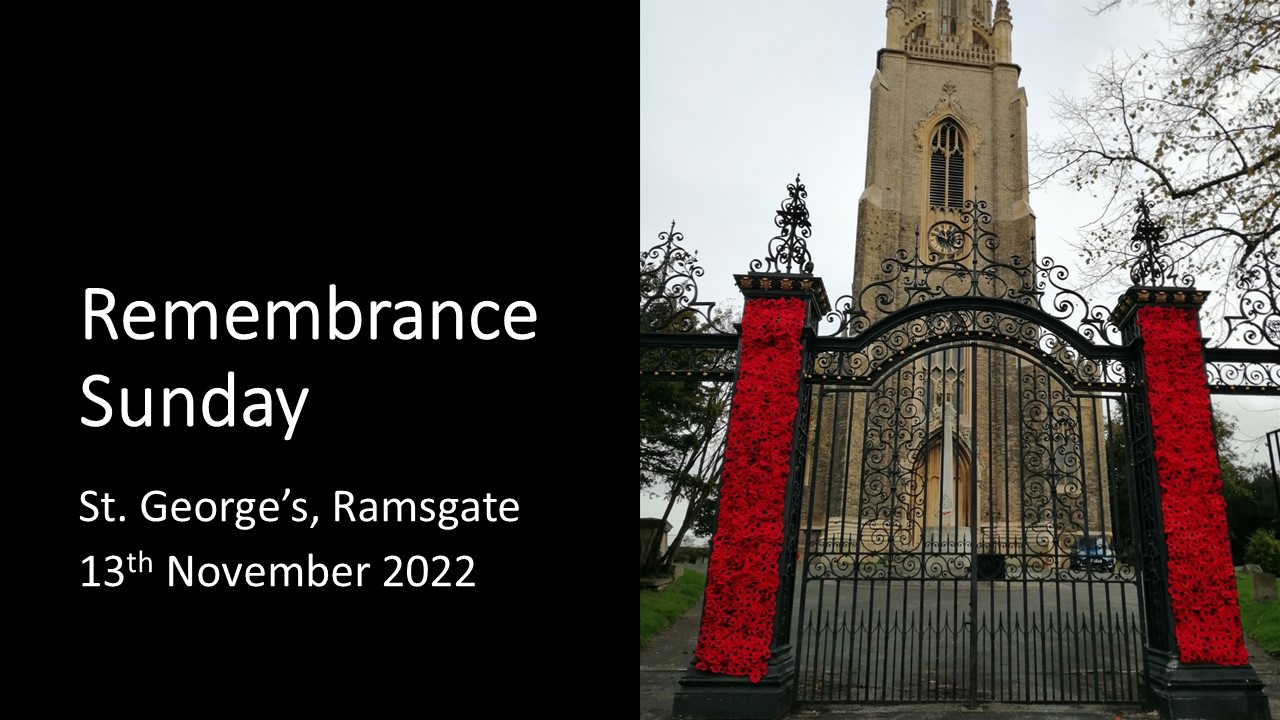
On Remembrance Sunday, it is a time to reflect on the wars that have been fought in our recent history, but perhaps also about the wars going on in the world now. As we do so we hold in tension a desire to honour, even celebrate the courage and sacrifice of those who have given or risked their lives for our freedoms with a need to remember the horror of war, so that we seek peace. Today, I want to focus on the horror of war.
The Horror of War
It’s horror
The poem that the mayor chose and read a little while ago, brings out some of the horror of war. It is a horror that was especially expressed by the poets after the great and tragic loss of life in the First World War.
Yet, it is also a horror that we see so clearly in Ukraine now. This week, one expert estimated that around 100,000 Russian soldiers and 100,000 Ukrainian soldiers have been killed or injured in the war so far. In addition to that 1,000s of civilians have also been killed and millions have fled as refugees. It’s hard to grasp what those numbers mean, but they are more than numbers, they are countless stories of individual tragedy.
Before the war, Irina and Ivan were a married couple living happily in Mariupol in Ukraine. Ivan was an engineer at the steelworks and Irina was a manager of a clothes shop. They had been trying for a baby for many years and were overjoyed when finally Irina fell pregnant. It was going to be a boy and they were going to call him Miron.
By the time Miron was due, the war had begun and Russian troops had surrounded Mariupol and were bombarding the city as they sought to capture this important strategic point on the South East coast of Ukraine.
One of the most notorious moments in the war so far was the bombing of the maternity hospital in Mariupol. Irina was in the maternity hospital when it happened. It was a devastating attack in which Irina about to give birth was seriously injured. She was carried across the rubble on a stretcher an image that was photographed and used in the news media around the world. They tried to deliver the baby by Caesarean Section, but Miron was already dead. Irina learning of the death of her long hoped for child lost the will to live herself and soon also died of her injuries. Ivan had to bury his wife and his newborn child together.
Their story is just one among thousands from Ukraine over the last year. War is horrible.
It’s root: Sin – James 4:1-2
But why is there war at all?
John Lennon in his song, Imagine, sang:
“Imagine there’s no countries,
It isn’t hard to do,
Nothing to kill or die for
And no religion too
Imagine all the people living life in peace…”
The implication is that wars are caused by countries and religions. If you could get rid of countries and religions then we could all just live together in peace.
But is that really true? Yes, countries and religions are often the excuse for wars, but are they really the cause.
James, who was Jesus’s brother, suggests another reason for war. In your service sheets look at the quote from James 4:1-2:
“Where do you think all these appalling wars and quarrels come from? Do you think they just happen? Think again. They come about because you want your own way, and fight for it deep inside yourselves. You lust for what you don’t have and are willing to kill to get it. You want what isn’t yours and will risk violence to get your hands on it.” (James 4:1-2)
In other words he says the real root of war is within the heart of every human being – our own selfish desires that lead us to exploit, bully and kill others to get our own way. The Bible calls this inner attitude, ‘Sin!’
Nations when they work well control and limit sin, by putting in place and enforcing laws to stop people hurting each other. Yet sadly, wars come about when nations allow these inner selfish attitudes to determine their policy. Just as Russia has invaded Ukraine in order to achieve its own selfish goals. It’s because of such threats that we need a nation with strong armed forces as a deterrent against the sin of other nations threatening us.
So, nations can control and limit sin, but they cannot change the hearts of people, its ultimate cause. That is where religion comes in.
It’s opposite: Peace – Isaiah 2:4
The second quote comes from Isaiah, a prophet in the Old Testament that lived during a time when his nation, Judah was invaded a number of times by other nations. He would have known and seen the horror of war. Yet, 2,700 years before John Lennon he also imagined a better future.
“The Lord will mediate between nations and will settle international disputes. They will hammer their swords into ploughshares and their spears into pruning hooks. Nation will no longer fight against nation, nor train for war anymore.” (Isaiah 2:4)
It was a vision of a future with no war not brought about by the abolition of nations and religion, but brought about by God himself bringing peace between nations!
Yet, is this just a dream? How can peace become a reality?
Jesus, the Prince of Peace
This is where Jesus comes in. Jesus did not experience the horror of battle, but he did die an horrific death at the hand of Roman soldiers. He was crucified, because of the selfish desires and jealousies of the religious leaders of his own nation. He came to us as the Son of God, the Prince of Peace and what did we do to him? We murdered him. Here is the horror of sin writ large!
Yet, Jesus’s death was also a moment of supreme courage and sacrifice. He gave his life willingly, because somehow through his death the power of sin is neutralised as he took God’s anger at our sin on himself and went on to conquer death in his resurrection.
And he did this because he loves us. He himself said in the second reading:
“Greater love has no-one than this, that he lay down his life for his friends.” (John 15:13)
And so he calls those who accept and trust in this great act of love and choose to follow him, to love in return. Love is the opposite of sin. It is the desire to treat the other as important and as valuable as yourself, so that you don’t exploit them to get what you want, but like Jesus, you are willing to make sacrifices for their good. As the world is transformed by this love of Jesus, so peace grows and wars cease.
Of course this is still a work in progress, even those who have claimed to be followers of Jesus, often fail to live this out as Jesus wants. But ultimately, as Christians today, our hope, like Isiaiah’s is not in what we might achieve, but in the promised future God will bring about, when Jesus returns. We look with hope to a life beyond this life, where there will be no more wars or suffering or pain or peace. A life not without God, but where we see him face to face. That may feel like a far off dream, but when like Isaiah we have confidence in God’s ultimate plan for the future, we will want to help to bring it about as much as is possible now.
We need nations and our armed forces to control the worst effects of human sin and evil. But, will you come to Jesus, the Prince of Peace, to help transform your heart and have hope for a better future?







 St. George's Church Ramsgate